- The paper presents a novel Hamiltonian framework integrating quantum motional states and internal clock dynamics to unveil time-dilation-induced frequency shifts and entanglement phenomena.
- It details observable second-order Doppler shifts—including classical, vacuum, and squeezing-induced shifts—and their impact on Ramsey fringe visibility in ion clocks.
- The study outlines experimental protocols using trapped ions (e.g., 27Al+) to detect quantum proper time effects, advancing precision metrology and tests of fundamental physics.
Quantum Signatures of Proper Time in Optical Ion Clocks
Introduction
This paper presents a rigorous analysis of quantum mechanical effects in the proper time evolution of optical ion clocks, extending the conventional treatment of relativistic time dilation to include quantum signatures that cannot be captured by classical or semiclassical models. The authors employ a Hamiltonian formalism to derive the interplay between internal clock dynamics and motional degrees of freedom in harmonically trapped ions, revealing new frequency shifts and entanglement phenomena that arise from the quantization of both the clock and its motion. The work provides a comprehensive framework for understanding second-order Doppler shifts (SODS), vacuum-induced SODS (vSODS), squeezing-induced SODS (sqSODS), and quantum SODS (qSODS), and demonstrates the feasibility of observing time-dilation-induced entanglement in state-of-the-art ion clock experiments.
The central theoretical tool is a Hamiltonian that incorporates both the internal clock evolution and the motional dynamics of the ion, with relativistic corrections up to O(c−2):
H^=H^c+ℏω(n^+21)−2mc2ℏωH^cP^2
where H^c is the clock Hamiltonian, ω is the trap frequency, n^ is the motional number operator, and P^ is the dimensionless momentum quadrature. The last term couples the clock to the motion, leading to quantum corrections in the proper time experienced by the clock.
The evolution operator derived from this Hamiltonian includes clock-dependent squeezing operations, which are responsible for entanglement and additional frequency shifts:
U=e−iHct/ℏS(ζ)e−iλω(n+1/2)tS†(ζ)
with S(ζ) the squeezing operator, and ζ,λ functions of the clock energy.
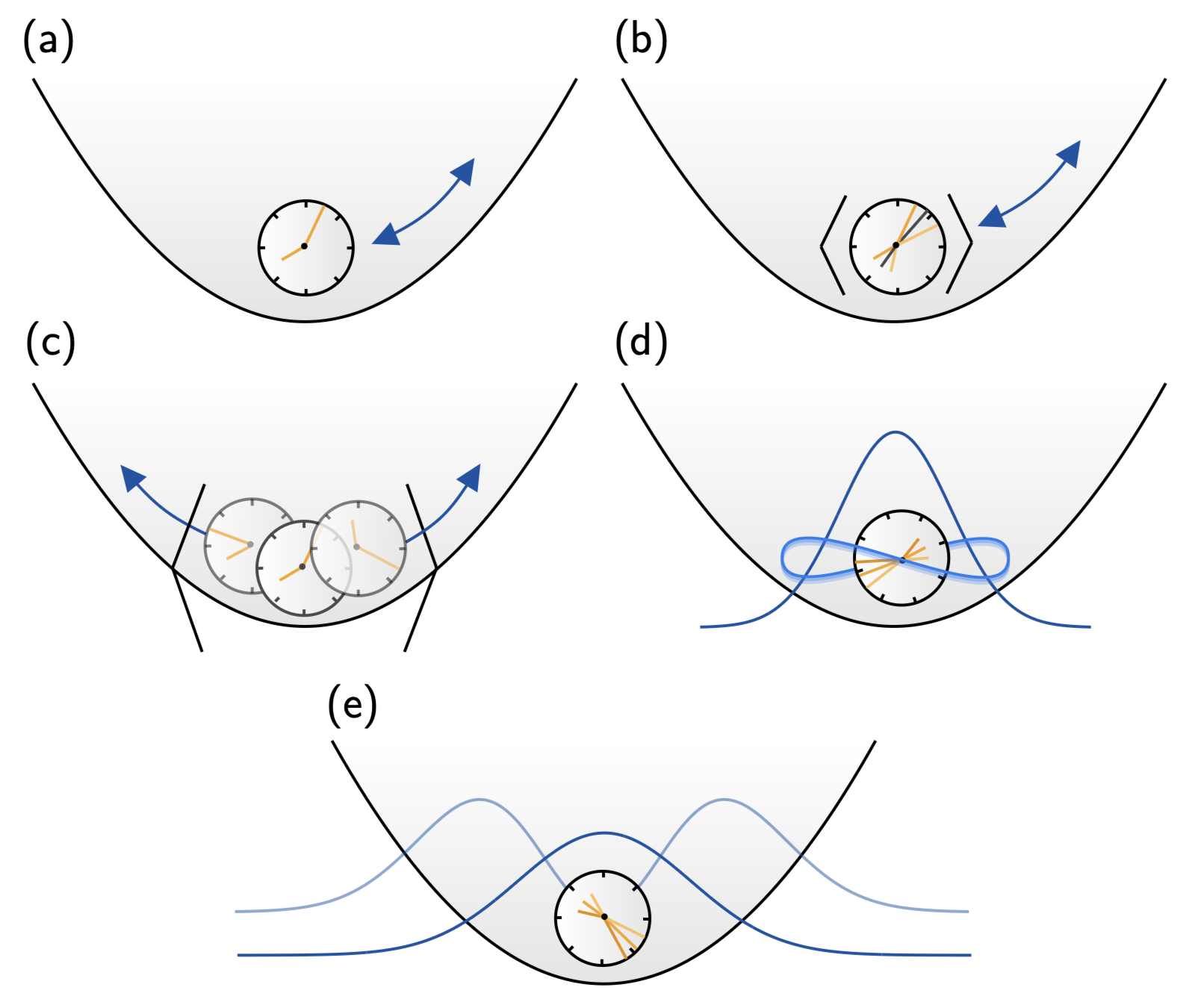
Figure 1: Illustration of classical, semiclassical, and quantum proper time dynamics of a trapped-ion atomic clock, showing the transition from classical motion to quantum entanglement and quantum SODS.
Second-Order Doppler Shifts: Classical, Vacuum, and Squeezing Effects
Classical and Vacuum-Induced SODS
The standard SODS arises from the velocity-dependent time dilation in the motional state of the ion. For a thermal state, the fractional frequency shift is:
νΔνSODS=−4mc2ℏω(2nˉ+1)≃−2mc2kBT
where H^=H^c+ℏω(n^+21)−2mc2ℏωH^cP^20 is the mean phonon number. Even when the ion is cooled to the ground state (H^=H^c+ℏω(n^+21)−2mc2ℏωH^cP^21), a residual shift remains due to vacuum fluctuations:
H^=H^c+ℏω(n^+21)−2mc2ℏωH^cP^22
This vSODS is a direct consequence of the quantum nature of the motional ground state, which is not a momentum eigenstate and thus has nonzero velocity variance.
Squeezing-Induced SODS and Visibility Loss
Preparation of the motional state in a squeezed vacuum leads to an enhanced frequency shift and, crucially, a measurable reduction in Ramsey fringe visibility due to entanglement between the clock and motion:
H^=H^c+ℏω(n^+21)−2mc2ℏωH^cP^23
H^=H^c+ℏω(n^+21)−2mc2ℏωH^cP^24
where H^=H^c+ℏω(n^+21)−2mc2ℏωH^cP^25 is the squeezing parameter. For realistic parameters (H^=H^c+ℏω(n^+21)−2mc2ℏωH^cP^26AlH^=H^c+ℏω(n^+21)−2mc2ℏωH^cP^27, H^=H^c+ℏω(n^+21)−2mc2ℏωH^cP^28, H^=H^c+ℏω(n^+21)−2mc2ℏωH^cP^29 s), the visibility drops to H^c0, which is within reach of current experimental capabilities.
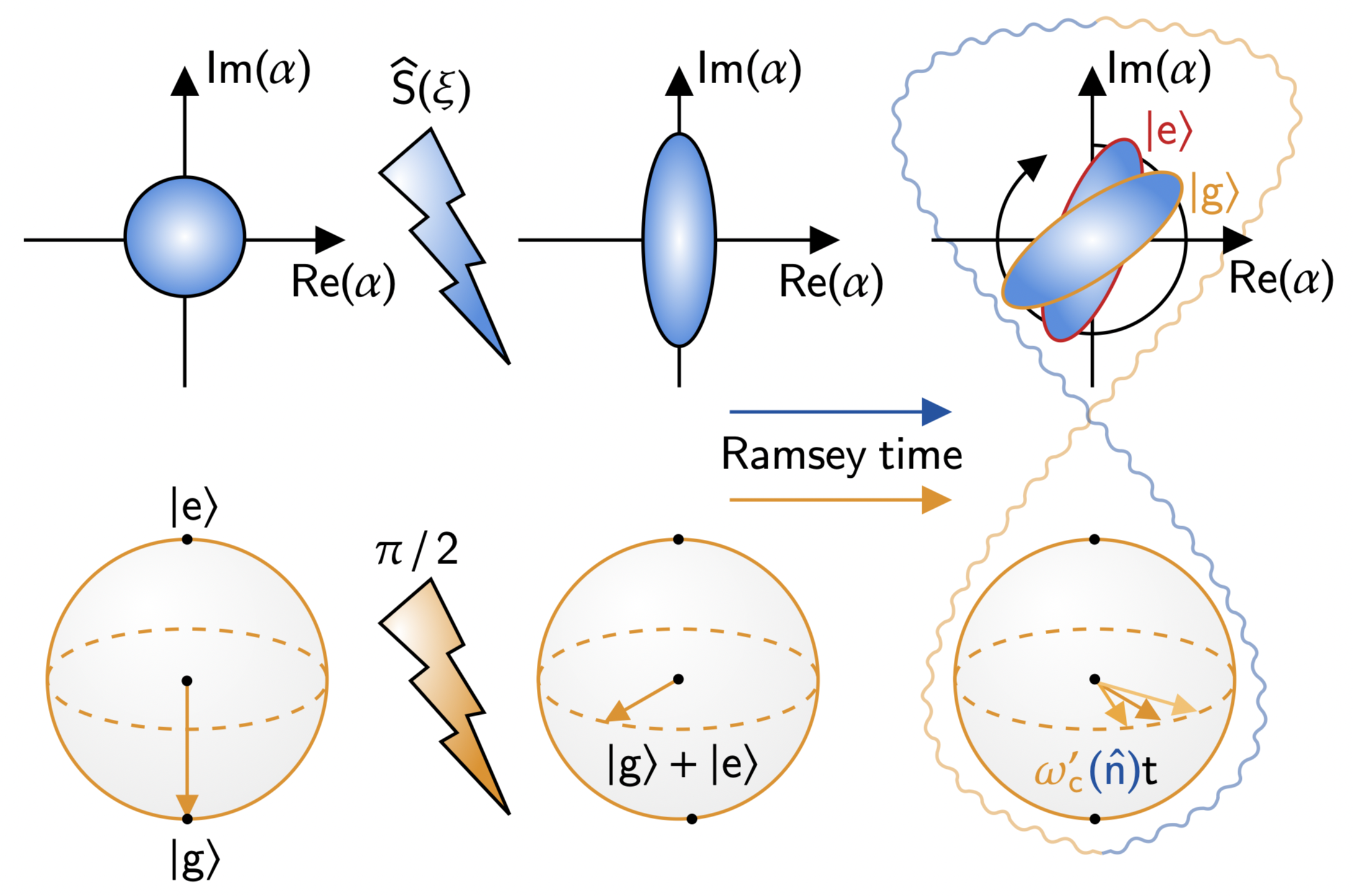
Figure 2: Protocol for observing time-dilation-induced entanglement via squeezing, showing phase-space evolution and Ramsey sequence on the Bloch sphere, with visibility reduction as a signature of quantum proper time.
Quantum SODS: Beyond Semiclassical Descriptions
The full quantum evolution includes clock-dependent squeezing generated by the relativistic Hamiltonian, leading to the quantum SODS (qSODS). This effect is not captured by averaging over classical proper time and requires projection onto specific motional superpositions to be observed. The qSODS phase shift is linear in the small parameter H^c1 but is currently too small (H^c2 rad) to be detected with existing technology. The authors propose protocols involving state-dependent displacements and projective measurements to amplify and isolate this quantum signature.
Experimental Feasibility and Implications
The analysis demonstrates that vSODS and sqSODS are observable in current ion clock setups, particularly with H^c3AlH^c4 and potentially lighter ions such as H^c5BH^c6. The entanglement-induced visibility loss provides a direct witness of quantum proper time evolution, moving beyond the classical paradigm. The qSODS remains a theoretical prediction, motivating future improvements in trap frequencies, coherence times, and measurement protocols.
The results have significant implications for precision metrology, fundamental tests of relativity in quantum systems, and the development of quantum technologies that exploit relativistic effects. The quantization of proper time evolution opens new avenues for probing the interface between quantum mechanics and general relativity.
Conclusion
This work establishes a comprehensive framework for understanding and probing quantum signatures of proper time in optical ion clocks. By extending the Hamiltonian formalism to include quantum motional states and their coupling to internal clock dynamics, the authors identify new frequency shifts and entanglement phenomena that are inaccessible to classical or semiclassical models. The predicted visibility loss due to time-dilation-induced entanglement is experimentally accessible, while the quantum SODS remains a target for future technological advances. These findings underscore the rich structure of proper time evolution in quantum systems and its relevance for both foundational physics and practical applications in quantum metrology.