- The paper demonstrates that ultralight boson clouds form gravitational molecules around binary black holes and undergo ionization driven by the binary’s orbital motion.
- It combines large-scale numerical simulations with semi-analytic methods to quantify ionization rates, channel ratios, and the backreaction on binary orbital parameters.
- The study reveals that boson ionization affects the stochastic gravitational wave background spectrum, with implications for detections via pulsar timing arrays.
Ultralight Boson Ionization from Comparable-Mass Binary Black Holes
Introduction and Physical Context
This work investigates the dynamics of ultralight bosonic fields in the gravitational environment of comparable-mass binary black holes (BBHs), focusing on the formation and ionization of gravitationally bound molecular states. Ultralight bosons, such as axions, are compelling dark matter candidates due to their high occupation numbers and coherent field behavior. Around isolated black holes, these fields can form gravitational atoms—bound states analogous to hydrogenic systems. In the context of BBHs, when the binary separation falls below the boson's Bohr radius, the system transitions to a regime where the bosonic field forms a gravitational molecule, with a co-moving inner region that tracks the binary's orbital motion.
The study combines large-scale numerical simulations with semi-analytic formalisms to characterize the formation, structure, and ionization of these gravitational molecules, and to quantify their backreaction on binary orbital evolution. The analysis is particularly relevant for supermassive BBHs, which are observable via pulsar timing arrays (PTAs) and may host significant bosonic clouds due to dark matter relaxation processes.
The scalar field evolution is governed by the covariant Klein-Gordon equation in a time-dependent BBH metric, with the binary following a Keplerian orbit. The simulations use a mass ratio q=1 and benchmark parameters μM=0.2, a=20M, and α=0.2, corresponding to a Bohr radius rb=25M and a~=0.8. The initial scalar profile is a static spherical Gaussian.
The field rapidly settles into a periodically stable configuration after a few orbits. The inner region of the bound state co-rotates with the binary, with angular velocity Ωϕ≈Ω, while the outer region lags behind. The boundary of the co-rotating region is set by the balance of centrifugal and gravitational forces, extending to r∼a/2 and exhibiting a dipolar structure.
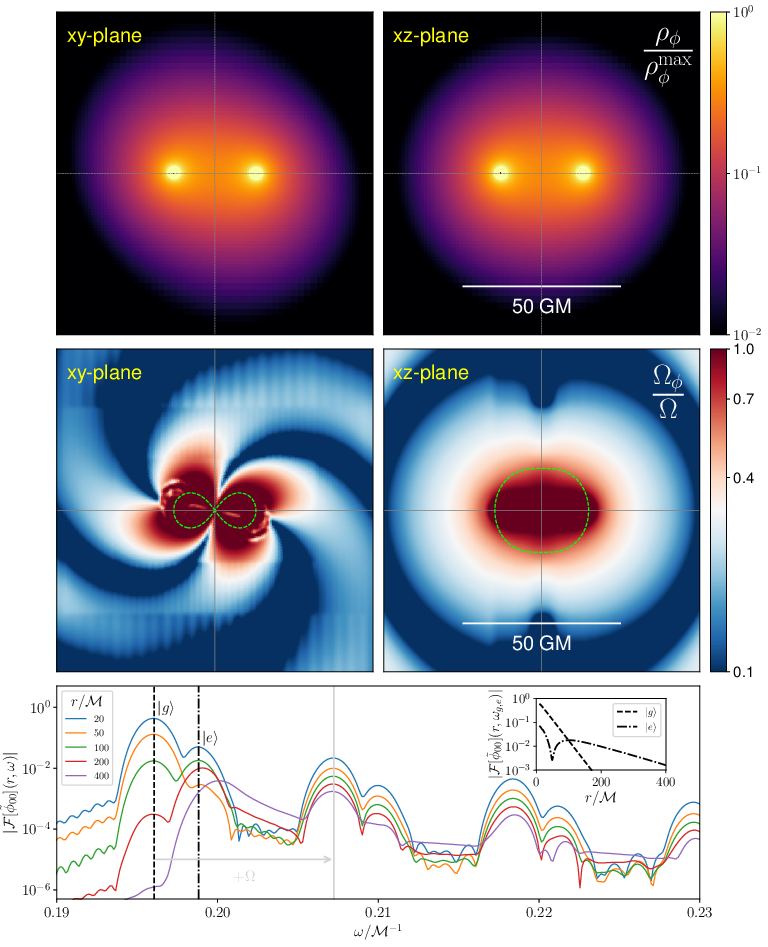
Figure 1: Simulation of a scalar field with mass μM around a comparable-mass binary, showing the energy density, angular velocity, and frequency spectrum at apoapsis.
The frequency spectrum of the scalar field reveals discrete peaks below the boson mass, corresponding to ground and excited bound states, and a series of peaks above the bound-state frequencies, spaced by integer multiples of the orbital frequency Ω. These higher-frequency peaks are signatures of ionized waves driven by the binary's motion.
The ionization of gravitational molecules is analyzed using a linear decomposition of the scalar field into bound and continuum states. The transition rates are computed via Fermi's Golden Rule, with the external potential arising from the time-dependent binary metric. The analysis distinguishes between co-moving (inner) and non-co-moving (outer) regions, each contributing differently to the ionization spectrum.
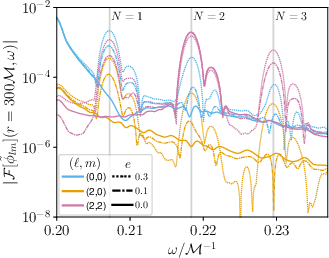
Figure 2: Frequency spectra of the dominant scalar spherical harmonic modes, showing ionization peaks for various eccentricities and mode numbers.
For circular orbits, the non-co-moving region dominates, with the (2,2) spherical harmonic mode at N=2 being the primary channel. For eccentric orbits, the co-moving region contributes significantly, with the (0,0) mode at N=1 scaling as e2 (eccentricity squared). The analytic estimates for the ratio of ionization amplitudes between modes are consistent with simulation results, with the (0,0):(2,0):(2,2) ratio near $6:1:3$ for moderate eccentricity.
Backreaction on Binary Orbital Evolution
Ionization of the bosonic cloud extracts energy and angular momentum from the binary, modifying its orbital parameters. The rates are given by
$\frac{dE}{dt}\Big|_{\mathrm{ion}} = -\sum_{C/\slashed{C}}\sum_{N\ell m} N\Omega \frac{M_g}{\mu} \Gamma^{C/\slashed{C}}_{(N)\ell m}$
$\frac{dL}{dt}\Big|_{\mathrm{ion}} = -\sum_{C/\slashed{C}}\sum_{N\ell m} m \frac{M_g}{\mu} \Gamma^{C/\slashed{C}}_{(N)\ell m}$
where Mg is the cloud mass and Γ the ionization rate.
The dominant channels are (0,0) at N=1 for the co-moving region and (2,2) at N=2 for the non-co-moving region. The analytic scaling for the ionization rates is
Γ(1)00C∼μα2a~13/4e2
$\Gamma^{\slashed{C}}_{(2)22} \sim 10^{-3} \mu\alpha^2 \tilde{a}^{9/4}$
with dimensionless coefficients FC and $F^{\slashed{C}}$ exhibiting mild dependence on α and a~.
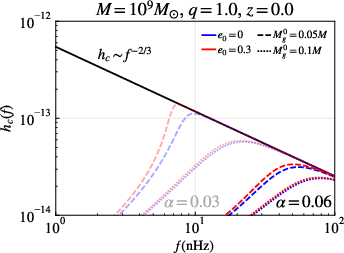
Figure 3: SGWB spectra from SMBHB populations for different initial eccentricities and bound-state masses, showing spectral turnover due to ionization.
Ionization-induced orbital hardening can dominate over gravitational wave (GW) emission at early stages, producing a turnover in the stochastic GW background (SGWB) spectrum. The transition frequency is
ft≈2.8nHz(0.1Mg/M)0.26(0.05α)1.7(M1010M⊙)
and the characteristic strain hc scales nearly linearly with frequency in the ionization-dominated regime, consistent with PTA observations.
Numerical Implementation and Convergence
The simulations employ the GRDzhadzha code, solving the Klein-Gordon equation in a $3+1$ formalism with mesh refinement and radiative boundary conditions. The scalar field and its conjugate momentum are evolved using high-order finite-difference stencils and Runge-Kutta time integration. Diagnostic quantities such as energy density, angular momentum density, and spherical harmonic decomposition are extracted at large radii.
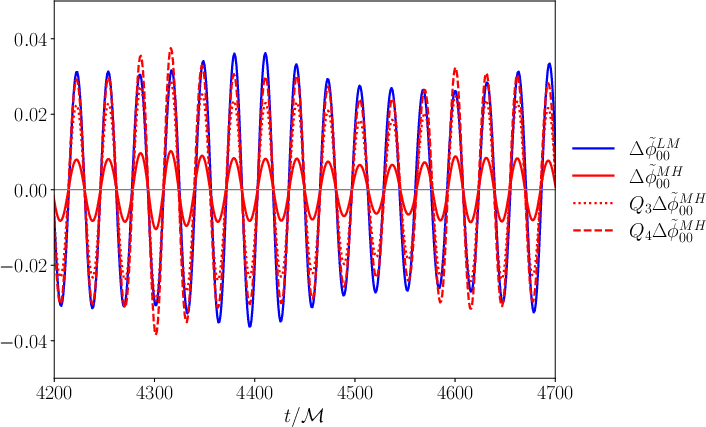
Figure 4: Convergence test of ϕ~00 at ro=300M, demonstrating third- to fourth-order convergence.
Parameter Dependence and Scaling
The analytic form factors for ionization are computed numerically for a range of α and a~, confirming the scaling relations and the mild dependence of the dimensionless coefficients.
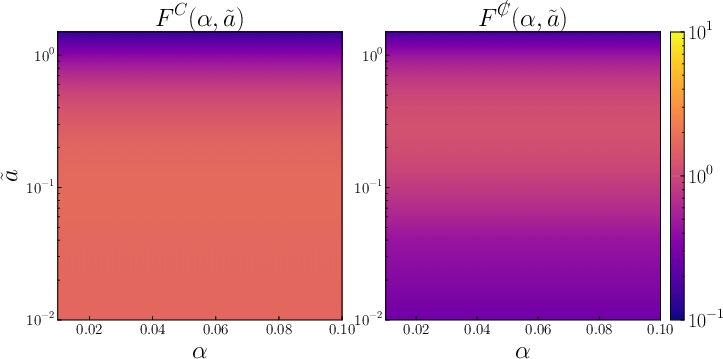
Figure 5: Distribution of FC and $F^{\slashed{C}}$ as functions of α and a~, normalized at a~=0.5, α=0.05.
Implications and Future Directions
The study demonstrates that ultralight boson clouds around BBHs can significantly affect binary evolution, particularly in the regime where the binary separation is below the bosonic Bohr radius. The ionization of gravitational molecules leads to orbital hardening and circularization, with observable consequences for the SGWB spectrum. These effects provide a novel probe of dark matter distributions and bosonic field properties in galactic nuclei.
The analysis is restricted to purely gravitational interactions; inclusion of couplings to Standard Model particles (e.g., axion-photon) would further enrich the phenomenology, enabling multi-messenger signatures such as birefringence, fine-structure constant oscillations, and particle production.
Theoretical implications include the need to refine models of bosonic cloud formation, survival, and depletion in dynamic binary environments, and to incorporate these effects into GW data analysis pipelines. Practically, the results motivate targeted searches for SGWB spectral turnovers and eccentricity evolution in PTA datasets, as well as electromagnetic counterparts in systems with dense bosonic clouds.
Conclusion
This work provides a comprehensive analysis of ultralight boson dynamics in comparable-mass BBH systems, elucidating the formation and ionization of gravitational molecules and their impact on binary evolution and GW observables. The combination of numerical simulations and semi-analytic theory yields robust predictions for ionization rates, orbital parameter evolution, and SGWB spectra, with direct relevance to current and future GW and multi-messenger observations. The results underscore the importance of environmental effects in precision GW astronomy and open new avenues for probing fundamental physics with astrophysical binaries.