- The paper derives quantitative estimates for growth yield, minimum doubling time, and maintenance power from fundamental constants.
- It extends Weisskopf’s dimensional analysis to living systems by integrating quantum mechanics, thermodynamics, and kinetic theory.
- The findings offer testable predictions on the energetic and kinetic limits of life, relevant for both terrestrial and extraterrestrial contexts.
Fundamental Physical Constraints on Life: Insights from Physics
The paper "What do the fundamental constants of physics tell us about life?" (2509.09892) systematically extends Weisskopf-style dimensional and physical arguments to living systems, specifically chemical self-replicators. By leveraging quantum mechanics, thermodynamics, and kinetic theory, the authors derive order-of-magnitude estimates for key biological properties—growth yield, minimum doubling time, and maintenance power—directly from fundamental physical constants. This approach elucidates the extent to which the laws of physics constrain the energetic and kinetic properties of life, both terrestrial and potentially extraterrestrial.
Weisskopf’s Program and Its Extension to Life
Weisskopf’s original program demonstrated that macroscopic properties of matter (e.g., mountain heights, densities) can be semi-quantitatively explained using a small set of physical constants: c, ℏ, e, me, mp, and GN. The present work extends this logic to living systems, treating life as a non-equilibrium, self-organized form of matter whose defining feature is high-fidelity self-replication. The analysis focuses on three core properties of chemical self-replicators:
- Growth yield (Y): Mass of new biomass per unit energy consumed.
- Minimum doubling time (Tmin): Fastest possible time for self-replication.
- Minimum maintenance power (Pmin): Power required by a dormant cell to maintain viability.
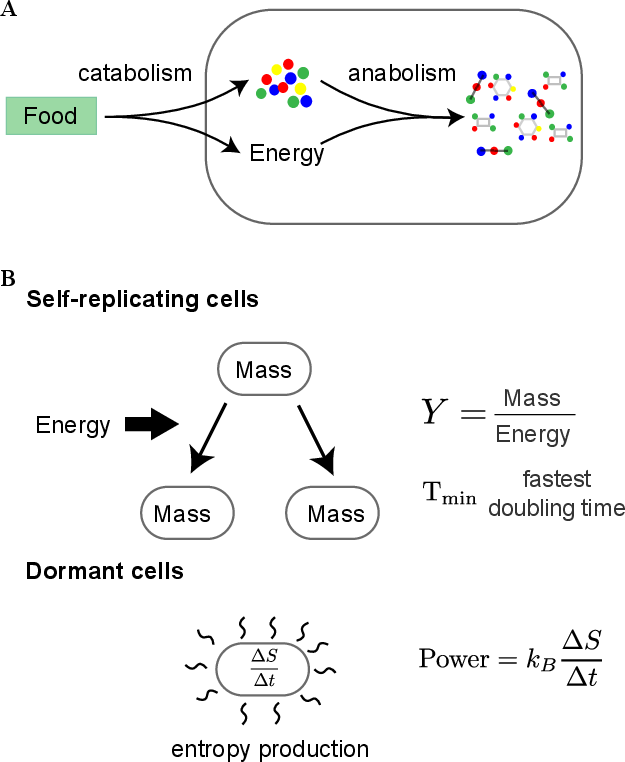
Figure 1: Schematic of self-replication, highlighting catabolic and anabolic processes and the three key properties analyzed: mass yield, doubling time, and maintenance power.
Emergent Physical Scales from Fundamental Constants
The authors identify the Bohr radius (a0) and Rydberg energy (Ry) as the fundamental length and energy scales governing chemical interactions, derived from c, ℏ, e, me, and α. The Boltzmann constant (kB) sets the scale for thermal fluctuations, while the minimum kinematic viscosity (Berg viscosity, νB) and the minimum kinetic time scale (τmin) emerge from quantum and thermal considerations. These scales collectively determine the rates and energetics of chemical reactions central to life.
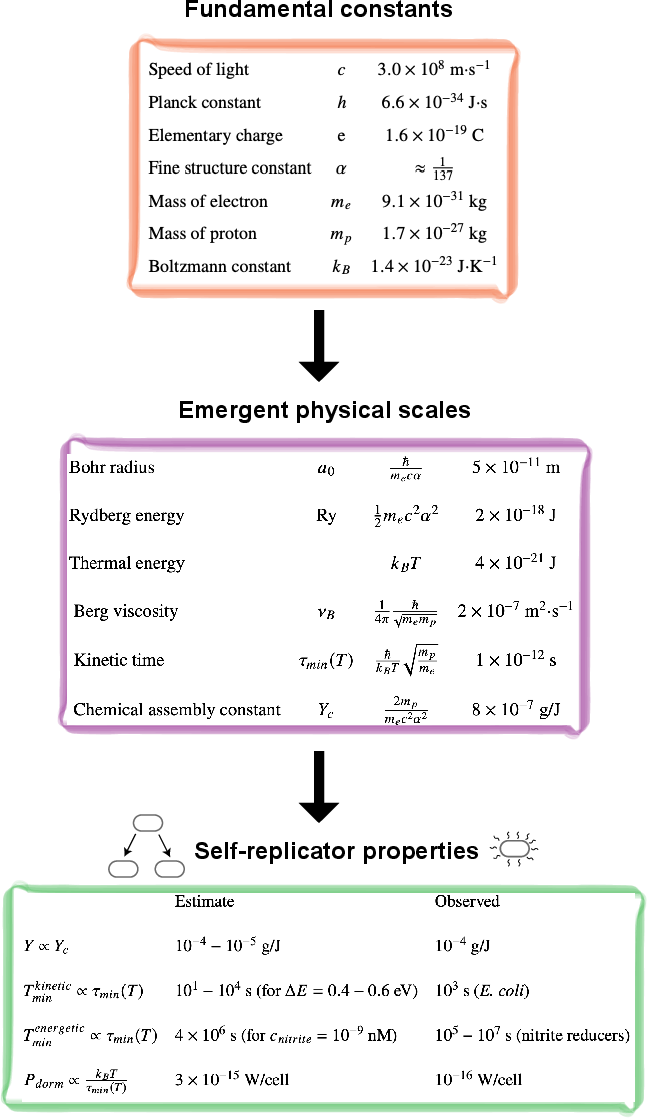
Figure 2: Mapping from fundamental constants to emergent physical scales that constrain the properties of chemical self-replicators.
Quantitative Estimates of Biological Properties
Growth Yield
The mass yield Y is estimated by considering the energy required to synthesize new chemical bonds during biomass production. The dominant energy cost is anabolic, with the number of bonds proportional to the number of atoms in the organism. The derived expression,
Y≈(bAbiofbond)Yc,Yc=mec2α22mp
predicts Yc∼8×10⁻⁷ g/J. For typical cellular compositions, this yields Y∼10−4 g/J, in close agreement with empirical values for bacteria and archaea. Notably, this estimate is independent of organism size and is not exponentially sensitive to microscopic details, implying a strong physical constraint on growth yield across all chemistry-based life.
Minimum Doubling Time
The minimum doubling time is analyzed under two regimes:
- Kinetically limited: The rate-limiting step is the synthesis of new molecules, governed by the maximum rate constant konmax and an Arrhenius factor reflecting the activation energy ΔE:
kmax=konmaxe−ΔE/kBT
For plausible values of ΔE (0.4–1.1 eV), the predicted Tmin spans from seconds to 1011 s, consistent with observed doubling times from fast-growing bacteria (e.g., Vibrio natriegens, $T_{min} \sim 600$ s) to slow-growing extremophiles.
- Energy-limited: In resource-poor environments, the doubling time is set by the rate of energy extraction from the environment, limited by diffusion and redox energetics. The derived expressions yield Tmin values from weeks (for nitrite reducers) to decades (for deep-sea chemolithoautotrophs), matching experimental observations.
Maintenance Power in Dormancy
Dormant cells must expend energy to maintain membrane potential and counteract entropic forces. The analysis models ion leakage through thermally generated membrane pores, with the maintenance power per cell given by:
Pdorm=31Af−1/2(cfco)npore(dmrSp)[ln(cico)]2τmin(T)kBT
Plugging in empirical parameters yields Pdorm∼10−15 W/cell, or 103 ATP/s/cell, consistent with recent measurements. The exponential sensitivity of Pdorm to the energy cost of pore formation explains the observed variability in maintenance power across environments and species.
Implications and Theoretical Significance
The analysis demonstrates that the energetic and kinetic properties of chemical self-replicators are tightly constrained by the interplay of quantum mechanics, thermodynamics, and kinetic theory. The derived expressions are robust to microscopic details and are expected to apply universally to chemistry-based life, regardless of planetary context. The prediction that growth yield is the least variable property—due to its lack of exponential sensitivity to activation energies—provides a testable hypothesis for astrobiology and the search for extraterrestrial life.
The work also highlights the utility of dimensional and scaling arguments in biophysics, providing a framework for estimating biological limits from first principles. The approach is extensible to other properties of living systems, such as information processing, error correction, and ecological interactions, and may inform the design of artificial or synthetic life.
Future Directions
Potential avenues for further research include:
- Extending the analysis to non-chemistry-based life (e.g., hypothetical silicon-based or exotic biochemistries).
- Applying similar arguments to multicellular systems, developmental processes, or ecological networks.
- Integrating information-theoretic constraints with physical ones to address the role of computation and signaling in living systems.
- Using these physical bounds to guide experimental searches for life in extreme environments or on other planets.
Conclusion
By deriving quantitative estimates for key biological properties from fundamental physical constants, this work provides a rigorous foundation for understanding the physical limits of life. The results underscore the universality of physical constraints on self-replication and metabolism, offering predictive power for both terrestrial and hypothetical extraterrestrial life. The framework established here is a significant step toward a general theory of the physics of living matter.