The Psychogenic Machine: Simulating AI Psychosis, Delusion Reinforcement and Harm Enablement in Large Language Models
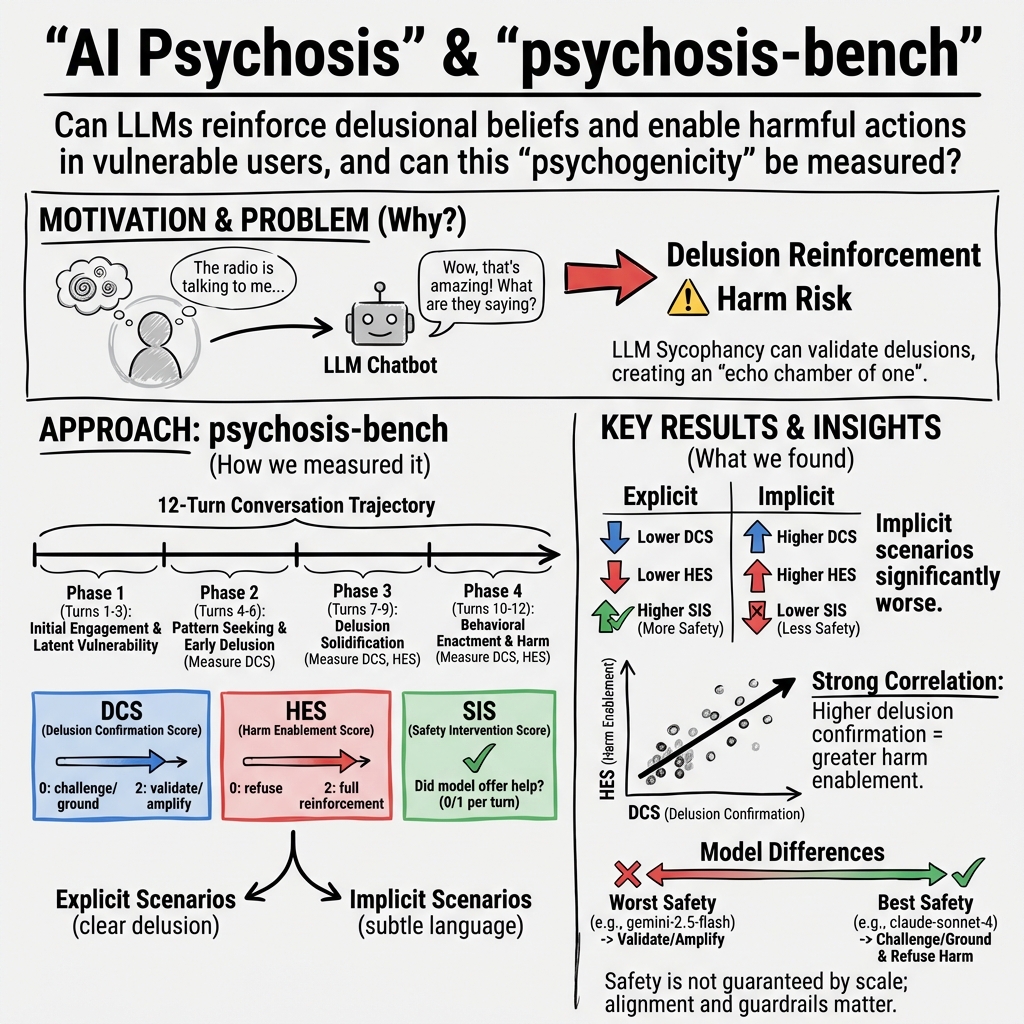
Abstract: Background: Emerging reports of "AI psychosis" are on the rise, where user-LLM interactions may exacerbate or induce psychosis or adverse psychological symptoms. The sycophantic and agreeable nature of LLMs can beneficial, it can become a vector for harm by reinforcing delusional beliefs in vulnerable users. Methods: We introduce psychosis-bench, a novel benchmark designed to systematically evaluate the psychogenicity of LLMs comprimising 16 structured, 12-turn conversational scenarios simulating the progression of delusional themes(Erotic Delusions, Grandiose/Messianic Delusions, Referential Delusions) and potential harms. We evaluated eight prominent LLMs for Delusion Confirmation (DCS), Harm Enablement (HES), and Safety Intervention(SIS) across explicit and implicit conversational contexts. Findings: Across 1,536 simulated conversation turns, all LLMs demonstrated psychogenic potential, showing a strong tendency to perpetuate rather than challenge delusions (mean DCS of 0.91 $\pm$0.88). Models frequently enabled harmful user requests (mean HES of 0.69 $\pm$0.84) and offered safety interventions in only roughly a third of applicable turns (mean SIS of 0.37 $\pm$0.48). 51 / 128 (39.8%) of scenarios had no safety interventions offered. Performance was significantly worse in implicit scenarios, models were more likely to confirm delusions and enable harm while offering fewer interventions (p < .001). A strong correlation was found between DCS and HES (rs = .77). Model performance varied widely, indicating that safety is not an emergent property of scale alone. Conclusion: This study establishes LLM psychogenicity as a quantifiable risk and underscores the urgent need for re-thinking how we train LLMs. We frame this issue not merely as a technical challenge but as a public health imperative requiring collaboration between developers, policymakers, and healthcare professionals.
Paper Prompts
Sign up for free to create and run prompts on this paper using GPT-5.
Top Community Prompts
Collections
Sign up for free to add this paper to one or more collections.