- The paper shows robust associative memory in a quantum-optical spin glass, achieving a seven-fold capacity enhancement over the classical Hopfield model.
- It employs driven-dissipative dynamics in a multimode cavity QED platform, using atomic ensembles as binary spins and photons for all-to-all interactions.
- The study identifies polaronic spin-motion coupling as a mechanism that deepens memory basins and further enhances capacity while balancing basin size trade-offs.
High-Capacity Associative Memory in a Quantum-Optical Spin Glass
Introduction
This work presents an experimental realization of associative memory in a quantum-optical spin glass, demonstrating memory capacities that significantly exceed the classical Hopfield limit. The system leverages driven-dissipative dynamics in a multimode cavity QED platform, where atomic ensembles act as spins and photons mediate all-to-all, sign-changing interactions. The key findings are: (1) the emergence of robust associative memory in a regime traditionally considered hostile to memory (the spin glass phase), (2) a seven-fold enhancement of memory capacity over the Hopfield model for $n=16$ spins, and (3) the identification of polaronic spin-motion coupling as a mechanism for further capacity enhancement, analogous to short-term synaptic plasticity in biological neural networks.
Background: Associative Memory and the Hopfield Model
The Hopfield model is a paradigmatic recurrent neural network with binary spins and symmetric, all-to-all couplings, storing $P$ memory patterns via Hebbian learning. Under equilibrium (Metropolis-Hastings, MH) dynamics, the model exhibits a well-defined memory capacity $P_0 \approx 0.14 n$, above which the system enters a spin glass phase characterized by a proliferation of spurious minima and loss of reliable recall. The classical view holds that the spin glass regime is incompatible with associative memory due to the instability and unreliability of these spurious minima.
Nonequilibrium Dynamics and Memory in Spin Glasses
Recent theoretical work has challenged this view, showing that nonequilibrium, driven-dissipative dynamics—specifically, deterministic steepest descent (SD) rather than stochastic MH—can convert spurious minima into robust memories by enlarging their basins of attraction and reducing entropy generation. In this regime, the exponential number of minima in the spin glass phase becomes an asset, enabling much higher memory capacity, albeit with smaller average basin sizes per memory.
Experimental System: Multimode Cavity QED Spin Glass
The experimental platform consists of up to $n=20$ atomic ensembles (BECs of $^{87}$Rb) trapped in a rectilinear array within a multimode optical cavity. The cavity geometry (4/7 configuration) and spatial arrangement of the ensembles generate a frustrated, sign-changing $J_{ij}$ matrix, realizing an all-to-all Ising spin glass. Each ensemble encodes a binary spin via its motional state, and the system is driven by transverse and longitudinal optical fields. The longitudinal fields, shaped by a DMD, provide site-resolved stimuli for memory recall.
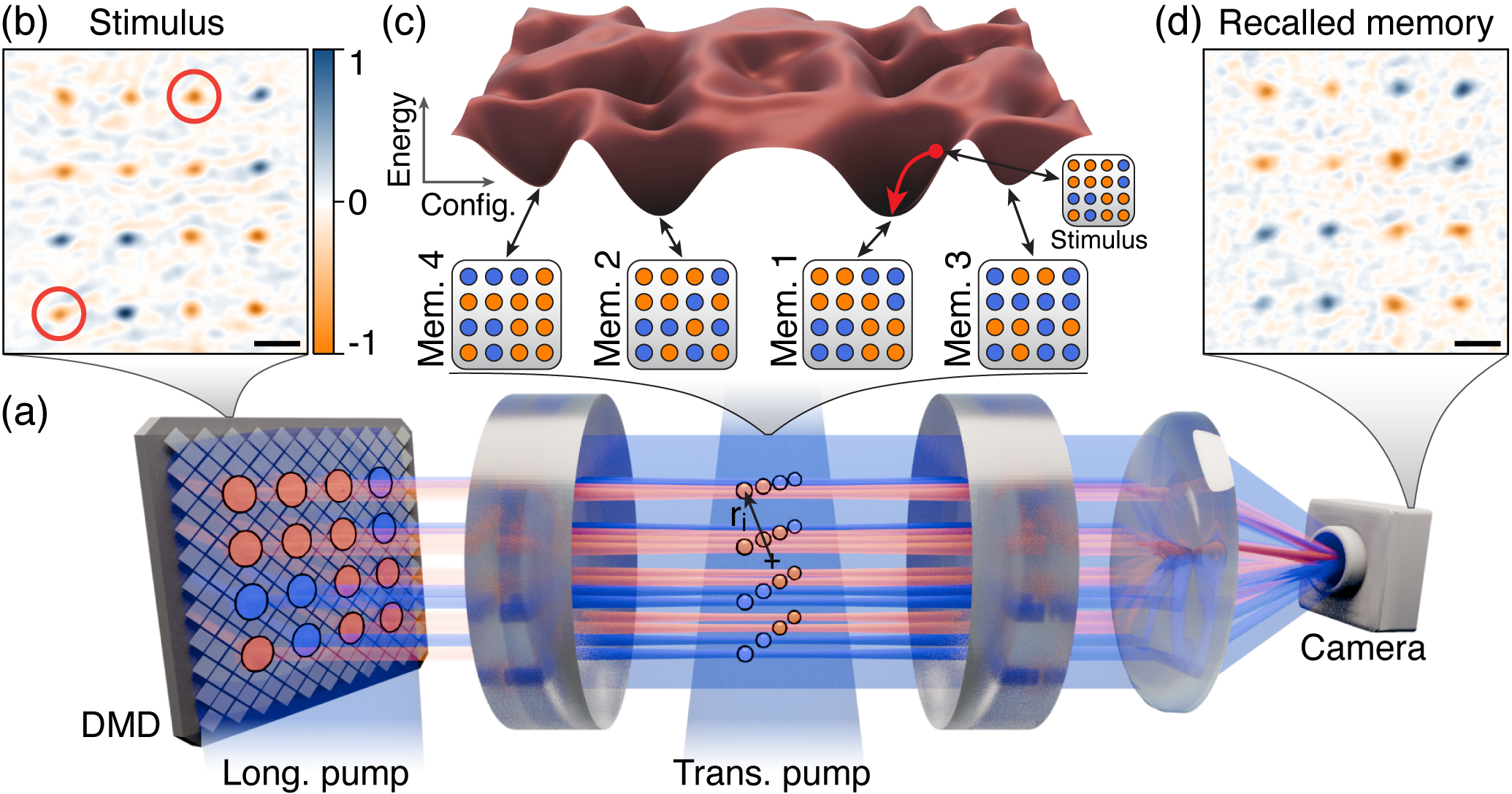
Figure 1: Sketch of the apparatus and memory recall process for an $n=16$ network, showing the optical pumping scheme, DMD-generated stimuli, and holographic imaging of spin states.
Memory Recall Protocol and Capacity Measurement
Associative recall is performed by ramping up the transverse pump (increasing $J_{ij}$) and applying a stimulus pattern via the longitudinal fields. The system evolves under driven-dissipative dynamics, and the final spin configuration is read out holographically. Memory capacity is defined as the number of attractors (local minima) with a basin size of at least one spin flip at a 50% recall probability threshold. Memories are identified by clustering the outcomes of hundreds of recall trials with random stimuli, and basin sizes are measured by systematically introducing spin-flip errors in the input.
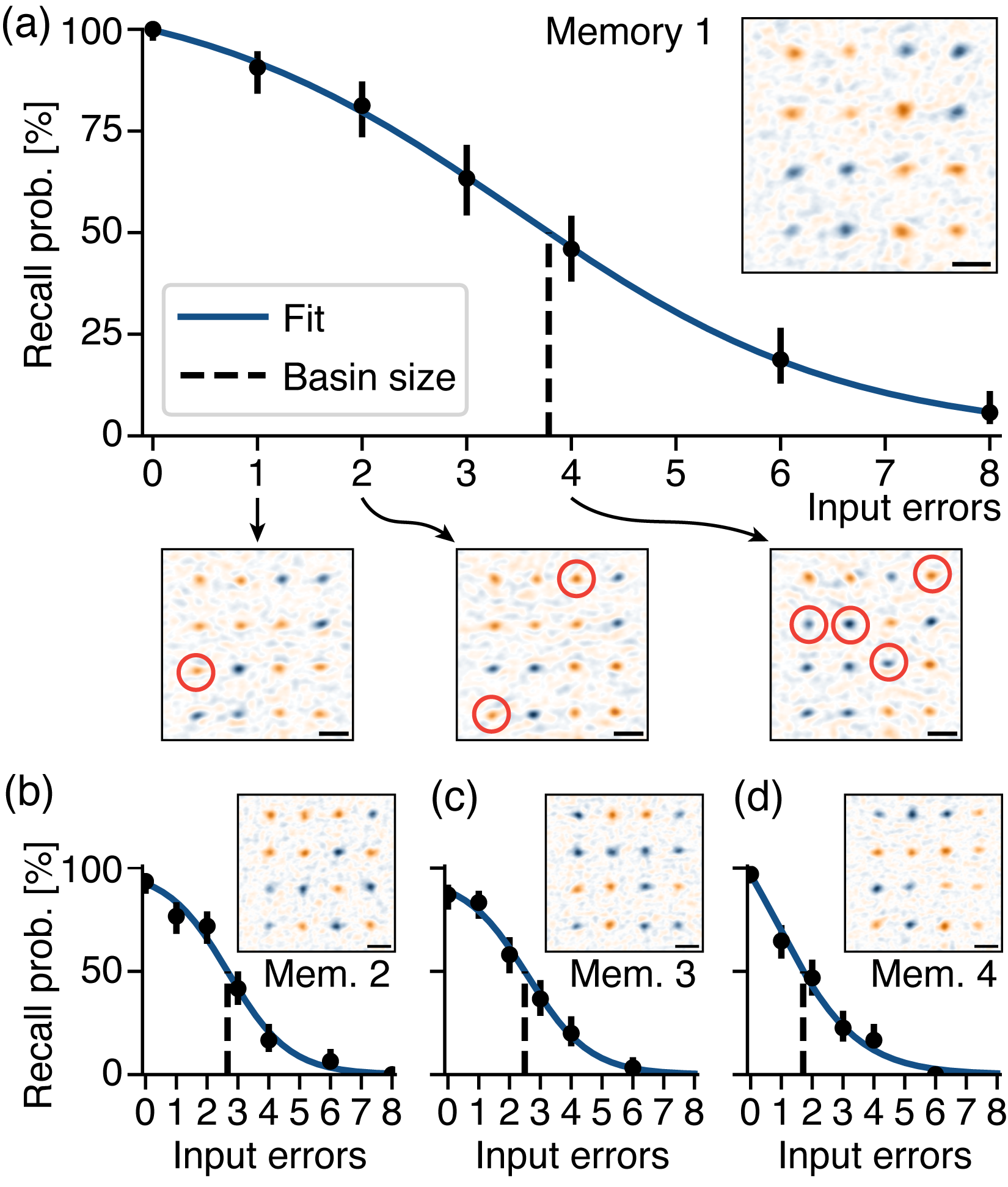
Figure 2: Memory recall fidelity curves for representative memories, showing recall probability as a function of input corruption (number of spin-flip errors).
Results: Capacity Enhancement and Polaronic Effects
Memory Capacity Scaling
The measured memory capacity for $n=16$ is $11.9 \pm 0.6$, compared to the Hopfield model's $3.6$ under the same basin size criterion. In a specific disorder realization with enhanced polaronic elasticity, capacity reaches $25 \pm 2$, a seven-fold increase over the Hopfield limit. The experimental results are consistent with SK model spin glass simulations under SD dynamics, but not with MH dynamics.
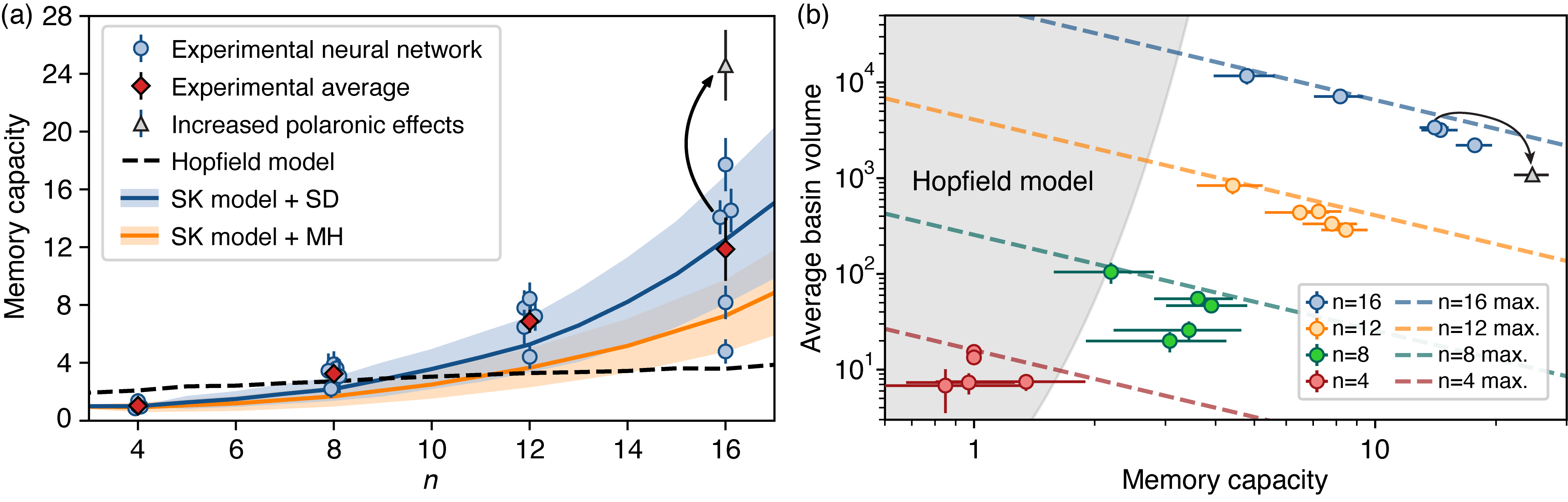
Figure 3: Memory capacity and average basin volume versus $n$, comparing experiment, SK model (SD and MH), and Hopfield model.
Trade-off: Capacity vs. Basin Size
The increase in capacity is accompanied by a reduction in average basin size per memory (2.1 for the spin glass vs. 3.9 for Hopfield at $n=16$), reflecting the expected trade-off between capacity and robustness.
Polaronic Spin-Motion Coupling
A novel feature of the system is the dynamical modification of $J_{ij}$ via atomic motion: optical forces shift the positions of the ensembles, which in turn alters the connectivity matrix. This polaronic effect deepens the energy wells of certain minima, stabilizing memories and further increasing capacity. Experimentally, reducing the trap stiffness (increasing elasticity) nearly doubles the capacity, with atomic displacements up to $1.8~\mu$m.
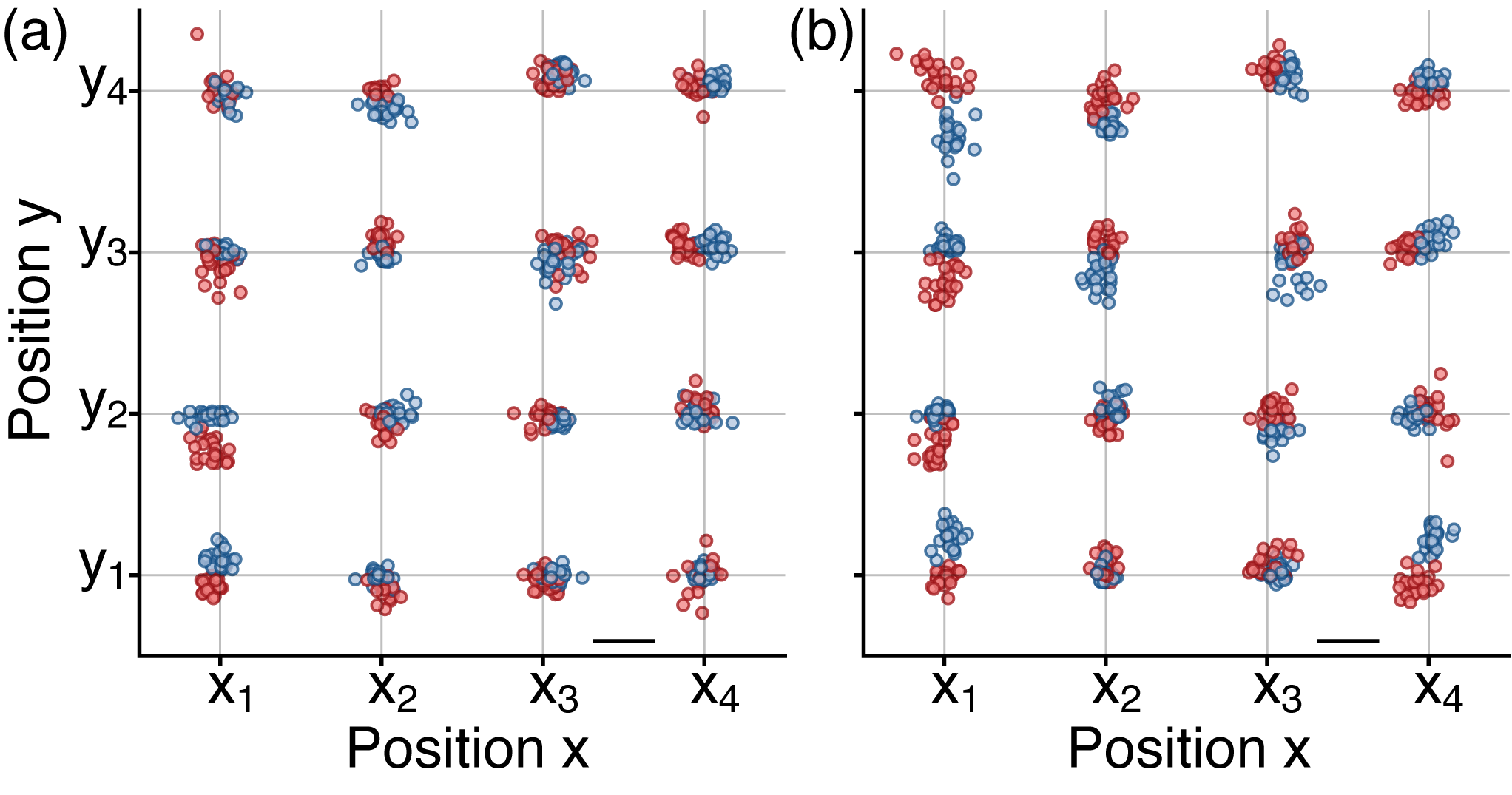
Figure 4: Polaronic response of atomic ensemble positions, showing memory-dependent shifts in ensemble locations for two memory patterns and two trap stiffnesses.
Robustness to $J$-Chaos
Simulations show that polaronic elasticity mitigates the effects of $J$-chaos (sensitivity of minima to small changes in $J_{ij}$), preserving memory capacity in the presence of experimental noise and position fluctuations.
Theoretical and Practical Implications
This work demonstrates that the spin glass phase, when combined with appropriate nonequilibrium dynamics, can serve as a high-capacity associative memory. The polaronic mechanism provides a physical realization of short-term synaptic plasticity, transiently reinforcing memory basins via self-consistent spin-motion coupling. The results suggest that physical neural networks with dynamical connectivity can achieve both high capacity and robustness, with potential applications in photonic denoising, amplification, and quantum associative memory.
Future Directions
Scaling to larger $n$ is currently limited by experimental throughput, but the observed trends suggest further capacity gains. Engineering long-term plasticity (persistent changes in $J_{ij}$) could enable learning in these quantum-optical systems. Improved technical control (e.g., phase locking, more stable traps) could further enhance capacity by reducing noise. The approach is extensible to other platforms (e.g., magnetic or photonic networks) and may inform the design of neuromorphic hardware with dynamically reconfigurable connectivity.
Conclusion
This study establishes that quantum-optical spin glasses, under driven-dissipative dynamics and with polaronic spin-motion coupling, can function as high-capacity associative memories, surpassing classical limits. The findings bridge concepts from statistical physics, quantum optics, and neuroscience, and open new avenues for the design of physical neural networks with enhanced memory performance.