Dynamical symmetry breaking described by cubic nonlinear Klein-Gordon equations
Published 14 Sep 2025 in math.NA, cs.NA, hep-th, nlin.AO, and nlin.CD | (2509.12272v1)
Abstract: The dynamical symmetry breaking associated with the existence and non-existence of breather solutions is studied. Here, nonlinear hyperbolic evolution equations are calculated using a high-precision numerical scheme. %%% First, for clarifying the dynamical symmetry breaking, it is necessary to use a sufficiently high-precision scheme in the time-dependent framework. Second, the error of numerical calculations is generally more easily accumulated for calculating hyperbolic equations rather than parabolic equations. Third, numerical calculations become easily unstable for nonlinear cases. Our strategy for the high-precision and stable scheme is to implement the implicit Runge-Kutta method for time, and the Fourier spectral decomposition for space. %%% In this paper, focusing on the breather solutions, the relationship between the velocity, mass, and the amplitude of the perturbation is clarified. As a result, the conditions for transitioning from one state to another are clarified.
The paper demonstrates that dynamical symmetry breaking in cubic nonlinear Klein-Gordon equations is governed by perturbation amplitude and phase velocity.
It employs an implicit Runge-Kutta method with Fourier spectral decomposition to accurately capture breather solutions and state transitions.
The study maps confined and unconfined oscillation regimes, providing insights into the stability and chaotic behavior in nonlinear wave dynamics.
Dynamical Symmetry Breaking in Cubic Nonlinear Klein-Gordon Equations
Introduction
This paper investigates the phenomenon of dynamical symmetry breaking in the context of cubic nonlinear Klein-Gordon equations, focusing on the existence and non-existence of breather solutions and their role in transitions between Lyapunov-stable states. The authors employ a high-precision numerical scheme, combining an implicit Runge-Kutta method for temporal integration and a Fourier spectral decomposition for spatial discretization, to systematically analyze the conditions under which dynamical symmetry breaking occurs. The study elucidates the interplay between phase velocity, mass parameter, and initial perturbation amplitude in governing the transition dynamics.
Mathematical Framework
The primary model considered is a nonlinear Klein-Gordon equation with a cubic nonlinearity: ∂t2∂2u+α∂x2∂2u+βu(u2−μ)=0,
where α<0, β,μ>0. The initial and boundary value problem (IBVP) is formulated with periodic boundary conditions and a spatially inhomogeneous perturbation added to a Lyapunov-stable state. The steady-state solutions u=0,±μ1/2 are analyzed, with u=±μ1/2 being Lyapunov-stable for μ>0.
A reduced ordinary differential equation (ODE) is derived by setting α=0, enabling point-wise analysis: dt2d2u=−u(u2−μ).
This reduction facilitates comparison between spatially homogeneous and inhomogeneous dynamics, isolating the effects of spatial distribution.
Numerical Scheme and Implementation
The authors emphasize the necessity of high-precision and stability in numerical simulations of nonlinear hyperbolic PDEs, particularly for time-dependent problems. The adopted scheme consists of:
Implicit Runge-Kutta method for time integration, ensuring stability in the presence of stiff nonlinearities.
Fourier spectral method for spatial discretization, providing spectral accuracy and mitigating numerical dispersion.
This combination is critical for resolving breather solutions and accurately capturing transitions between stable states. The scheme is validated through systematic simulations across a wide range of parameters, with 19×24×32=14592 cases computed to ensure statistical robustness.
Results: Phase Diagram and Transition Dynamics
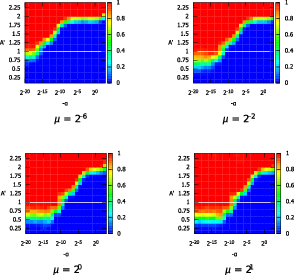
The central result is a phase diagram mapping the occurrence of dynamical symmetry breaking as a function of normalized amplitude A′ and phase velocity −α, for several mass parameters μ.
Figure 1: Phase diagram of stable oscillation regimes for various μ, showing the fraction of transitions (case ii) as a function of normalized amplitude A′ and phase velocity −α.
The diagram reveals two distinct oscillatory regimes:
Confined Oscillations: Solutions remain near a single Lyapunov-stable state (+μ1/2 or −μ1/2), corresponding to suppressed transitions.
Transition Suppression: For small amplitude perturbations (A≪1) and large phase velocity (−α), transitions are suppressed, and the system remains confined to a single stable state.
Transition Enhancement: For small phase velocity and larger amplitude, transitions are enhanced, with the system exhibiting sensitivity to initial conditions and coexistence of both oscillatory regimes.
Mass Dependence: The boundary between regimes is largely insensitive to −α for −α>2−6, but for very small μ, transition enhancement vanishes, indicating massless or light particles with high velocity are naturally confined.
The coexistence region, characterized by chaotic sensitivity to initial conditions, is prominent for small amplitude and small phase velocity, highlighting the intricate dependence of symmetry breaking on system parameters.
Theoretical and Practical Implications
The study provides a rigorous characterization of dynamical symmetry breaking in nonlinear wave equations, with implications for understanding pattern formation, soliton dynamics, and breather stability in physical systems governed by Klein-Gordon-type models. The results demonstrate that the sustainability of pure states (absence of transition) is favored in systems with small mass or high phase velocity, while mixed states (transition between stable states) require sufficient perturbation amplitude and are enhanced by low phase velocity.
From a practical perspective, the high-precision numerical scheme developed is broadly applicable to nonlinear hyperbolic PDEs, offering a robust framework for investigating time-dependent phenomena where standard finite difference methods fail to capture critical dynamics. The systematic approach to parameter exploration sets a precedent for future studies on nonlinear wave equations and their applications in physics and engineering.
Future Directions
The findings suggest several avenues for further research:
Mechanistic Analysis: Detailed investigation of the mechanisms underlying transition enhancement and suppression, particularly in the context of wave effects and spatial inhomogeneity.
Extension to Coupled Systems: Application of the numerical scheme to coupled Klein-Gordon equations and higher-dimensional models.
Stability and Chaos: Exploration of chaotic regimes and sensitivity to initial conditions, with potential connections to Lyapunov exponents and bifurcation theory.
Physical Realizations: Experimental validation in systems exhibiting nonlinear wave dynamics, such as condensed matter, optical lattices, or field-theoretic models.
Conclusion
This paper provides a comprehensive analysis of dynamical symmetry breaking in cubic nonlinear Klein-Gordon equations, elucidating the conditions for transitions between Lyapunov-stable states and the role of breather solutions. The high-precision numerical scheme enables systematic exploration of parameter space, revealing the dependence of transition dynamics on mass, phase velocity, and perturbation amplitude. The results have significant implications for the study of nonlinear wave phenomena and offer a robust computational framework for future investigations.