- The paper introduces BinocMesher, a novel 4D binary-octree algorithm that enables temporally smooth mesh extraction for procedural scenes with long-range camera trajectories.
- It extends dual contouring to 4D using a binary-octree to achieve coherent level-of-detail transitions and significantly mitigate popping artifacts.
- Experimental results show high visual and geometric consistency with efficient memory usage, outperforming baseline methods in large-scale procedural environments.
Introduction and Motivation
Procedural occupancy functions provide a compact and expressive means for representing complex, unbounded 3D scenes, which are prevalent in applications such as animation, synthetic data generation, and large-scale virtual environments. While direct rendering via ray-marching is possible, mesh extraction remains essential for compatibility with standard rendering pipelines, efficient rasterization, and artist workflows. However, extracting meshes for unbounded scenes traversed by long-range camera trajectories presents a unique challenge: a single global mesh is often prohibitively large, while per-view or per-segment meshes introduce severe popping artifacts due to abrupt changes in geometry.
This work introduces BinocMesher, a temporally coherent mesh extraction algorithm that leverages a novel 4D spacetime tree structure—the binary-octree—to generate a sequence of 3D meshes with smooth transitions along arbitrary, pre-defined camera paths. The approach generalizes dual contouring to 4D, enabling temporally smooth level-of-detail (LOD) transitions and mitigating popping artifacts without incurring excessive memory or computational overhead.
Methodology
Binary-Octree Construction
The core innovation is the binary-octree, a hierarchical data structure that partitions 4D spacetime (3D space + time) by alternating between spatial and temporal splits. Each internal node either subdivides its spatial extent into eight children (octree split) or its temporal extent into two children (binary split). This design allows for spatial refinements to be localized in both space and time, supporting view-dependent LOD that adapts as the camera moves.
Temporal splits are applied only when necessary to enable differing spatial subdivisions in the two temporal children, and are constrained by a transition control parameter τ0 to ensure temporal coherence. This parameter enforces a minimum duration for each node, directly controlling the smoothness of LOD transitions.
Coarse-to-Fine Refinement
The binary-octree is constructed in a coarse-to-fine manner:
- Coarse Tree Construction: Nodes are prioritized for splitting based on their projected angular diameter as seen from the camera trajectory. Nodes exceeding a coarse threshold are subdivided.
- Surface Intersection: Nodes intersecting the isosurface (as determined by the occupancy function) are identified using a flood-fill approach, ensuring both spatial and temporal connectivity.
- Refinement: Surface-intersecting nodes are further refined using a finer diameter threshold, focusing computational resources on regions relevant to the visible surface.
4D Dual Contouring and Vertex Placement
Dual contouring is extended to 4D, associating each surface-intersecting hypercube with a mesh vertex and each bipolar edge (edge connecting nodes with differing occupancy) with a 3D polyhedron embedded in 4D. To avoid "staircase" artifacts from naive vertex placement at hypercube centers, a bisection search is used to project vertices closer to the true isosurface.
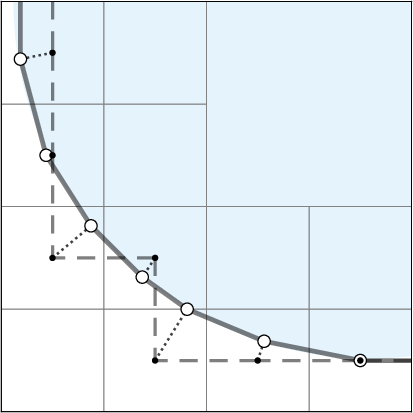
Figure 2: Bisection-based vertex placement reduces staircase artifacts by projecting mesh vertices toward the true geometry.
Mesh Slicing
At each timestamp, the 4D mesh is sliced along the time axis to produce a 3D mesh. This involves intersecting 4D polyhedra with the slicing plane, generating polygons that form the 3D mesh for that frame. As the camera moves, the mesh evolves smoothly, with polygons merging or splitting to reflect LOD changes.
Grouping and Efficient Polyhedron Extraction
To manage memory for long sequences, coarse nodes are grouped by their temporal range using binary encodings. Bipolar edge and polyhedron extraction is performed group-wise, leveraging the structure of the binary-octree to efficiently identify neighboring nodes and minimize redundant computation.

Figure 4: Temporal grouping of hypercubes using binary encodings enables efficient neighbor queries during polyhedron extraction.
Experimental Evaluation
Visual Consistency
The method is evaluated on complex procedural scenes (e.g., Forest, Mountain, Arctic, Cave, Beach, City) with long camera trajectories. Visual consistency is quantified using SSIM between consecutive frames, warped by ground-truth optical flow. BinocMesher exhibits consistently high SSIM scores with only minor valleys, indicating minimal popping artifacts. In contrast, baseline methods (Spherical Mesher, OcMesher with various segment lengths) show periodic and severe valleys corresponding to mesh updates.
Geometric Consistency
Clay-style renderings and surface normal difference heatmaps further corroborate the geometric smoothness of BinocMesher's outputs. The normal difference metric is highly correlated with SSIM, confirming that the method maintains both visual and geometric coherence.
Computational Cost
BinocMesher achieves comparable overall runtime to OcMesher and significantly outperforms Spherical Mesher in terms of memory efficiency. The amortized meshing cost per frame is dominated by mesh slicing, with binary-octree construction and 4D mesh extraction constituting a minor fraction. The method scales gracefully with sequence length due to group-wise processing and bounded memory usage.
Parameter Sensitivity
The transition control parameter τ0 directly trades off between memory usage and temporal coherence. Larger values yield less frequent but more severe LOD transitions, while smaller values increase memory usage but further suppress popping. Empirically, τ0=1 s provides a balanced compromise.
Implementation Considerations
- Occupancy Function Evaluation: GPU acceleration is leveraged for occupancy queries, critical for high-resolution scenes.
- Virtual Grids: To avoid excessive refinement, virtual grids are used to flag regions requiring further subdivision without instantiating all nodes.
- Frustum Culling and Depth Buffering: Nodes outside the camera frustum or occluded in all views are deprioritized or omitted, reducing unnecessary computation.
- Memory Management: Only relevant node groups are loaded into memory at any time, enabling scalability to long sequences and large scenes.
Limitations and Extensions
- Predefined Camera Trajectories: The method assumes known camera paths, limiting applicability to offline rendering and non-interactive scenarios. However, it can be extended to "fuzzy" camera regions by sampling multiple plausible paths.
- Dynamic Scenes: While dynamic effects can be layered via displacement maps or animated meshes, fully dynamic occupancy functions would require per-frame octree construction, negating temporal coherence benefits.
- Residual Popping: Minor popping artifacts arise from time-orthogonal faces in the 4D mesh. An extension that extrudes these faces into pyramidal volumes further ameliorates these artifacts, as demonstrated in additional experiments.
Theoretical and Practical Implications
The binary-octree framework generalizes multiresolution mesh extraction to the spacetime domain, enabling temporally smooth LOD transitions for unbounded procedural scenes. This approach is particularly relevant for synthetic data generation, cinematic rendering, and any application requiring high-fidelity, temporally coherent geometry along complex camera paths. The method's scalability and memory efficiency make it suitable for large-scale scenes and long-duration sequences.
Theoretically, the work demonstrates that 4D mesh extraction and slicing can be made practical for real-world applications by careful data structure design and algorithmic optimizations. The binary-octree's hybrid spatial-temporal splitting strategy is a key enabler for this scalability.
Conclusion
BinocMesher provides a principled and efficient solution to the problem of temporally smooth mesh extraction for procedural scenes with long-range camera trajectories. By leveraging a 4D binary-octree and extending dual contouring to spacetime, the method achieves superior visual and geometric consistency compared to existing baselines, with competitive computational and memory requirements. The approach is well-suited for offline rendering applications and can be further extended to handle fuzzy camera paths and residual popping artifacts. Future work may explore interactive extensions, hybrid ray-marching strategies, and broader applications in dynamic scene modeling.

