- The paper introduces Bering's formalism, modifying classical equations by replacing the Poisson bracket with a Bering bracket to account for boundary contributions.
- It adapts the Klein-Gordon equation for finite domains, adding inhomogeneous boundary terms that reveal new scattering dynamics.
- The study demonstrates through simple geometries how finite space effects shift classical dynamics, with potential implications for condensed matter and fluid dynamics.
Classical Mechanics on Finite Spaces
Introduction
The paper "Classical Mechanics on Finite Spaces" explores the impact of topology on classical mechanics, specifically examining how the presence of boundaries affects classical equations of motion. Building on Bering's formalism, this study aims to bridge the gap between topology, traditionally associated with quantum mechanics, and its influence on classical systems.
Classical Field Theory with Boundary Considerations
Classical mechanics typically assumes an infinite extent of space. The paper challenges this notion by reformulating the equations of motion for classical systems in finite spaces. The key modification involves integrating Bering's approach, which acknowledges the significance of boundaries. This adjustment is crucial for accurately describing phenomena like scattering from impenetrable obstacles, a concept analogous to the Aharonov-Bohm effect in quantum mechanics.
The formalism transitions the Poisson bracket into a Bering bracket, accommodating boundary contributions. The Bering bracket incorporates higher-order derivatives and a regularized characteristic function χϵ(x) which smooths the boundary. This function allows precise determination of boundary effects, transforming the system equations into a more comprehensive description that includes boundary influences.
Klein-Gordon Equation on Finite Spaces
The study applies this formalism to solve the Klein-Gordon equation, traditionally a quantum equation, in finite classical domains. The Klein-Gordon Hamiltonian is adapted to account for finite boundaries through additional terms derived from the Bering bracket. This leads to a modified Klein-Gordon equation:
(∂t2−∇2+m2)ϕ=ϵ→0limχϵ1∇χϵ⋅∇ϕ
The boundary condition introduces an inhomogeneous component, turning the equation from homogeneous in the bulk to inhomogeneous near the boundary due to the source term.
Boundary and Bulk Solutions
For the practical computation of solutions, the paper examines several simple systems: a one-dimensional interval and discs/spheres in two/three-dimensional spaces. In these configurations, the solutions are obtained by separating the problem into homogeneous and particular solutions. The homogeneous solutions are undisturbed by the boundary, while particular solutions directly integrate the boundary-contributed terms, showcasing the shift from idealized infinite-space solutions to finite-space dynamics.
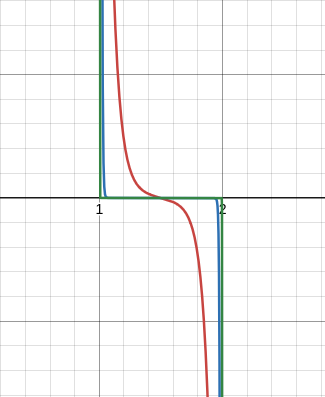
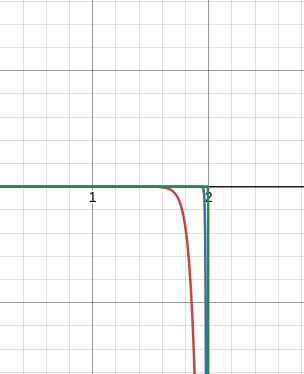
Figure 1: Plots of 'weight functions vs position' for ϵ=0.05, ϵ=0.005, and ϵ=0.0005, illustrating boundary effects.
These solutions demonstrate that the weight functions, influenced by boundary proximity, significantly alter field dynamics. The analysis reveals how finite spaces encourage a deeper exploration into boundary interaction effects and their implications for classical mechanics.
Implications and Future Directions
The modifications introduced to the Klein-Gordon equation for finite spaces provide insights into how classical systems can be influenced by boundaries, a typically overlooked aspect in infinite space models. This approach potentially aids in understanding more complex physical phenomena, particularly in systems where boundary conditions play a pivotal role, such as condensed matter physics or fluid dynamics.
Future research could further extend this framework to more complex geometries and systems, exploring chaotic dynamics in bounded systems and the implications of impenetrable boundaries in other classical equations. Additionally, the paper invites discourse on how these classical boundary effects might offer analogies or extensions to quantum mechanical systems confined by boundaries.
Conclusion
"Classical Mechanics on Finite Spaces" significantly contributes to the understanding of topology's role in classical physics, providing a novel perspective on boundary effects via classical field theory in finite domains. By combining Bering's approach with classical mechanics, the paper lays the groundwork for further exploration in the intersection of topology and classical systems, broadening the scope of physics from traditional infinite space assumptions to real-world applications involving finite spaces.