- The paper introduces two integration paradigms—plugin and solver—that significantly improve accuracy and robustness in wireless sensing.
- The paper employs state-of-the-art generative models like GANs, VAEs, and diffusion models to address challenges including data scarcity and domain adaptation.
- The paper advocates developing a unified wireless foundation model to create scalable, adaptable sensing systems via self-supervised learning and efficient fine-tuning.
Generative AI Meets Wireless Sensing: Towards Wireless Foundation Model
Introduction
The exploration of applying Generative AI (GenAI) techniques within the field of wireless sensing represents a novel interdisciplinary frontier at the intersection of artificial intelligence and wireless communication technologies. As traditional wireless sensing methods often suffer from fundamental limitations relating to data scarcity, environmental specificity, and operational scalability, GenAI offers promising solutions through capabilities like data synthesis, domain adaptation, and robust representation learning across diverse modalities (Figure 1). These capabilities have the potential to address challenges in device localization, human activity recognition, anomaly detection, and environmental monitoring, and inspire the development of models for a unified, scalable, and adaptable wireless foundation.
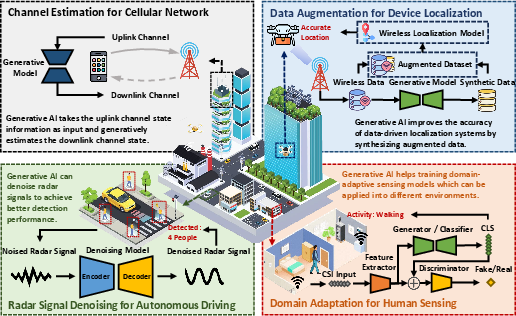
Figure 1: Typical application scenarios of Generative AI-enabled wireless sensing. Generative AI enhances the performance of various wireless tasks by leveraging generative methods for channel estimation and signal denoising, as well as serving as a data augmentation or domain adaptation module to improve the accuracy of device localization and human activity perception.
Integration Modes of Generative AI in Wireless Sensing
The paper explores two primary paradigms for integrating GenAI in wireless sensing: as a plugin module that augments existing models, and as a solver directly performing sensing tasks. The plugin approach leverages GenAI for data augmentation, domain adaptation, and signal denoising, enhancing traditional discriminative models (Figure 2). In contrast, the solver approach utilizes GenAI to tackle tasks such as channel estimation and activity recognition through generative synthesis (Figure 3). Each mode has shown substantial improvements in accuracy, robustness, and environmental adaptability, fostering more capable and scalable wireless sensing systems.
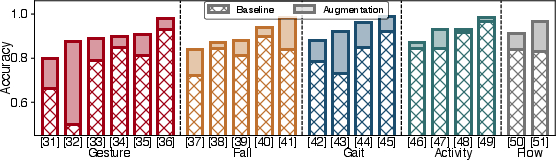
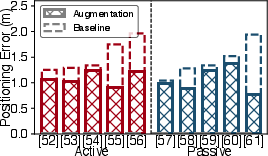
Figure 2: Performance gains of generative model as a plugin for data augmentation in wireless sensing pipelines.
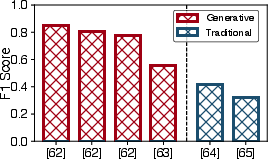
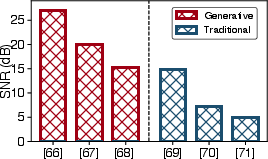
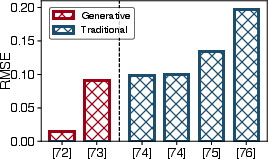
Figure 3: Performance improvement of generative methods as standalone task solvers compared to traditional methods.
Generative Techniques and Their Implications
The paper reviews mainstream generative models, including Generative Adversarial Networks (GANs), Variational Autoencoders (VAEs), and Diffusion Models, assessing their applicability and advantages across diverse sensing tasks (Figure 4). GANs are noted for their ability to generate high-fidelity signal distributions, although they face challenges such as mode collapse and stability issues. VAEs offer a probabilistic framework beneficial for data augmentation and anomaly detection but produce less sharp outputs compared to GANs. Diffusion Models bring robustness and stable training, ideal for reconstructing complex signal environments, but are computationally intensive and impractical for real-time applications.
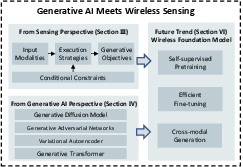
Figure 4: Structure of this survey. This paper reviews the applications of Generative AI in wireless sensing tasks from two distinct perspectives: the wireless sensing pipeline and generative AI techniques. Based on this analysis, this paper further outlines future trends towards wireless foundation models.
Key Issues and Challenges
Despite advancements, applying GenAI to wireless sensing is subject to significant challenges, including data scarcity, model generalization, and computational scalability. The data scarcity challenge is highlighted due to inherent limitations in acquiring rich and diverse labeled data necessary for training robust generative models. Model generalization remains a bottleneck due to the sensitivity of signal environments and propagation characteristics, necessitating domain-adaptive strategies. Additionally, the deployment of heavy generative models on edge devices poses efficiency challenges, calling for innovations in model compression and efficient fine-tuning techniques.
Future Trends: Wireless Foundation Model
The paper proposes the development of a wireless foundation model as a strategic direction to unify generative techniques and create adaptable, scalable, and efficient wireless sensing systems. This involves leveraging self-supervised learning for data-efficient representation learning, employing efficient fine-tuning strategies on edge devices, and exploiting cross-modal generative capabilities to integrate multimodal sensing data (Figure 5). As foundational models in NLP, CV, and speech demonstrate transformative impacts, their analogous adoption in wireless sensing is anticipated to unlock universal capabilities across diverse sensing tasks and environments, catalyzing next-generation intelligent wireless applications.

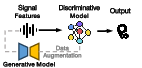

Figure 5: Comparison of wireless sensing pipelines. (a) The traditional pipeline employs task-specific discriminative models without generative assistance. (b) In plugin-based pipelines, GenAI modules are used to enhance data diversity and domain generalization. (c) In solver-based pipelines, GenAI models directly perform sensing tasks by generating outputs from input signals and conditional priors.
Conclusion
Generative AI's potential in wireless sensing presents opportunities for building more dynamic and effective sensing systems. By adopting generative frameworks, both as plugins and solvers, wireless sensing can overcome traditional limitations and adapt to complex practical applications. Future developments towards a wireless foundation model envision scalable, adaptable, and efficient systems capable of seamless operations in diverse environments, marking a significant forward step in the integration of AI with wireless technologies.