- The paper presents a two-scalar-field model that unifies inflation, dark matter, and dark energy while computing its stochastic gravitational-wave spectrum.
- It employs the continuous Bogoliubov coefficient formalism to track graviton production across cosmic epochs, ensuring smooth transitions between inflationary and post-inflationary phases.
- The analysis highlights robust parameter dependencies, offering clear predictions within the sensitivity range of forthcoming gravitational-wave observatories.
Gravitational Waves from Two Scalar Fields Unifying the Dark Sector with Inflation
Introduction and Theoretical Framework
This paper presents a comprehensive analysis of the stochastic gravitational-wave background generated in a cosmological model featuring two scalar fields, designed to unify primordial inflation, dark matter, and dark energy within a single theoretical framework. The model is constructed from an action inspired by extensions of general relativity and string-theoretic scenarios, incorporating a non-minimal interaction between the scalar fields ϕ and ξ, while both remain minimally coupled to gravity. The potential V(ξ) is chosen to be quadratic, V(ξ)=Va+21m2ξ2, facilitating a warm inflationary phase and subsequent transitions to radiation, matter, and dark energy domination.
The dynamical equations are derived for both the inflationary and post-inflationary epochs, with dissipation coefficients Γξ and Γϕ parameterized by temperature-dependent power laws and exponential suppression, enabling a smooth transition from inflation to radiation domination. The model parameters α and β are constrained via MCMC analysis against cosmological data, yielding α=0.36−0.26+0.18 and β=0.01−0.24+0.34, with the base scenario adopting their mean values.
The gravitational-wave spectrum is computed using the continuous Bogoliubov coefficient formalism, which tracks the evolution of graviton creation and annihilation operators in an expanding Universe. This approach avoids the need for sudden transitions between cosmological epochs and provides a unified framework for calculating the full spectrum of gravitational waves. The tensor perturbations to the FLRW metric are expanded in plane waves, and the mode functions χ satisfy a parametric oscillator equation. The Bogoliubov coefficients αk and βk evolve according to a coupled system of ODEs, with initial conditions corresponding to the Bunch–Davies vacuum.
The number of gravitons produced is given by ∣βk∣2, and the spectral energy density parameter is
ΩGW(ω0)=3πc5H028ℏGω04(∣βk∣2)0
where ω0 is the present-day angular frequency. The system is reformulated in terms of the variable u=−ln(a0/a) to match the cosmological evolution equations.
Gravitational-Wave Spectrum: Numerical Results
The gravitational-wave energy spectrum is obtained by numerically integrating the Bogoliubov equations across the full range of allowed frequencies, from ωmin∼10−17 rad/s (corresponding to the present Hubble radius) to ωmax∼109 rad/s (set by the Hubble scale at the end of inflation).
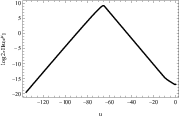
Figure 1: The minimum angular frequency of a gravitational wave corresponds to a wavelength equal, today, to the Hubble distance, ωmin=2πc/dHub(u0)eu0.
The numerical analysis reveals that the dominant production of gravitational waves occurs during the inflationary epoch, with subdominant features arising at the transitions between inflation and radiation, radiation and matter, and matter and dark energy. The evolution of ∣βk∣2 as a function of u demonstrates copious graviton production during inflation, with negligible generation during the radiation-dominated era.
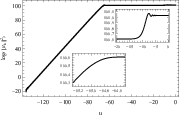
Figure 2: Evolution of ∣βk∣2 as a function of u for the base scenario and ω0=10−16 rad/s, highlighting graviton production during inflation and transitions.
The full gravitational-wave energy spectrum for the base scenario is superimposed on the sensitivity curves of planned next-generation detectors (LISA, BBO, CE, ET, SKA, IPTA, DECIGO). The spectrum exhibits a broad peak in the 10−2–$1$ Hz range, accessible to BBO and DECIGO, with marginal detectability at lower frequencies by SKA.
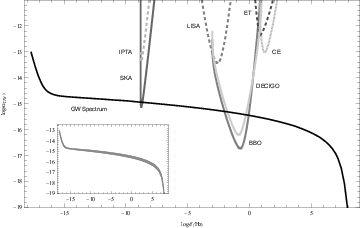
Figure 3: Full gravitational-wave energy spectrum for the base scenario, compared with sensitivity curves of future detectors.
Parameter Dependence and Model Robustness
The paper systematically explores the dependence of the gravitational-wave spectrum on the model parameters α, β, p, and q. The spectra remain qualitatively similar across the parameter space, with quantitative differences in ΩGW limited to less than an order of magnitude. The parameters β and p have the most significant impact, as they directly affect the inflationary dynamics and energy transfer rates, while α and q play a secondary role.
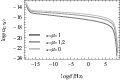
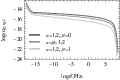
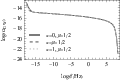
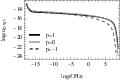
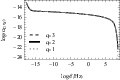

Figure 4: Full gravitational-wave energy spectra for different parameter choices, illustrating robustness and sensitivity to α, β, p, and q.
The envelope of all spectra corresponding to the considered parameter sets is shown, confirming the model's predictions are robust against reasonable variations in the underlying parameters.
Implications and Future Directions
The results demonstrate that multi-field cosmological models, such as the two-scalar-field scenario analyzed here, introduce additional dynamical degrees of freedom and new channels for gravitational-wave production, including parametric resonance, isocurvature-to-curvature conversion, and nonlinear emission from quasi-particles. The predicted gravitational-wave background provides a testable signature for future detectors, offering a means to discriminate between single-field and multi-field inflationary models and to constrain the physics of the dark sector.
The analysis is computationally intensive but tractable, and the predictions are stable under variations in cosmological parameters such as H0. The approach can be extended to include more general potentials, couplings, and reheating dynamics, as well as higher-order quantum corrections and non-Gaussian features in the gravitational-wave spectrum.
Conclusion
This work provides a detailed calculation of the stochastic gravitational-wave background in a two-scalar-field cosmological model unifying inflation, dark matter, and dark energy. The continuous Bogoliubov coefficient formalism enables a precise determination of the gravitational-wave spectrum across all cosmological epochs. The dominant contribution arises from inflation, with subdominant features at cosmic transitions. The predicted spectrum is robust against parameter variations and falls within the sensitivity range of future gravitational-wave observatories, particularly BBO and DECIGO. These results underscore the potential of gravitational-wave astronomy to probe multi-field cosmological models and the physics of the early Universe, motivating further theoretical and observational investigations.