- The paper demonstrates that increased SCD severity is linked to reduced cortical tracking of segmentation and phonotactic features, especially for prosodically flat speech.
- It employs robust EEG-based mTRF modeling across four distinctive expressive styles to quantify neural responses in 56 Cantonese-speaking older adults.
- The findings imply that prosodic enrichment may mitigate SCD-related deficits, positioning cortical speech tracking as a sensitive early biomarker for cognitive decline.
Expressive Style Modulates Cortical Speech Tracking in Subjective Cognitive Decline
Introduction
This study investigates the neural correlates of subjective cognitive decline (SCD) in older adults, focusing on how expressive prosodic style in speech modulates cortical tracking of linguistic features. SCD, characterized by self-perceived cognitive worsening despite normal neuropsychological performance, is a known risk factor for progression to mild cognitive impairment and dementia. The research leverages EEG-based multivariate temporal response function (mTRF) modeling to quantify cortical tracking strength (CTS) for different speech feature hierarchies—acoustic, segmentation, and phonotactic—across four expressive styles varying in prosodic richness. The central findings challenge the hypothesis that prosodically rich speech is most sensitive to SCD, instead revealing that prosodically flat speech yields the strongest negative association between SCD severity and cortical tracking of higher-level linguistic features.
Experimental Design and Methodology
The participant cohort comprised 56 Cantonese-speaking older adults (aged 60–70), all cognitively normal by MoCA-HK criteria. SCD was quantified using the 14-item Subjective Cognitive Decline Scale (SCDS). Auditory stimuli consisted of 16 one-minute speech segments, balanced across four expressive styles: scrambled (prosodically flat, semantically incoherent), descriptive (prosodically flat, semantically coherent), dialogue (prosodically rich, multi-speaker), and exciting (prosodically rich, high arousal). EEG was recorded with a 64-channel BioSemi system.
Feature extraction targeted three hierarchical levels:
- Acoustic: Speech envelope and onset, using gammatone filterbanks and power-law compression.
- Segmentation: Subsyllabic boundaries (initials and finals) via forced alignment and manual verification.
- Phonotactic: Surprisal values for initials, finals, and tones, computed from a large Cantonese corpus.
The mTRF framework modeled EEG as a linear convolution of stimulus features, with model fitting performed via boosting (Eelbrain toolkit), and CTS quantified as the Pearson correlation between predicted and observed EEG in a leave-one-out cross-validation scheme.
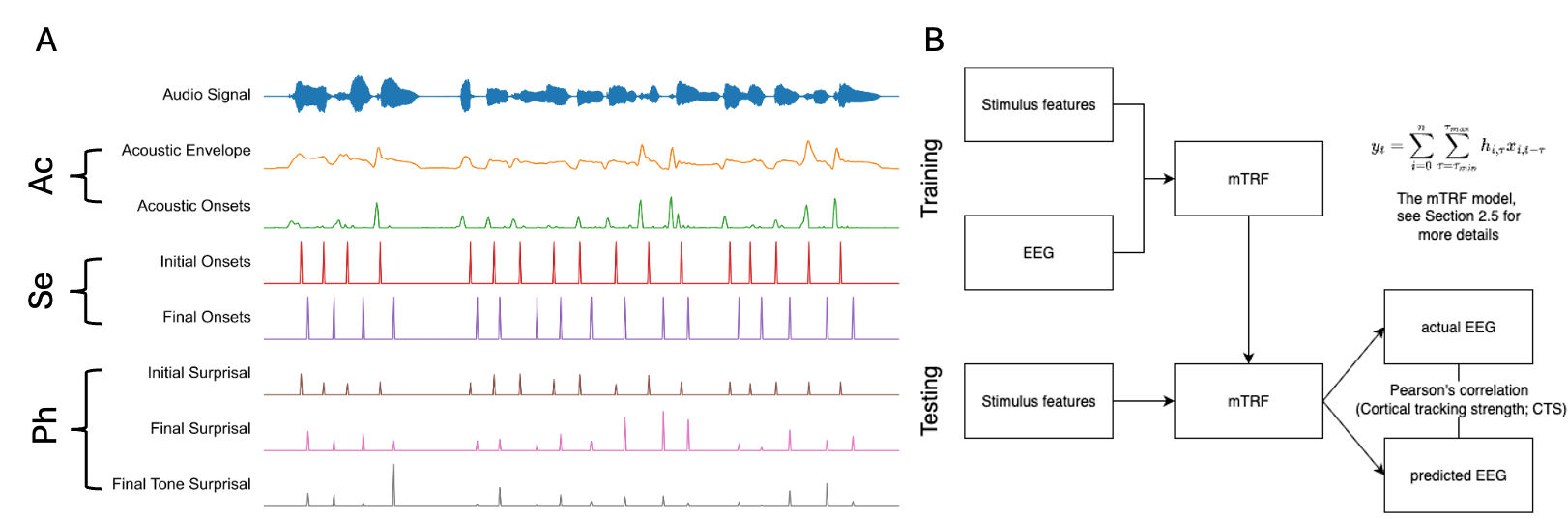
Figure 1: The mTRF framework, illustrating the three stimulus feature sets and the training/testing pipeline for deriving cortical tracking strength.
Statistical analysis employed linear mixed-effects modeling, with CTS as the dependent variable and fixed effects for SCDS, model type, expressive style, and their interactions, controlling for demographic and perceptual covariates.
Results
Hierarchical Feature Tracking
A significant main effect of model type was observed: CTS was highest for the phonotactic model, intermediate for segmentation, and lowest for acoustic features. This hierarchy indicates that, in older adults, EEG responses are better explained by higher-level linguistic information than by low-level acoustics.
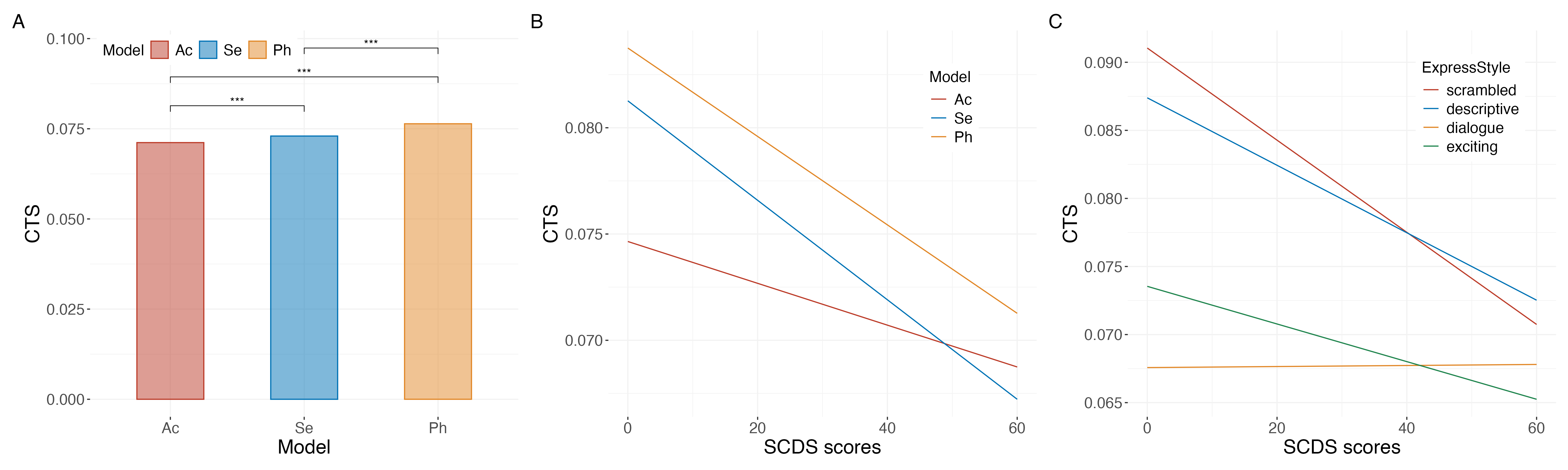
Figure 2: (A) CTS for each mTRF model; (B) SCDS × Model interaction; (C) SCDS × Expressive Style interaction, with estimated marginal means of CTS.
SCD Modulation of Cortical Tracking
The interaction between SCDS and model type revealed that higher SCDS scores (greater subjective concern) were associated with weaker CTS for segmentation and phonotactic models, but not for the acoustic model. The negative slopes for segmentation and phonotactic models were significantly steeper than for the acoustic model, indicating that SCD specifically impairs cortical tracking of higher-level linguistic features.
Expressive Style Effects
Contrary to the initial hypothesis, the SCDS × Expressive Style interaction showed that the negative association between SCD and CTS was strongest for prosodically flat speech (scrambled and descriptive styles). For scrambled speech, the negative slope was significant (p=.012), and for descriptive speech, marginally significant (p=.063). In contrast, dialogue and exciting styles (prosodically rich) showed no significant negative association. Pairwise comparisons confirmed that the negative effect of SCD on CTS was significantly greater for scrambled and descriptive styles than for dialogue and exciting styles.
Discussion
The results demonstrate that in older adults with higher subjective cognitive concerns, cortical tracking of higher-level linguistic features is selectively impaired, but only when listening to prosodically flat speech. This finding contradicts the compensatory enhancement hypothesis, which posits that SCD would be associated with increased CTS as a compensatory mechanism, especially for prosodically rich speech. Instead, the data suggest that prosodic richness in speech may mitigate the impact of SCD on cortical tracking, possibly by providing additional cues that facilitate top-down processing or by engaging alternative neural resources.
The superior performance of the phonotactic model over segmentation and acoustic models aligns with prior evidence that older adults rely more on higher-level linguistic cues for speech comprehension. The lack of SCD effect on acoustic tracking further supports the specificity of SCD-related deficits to linguistic, rather than sensory, processing.
The unexpected finding that prosodically flat speech is more sensitive to SCD effects has practical implications for early detection: cortical tracking of subsyllabic linguistic features in prosodically flat speech may serve as a sensitive biomarker for preclinical cognitive decline. This is particularly relevant given the limitations of behavioral neuropsychological tests in detecting early-stage impairment.
Implications and Future Directions
The study provides evidence that neural speech tracking, especially at the subsyllabic and phonotactic levels, is a promising candidate for objective, non-invasive biomarkers of early cognitive decline. The interaction with expressive style suggests that future diagnostic protocols should consider stimulus prosody when designing EEG-based screening tools for SCD and related conditions.
Further research should address the confound introduced by multi-speaker stimuli in dialogue and exciting styles, and extend the feature set to include explicit prosodic representations (e.g., pitch, rhythm, intonation contours). Longitudinal studies are needed to establish the predictive validity of CTS measures for conversion from SCD to MCI or dementia. Additionally, integrating mTRF-based cortical tracking with other neuroimaging modalities and computational models of language processing could elucidate the mechanistic basis of compensatory and maladaptive changes in aging.
Conclusion
This work demonstrates that expressive style modulates the relationship between subjective cognitive decline and cortical speech tracking. Specifically, SCD is associated with reduced cortical tracking of higher-level linguistic features, but only for prosodically flat speech. These findings highlight the importance of considering both linguistic hierarchy and prosodic context in the neural assessment of cognitive aging, and suggest that EEG-based cortical tracking of speech may provide a sensitive, early biomarker for cognitive decline in at-risk populations.