- The paper demonstrates that the polarization observable (angle β₂) reliably traces black hole spin under calibrated conditions.
- It employs GRMHD simulations alongside a semi-analytic inflow model to relate magnetic field geometry and plasma dynamics to spin.
- The study emphasizes that accurate calibration of magnetization and field rotation parameters is key for precise black hole spin inference.
Black Hole Polarimetry II: The Connection Between Spin and Polarization
Introduction
This work investigates the relationship between black hole spin and the polarization structure of synchrotron emission observed near event horizons, with a focus on spatially resolved images from the Event Horizon Telescope (EHT). The study leverages both general relativistic magnetohydrodynamic (GRMHD) simulations and a newly developed semi-analytic inflow model to elucidate how the complex polarization observable ∠β2 encodes information about black hole spin, magnetic field geometry, and plasma dynamics. The inflow model, which interpolates between force-free and inertial regimes via a tunable magnetization parameter, provides a computationally efficient and physically interpretable surrogate for full GRMHD simulations. The results demonstrate that polarimetric imaging, specifically the measurement of ∠β2, can serve as a robust diagnostic of black hole spin under controlled assumptions about Faraday rotation and emission geometry.
The EHT has produced high-resolution polarimetric images of M87∗ and Sgr A∗, revealing coherent, spiral-like patterns in the electric vector position angle (EVPA) on event-horizon scales. These patterns are quantified using the complex β2 coefficient, which captures the amplitude and orientation of the dominant m=2 azimuthal mode in the polarization field. The phase ∠β2 is particularly sensitive to the ratio of azimuthal to radial magnetic field components and has been shown to correlate with the dimensionless spin parameter a∗. The image-integrated value of ∠β2 provides a flux-weighted measure of the net rotational symmetry in the polarization field, while its radial decomposition offers insight into the spatial variation of magnetospheric structure.
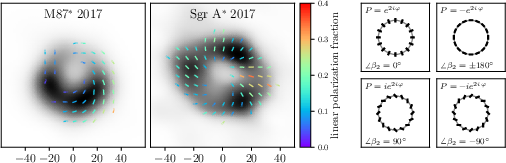
Figure 1: Polarimetric structure of M87∗ and Sgr A∗ as observed by the EHT, showing coherent spiral polarization patterns indicative of strong m=2 modes.
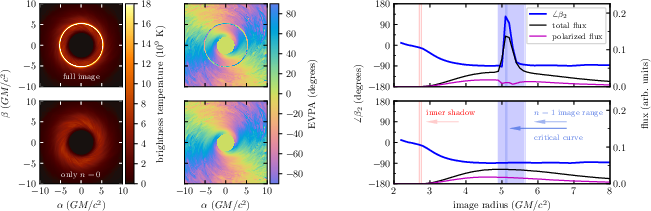
Figure 2: Simulated black hole images and radial decomposition of the β2 polarization mode, illustrating the spatial variation of ∠β2 and its connection to magnetic field geometry.
Magnetospheric Modeling: Force-Free, GRMHD, and Inflow Approaches
The study considers three classes of models for the near-horizon magnetosphere:
- Force-Free Split Monopole (Blandford-Znajek) Solution: Provides an analytic baseline for highly magnetized, inertia-free magnetospheres, with field structure anchored on the horizon and collimated along the spin axis. The solution is constrained by the Znajek condition at the horizon and reduces to a flat-space monopole at large radii.
- GRMHD Simulations: Numerically evolve the coupled dynamics of plasma and electromagnetic fields in the Kerr spacetime, capturing turbulence, finite inertia, and time-dependent effects. The focus is on the magnetically arrested disk (MAD) state, which is consistent with EHT observations and efficient at powering Blandford-Znajek jets.
- Semi-Analytic Inflow Model: Developed in this work, the inflow model solves the stationary, axisymmetric GRMHD equations in the equatorial plane, with a free magnetization parameter ϕ~ controlling the transition between force-free and inertia-dominated regimes. The model is specified by black hole spin, magnetic flux, field line rotation rate, and outer boundary location, and is closed by regularity at the fast magnetosonic point.
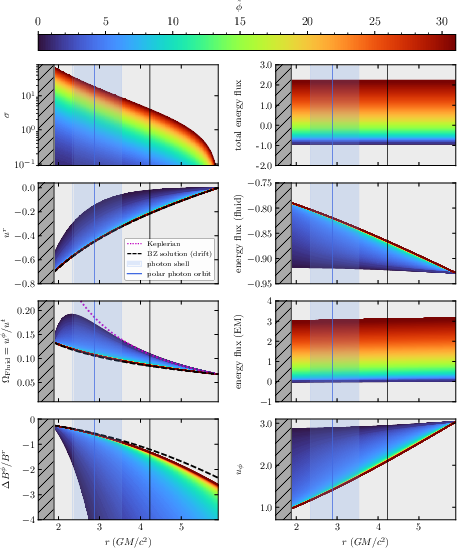
Figure 3: Midplane inflow solutions for a∗=0.5 and varying magnetization, showing the transition from inertia-dominated to force-free behavior as ϕ~ increases.
Comparison of Inflow Model and GRMHD Simulations
The inflow model is benchmarked against time- and azimuthally averaged GRMHD simulations of MAD accretion flows. The comparison focuses on the radial profiles of fluid velocity, angular velocity, and magnetic field winding in the emission region, as determined by attenuated emissivity maps.
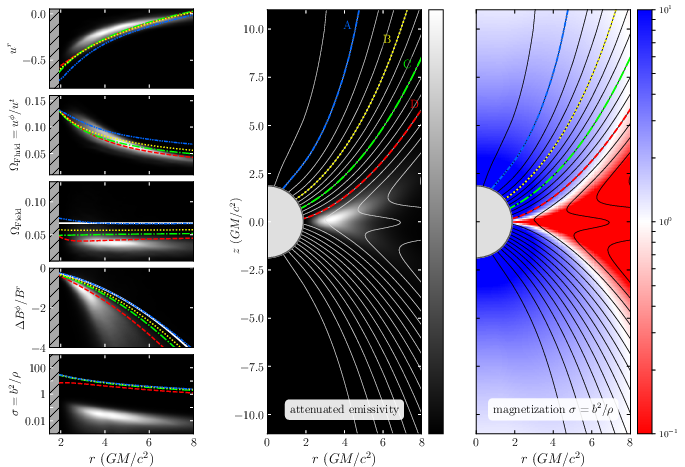
Figure 4: Location and properties of the emission region in a GRMHD simulation, with overlays of field line rotation and magnetization.
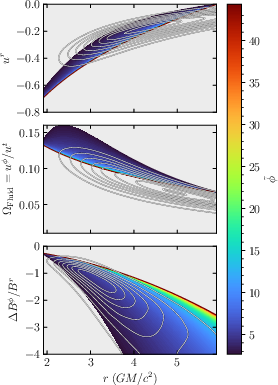
Figure 5: Comparison between inflow model and GRMHD simulation for a∗=0.5, showing qualitative agreement in velocity and field winding profiles.
The inflow model reproduces the qualitative structure of the GRMHD simulations for moderate values of ϕ~ (∼5−7), particularly in the emission-weighted regions. Discrepancies in the radial velocity profile are attributed to the cold-plasma assumption in the inflow model, which neglects thermal pressure support present in GRMHD.
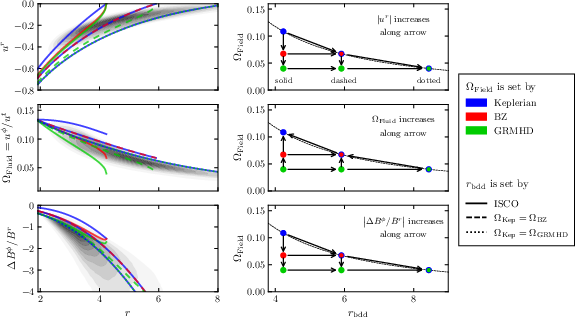
Figure 6: Effect of varying outer boundary conditions in the inflow model, illustrating trade-offs between matching velocity and field winding to GRMHD results.
Polarimetric Signatures and Spin Diagnostics
The inflow model is used to compute the radial and image-integrated profiles of ∠β2 for a range of spins and magnetizations. The model demonstrates that higher black hole spin leads to more tightly wound magnetic fields and a more radial polarization pattern, with ∠β2 serving as a geometric tracer of spin.
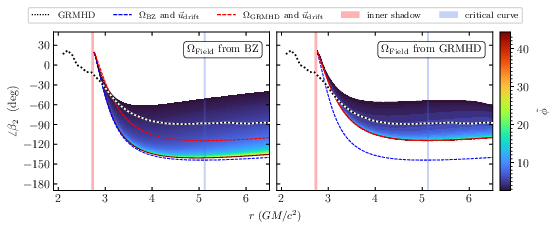
Figure 7: Radial profiles of ∠β2 from inflow models and GRMHD simulations for a∗=0.5, showing convergence to spin-dependent asymptotic values.
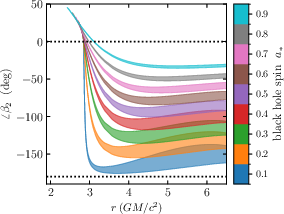
Figure 8: Radial profiles of ∠β2 for varying spin and moderate magnetization, illustrating the monotonic dependence on a∗.
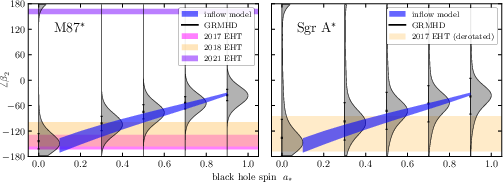
Figure 9: Image-averaged ∠β2 as a function of spin for M87∗ and Sgr A∗, comparing inflow model, GRMHD simulations, and EHT observations.
The inflow model quantitatively tracks the GRMHD results across spin, provided that ϕ~ and ΩField are calibrated to simulation values. The observed ranges of ∠β2 in EHT data for M87∗ and Sgr A∗ are consistent with low-to-intermediate spin configurations, though robust inference requires correction for Faraday rotation and improved constraints on plasma parameters.
Theoretical and Practical Implications
The results establish the inflow model as a computationally efficient and physically transparent surrogate for GRMHD in the context of polarimetric imaging. The model clarifies the physical origin of the spin dependence in ∠β2 as arising from the interplay between frame dragging, field line rotation, and plasma inertia. The ability to interpolate between force-free and inertial regimes enables systematic exploration of parameter space and identification of the dominant sources of uncertainty in spin inference from polarimetric data.
The primary systematic uncertainties are the field line rotation rate and magnetization in the emission region, as well as the effects of Faraday rotation and time variability. The model is most applicable to MAD accretion flows; extension to SANE or more turbulent regimes may require additional modeling of Faraday effects and emission geometry.
Limitations and Future Directions
The inflow model is restricted to stationary, axisymmetric, equatorial solutions and neglects turbulence, off-midplane emission, and jet/outflow components. Incorporating thermal pressure, retrograde or tilted accretion, and coupling to outflow models are natural extensions. Improved multi-frequency polarimetric observations, higher dynamic range VLBI, and time-averaged imaging will be essential for disentangling intrinsic spin signatures from propagation effects and variability.
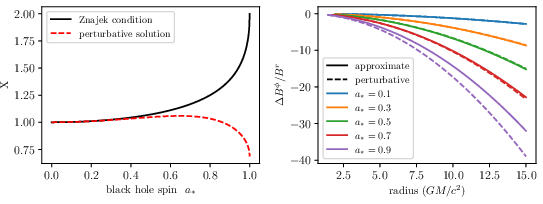
Figure 10: Comparison between approximate and perturbative Blandford-Znajek split monopole solutions, validating the analytic approach used in the inflow model.
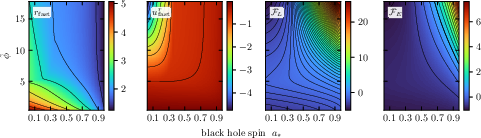
Figure 11: Eigenvalues of inflow model solutions as a function of spin and magnetization, illustrating the parameter space accessible to the model.
Conclusion
This study demonstrates that the complex polarization observable ∠β2 in horizon-scale black hole images is a robust geometric tracer of black hole spin, provided that plasma magnetization and field line rotation are appropriately constrained. The semi-analytic inflow model introduced here offers a practical and interpretable framework for connecting polarimetric observables to underlying magnetospheric structure, bridging the gap between analytic force-free models and computationally intensive GRMHD simulations. The approach enables efficient exploration of parameter space and provides a foundation for future efforts to constrain black hole spin and plasma properties from high-resolution polarimetric imaging.