Papers
Topics
Authors
Recent
Search
2000 character limit reached

NeuroBridge: Using Generative AI to Bridge Cross-neurotype Communication Differences through Neurotypical Perspective-taking

Published 27 Sep 2025 in cs.HC and cs.AI | (2509.23434v1)

Abstract: Communication challenges between autistic and neurotypical individuals stem from a mutual lack of understanding of each other's distinct, and often contrasting, communication styles. Yet, autistic individuals are expected to adapt to neurotypical norms, making interactions inauthentic and mentally exhausting for them. To help redress this imbalance, we build NeuroBridge, an online platform that utilizes LLMs to simulate: (a) an AI character that is direct and literal, a style common among many autistic individuals, and (b) four cross-neurotype communication scenarios in a feedback-driven conversation between this character and a neurotypical user. Through NeuroBridge, neurotypical individuals gain a firsthand look at autistic communication, and reflect on their role in shaping cross-neurotype interactions. In a user study with 12 neurotypical participants, we find that NeuroBridge improved their understanding of how autistic people may interpret language differently, with all describing autism as a social difference that "needs understanding by others" after completing the simulation. Participants valued its personalized, interactive format and described AI-generated feedback as "constructive", "logical" and "non-judgmental". Most perceived the portrayal of autism in the simulation as accurate, suggesting that users may readily accept AI-generated (mis)representations of disabilities. To conclude, we discuss design implications for disability representation in AI, the need for making NeuroBridge more personalized, and LLMs' limitations in modeling complex social scenarios.
Summary

  • The paper introduces NeuroBridge, an AI platform that leverages LLMs to simulate autistic communication and facilitate understanding among neurotypes.
  • The methodology integrates iterative design with autistic advisory input, pilot studies, and user testing to ensure authentic and insightful simulations.
  • The evaluation demonstrates that neurotypical participants improved empathy and understanding of autistic communication through interactive, feedback-driven dialogues.

NeuroBridge: Using Generative AI to Bridge Cross-Neurotype Communication Differences

Introduction

The paper "NeuroBridge: Using Generative AI to Bridge Cross-neurotype Communication Differences through Neurotypical Perspective-taking" explores an innovative platform designed to mediate between autistic and neurotypical communication. Utilizing LLMs, NeuroBridge simulates direct and literal communication styles common among autistic individuals. The interactive platform provides neurotypical users insight into autistic communication through feedback-driven scenarios designed to elucidate potential communication breakdowns.

NeuroBridge Architecture

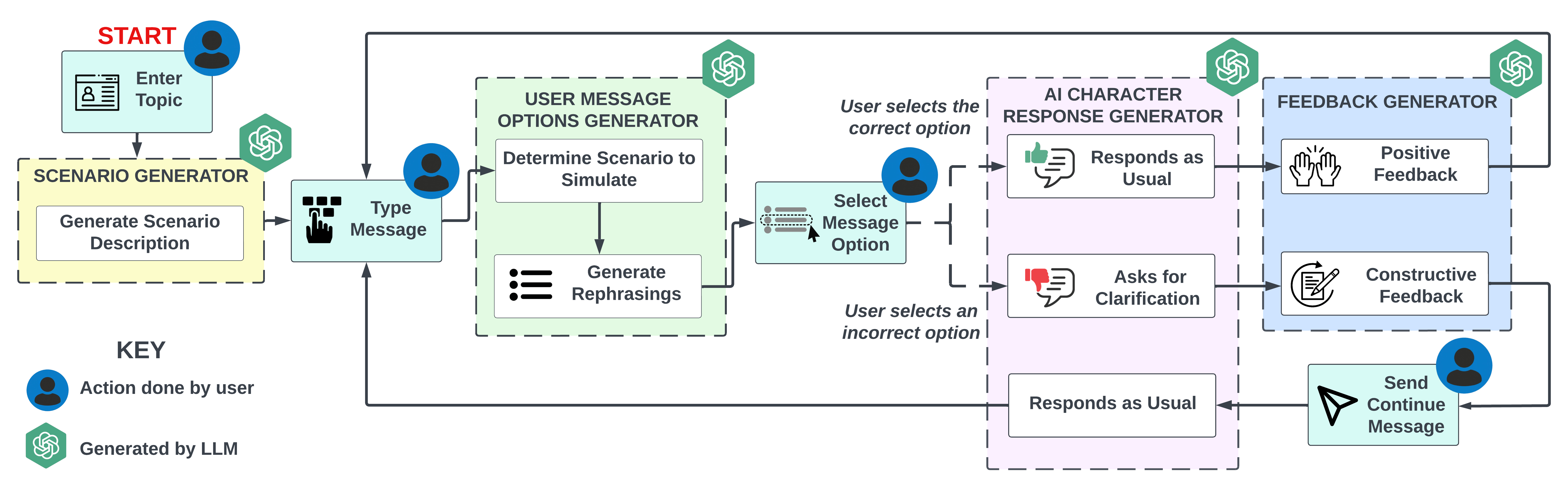
NeuroBridge relies on several interconnected components, each powered by LLMs, to simulate a coherent conversational experience. These components include the Scenario Generator, Message Options Generator, Response Generator, and Feedback Generator.

  • Scenario Generator: Customizes conversation scenarios based on personal details input by the user, aiming to keep interactions relatable and engaging.
  • Message Options Generator: Produces variations of the user’s message, differing in tone and clarity, to highlight potential misunderstandings in communication styles.
  • Response Generator: Crafts responses from the AI character based on the message option chosen, mimicking different interpretations that may arise in autistic-neurotypical interactions.
  • Feedback Generator: Provides structured feedback explaining why a chosen message could lead to misunderstanding, encouraging users to refine their communication. Figure 1

    Figure 1: NeuroBridge architecture and interaction flow. Users begin by entering a topic and then engage in a loop of sending messages, receiving responses, and getting feedback.

Methodology and Implementation

NeuroBridge was co-designed with input from an advisory board of autistic individuals ensuring the simulation authentically represents autistic communication traits. The development process was iterative, integrating feedback from pilot studies, advisory board insights, and user testing.

The platform's backend leverages GPT-4o and Claude 3.5 Sonnet models to perform language generation tasks. It is deployed across various cloud-based services, ensuring scalability and responsiveness necessary for dynamic user interaction. Figure 2

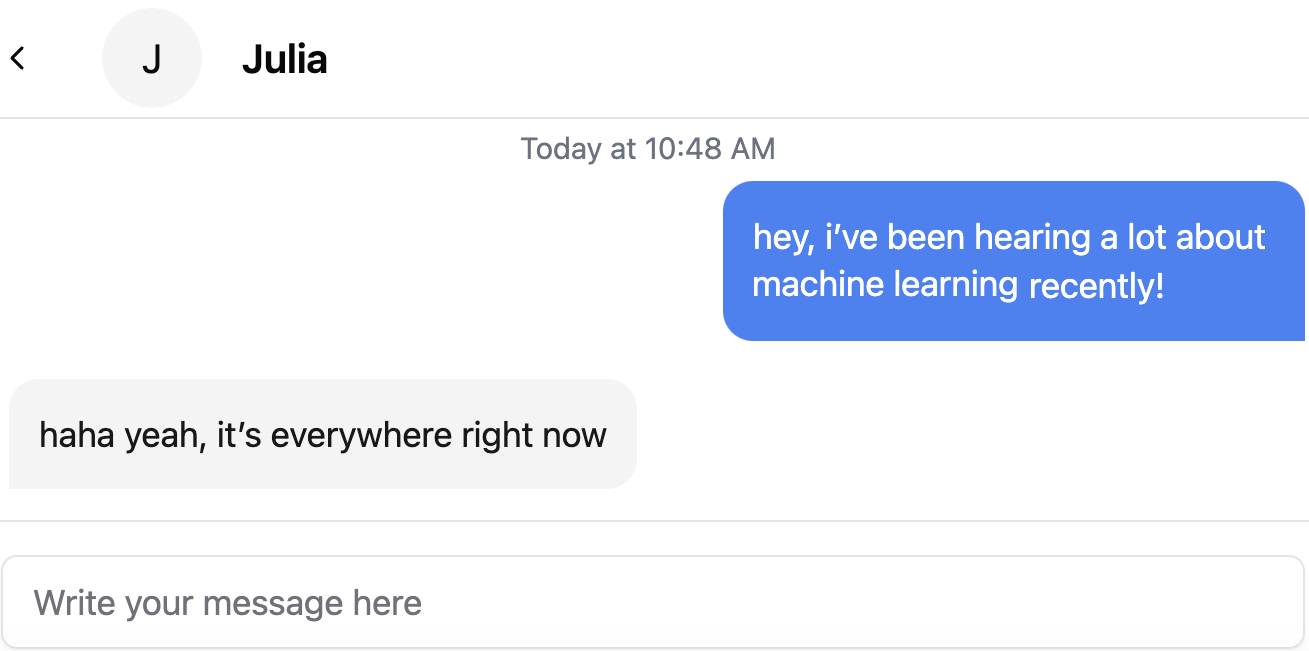
Figure 2: The main interface of NeuroBridge is designed to replicate regular messaging apps, making it familiar to users.

Evaluation

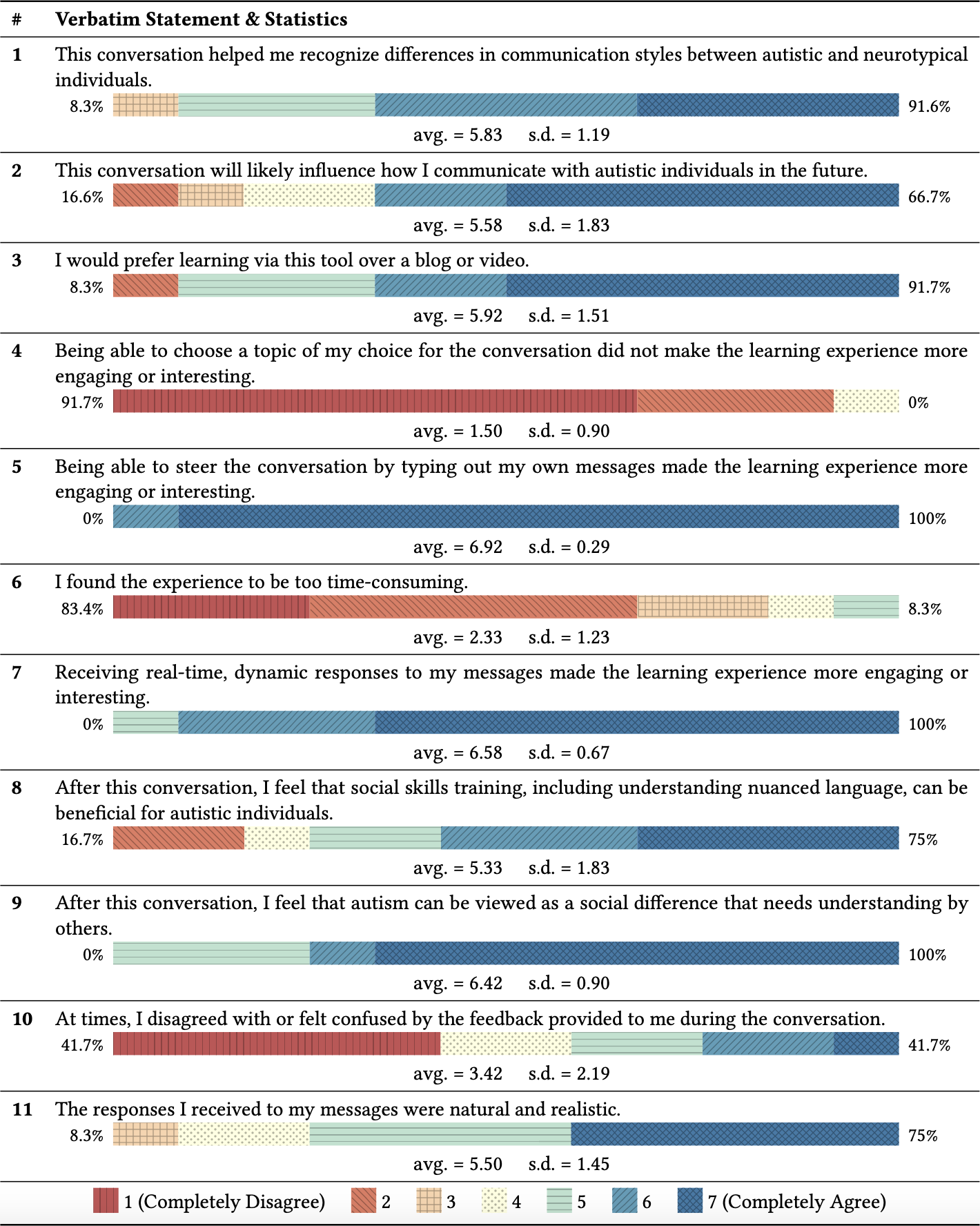
A user study with 12 neurotypical participants evaluated the platform’s effectiveness. Participants showed improved understanding of autistic communication styles, viewing autism as a social difference requiring understanding. Feedback was generally received as constructive and insightful, though occasionally seen as instructional. Figure 3

Figure 3: Survey results with verbatim statements and statistics. The percentage on the left represents the number of participants who selected values between 1 and 3, while the percentage on the right represents the number of participants who selected values between 5 and 7. Responses of 4 (middle) are excluded from both percentages.

Discussion

The findings highlight the potential of LLMs to simulate communication nuances across neurotypes, offering immersive learning experiences. However, challenges include the risk of oversimplified or misrepresented autistic communication in simulations. Ensuring diversity in scenarios can mitigate reinforcing stereotypes.

Conclusion

NeuroBridge offers a novel approach to promoting empathy and understanding between neurotypes using interactive, AI-driven simulations. While promising, the challenges identified suggest areas for future refinement, emphasizing the need for broader representation and contextual awareness in AI-generated content. The study underlines the importance of involving autistic voices in the development process, ensuring technological interventions foster genuine mutual understanding.

Paper to Video (Beta)

No one has generated a video about this paper yet.

Whiteboard

No one has generated a whiteboard explanation for this paper yet.

Open Problems

We haven't generated a list of open problems mentioned in this paper yet.

Collections

Sign up for free to add this paper to one or more collections.