- The paper demonstrates a CMOS-compatible NbN-Si/SiGe hybrid platform that achieves long coherence times critical for quantum circuit performance.
- It employs precise fabrication techniques and high-resolution microscopy to reveal TLS-induced resonance shifts and mitigate dielectric losses.
- Experimental cryogenic spectroscopy confirms stable performance with quality factors around 1100 over multiple cooldown cycles.
Robust NbN on Si-SiGe Hybrid Superconducting-Semiconducting Microwave Quantum Circuit
Abstract and Introduction
The paper discusses the integration of niobium nitride (NbN) coplanar waveguide resonators with Si/SiGe quantum wells to construct a hybrid platform that is CMOS-compatible, targeting advanced quantum computing applications. The study emphasizes the significance of long coherence times achievable with these materials, crucial for resilient and scalable quantum information processing systems.
Fabrication and Structural Analysis
The fabrication involves a detailed process of constructing CPW resonators on a 100 nm NbN film sputtered onto a Si/SiGe wafer. The process innovates by etching through the heterostructure stack, thus reducing interactions that contribute to charge noise in semiconductor quantum wells. The structural integrity and epitaxial growth quality are confirmed via high-resolution characterization techniques such as Scanning Transmission Electron Microscopy (STEM) and Atomic Force Microscopy (AFM).
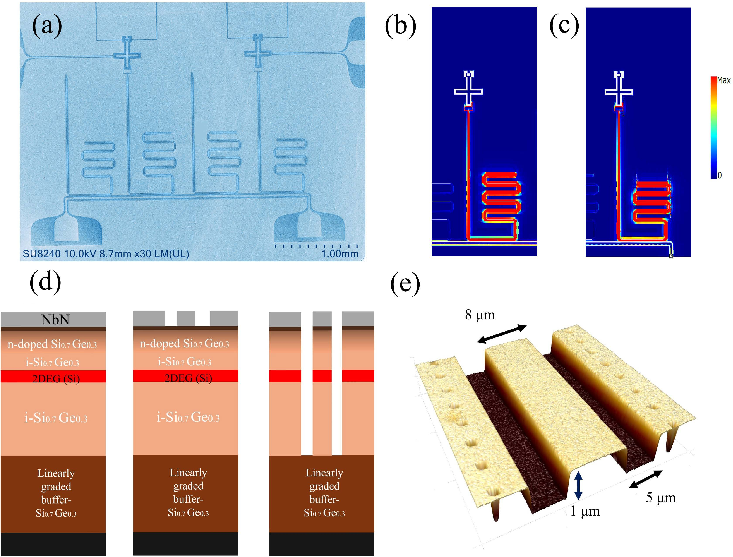
Figure 1: False color SEM image of fabricated SiGe chip and surface current density magnitude for resonant modes.
Experimental Measurements and Spectroscopy
The study employs cryogenic microwave spectroscopy to assess the performance of the NbN CPW resonators. Internal quality factors (Qi) of approximately 1100 are maintained across different cooldowns over two years, highlighting exceptional operational stability and robustness. Spectroscopic data reveal shifts in resonance frequencies due to two-level system (TLS) defect saturation, with measurements conducted across extensive temperature and power ranges.
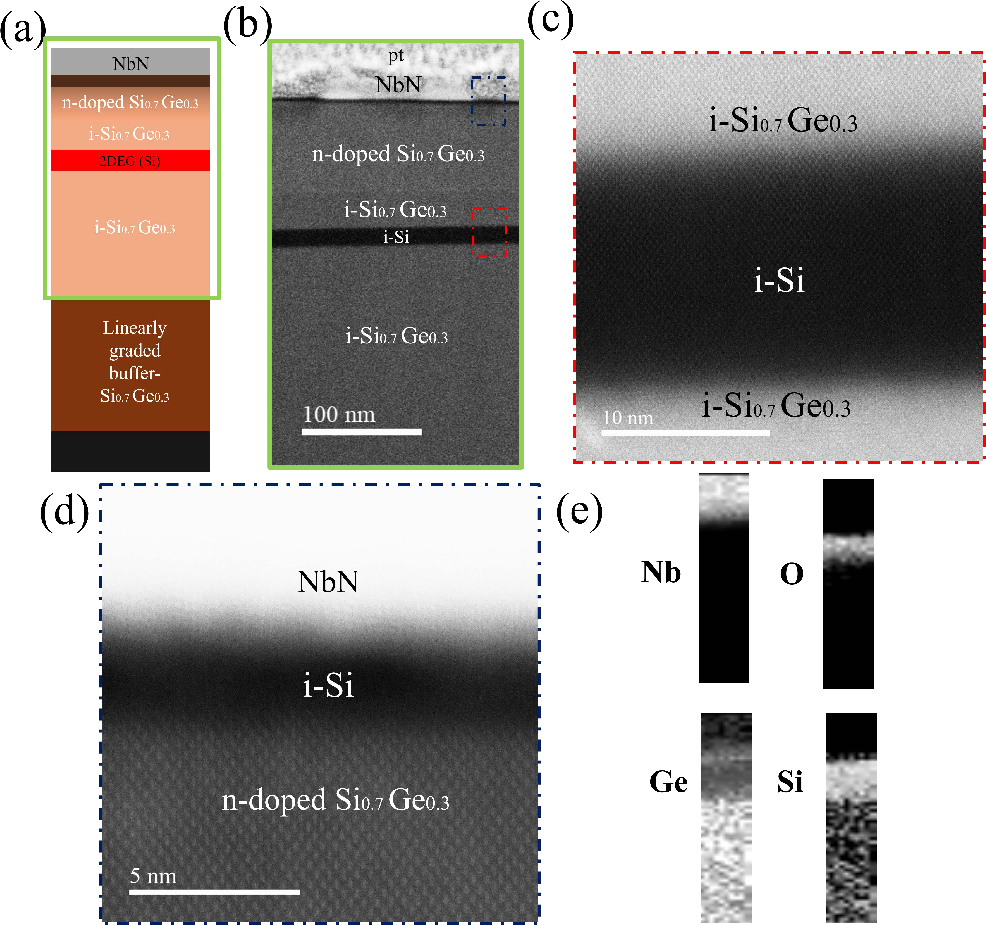
Figure 2: Schematic of the SiGe wafer with sputtered NbN top layer and cross-sectional STEM images.
Power and Temperature-Dependent Analysis
Detailed power-dependent microwave spectroscopy indicates that increased input power leads to TLS saturation effects, manifesting as shifts in resonance frequency. Additionally, temperature-dependent studies identify quasiparticle losses beyond 900 mK causing frequency shifts, emphasizing the critical role of TLS and scattering mechanisms in loss mechanisms.
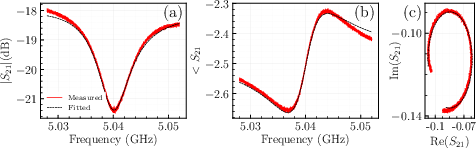
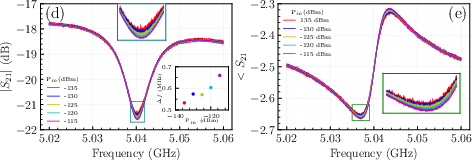
Figure 3: Measured and fitted notch-type circuit model data for resonance frequency and quality factors.
RLC Circuit Model and Loss Mechanisms
The paper constructs an RLC circuit model to evaluate dielectric constants and extract resistance properties, incorporating kinetic and geometrical inductances. The analysis elucidates multiple loss mechanisms, including quasiparticle and scattering losses, which originate from structural imperfections such as grain boundaries and induced dislocations.
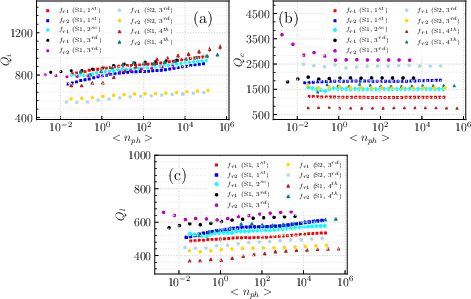
Figure 4: Measured quality factors (Qi, Qc, Ql) at various cooldowns and photon number relations.
Discussion
The discussion centers on parallels with recent advancements in superconducting circuits fabricated on alternative substrates, like Ge/SiGe wafers, acknowledging the need for meticulous wafer growth strategies to combat intrinsic losses. The authors advocate for optimizing fabrication methods to enhance coherence times and elevate CMOS-compatibility in superconducting-semiconducting circuits, leveraging Si/SiGe stacks' inherent properties to suppress dielectric losses.
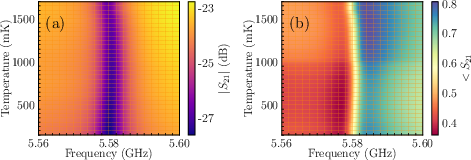
Figure 5: Measured frequency spectrum and phase variations across temperature ranges.
Conclusion
This work demonstrates a pathway towards unifying superconducting and semiconductor qubits through the development of high-performance, CMOS-compatible microwave quantum circuits. By addressing critical loss mechanisms and leveraging the inherent stability of NbN-Si/SiGe architectures, the research paves the way for integration in scalable quantum computing systems, potentially extending to topological qubits.
In essence, the findings underscore the importance of strategic material and structural innovations in advancing superconducting microwave quantum circuits, emphasizing future device miniaturization, improved coherence, and robust architecture deployment in quantum information processing frameworks.