- The paper demonstrates that advanced multi-epoch spectroscopy refines UMaIII/U1's velocity dispersion to <1.4 km/s, eliminating previous dark matter claims.
- The study uses Ca II K measurements to reveal a narrow [Fe/H] range with a 95% upper limit of 0.35 dex, indicating strong chemical homogeneity.
- The paper reclassifies UMaIII/U1 from a dark-matter-dominated dwarf to a likely star cluster, challenging established galaxy formation boundaries.
Introduction and Context
Ursa Major III / UNIONS 1 (UMaIII/U1) is the faintest known ancient stellar system in the Milky Way, with LV=11L⊙ and a compact half-light radius a1/2=3 pc. Initial spectroscopic data suggested a substantial velocity dispersion (σv=3.7−1.0+1.4 km s−1), implying a mass-to-light ratio M/LV∼6500M⊙/L⊙ and a possible dark-matter-dominated dwarf galaxy classification. However, the small sample size, potential binary contamination, and lack of metallicity data left the nature of UMaIII/U1 ambiguous. This paper presents new, deeper spectroscopic observations, expanding the member sample and providing both dynamical and chemical constraints to reassess the system's classification.
Kinematic Analysis and Binary Contamination
The authors obtained a second epoch of Keck/DEIMOS spectroscopy, increasing the member sample to 16 stars and improving velocity precision. The velocity distribution shows a clear regression to the mean for most members, with the previously suspected binary (S24_M2) confirmed via multi-epoch monitoring (MagE, GMOS, HIRES). Three additional candidate binaries were identified based on significant velocity variations between epochs.
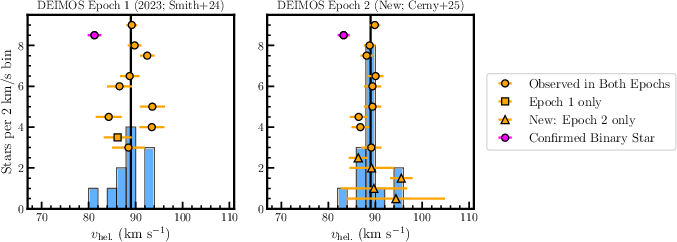
Figure 1: Velocity distributions for UMaIII/U1 members in 2023 and 2025, highlighting the regression to the mean and the confirmed binary outlier.
Excluding confirmed and candidate binaries, the velocity dispersion was re-evaluated using both frequentist profile likelihood and Bayesian nested sampling approaches. The likelihood is maximized for dispersions ≲0.1 km s−1, with a 121:1 likelihood ratio favoring the stellar-only scenario over the original high-dispersion measurement. The 95% confidence upper limit is σv<2.3 km s−1 (frequentist), with Bayesian limits as low as σv<1.4 km s−1 depending on priors and sample selection.
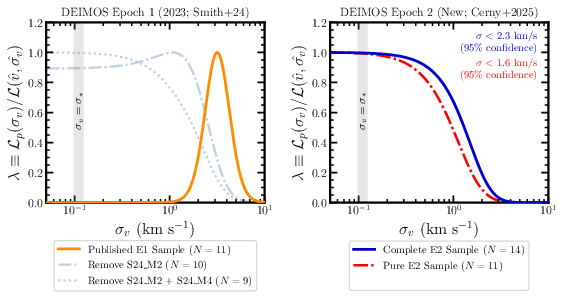
Figure 2: Profile likelihoods for velocity dispersion, showing the original resolved dispersion is strongly disfavored by new data.
Bayes factor comparisons indicate a positive preference for the null hypothesis of no intrinsic velocity spread. The dynamical mass within the half-light radius is constrained to M1/2≲10670M⊙, and M/LV≲1940M⊙/L⊙ (or tighter for more restrictive subsamples). These results remove the previous observational evidence for substantial dark matter in UMaIII/U1.
Low-resolution Keck/LRIS spectra of 12 member stars were used to measure [Fe/H] via the Ca II K line. The mean metallicity is [Fe/H] =−2.65±0.1 (stat.) ±0.3 (zeropoint), with individual star metallicities spanning a narrow range. Bayesian analysis yields a 95% credible upper limit on the intrinsic metallicity dispersion of σ[Fe/H]<0.35 dex, with Bayes factors again favoring the no-spread model.
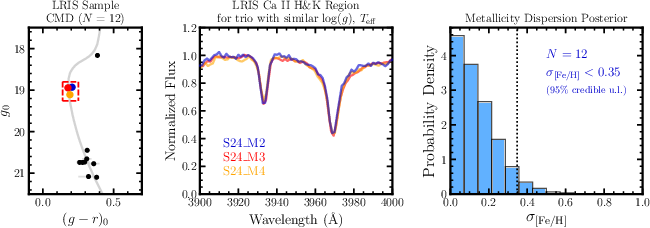
Figure 3: CMD, representative Ca II K spectra, and posterior for metallicity dispersion, demonstrating chemical homogeneity.
This lack of a significant metallicity spread is more consistent with globular clusters (σ[Fe/H]≲0.1 dex) than with ultra-faint dwarf galaxies, which typically exhibit σ[Fe/H]=0.3–$0.7$ dex due to extended star formation and self-enrichment.
Comparative Analysis and Reclassification
The velocity and metallicity dispersion limits for UMaIII/U1 are among the tightest for any faint, compact Milky Way satellite. In comparison to a curated sample of systems with MV>−3.5 and r1/2<25 pc, only Tucana III has stronger limits, but its classification is itself ambiguous due to tidal disruption and chemical peculiarities.
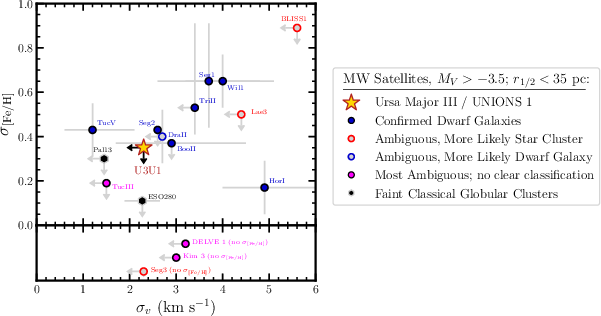
Figure 4: UMaIII/U1's dispersion limits compared to other faint satellites, supporting its star cluster classification.
The absence of positive evidence for dark matter or a large metallicity spread leads to a reclassification of UMaIII/U1 as a likely star cluster. Its stability may require a substantial population of stellar remnants (white dwarfs, neutron stars, black holes), and it is among the most metal-poor clusters known.
Membership Diagnostics and Spectroscopic Sample
The dual-epoch DEIMOS sample shows a coherent velocity peak, consistent proper motions, and a tight CMD locus, confirming membership and the bound nature of the system.
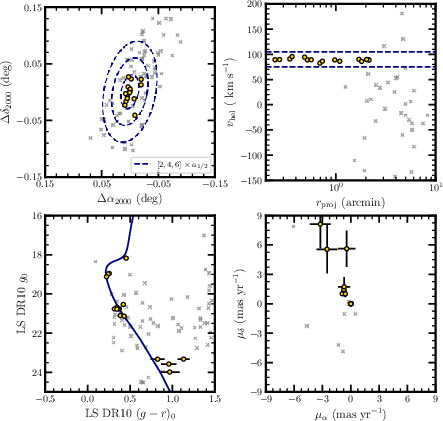
Figure 5: Spatial, kinematic, photometric, and proper motion diagnostics for the spectroscopic sample.
The LRIS spectra for all 12 stars further support the absence of significant iron abundance dispersions, though a few stars (S24_M6, S24_M11, S24_M13) warrant future investigation for possible chemical anomalies or binary blending.
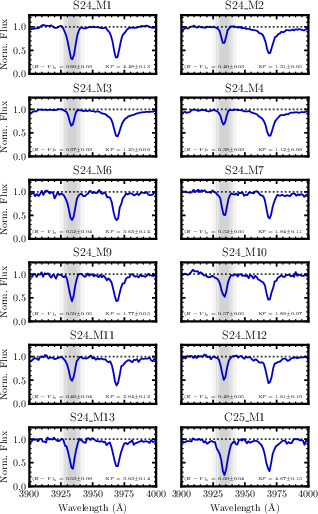
Figure 6: LRIS spectra for all program stars, showing uniform Ca II K absorption and no strong evidence for iron abundance dispersions.
Implications and Future Directions
The results have several implications:
- Dark Matter Constraints: UMaIII/U1 is no longer a compelling target for indirect dark matter detection; the J-factor limit is an order of magnitude lower than previous estimates.
- Galaxy Formation: The findings challenge the lower mass limit for galaxy formation and the distinction between star clusters and dwarf galaxies at the faint end.
- Spectroscopic Classification: Low-resolution Ca II K spectroscopy is demonstrated as an effective tool for classifying ultra-faint systems.
- Observational Strategy: The study highlights the necessity of deep, multi-epoch spectroscopy and binary monitoring for robust dynamical measurements in low-mass systems.
Future work should focus on high-resolution abundance measurements (e.g., neutron-capture elements), further binary characterization, and searches for chemical inhomogeneities beyond iron. The classification of similar systems discovered in wide-field surveys will require substantial spectroscopic investment, especially for more distant satellites.
Conclusion
The expanded spectroscopic dataset for UMaIII/U1 removes the previous observational evidence for dark matter and a large metallicity spread, favoring a star cluster classification. The system is chemically homogeneous and dynamically cold, with properties more consistent with globular clusters than ultra-faint dwarf galaxies. While the possibility of a galaxy classification cannot be excluded at the current limits, the absence of positive evidence for dark matter or self-enrichment sets a new standard for the classification of extreme Milky Way satellites. The study underscores the challenges and requirements for future spectroscopic campaigns targeting the faintest stellar systems in the Galaxy.