- The paper introduces a method using magnetized plasma lenses that achieve a refractive index greater than unity for RCP waves, enabling robust transverse focusing of lasers.
- It employs optimized nonlinear chirped pulse compression to temporally shorten laser pulses while suppressing diffraction through a large-aperture plasma lens.
- Simulation results show up to a 100-fold intensity amplification, highlighting scalability for extreme light applications like high-field QED experiments.
Magnetized Plasma Lenses and Chirp Tailoring for Extreme Laser Intensities
Introduction
This paper presents a comprehensive study of a novel scheme for amplifying laser intensity by leveraging magnetized plasma lenses (MPLs) in conjunction with tailored chirped laser pulses. The approach exploits the unique refractive properties of magnetized plasmas, enabling a refractive index exceeding unity for right circularly polarized (RCP) waves. Through rigorous 2D and 3D Particle-in-Cell (PIC) simulations using the OSIRIS 4.0 framework, the authors demonstrate simultaneous transverse focusing and temporal compression of laser pulses, achieving up to a 100-fold increase in intensity. The work is motivated by the need for robust optical systems capable of handling exawatt-class lasers, which are essential for probing high-field @@@@1@@@@ phenomena and other frontier physics applications.
Theoretical Framework
Magnetized Plasma Optics
The central theoretical advance is the realization that, under strong external magnetic fields, the refractive index of a plasma for RCP waves can be tuned above unity. The dispersion relation for the R-mode is given by:
nR2=1−1−ωce/ωlωpe2/ωl2
where ωpe is the plasma frequency, ωce is the electron cyclotron frequency, and ωl is the laser frequency. For ωce>ωl, nR>1, allowing the plasma to act as a convex lens and focus incident laser pulses, analogous to conventional solid-state optics but without the damage threshold limitations.
Chirp Pulse Compression
Temporal compression is achieved by launching a negatively chirped laser pulse through the MPL. The group velocity vg and phase velocity vp for the RCP wave are both frequency-dependent and decrease with increasing frequency. By designing the chirp profile such that high-frequency components lead and low-frequency components trail, the pulse compresses as it propagates through the lens. The optimal chirp profile is derived by inverting the group velocity integral:
τ(ω)=∫x1x2vg(ω,ωce)dx
This necessitates a nonlinear chirp, which is implemented as a fourth-order polynomial in the simulations.
Simulation Methodology
The authors employ 3D PIC simulations with a convex plasma lens geometry and a spatially inhomogeneous magnetic field. The plasma lens consists of fully ionized hydrogen at ne=0.69nc, where nc is the critical density for the central laser wavelength. The external magnetic field is linearly graded along the propagation axis, with strengths in the range of 15–25 kT for an 800 nm laser. The incident laser is a negatively chirped RCP Gaussian pulse with a spot size of 12μm, duration of $80$ fs, and initial intensity 1.36×10¹⁶W/cm2.
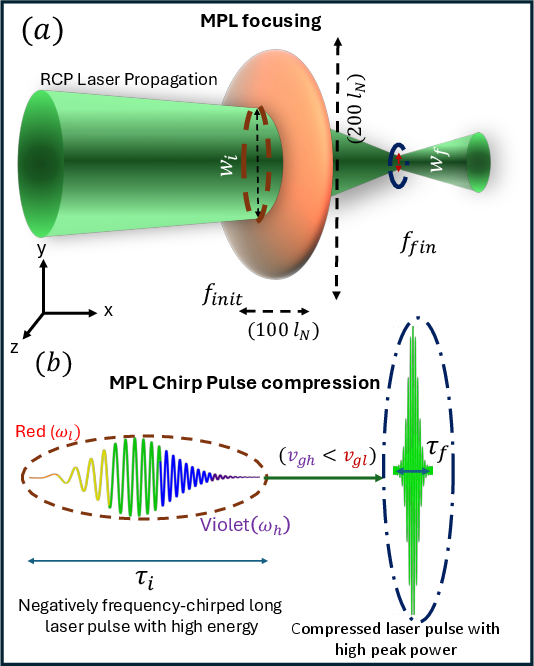
Figure 1: Schematic of the 3D simulation geometry, showing a negatively chirped RCP laser pulse incident on a magnetized plasma lens immersed in an inhomogeneous magnetic field.
The simulation domain is discretized into 1840×880×880 cells, with both electron and ion dynamics included. The lens geometry and magnetic field profile are optimized to minimize spherical aberration and maximize intensity gain.
Results
Intensity Amplification and Pulse Compression
The simulations reveal that the combined action of the MPL and the tailored chirp profile leads to substantial intensity amplification. In the optimal configuration (case iii), the peak EMF energy density increases from $0.014$ to $1.63$ in normalized units, corresponding to a rise in intensity from 1.36×10¹⁶ to 1.58×10¹⁸W/cm2—a nearly two-order-of-magnitude gain.
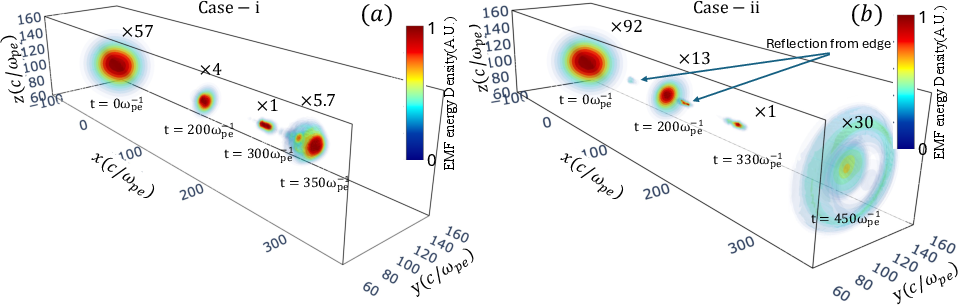
Figure 2: Normalized EMF energy density evolution in time for cases I and II under interaction with MPL, showing the dynamics of field amplification and focusing.
The pulse undergoes both transverse focusing and temporal compression, reaching its shortest duration and smallest waist at the focal point outside the plasma lens. The large aperture of the lens (D≫λ) suppresses diffraction, resulting in a clean, distortion-free focused pulse.
Dependence on Chirp Profile and Magnetic Field
The quality of compression and amplification is highly sensitive to the chirp profile and the magnetic field strength. Linear chirp profiles result in broadened focal regions and noisy pulses, while the optimized nonlinear chirp yields a clean, sharply focused pulse. Increasing the magnetic field strength (B0) shifts the focal point outside the plasma lens, mitigating nonlinear plasma effects and resonant absorption that degrade pulse quality at higher incident intensities.
Scaling and Limitations
The simulations are performed at modest initial intensities due to computational constraints, but the scheme is scalable to higher energies and longer pulse durations by increasing the lens dimensions. The main limitation arises from resonant heating and nonlinear plasma response at high intensities, which can be mitigated by tuning the magnetic field profile to position the focal spot outside the plasma region.
Practical Implications and Future Directions
The proposed MPL scheme offers a robust pathway for achieving extreme laser intensities without the need for petawatt-class sources or high-contrast plasma mirrors. The approach is compatible with current advances in high-field magnet technology, shaped plasma targets, and ultrafast pulse shaping. Potential applications include high-field QED experiments, compact particle accelerators, and advanced light-matter interaction studies.
Future work should focus on experimental realization, optimization of plasma lens fabrication (e.g., foam targets), and integration with high-energy laser systems. Further theoretical investigation into nonlinear plasma effects, aberration control, and multi-pulse amplification strategies will be essential for scaling the technique to exawatt-class regimes.
Conclusion
This study demonstrates that magnetized plasma lenses, when combined with tailored nonlinear chirped laser pulses, can achieve simultaneous transverse focusing and temporal compression, resulting in up to 100-fold intensity amplification. The scheme leverages the tunable refractive index of magnetized plasmas and advanced pulse shaping techniques, providing a scalable and experimentally feasible route to extreme light intensities. The results have significant implications for high-field physics and the development of next-generation laser systems.