End-to-End Quantum Algorithm for Topology Optimization in Structural Mechanics
Published 8 Oct 2025 in quant-ph and physics.comp-ph | (2510.07280v1)
Abstract: Topology optimization is a key methodology in engineering design for finding efficient and robust structures. Due to the enormous size of the design space, evaluating all possible configurations is typically infeasible. In this work, we present an end-to-end, fault-tolerant quantum algorithm for topology optimization that operates on the exponential Hilbert space representing the design space. We demonstrate the algorithm on the two-dimensional Messerschmitt-B\"olkow-Blohm (MBB) beam problem. By restricting design variables to binary values, we reformulate the compliance minimization task as a combinatorial satisfiability problem solved using Grover's algorithm. Within Grover's oracle, the compliance is computed through the finite-element method (FEM) using established quantum algorithms, including block-encoding of the stiffness matrix, Quantum Singular Value Transformation (QSVT) for matrix inversion, Hadamard test, and Quantum Amplitude Estimation (QAE). The complete algorithm is implemented and validated using classical quantum-circuit simulations. A detailed complexity analysis shows that the method evaluates the compliance of exponentially many structures in quantum superposition in polynomial time. In the global search, our approach maintains Grover's quadratic speedup compared to classical unstructured search. Overall, the proposed quantum workflow demonstrates how quantum algorithms can advance the field of computational science and engineering.
The paper introduces a fault-tolerant quantum algorithm that leverages quantum superposition and Grover's search to perform global topology optimization.
The methodology integrates FEM block-encoding, QSVT-based matrix inversion, and quantum amplitude estimation to compute compliance efficiently.
The approach demonstrates polynomial-time compliance evaluation with quadratic speedup over classical methods, paving the way for future quantum design workflows.
End-to-End Quantum Algorithm for Topology Optimization in Structural Mechanics
Overview and Motivation
This paper presents a fault-tolerant quantum algorithm for topology optimization (TO) in structural mechanics, specifically targeting the Messerschmitt-Bölkow-Blohm (MBB) beam problem. The approach leverages quantum superposition to encode exponentially many candidate structures, enabling global search via Grover's algorithm and compliance evaluation through quantum linear system solvers. The workflow integrates block-encoding of finite element method (FEM) stiffness matrices, Quantum Singular Value Transformation (QSVT) for matrix inversion, Hadamard test, and Quantum Amplitude Estimation (QAE), all within a coherent quantum circuit framework. The algorithm is validated through classical quantum-circuit simulations, and a detailed complexity analysis is provided.
Classical Topology Optimization and FEM Discretization
TO seeks optimal material distributions to maximize structural performance under constraints, typically minimizing compliance subject to a volume fraction. The design domain is discretized using FEM into nx×ny quadrilateral elements, each with four nodes and two translational degrees of freedom (DoFs).
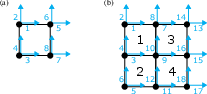
Figure 1: FEM domain discretization using quadrilateral elements; (a) single element with four nodes, (b) 2×2 element domain with column-wise DoF ordering.
The global stiffness matrix K(x) is assembled from element matrices, with the compliance c(x)=f⊤K−1(x)f serving as the objective. Classical methods often relax binary material assignments to continuous densities, enabling gradient-based optimization but introducing non-physical intermediate states.
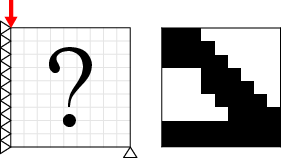
Figure 2: Example solution for the MBB beam problem, showing boundary conditions and an optimized structure for 9×9 elements and V0=1/2.
Quantum Reformulation: Problem Encoding and Search
The quantum algorithm restricts design variables to binary values, representing each candidate structure as a computational basis state. The TO problem is reformulated as a combinatorial satisfiability problem:
Find x∈{0,1}nel such that c(x)<c0,V(x)=V0
Grover's algorithm is employed for global search, with Dicke state initialization enforcing volume constraints. The search space is exponentially large, but quantum superposition enables simultaneous evaluation.
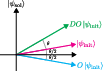
Figure 3: Geometrical illustration of a single Grover iteration, showing amplitude amplification toward solution states.
Oracle Construction and Compliance Computation
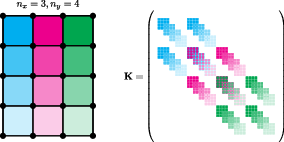
Grover's oracle marks solution states by evaluating compliance via a quantum subroutine. The compliance is computed using block-encoding of the stiffness matrix, QSVT for matrix inversion, and the Hadamard test embedded in QAE. The block-encoding efficiently assembles the global stiffness matrix from element contributions, leveraging the sparsity and structure of FEM matrices.
Figure 4: Element-wise contributions to the global stiffness matrix for a 3×4 domain, illustrating the assembly process.
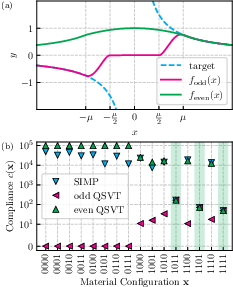
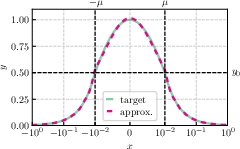
QSVT applies a polynomial transformation to the singular values of the block-encoded matrix, approximating the reciprocal function for matrix inversion. The choice of QSVT polynomial (odd/even) is critical for handling singular or near-singular matrices, with even polynomials providing robust penalization for infeasible configurations.
Figure 5: Impact of the QSVT polynomial on compliance computation; (a) reciprocal and polynomial approximations, (b) compliance values for 2×2 domain using SIMP and QSVT.
Numerical Experiments
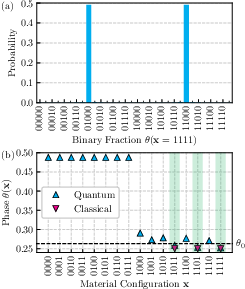
Simulations are performed using PennyLane, demonstrating compliance computation and Grover's search on small domains. For a 2×2 domain, the quantum circuit accurately reproduces classical compliance values for feasible configurations, with QSVT-based matrix inversion distinguishing feasible from infeasible designs.
Figure 6: Quantum compliance computation for the 2×2 MBB beam; probability distribution of phase register after QAE.
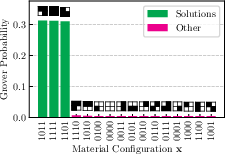
Grover's algorithm amplifies the probability of feasible configurations, as shown in the sorted probability distribution after one iteration.
Figure 7: Sorted probability distribution over all 16 configurations after Grover's algorithm for 2×2 beam; black elements indicate solid material.
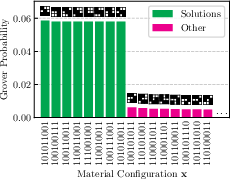
Volume-constrained search is demonstrated on a 3×3 domain, with Dicke state initialization reducing the search space and Grover's algorithm identifying all feasible configurations.
Figure 8: Sorted probability distribution of the 16 most probable configurations for volume-constrained Grover's search on 3×3 beam with V0=5/9.
Complexity Analysis and Scaling
The end-to-end gate complexity of the algorithm is:
O(N/Mnel6lognellog(nel/ϵ))
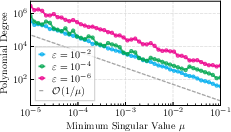
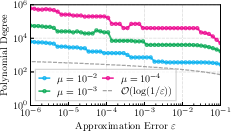
where N is the search space size, M the number of solutions, and nel the number of elements. The block-encoding of the global stiffness matrix is achieved in O(nellognel) gates, efficiently handling 2nel possible configurations. The QSVT polynomial degree scales as O(1/μ), with μ the smallest singular value, and the number of phase qubits required for QAE scales as O(nel).
Figure 10: Scaling of the polynomial degree with μ for different error tolerances ε; confirms O(1/μ) behavior.
Figure 11: Scaling of the polynomial degree with approximation error ε; matches O(log(1/ε)).
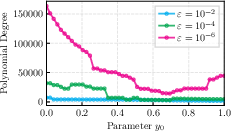
Figure 12: Influence of y0 on the required polynomial degree; degree increases with decreasing y0.
Implementation Considerations
Block-Encoding: The assembly of the global stiffness matrix exploits the repetitive structure of FEM, enabling efficient quantum circuit construction.
QSVT Polynomial Construction: Chebyshev polynomial fitting is used for practical QSVT implementation, with degree determined by desired accuracy and smallest singular value.
Resource Requirements: The algorithm requires O(nel) logical qubits, dominated by the phase register for QAE.
Limitations: The scaling of the QSVT polynomial degree with system size and the required phase resolution for distinguishing near-optimal solutions are significant bottlenecks. The quadratic speedup of Grover's algorithm may not yield practical advantage over classical relaxation methods for moderate problem sizes.
Implications and Future Directions
The presented quantum workflow demonstrates the feasibility of integrating quantum linear system solvers and global search for combinatorial engineering design problems. The approach is logically consistent and provides a blueprint for future fault-tolerant quantum TO algorithms. Potential improvements include quantum-compatible preconditioners to mitigate scaling with the condition number, optimized block-encoding schemes, and alternative quantum optimization algorithms (e.g., QAOA, decoded quantum interferometry).
The principles established here may enable practical quantum advantage for TO in domains where the combinatorial explosion of candidate structures is the primary computational bottleneck, contingent on advances in large-scale fault-tolerant quantum hardware.
Conclusion
This work provides a comprehensive end-to-end quantum algorithm for topology optimization in structural mechanics, integrating FEM analysis, QSVT-based matrix inversion, and Grover's search within a fault-tolerant quantum circuit framework. The algorithm is validated through classical simulation, with complexity analysis confirming polynomial-time compliance evaluation and quadratic speedup for global search. While current limitations preclude immediate practical advantage, the methodology establishes a foundation for future quantum engineering design workflows.