FLAMINGO: Baryonic effects on the weak lensing scattering transform
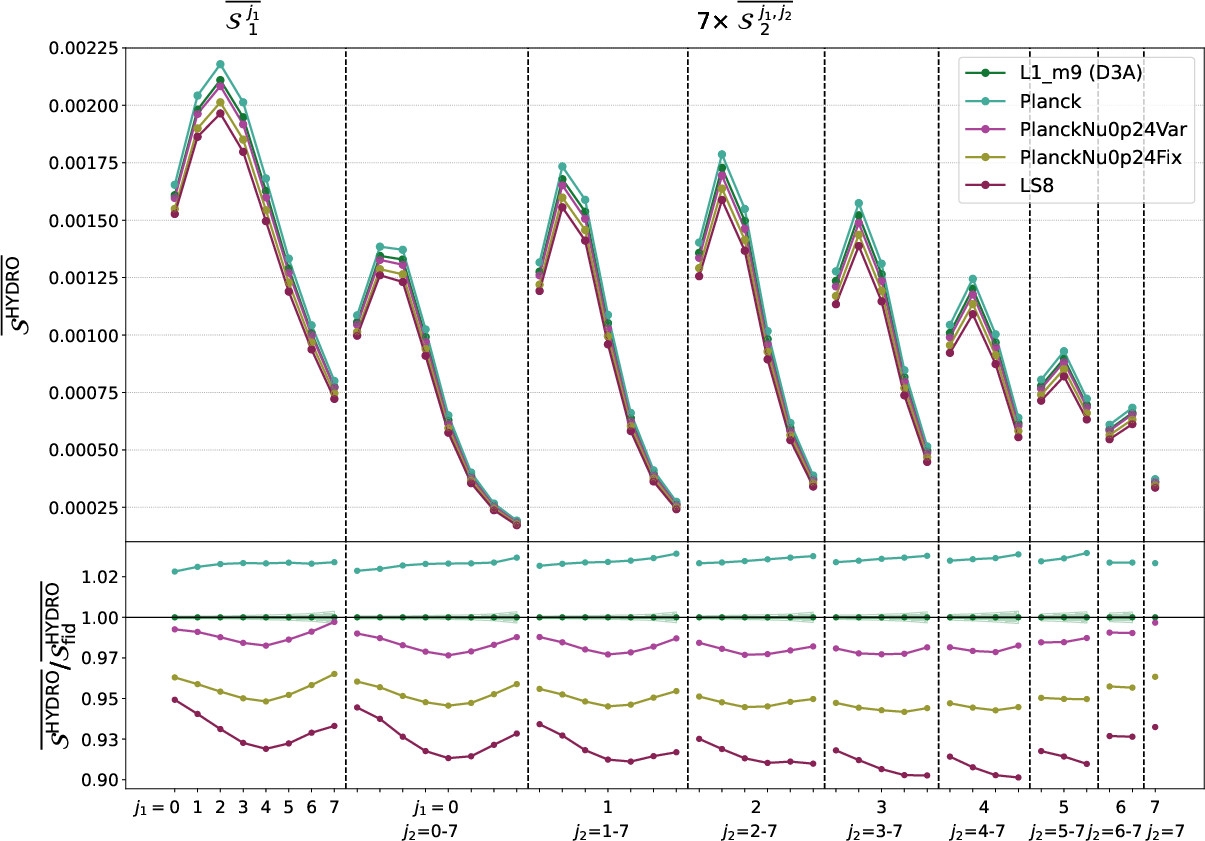
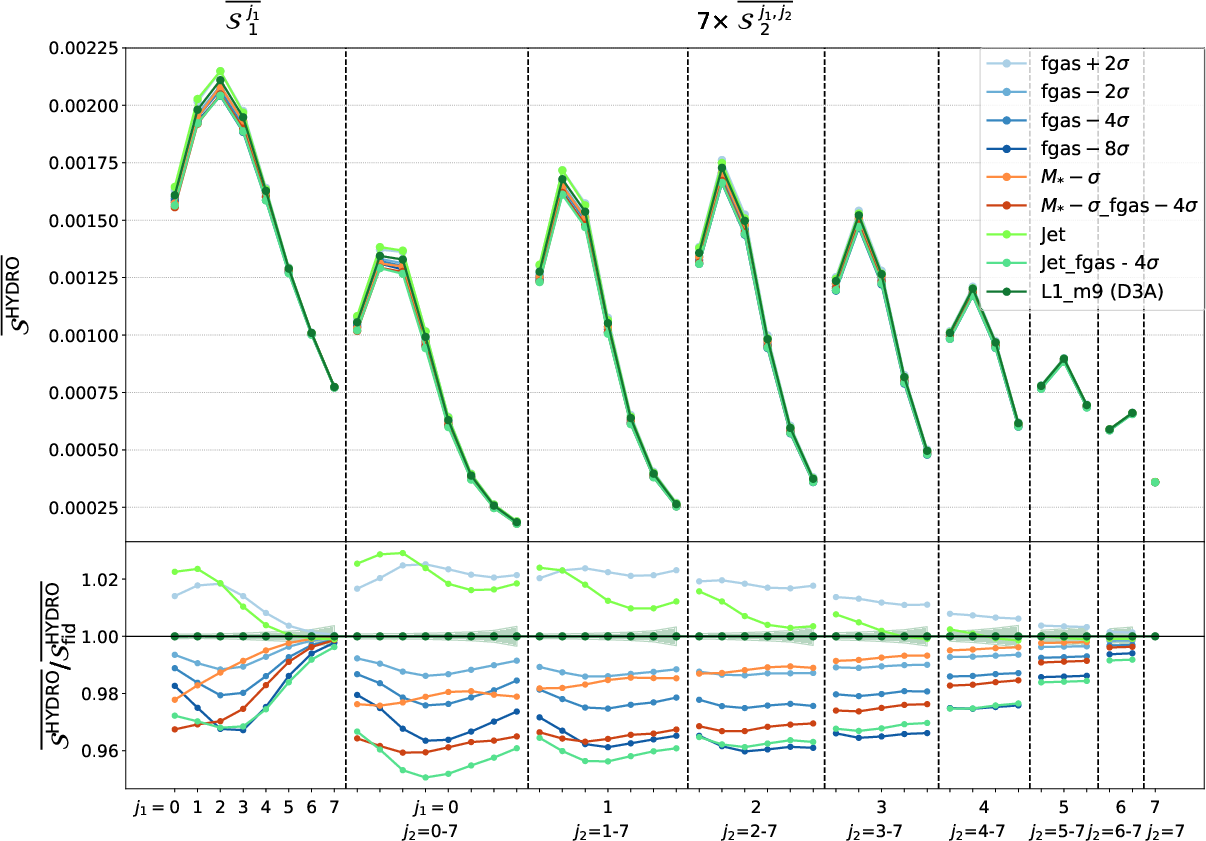
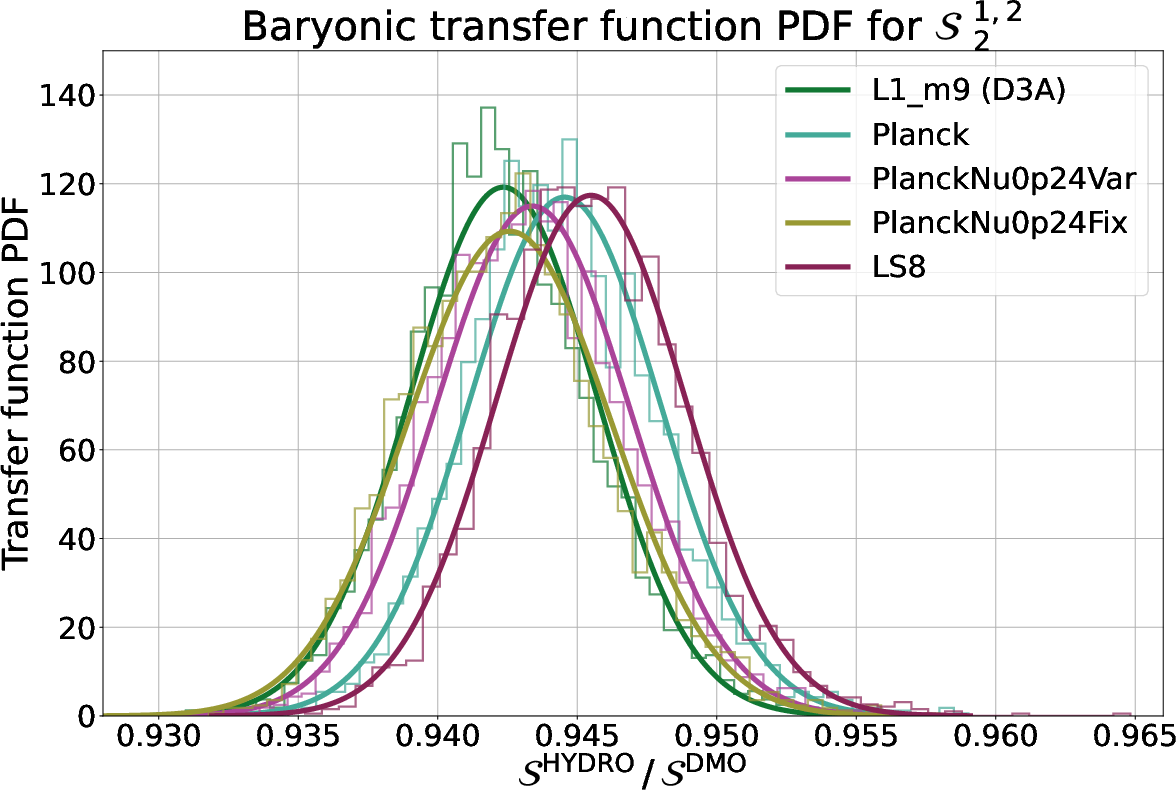
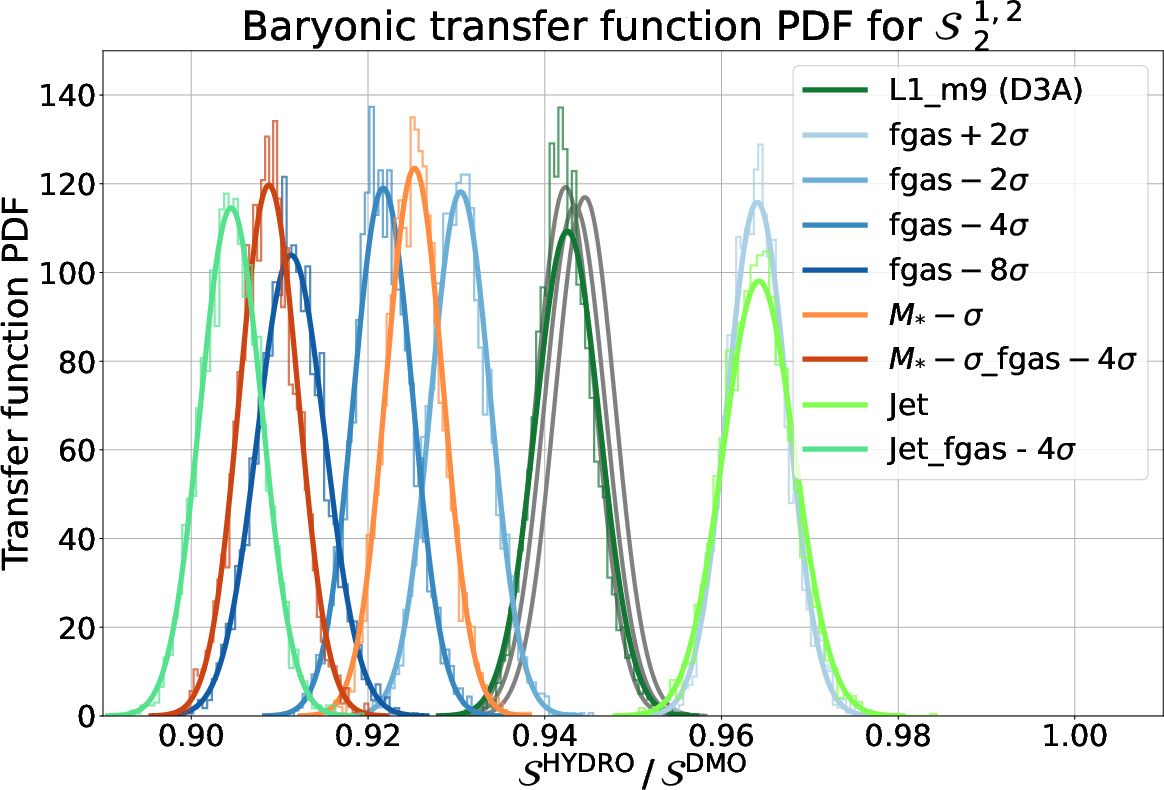
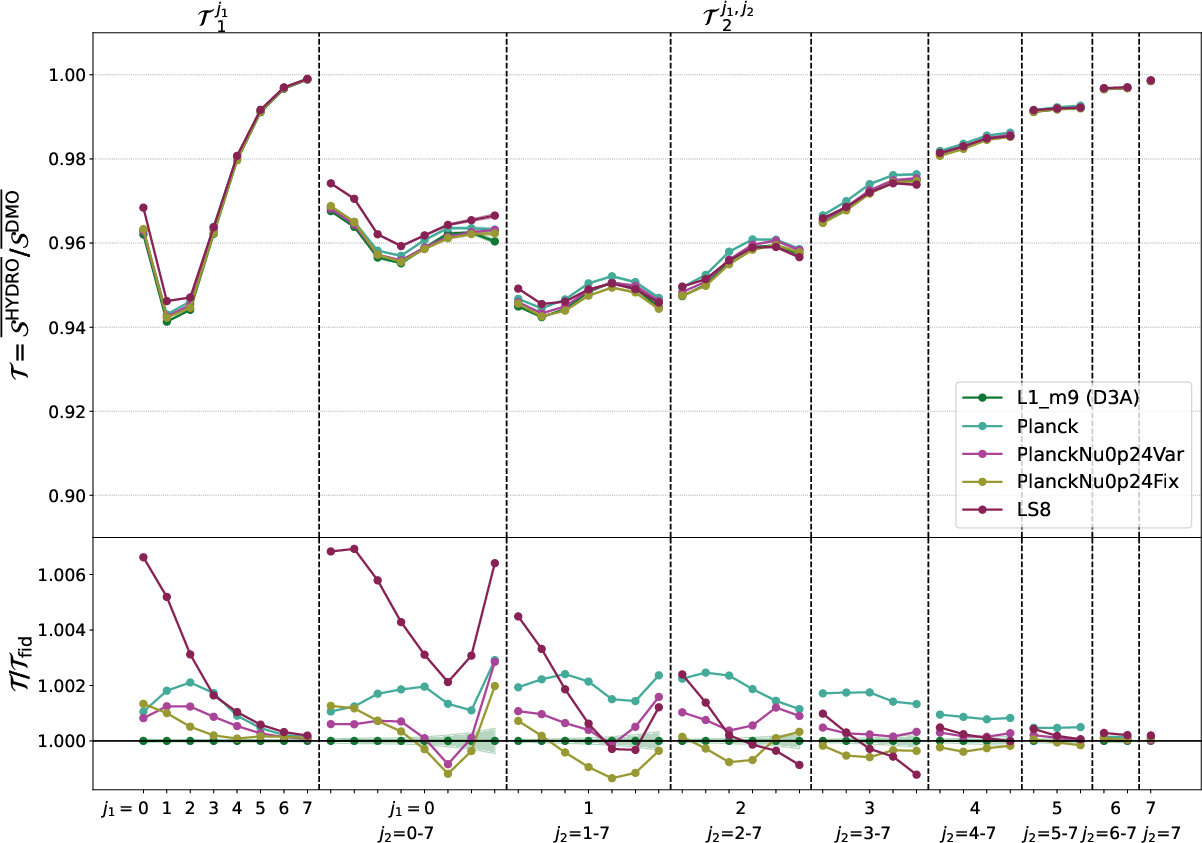
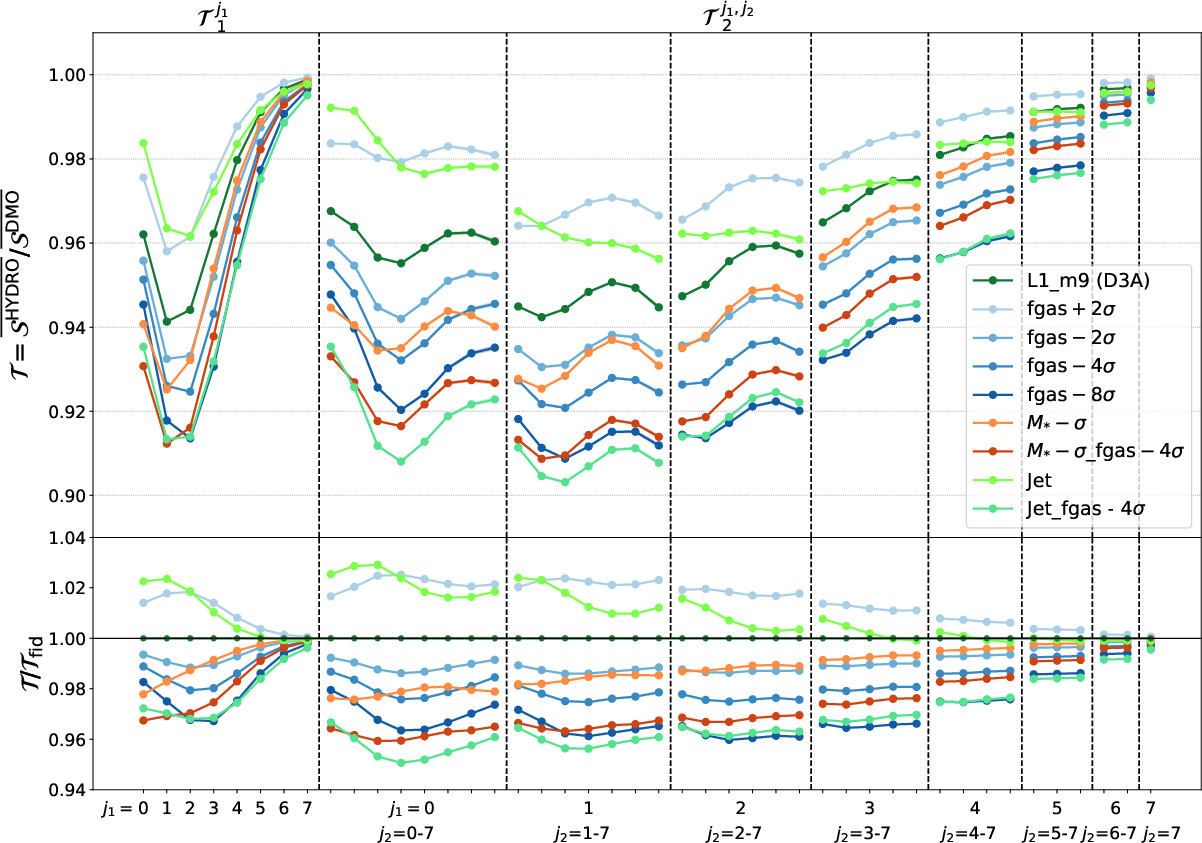
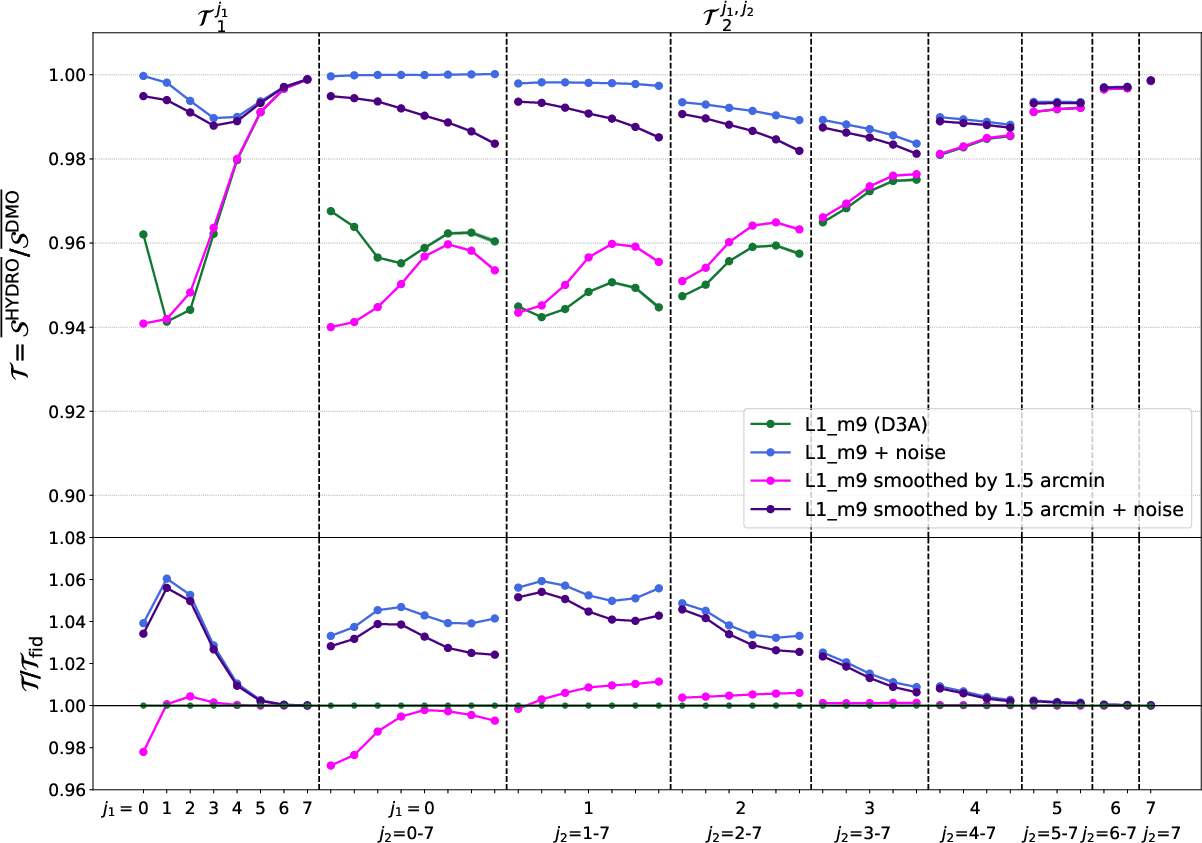
Abstract: The scattering transform is a wavelet-based statistic capable of capturing non-Gaussian features in weak lensing (WL) convergence maps and has been proven to tighten cosmological parameter constraints by accessing information beyond two-point functions. However, its application in cosmological inference requires a clear understanding of its sensitivity to astrophysical systematics, the most significant of which are baryonic effects. These processes substantially modify the matter distribution on small to intermediate scales ($k\gtrsim 0.1\,h\,\mathrm{Mpc}{-1}$), leaving scale-dependent imprints on the WL convergence field. We systematically examine the impact of baryonic feedback on scattering coefficients using full-sky WL convergence maps with Stage IV survey characteristics, generated from the FLAMINGO simulation suite. These simulations include a broad range of feedback models, calibrated to match the observed cluster gas fraction and galaxy stellar mass function, including systematically shifted variations, and incorporating either thermal or jet-mode AGN feedback. We characterise baryonic effects using a baryonic transfer function defined as the ratio of hydrodynamical to dark-matter-only scattering coefficients. While the coefficients themselves are sensitive to both cosmology and feedback, the transfer function remains largely insensitive to cosmology and shows a strong response to feedback, with suppression reaching up to $10\%$ on scales of $k\gtrsim 0.1\,h\,\mathrm{Mpc}{-1}$. We also demonstrate that shape noise significantly diminishes the sensitivity of the scattering coefficients to baryonic effects, reducing the suppression from $\sim 2 - 10 \;\%$ to $\sim 1\;\%$, even with 1.5 arcmin Gaussian smoothing. This highlights the need for noise mitigation strategies and high-resolution data in future WL surveys.
Paper Prompts
Sign up for free to create and run prompts on this paper using GPT-5.
Top Community Prompts
Knowledge Gaps
Below is a single, focused list of knowledge gaps, limitations, and open questions left unresolved by the paper. Each item is phrased to be concrete and actionable for follow-up research.
- Cosmology independence of the transfer function was tested only over a limited parameter range (DES-like ΛCDM, Planck variants, modest neutrino masses); assess robustness across broader cosmological spaces (e.g., w0–wa, curvature, modified gravity, wider ranges of n_s, h, Ω_m, and Σmν), and quantify where the “cosmology-insensitive” assumption breaks down.
- Redshift and tomographic dependence is unaddressed: the transfer function was derived for a single Euclid-like source distribution integrated to z=3; quantify how baryonic suppression in scattering coefficients varies with tomographic binning and evolves with redshift.
- Orientation information was averaged out; evaluate orientation-dependent scattering coefficients (retain l indices) to test sensitivity to anisotropic feedback (e.g., jet-mode AGN) and determine whether directional features add discrimination power or help with marginalization.
- Only second-order scattering coefficients were used; determine whether higher-order (n≥3) coefficients carry meaningful additional baryonic information relative to their noise amplification and computational cost.
- No full covariance characterization: compute the non-Gaussian covariance of the first- and second-order scattering coefficients (including inter-scale and inter-patch correlations), and build realistic covariance models required for parameter inference and robust marginalization over feedback.
- Survey systematics were not modeled (masks, PSF anisotropy, shear calibration biases, photo-z errors, B-modes, spatially varying depth); quantify their impact on scattering coefficients and the transfer function, and develop mitigation strategies compatible with Stage IV survey pipelines.
- Shape noise modeling was simplistic and strongly diminished baryonic sensitivity (to ~1% with 1.5 arcmin smoothing); systematically explore denoising strategies (e.g., wavelet thresholding, Wiener/sparse priors, multi-scale filtering), optimal smoothing choices, and multi-statistic combinations to recover small-scale sensitivity in realistic noise conditions.
- Mapping from dyadic scales j to physical wavenumbers k was only approximate; derive a calibrated j→k mapping that accounts for the lensing kernel and redshift mixing (ideally per tomographic bin), and assess how this mapping affects the interpretation of scale-dependent suppression.
- Build and validate an emulator for the scattering-transform transfer function across the baryonic subgrid parameter space (f_SN, Δv_SN, β_BH, ΔT_AGN / v_jet), conditioned on observational proxies (SMF, f_gas), to enable fast marginalization in inference.
- Test whether baryonic correction models (BCMs) can reproduce hydrodynamics-based transfer functions for scattering coefficients; if not, develop ST-calibrated BCMs or hybrid approaches tailored to non-Gaussian statistics.
- Joint baryon–neutrino degeneracies are largely unexplored for the scattering transform; quantify whether the baryonic transfer function factorizes with neutrino effects and identify scales where degeneracies are most acute.
- Cross-statistic benchmarking is missing: compare ST’s baryonic sensitivity and cosmology–baryon separability to other HOS (peaks, PDFs, Minkowski functionals, Betti numbers) using identical mocks, and evaluate combined constraints and optimal statistics portfolios.
- Sensitivity to the source redshift distribution is assumed negligible for small changes; explicitly quantify how uncertainties and biases in n(z) propagate to scattering coefficients and the transfer function, and establish tolerances for survey requirements.
- End-to-end inference was not demonstrated; integrate the transfer function into a full parameter estimation pipeline (priors on baryonic parameters, cosmology, nuisance systematics), and quantify residual biases on S8 and other parameters under realistic survey conditions.
- Physical attribution is limited: decompose scattering-coefficient changes by halo mass, environment (clusters vs. filaments/voids), and feedback channel to link ST signatures to physical processes and improve interpretability/modeling.
- B-mode contamination was not considered; assess ST sensitivity to spurious B-modes and test whether the transfer function remains valid when B-mode systematics are present.
- Patch-size and projection effects were only partially explored (alternate sizes noted in a repository); systematically quantify sensitivity to patch size, HEALPix-to-plane projection distortions, and choices of L (orientations) and J (scales), and establish best practices for survey analyses.
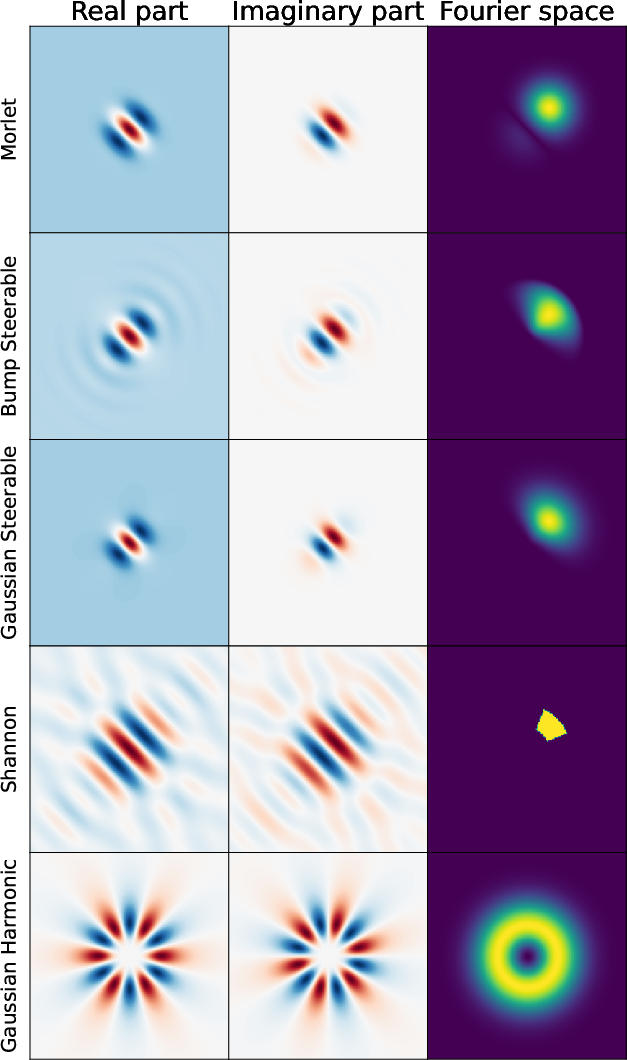
- Wavelet-family robustness: main results emphasize Morlet wavelets; evaluate whether transfer functions and baryonic sensitivity are consistent across wavelet families (Gaussian, bump, Shannon, etc.) and identify optimal filters for WL applications.
- Resolution and box-size convergence is not demonstrated; test whether ST coefficients and transfer functions converge with particle mass resolution, force softening, and box size (e.g., compare L1_m9, L1_m8, L2p8_m9), and quantify biases from finite-volume and resolution limits.
- Jet-mode AGN impacts appear different but remain under-characterized; quantify distinct ST signatures of jet vs. thermal feedback (including possible orientation dependencies) and assess their separability from cosmology.
- Realistic survey geometry was not applied; test transfer-function stability under Euclid/LSST masks, inhomogeneous depth, and realistic footprint, and develop corrections if needed.
- Light-cone construction used a single observer and box replication with random rotations; quantify residual biases from repeated-structure correlations and validate variance estimates with multiple independent observers/light-cones.
- Spatial uniformity was assumed by averaging over patches; investigate whether the transfer function varies with local density or environment and whether per-patch or environment-conditioned corrections improve modeling.
- Downsampling to Nside=8192 and 512×512 patch grids may affect small scales; assess sensitivity of scattering coefficients and transfer functions to map resolution choices and pixelization.
- The transfer function is applied as a ratio of ensemble-averaged coefficients; explore per-patch or scale-dependent corrections and quantify how the finite width of the transfer-function distribution impacts inference and uncertainty propagation.
Practical Applications
Immediate Applications
- Baryonic-mitigation module for non-Gaussian weak-lensing pipelines (academia; software)
- Use the paper’s baryonic transfer function (ratio of HYDRO/DMO scattering coefficients) to correct scattering-transform (ST) observables before cosmological inference, avoiding large information losses from conservative scale cuts.
- Potential tools/products: a plug-in for Euclid/LSST ST pipelines; a lightweight library that ingests DMO ST predictions and applies model-specific transfer functions.
- Assumptions/dependencies:
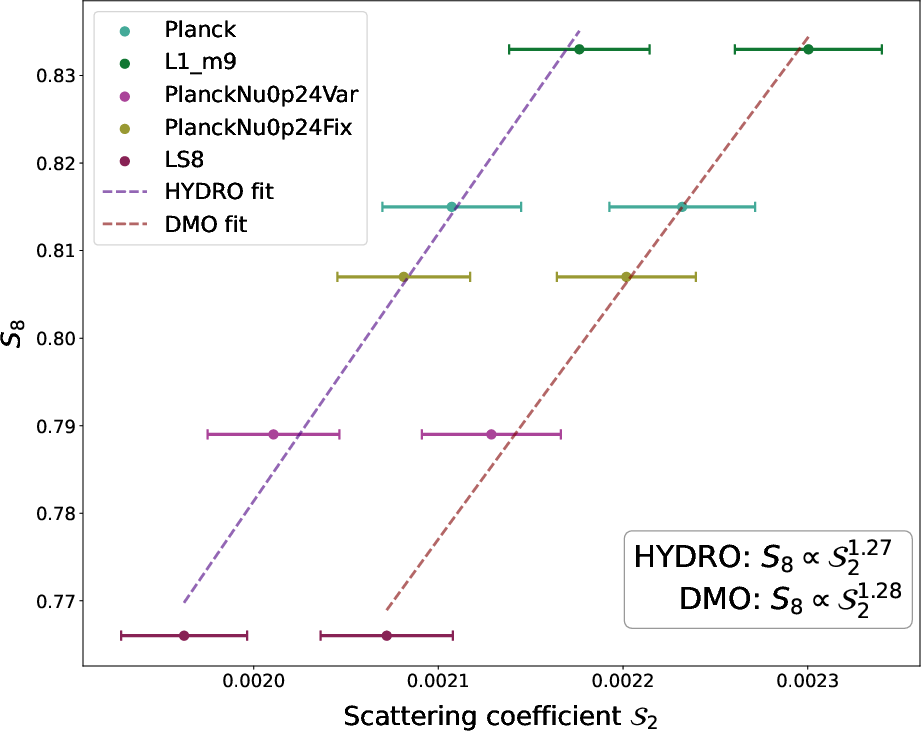
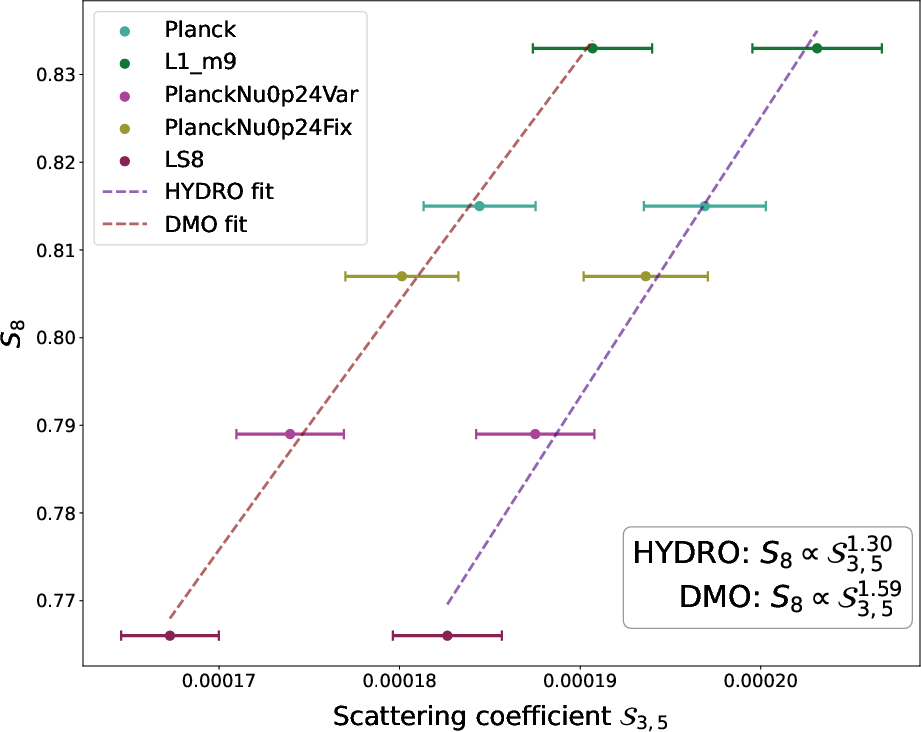
- Cosmology-insensitivity of the transfer function holds within tested ranges (small S8 shifts; see LS8 caveat).
- Availability of DMO predictions that match the same map-making choices (n(z), smoothing, patching).
- Transfer functions derived under Stage IV-like conditions; revalidation needed for other survey configurations and masking.
- Scale-selection and information-retention strategy for Stage IV surveys (academia; policy)
- Replace uniform small-scale cuts with scale-dependent adjustments guided by the measured “spoon-like” suppression pattern in ST coefficients, preserving more constraining power at intermediate/large dyadic scales.
- Potential workflows: pre-analysis dashboards that flag scales with robust transfer-function behavior; dynamic scale weighting.
- Assumptions/dependencies:
- Accurate mapping between ST dyadic scales and physical k-scales for the survey’s redshift distribution.
- Stable instrument PSF and well-characterized masks.
- Emulator shortcut: fast mapping from DMO to HYDRO in ST space (academia; software/HPC)
- Train a simple emulator to multiply DMO ST coefficients by the transfer function, instead of re-running hydrodynamic simulations in likelihood loops.
- Potential tools/products: JAX/PyTorch emulators packaged for CosmoSIS/Cobaya.
- Assumptions/dependencies:
- Transfer-function stability across the local cosmology neighborhood.
- Consistent map preprocessing (smoothing, pixelization, patch size).
- Feedback-model discrimination using ST suppression signatures (academia)
- Use the scale-dependent patterns to test thermal vs jet-mode AGN, or variations in cluster gas fraction and SMF, via model comparison or Bayesian model averaging.
- Potential workflows: add a “feedback model index” parameter marginalised with priors informed by the paper’s transfer functions.
- Assumptions/dependencies:
- Sufficient signal-to-noise (S/N) at small–intermediate scales; impact of shape noise considered.
- Cross-validation of baryonic correction models (BCMs) for higher-order statistics (academia; software)
- Benchmark BCMs against the hydrodynamics-calibrated transfer functions in ST space, where many BCMs underperform for HOS.
- Potential tools/products: BCM calibration routines targeting ST residuals; test suites for simulation–BCM agreement.
- Assumptions/dependencies:
- BCM parameter space can reproduce the ST suppression across scales; requires multi-scale fitting.
- Survey design decisions to preserve ST sensitivity (academia; policy)
- Immediately inform smoothing choices and cadence for Euclid/LSST analysis: the paper shows shape noise can reduce baryonic sensitivity from ~2–10% to ~1% even with 1.5’ smoothing, motivating higher-resolution imaging and denoising.
- Potential workflows: pre-survey trade studies on resolution vs shape-noise mitigation impacts specifically for ST.
- Assumptions/dependencies:
- Reliable forecasts of shape noise and PSF systematics; availability of denoising strategies that do not distort ST statistics.
- Quality-control diagnostic for real data (academia; operations)
- Compare measured ST ratios to expected transfer functions; significant deviations may indicate unmodeled systematics (masking, PSF residuals, photo-z tails).
- Potential tools/products: QC dashboards that track ST residuals vs scale and sky region.
- Assumptions/dependencies:
- Robust estimation of covariances and cosmic/sample variance for the adopted patch tiling; controlled masking.
- Public resource re-use (academia; education)
- Immediate uptake of the provided transfer functions (multiple wavelet families and patch sizes) in teaching and method-comparison studies; baselines for future data challenges.
- Potential products: tutorial notebooks and classroom modules on wavelets and ST in cosmology.
- Assumptions/dependencies:
- Clear documentation of the transfer-function validity domain (map resolution, n(z), smoothing).
Long-Term Applications
- End-to-end, joint non-Gaussian cosmology with baryon mitigation (academia; software/HPC)
- Integrate transfer-function–based corrections with full tomographic ST analyses, joint with two-point functions, peaks, or PDFs, with correct joint covariances and survey realism (masks, inhomogeneous noise, shear calibration).
- Potential products: unified likelihood modules for ST+2pt+peaks with baryon-aware data vectors and covariances.
- Assumptions/dependencies:
- Accurate, survey-specific covariances; validated treatment of photo-z uncertainties; comprehensive systematics propagation.
- Inference of astrophysical feedback parameters from WL ST (academia)
- Treat AGN/SN feedback controls (e.g., ΔTAGN, vjet, βBH) as parameters and constrain them jointly with cosmology by leveraging the cosmology-insensitive transfer function as a forward model.
- Potential workflows: hierarchical inference linked to external X-ray/SZ constraints for fgas and SMF.
- Assumptions/dependencies:
- Transfer-function interpolation across feedback parameter space remains accurate; multi-probe calibration to break degeneracies.
- Shape-noise–aware denoising tailored to preserve ST statistics (academia; software/ML)
- Develop de-noising and inpainting techniques (e.g., self-supervised denoisers, wavelet-domain regularization) that explicitly preserve ST coefficients, recovering the lost small-scale baryonic signal.
- Potential products: ST-preserving image-processing toolkits for WL.
- Assumptions/dependencies:
- Provable preservation of ST distributions; minimal leakage from noise to signal scales; robust performance with realistic masks.
- Standardization of baryonic-transfer–function practices (academia; policy)
- Establish community standards for generating, validating, and sharing baryonic transfer functions for non-Gaussian observables (data formats, metadata, validation suites), enabling reproducibility across surveys.
- Potential outcomes: survey policy documents and best-practice guides adopted by Euclid/LSST working groups.
- Assumptions/dependencies:
- Community buy-in; sustained support for cross-survey validation efforts.
- Real-time, adaptive observing and processing strategies (academia; operations)
- Use on-the-fly ST diagnostics to adjust scale usage and processing (e.g., smoothing, deblending parameters) across survey regions with different noise/mask properties.
- Potential workflows: operations dashboards that feed back into nightly processing for optimal information retention.
- Assumptions/dependencies:
- Low-latency computation of ST and transfer-function diagnostics; robust region-by-region covariance modeling.
- Generalization to other non-Gaussian families (academia; software)
- Extend the transfer-function concept to wavelet moments, phase harmonics, and scattering spectra to harmonize baryonic mitigation across HOS families.
- Potential products: multi-observable baryon-correction suites with shared calibration layers.
- Assumptions/dependencies:
- Consistency of baryonic response across related HOS; shared, validated simulation anchors.
- Mission and instrument requirement studies guided by ST sensitivity (policy; agencies)
- Use the demonstrated noise sensitivity and scale dependence to set top-level requirements on PSF size/stability, depth, and cadence that preserve ST leverage on baryons and cosmology.
- Potential outcomes: requirement flow-downs for next-generation space/ground surveys.
- Assumptions/dependencies:
- Realistic end-to-end simulations linking hardware choices to ST-based science metrics.
- Cross-domain methodology transfer to imaging industries (industry; remote sensing, medical imaging)
- Adapt the “physics-informed transfer function” idea to correct higher-order descriptors for domain-specific small-scale systematics (e.g., microstructure bias in medical images; atmospheric or sensor effects in Earth observation), leveraging scattering-based descriptors’ stability to deformations.
- Potential products: inspection/diagnostic modules for stable multi-scale feature extraction with domain-correction layers.
- Assumptions/dependencies:
- Availability of domain-matched “DMO vs HYDRO analogs” (i.e., clean vs contaminated datasets); careful validation to avoid overfitting domain corrections.
- Public data challenges focused on baryon-aware non-Gaussian inference (academia; community-building)
- Organize challenges where participants must perform cosmology in the presence of baryonic effects using ST and related HOS, benchmarking denoising and mitigation methods.
- Potential outcomes: community-curated best practices; accelerated method maturity for Stage IV exploitation.
- Assumptions/dependencies:
- Curated simulation suites with realistic masks/noise; standardized scoring metrics and open baselines.
Notes on key dependencies common across applications
- Validity domain of transfer functions: calibrated on FLAMINGO with specific feedback models, Euclid-like n(z), given map resolutions, smoothing, and patch tiling; re-derivation may be needed for significantly different survey setups.
- Cosmology insensitivity: holds within the tested parameter variations; large S8 shifts (e.g., LS8) show deviations at the smallest scales and should be explicitly tested.
- Shape noise: can suppress baryonic signatures in ST to ~1% with 1.5 arcmin smoothing; practical gains rely on effective noise mitigation and high-resolution data.
- Covariances and masking: robust cosmological use requires realistic covariances that capture survey geometry, depth variations, and photo-z errors.
Collections
Sign up for free to add this paper to one or more collections.