Papers
Topics
Authors
Recent
Search
2000 character limit reached

People use fast, flat goal-directed simulation to reason about novel problems

Published 13 Oct 2025 in q-bio.NC, cs.AI, and cs.GT | (2510.11503v1)

Abstract: Games have long been a microcosm for studying planning and reasoning in both natural and artificial intelligence, especially with a focus on expert-level or even super-human play. But real life also pushes human intelligence along a different frontier, requiring people to flexibly navigate decision-making problems that they have never thought about before. Here, we use novice gameplay to study how people make decisions and form judgments in new problem settings. We show that people are systematic and adaptively rational in how they play a game for the first time, or evaluate a game (e.g., how fair or how fun it is likely to be) before they have played it even once. We explain these capacities via a computational cognitive model that we call the "Intuitive Gamer". The model is based on mechanisms of fast and flat (depth-limited) goal-directed probabilistic simulation--analogous to those used in Monte Carlo tree-search models of expert game-play, but scaled down to use very few stochastic samples, simple goal heuristics for evaluating actions, and no deep search. In a series of large-scale behavioral studies with over 1000 participants and 121 two-player strategic board games (almost all novel to our participants), our model quantitatively captures human judgments and decisions varying the amount and kind of experience people have with a game--from no experience at all ("just thinking"), to a single round of play, to indirect experience watching another person and predicting how they should play--and does so significantly better than much more compute-intensive expert-level models. More broadly, our work offers new insights into how people rapidly evaluate, act, and make suggestions when encountering novel problems, and could inform the design of more flexible and human-like AI systems that can determine not just how to solve new tasks, but whether a task is worth thinking about at all.

Summary

  • The paper's main contribution is presenting the Intuitive Gamer model that simulates human decision-making in new games using efficient, goal-based probabilistic sampling.
  • It demonstrates that shallow, single-step look-ahead with simple heuristics predicts human judgments on game fairness and funness, outperforming deeper search methods.
  • The study implies that integrating fast, resource-limited simulations can enhance AI adaptability and mirror natural human cognitive patterns in novel problem solving.

People use fast, flat goal-directed simulation to reason about novel problems

Introduction

The paper investigates how humans strategically engage with novel problems using a computational cognitive model called the "Intuitive Gamer." The study assesses human reasoning in strategy games, where participants demonstrate adaptive rationality without prior experience. The Intuitive Gamer model leverages mechanisms akin to Monte Carlo tree-search but scales them down to suit everyday human thought, employing limited stochastic samples and goal heuristics. The findings are derived from large-scale behavioral studies with over 1000 participants and 121 board games.

The Intuitive Gamer Model

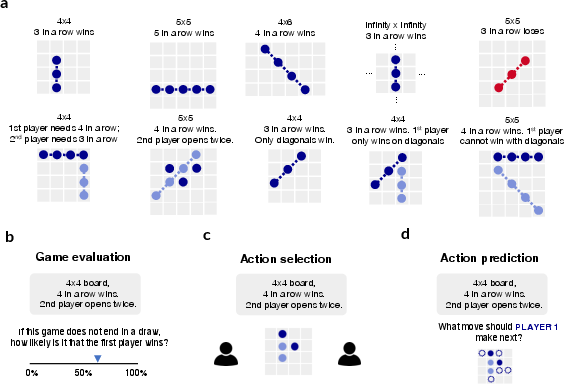
The Intuitive Gamer model proposes a framework for understanding human reasoning in new problem settings through fast, flat, goal-directed probabilistic simulations. Contrary to expert models that use deep tree searches, this model evaluates decisions with minimal computational resources. The model comprises two modules: a shallow game-playing agent and a reasoning component. The game-playing agent uses a single-step look-ahead with simple heuristics, while the reasoning module synthesizes these simulations to infer game properties. Figure 1

Figure 1: Our novel game dataset and suite of game tasks. a, Ten example games from our 121 game dataset...

Evaluating New Games

The study explores how individuals anticipate game characteristics before direct interaction. Two metrics are used: game payoff (fairness) and subjective funness. The Intuitive Gamer model successfully predicts human evaluations by using a limited number of simulated plays, demonstrating superior correlation with human judgments compared to more resource-intensive models such as Monte Carlo Tree Search (MCTS). Figure 2

Figure 2: Evaluating whether games are likely to be fun, before ever playing them...

First Encounter Game Play

In actual game-play situations, the Intuitive Gamer model effectively captures human decision-making during initial exposure to new games. It aligns closely with human behavior in predicting moves and understanding how participants judge subsequent player moves. The comparison of model predictions with observed human gameplay reveals the model's efficiency in mirroring natural decision processes over more computationally demanding models. Figure 3

Figure 3: Modeling people's actions and distribution over predicted actions in the first encounter with a new game...

Application and Implications

This research enhances our understanding of human cognitive processes in novel situations and informs the design of AI systems that replicate human-like flexibility and efficiency. The findings suggest pathways for developing AI capable of fast, resource-efficient evaluations, essential for applications requiring rapid adaptation without extensive pre-computation.

Conclusion

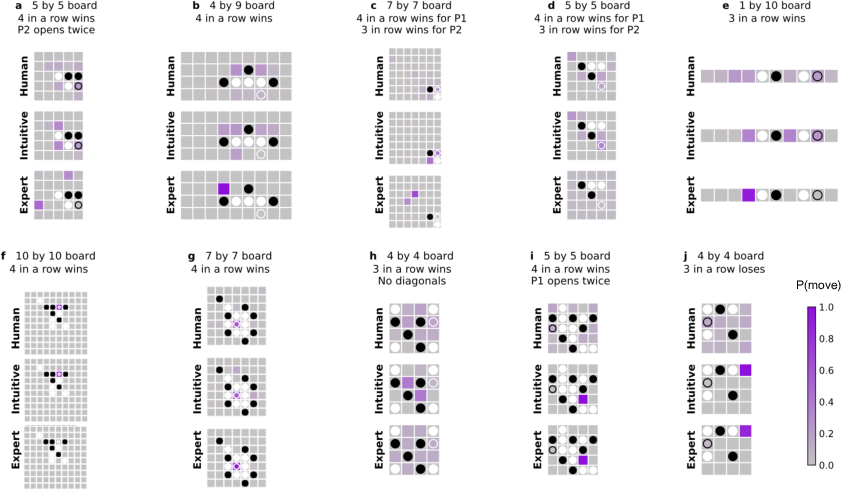
The Intuitive Gamer model provides a valuable computational framework for understanding novice human reasoning in unfamiliar decision-making tasks. It outperforms traditional deep-search models in mirroring human evaluations and actions in new games by utilizing goal-directed, probabilistic simulations. Future AI systems could benefit from integrating such mechanisms to enhance adaptability and efficiency in dynamic environments. Figure 4

Figure 4: Example human- and model-predicted distributions over the next action in real games...

Whiteboard

No one has generated a whiteboard explanation for this paper yet.

Open Problems

We haven't generated a list of open problems mentioned in this paper yet.

Collections

Sign up for free to add this paper to one or more collections.