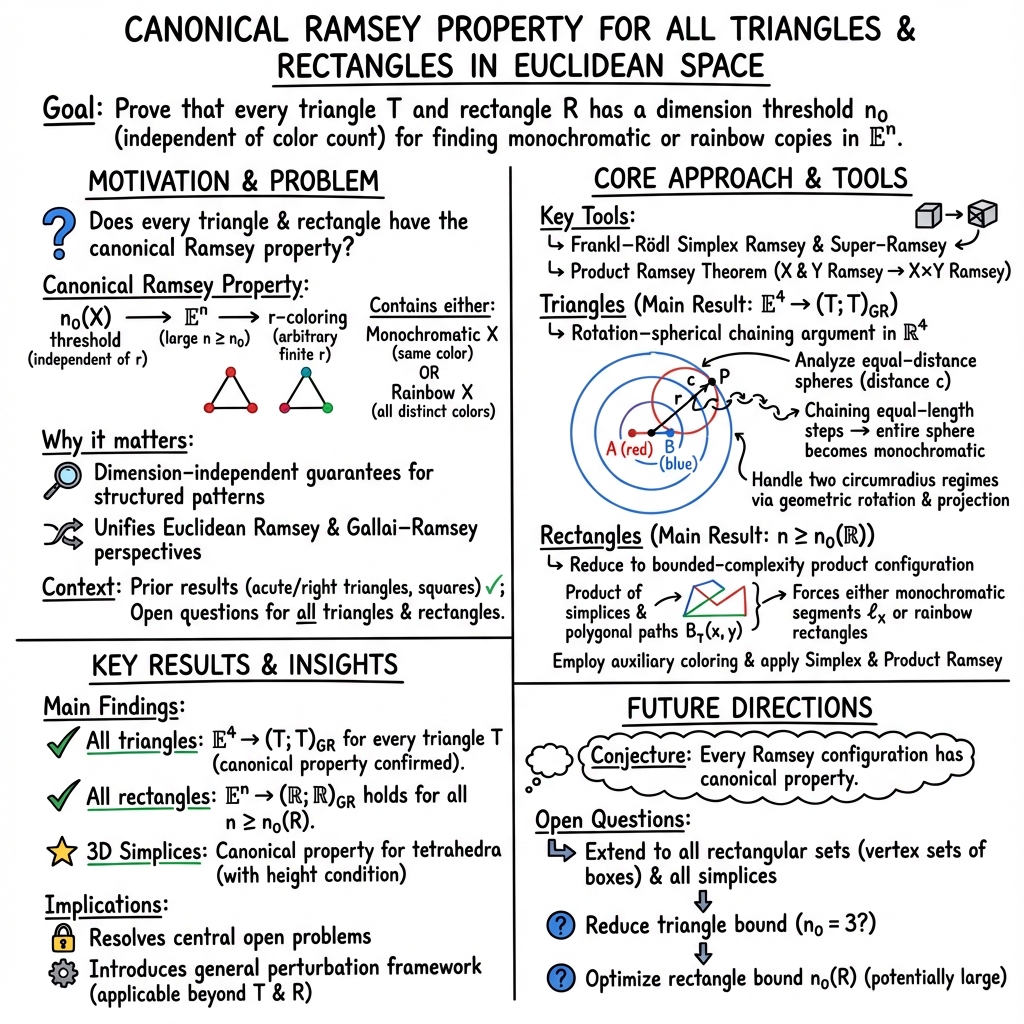
- The paper establishes that all triangles possess the canonical Ramsey property by confining the analysis to four dimensions using a rotation-spherical chaining argument.
- The paper shows that rectangles achieve the canonical Ramsey property through a structural reduction to product configurations with bounded color complexity.
- The paper introduces a perturbation framework extending canonical Ramsey results to complex geometric arrangements, paving the way for future research.
Canonical Ramsey: Triangles, Rectangles, and Beyond
Introduction
This paper addresses questions related to the canonical Ramsey property for geometrical shapes in Euclidean spaces, specifically focusing on triangles and rectangles. The canonical Ramsey property posits that for certain finite configurations, any r-coloring of a sufficiently high-dimensional Euclidean space must yield a monochromatic or a rainbow congruent copy of the configuration, regardless of the dimensionality, provided it is above a certain threshold. This ongoing dialogue in combinatorial geometry explores the intersection of geometry and Ramsey theory, a field interested in the conditions under which certain patterns must appear in sufficiently large structures.
Background
The study traces back to fundamental work by Cheng and Xu, who demonstrated certain configurations such as squares and triangles possessing this property. They laid the groundwork by showing dimension-independent results for specific shapes, which were later broadened by researchers like Geher, Sagdeev, and Toth examining hypercubes and asking pivotal questions about the applicability of these properties to all triangles and rectangles. Such inquiries suggest an inherent complexity and depth as configurations shift from simpler 2-dimensional shapes to their higher-dimensional counterparts.
Main Contributions
The paper resolves key open questions in Euclidean Ramsey theory. It establishes:
- For Triangles: That all triangles indeed possess the canonical Ramsey property. The study confines the solution effectively to four dimensions using innovative geometric reasoning, including a rotation-spherical chaining argument that allows complex alignments to reduce dimensional dependencies.
- For Rectangles: A structural reduction approach is adopted, showing that canonical Ramsey results for rectangles can also be achieved. This involves reducing the problem to product configurations with bounded color complexity and leveraging powerful Ramsey theorems.
- Advanced Theoretical Constructs: Beyond individual configurations, the paper introduces a perturbation framework that pushes the boundaries, applying the canonical Ramsey principle innovatively to classes of 3-dimensional simplices by using the simplex super-Ramsey theorem—indicative of canonical properties in more complex geometrical arrangements.
Theoretical Implications
The resolution that triangles and rectangles hold the canonical Ramsey property enriches the general understanding of geometric pattern emergence under coloring constraints. The ability to generalize such properties as dimension-independent indicates profound robustness in geometric combinatorial structures. This work lays the foundation for further explorations into other configurations, potentially all finite bounded configurations, hypothesized to exhibit such uniform constraint-driven properties as predicted by the paper’s concluding conjecture.
Future Directions
The results open several pathways for exploration in combinatorial geometry and Ramsey theory. There is immense potential for determining the canonical Ramsey properties of other configurations, especially more intricate high-dimensional simplices and polyhedral sets. Extending these principles beyond traditional geometric limits and validating their applicability in other combinatorial settings represents a compelling research trajectory.
Conclusion
This study decisively answers previously open questions regarding the canonical Ramsey properties of triangles and rectangles, advancing the dialogue in Euclidean Ramsey theory. The methodologies developed not only reinforce existing theories but also introduce innovative concepts that could redefine the understanding of dimension-independent properties in combinatorially constrained geometries. It signals a stride forward in finding universal patterns across geometric dimensions, shaping the future of mathematical exploration in this domain.