- The paper introduces a CTI framework that combines an LLM-based path planner with a graph executor to accurately resolve complex, multi-hop queries.
- It leverages a specialized TITAN Ontology, adapted from the MITRE ATT&CK framework, to clearly define cybersecurity entities and their interactions.
- The experimental results reveal that incorporating Chain-of-Thought reasoning significantly enhances path accuracy in navigating vast cyber threat datasets.
TITAN: Graph-Executable Reasoning for Cyber Threat Intelligence
TITAN (Threat Intelligence Through Automated Navigation) represents a sophisticated framework aiming to enhance the automation and accuracy of Cyber Threat Intelligence (CTI). This essay provides an expert summary of the paper titled "TITAN: Graph-Executable Reasoning for Cyber Threat Intelligence" (2510.14670), detailing its framework, methodology, and implications for the field of cybersecurity.
Introduction to TITAN Framework
TITAN is conceived to overcome the limitations of existing CTI systems that struggle with multi-hop queries and lack dynamic reasoning capabilities. It achieves this by incorporating a novel approach where the reasoning process is tightly integrated with a structured knowledge graph. The knowledge graph, based on the MITRE ATT&CK framework, is expressly adapted here as the TITAN Ontology, enabling reversible navigation across different cybersecurity concepts such as threats, behaviors, and defenses.
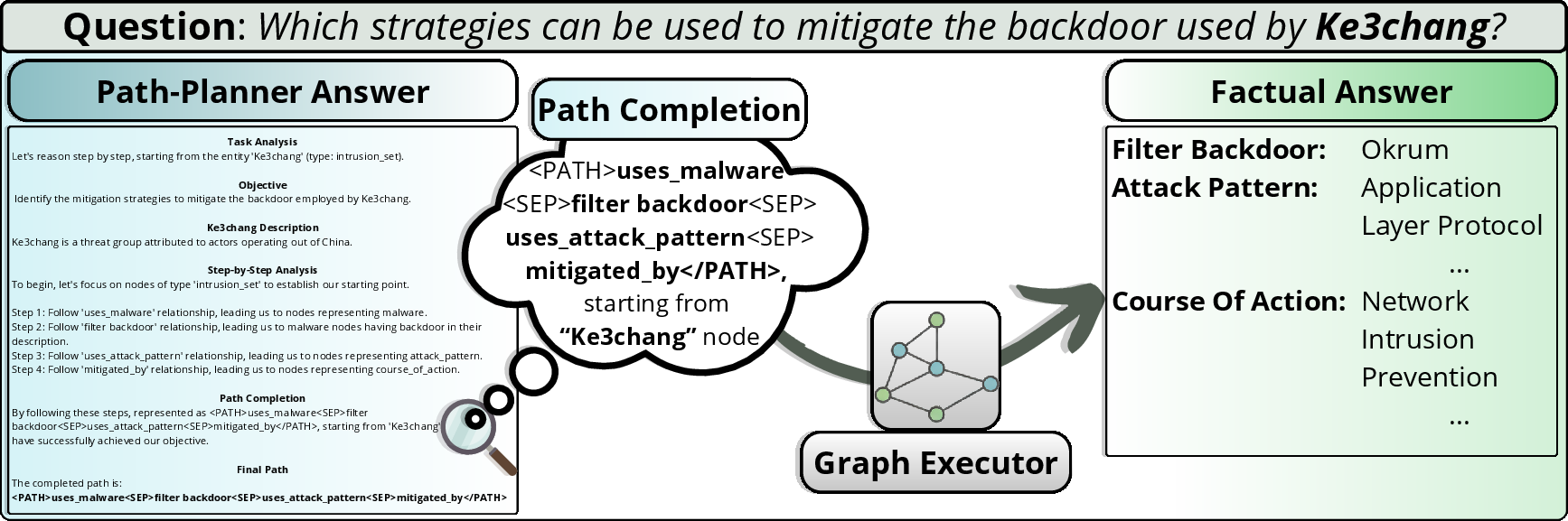
Figure 1: TITAN Framework
The TITAN framework is composed of two primary components: a path planner, which is a LLM tasked with predicting logical relational paths, and a graph executor, which traverses these paths to retrieve answers. This setup enables TITAN to handle natural-language cyber threat queries with precision by automatically determining the reasoning paths needed to answer them.
The Role of TITAN Ontology
The TITAN Ontology underpins the entire framework, providing a typed, bidirectional schema that differentiates between various cybersecurity entities and their interrelations (Figure 2). This ontological structure supports clear semantic navigation and rationalization from causes to effects within the CTI domain.
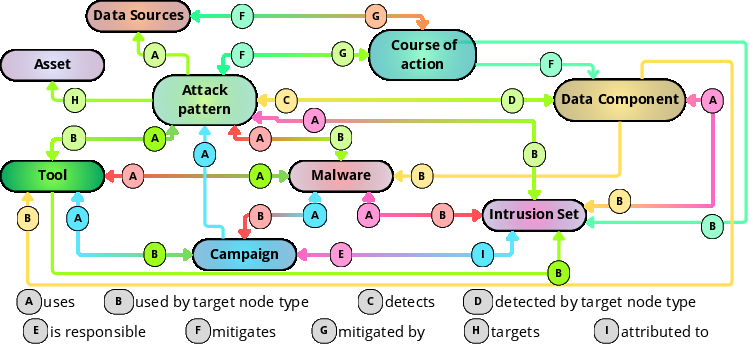
Figure 2: TITAN Ontology Structure
Specifically, the ontology includes entities like Attack Patterns, Malware, Tools, Courses of Action, and others, each representing critical abstraction levels within CTI. The ontology's design ensures that relations between these entities are both explicit and directional, thereby facilitating transparent and effective reasoning over the graph.
TITAN Dataset
To effectively train and evaluate the system, the authors developed the TITAN Dataset, an expansive corpus of 88,209 examples that pairs natural-language questions with executable reasoning paths and Chain-of-Thought (CoT) explanations. This dataset is pivotal for demonstrating the framework’s capability to perform reasoning over the knowledge graph. It further aids in training the path planner to generate paths that are both syntactically valid and semantically coherent, thereby improving model performance on complex, multi-hop CTI queries.
Experimental Evaluation
The empirical evaluation of the TITAN framework focuses on path accuracy and the efficacy of reasoning abilities. The results indicate that the incorporation of explicit CoT reasoning within the TITAN framework substantially improves path accuracy, especially for queries involving complex reasoning paths (categories L2-L4+). CoT-enabled models consistently outperform those without CoT support, exemplifying the importance of structured reasoning processes in deriving accurate outputs from the graph.
Moreover, the use of numeric metrics like ROUGE, BLEU, and BERTScore to measure the quality of reasoning outputs highlights that CoT-enhanced explanations maintain a high degree of linguistic and semantic alignment with the reference outputs, underscoring the robustness of the TITAN framework.
Implications and Future Directions
The implications of the TITAN framework are significant for both practical applications in cybersecurity and theoretical advancements in knowledge graph reasoning. Practically, TITAN enhances the capability to autonomously navigate and infer accurate information from vast CTI datasets. Theoretically, it introduces a refined method to integrate machine learning models with knowledge graphs, paving the way for future systems that demand high degrees of interpretability and flexibility.
Future developments could focus on enriching the knowledge graph with live threat intelligence inputs and expanding the ontology to cover more complex cybersecurity scenarios. Additionally, there is potential for applying reinforcement learning techniques to further align the path planner's predictions with expert human reasoning patterns, thereby improving overall system performance.
Conclusion
In summary, the TITAN framework represents a significant advancement in CTI, providing a mechanism for improved automatic reasoning and evidence retrieval via graph-execution. Its integration of an explicit reasoning framework with a dynamically navigable knowledge graph marks a crucial step forward in cybersecurity intelligence, offering a robust foundation for future innovations in the field.