- The paper presents a physics-inspired framework to model information diffusion, revealing critical thresholds and universal scaling in news and rumors.
- It integrates complex network models, percolation theory, and epidemic processes to capture empirical features of online media ecosystems.
- The study highlights mitigation strategies against misinformation through targeted node analysis and adaptive algorithmic interventions.
The Physics of News, Rumors, and Opinions: A Technical Synthesis
Introduction and Motivation
The paper "The Physics of News, Rumors, and Opinions" (2510.15053) presents a comprehensive review of the application of statistical physics and network science to the study of information diffusion, opinion dynamics, and the emergence of collective phenomena in socio-technical systems. The authors argue that the complexity of modern information ecosystems—characterized by heterogeneous, time-varying networks and active, adaptive agents—necessitates a quantitative, physics-inspired approach to understand, predict, and potentially control the spread of news, rumors, and opinions, including the dynamics of misinformation.
Structural Foundations: Complex Networks
A central premise is that social systems are best modeled as complex networks, where nodes represent individuals or entities and edges encode interactions or information pathways. The review systematically covers the empirical properties of real-world networks, including heavy-tailed degree distributions, small-world effects, high clustering, community structure, and assortativity. These features fundamentally shape the pathways and thresholds of information diffusion.
The paper details a hierarchy of network models:
- Random Graphs and Configuration Models: Capture baseline connectivity but fail to reproduce clustering and degree heterogeneity.
- Exponential Random Graph Models (ERGMs) and Maximum Entropy Ensembles: Provide principled null models for statistical inference and significance testing.
- Generative Mechanistic Models: Such as preferential attachment (Barabási–Albert), triadic closure, and homophily-driven rewiring, which explain the emergence of hubs, communities, and echo chambers.
- Latent Space and Geometric Models: Account for similarity and navigability, crucial for understanding decentralized search and routing.
The review emphasizes the importance of maximum-entropy null models as unbiased statistical benchmarks for detecting nontrivial mesoscale structures, such as echo chambers and discursive communities.
Physical Models of Social Dynamics
The authors present a taxonomy of dynamical models, drawing analogies between social and physical systems:
- Percolation and Branching Processes: Used to analyze critical thresholds for global connectivity and the emergence of giant components in information diffusion.
- Epidemic-like Compartmental Models (SI, SIS, SIR): Adapted to model the spread of information, rumors, and behaviors, with extensions to account for network heterogeneity (HMF, QMF) and temporal dynamics.
- Diffusion, Random Walks, and Navigation: Capture exploratory information flow and the role of network topology in facilitating or impeding spread.
- Threshold and Cascade Models: Linear Threshold Model (LTM) and Independent Cascade Model (ICM) formalize simple and complex contagion, with submodular variants enabling efficient influence maximization.
- Spin Models and Synchronization: Ising and Kuramoto-type models are used to study consensus, polarization, and critical phenomena in opinion dynamics.
The review highlights the universality of phase transitions, criticality, and scaling laws, drawing direct parallels to phenomena in statistical mechanics.
The paper provides a detailed comparative analysis of major online platforms (X/Twitter, Facebook, Reddit, Instagram, Weibo, WhatsApp/Telegram), focusing on their network representations, data affordances, and the challenges of data access, privacy, and ethical constraints. The authors discuss the emergence of information disorders—misinformation, disinformation, and mal-information—and their amplification via platform algorithms, bots, and coordinated campaigns.
The review distinguishes between simple contagion (single exposure suffices) and complex contagion (multiple exposures or reinforcement required), emphasizing the role of cognitive and behavioral mechanisms such as memory, attention, and confirmation bias. The authors synthesize findings from both analytical models and large-scale empirical studies, demonstrating:
- The critical role of network topology (hubs, k-core, community structure) in determining cascade size and reach.
- The emergence of "hidden influentials"—nodes with high spreading power not necessarily correlated with degree.
- The impact of temporal heterogeneity (burstiness, non-Markovianity) and adaptive coevolution of network structure and state.
- The universality of critical exponents and scaling laws in cascade size and duration distributions, supporting the hypothesis that social systems often operate near criticality.
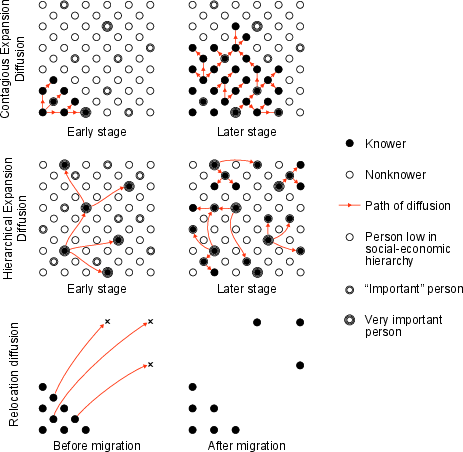
Figure 1: Models of cultural diffusion, illustrating relocation, contagious expansion, and hierarchical expansion diffusion mechanisms.
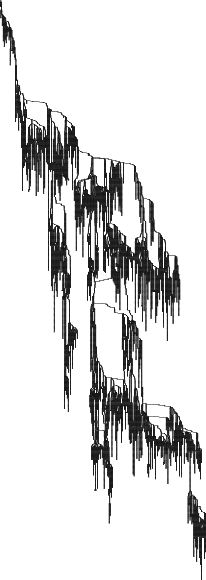
Figure 2: Visualization of a real-world information cascade from an email chain letter, highlighting the depth and branching structure of social contagion.
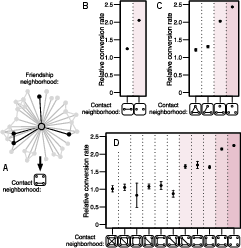
Figure 3: Empirical evidence for the importance of structural diversity in adoption, showing that the number of disconnected clusters among inviters predicts conversion rates.
A significant portion of the review is devoted to the distinct dynamics of misinformation, characterized by:
- Faster, deeper, and broader spread compared to reliable information, driven by novelty, emotional salience, and algorithmic amplification.
- The role of bots and coordinated inauthentic behavior in seeding and amplifying false narratives.
- The concentration of exposure and amplification among a small fraction of users, often forming tightly connected clusters.
The authors survey advanced modeling frameworks for misinformation, including:
- Multiplex and Competing Contagion Models: Capture the interplay between misinformation and corrective information (fact-checking), revealing metacritical points and backfire effects.
- Non-Markovian and Memory-Aware Models: Account for the persistence of false beliefs and the continued influence effect.
- Reversible Bootstrap Percolation: Model the hysteresis and irreversibility of entrenched misinformation.
Mitigation strategies discussed include optimal seeding and node removal (influence minimization), algorithmic interventions (feed modification, demotion of reshared content), and advanced bot detection using feature-based and graph-based machine learning.
Opinion Dynamics: Discrete, Continuous, and Coevolutionary Models
The review covers the major paradigms in opinion dynamics:
- Discrete Models: Voter, majority rule, and Sznajd models, with extensions to account for group-size effects (q-voter), nonlinearity, and noise (noisy voter).
- Continuous Models: Deffuant-Weisbuch and Hegselmann-Krause models, focusing on bounded confidence and the emergence of consensus, polarization, and fragmentation. The role of bifurcation diagrams and the sensitivity to initial conditions and network topology are emphasized.
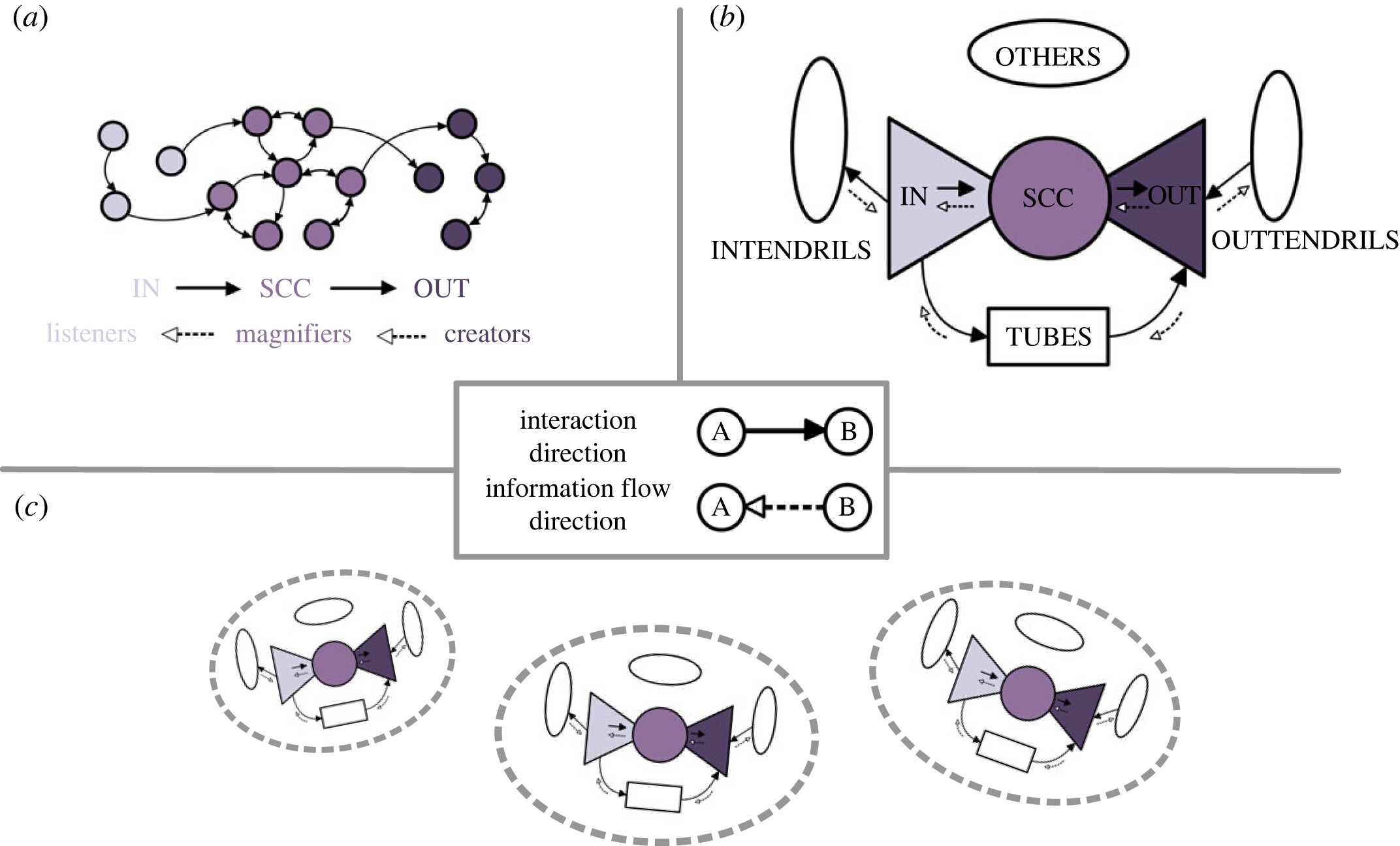
Figure 4: Bow-tie structure in online social networks, illustrating the organization into core (SCC), IN, OUT, and tendril components.
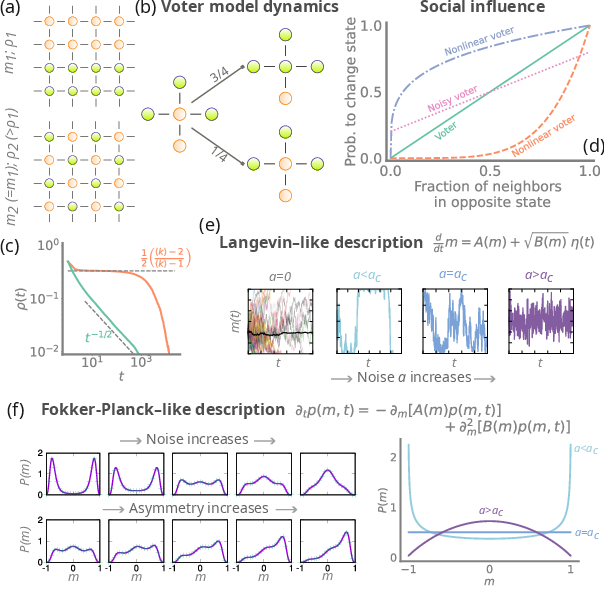
Figure 5: Physically-inspired metrics for opinion dynamics, including magnetization and density of active links, and sketches of voter model update rules and consensus formation.
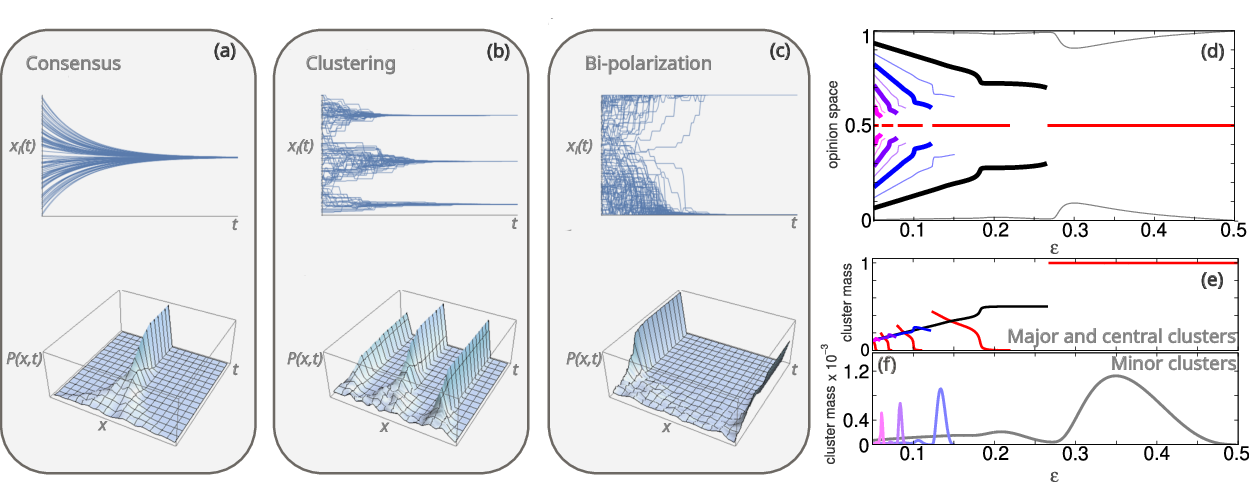
Figure 6: Outcomes for the Deffuant-Weisbuch model as a function of tolerance parameter ϵ, showing consensus, clustering, and polarization, with associated bifurcation diagrams.
- Coevolutionary Models: Address the feedback between opinion dynamics and network rewiring, leading to fragmentation transitions and the formation of echo chambers. The review presents analytical and simulation results on the critical rewiring probability and the scaling of fragmentation time.
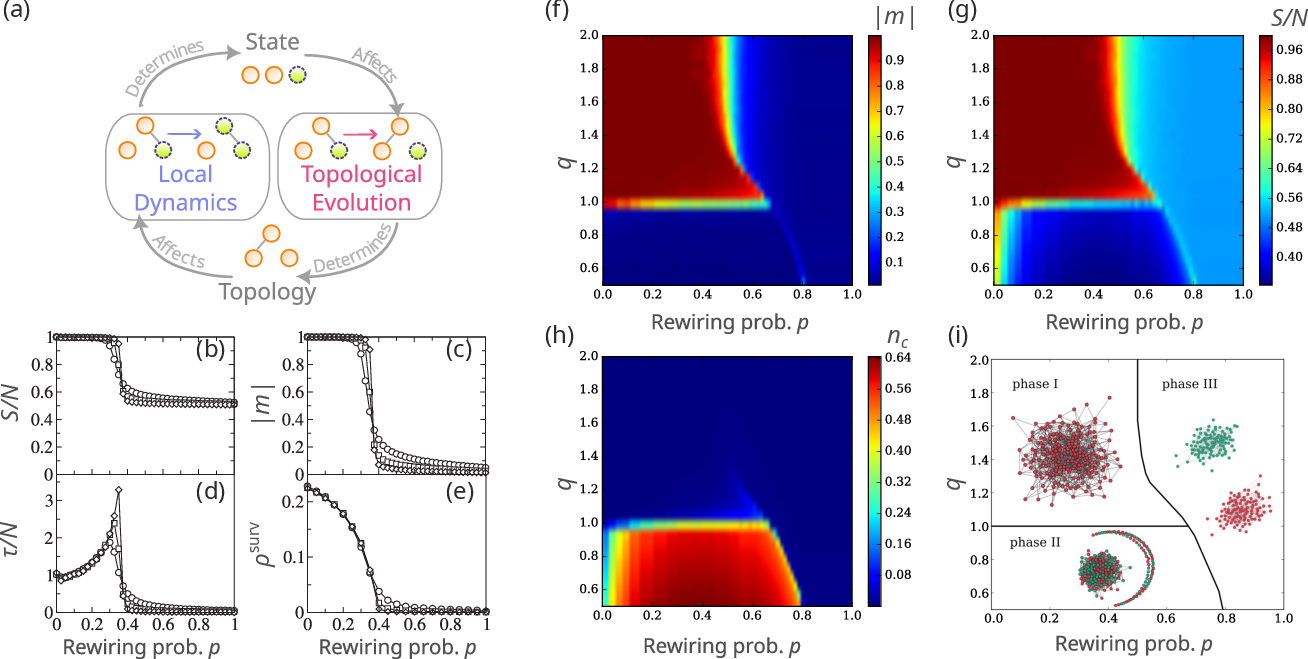
Figure 7: Feedback logic in coevolving adaptive processes, with phase diagrams showing fragmentation transitions as a function of rewiring probability and nonlinearity.
- Temporal and Memory Effects: The impact of burstiness, aging, and non-Markovian activation patterns on consensus formation and the universality class of the dynamics.
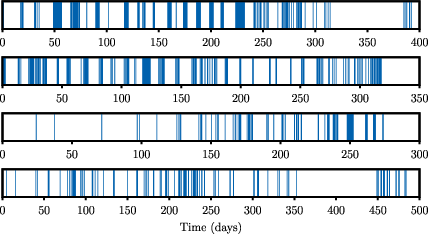
Figure 8: Activity patterns between Twitter user pairs, illustrating bursty, heterogeneous interevent times.
Implications and Future Directions
The review demonstrates that statistical physics provides a rigorous, quantitative framework for understanding the collective dynamics of information and opinions in complex socio-technical systems. Theoretical implications include the identification of universality classes, critical thresholds, and scaling laws that transcend platform-specific details. Practically, the insights inform the design of interventions for misinformation mitigation, the detection of structural vulnerabilities, and the optimization of information campaigns.
The authors highlight several open challenges:
- Integrating cognitive and behavioral heterogeneity into large-scale, predictive models.
- Developing scalable, cross-platform data pipelines for empirical validation.
- Designing interventions that balance efficacy, scalability, and ethical considerations, especially in the context of rapidly evolving generative AI and synthetic media.
Conclusion
This review establishes a unified, physics-based perspective on the dynamics of news, rumors, and opinions, demonstrating that the interplay of network structure, individual behavior, and platform algorithms gives rise to emergent collective phenomena analogous to those in physical systems. The synthesis of empirical findings, theoretical models, and methodological innovations provides a robust foundation for future research and policy interventions aimed at fostering a more resilient and informed digital society.