Re-Activating Frozen Primitives for 3D Gaussian Splatting
Published 21 Oct 2025 in cs.CV | (2510.19653v1)
Abstract: 3D Gaussian Splatting (3D-GS) achieves real-time photorealistic novel view synthesis, yet struggles with complex scenes due to over-reconstruction artifacts, manifesting as local blurring and needle-shape distortions. While recent approaches attribute these issues to insufficient splitting of large-scale Gaussians, we identify two fundamental limitations: gradient magnitude dilution during densification and the primitive frozen phenomenon, where essential Gaussian densification is inhibited in complex regions while suboptimally scaled Gaussians become trapped in local optima. To address these challenges, we introduce ReAct-GS, a method founded on the principle of re-activation. Our approach features: (1) an importance-aware densification criterion incorporating $\alpha$-blending weights from multiple viewpoints to re-activate stalled primitive growth in complex regions, and (2) a re-activation mechanism that revitalizes frozen primitives through adaptive parameter perturbations. Comprehensive experiments across diverse real-world datasets demonstrate that ReAct-GS effectively eliminates over-reconstruction artifacts and achieves state-of-the-art performance on standard novel view synthesis metrics while preserving intricate geometric details. Additionally, our re-activation mechanism yields consistent improvements when integrated with other 3D-GS variants such as Pixel-GS, demonstrating its broad applicability.
The paper introduces ReAct-GS, which re-activates frozen primitives using an adaptive mechanism to mitigate over-reconstruction artifacts.
It applies an importance-aware densification criterion to weight gradient contributions from key viewpoints, ensuring fine detail preservation and geometric consistency.
Experimental results demonstrate significant improvements in novel view synthesis metrics, highlighting enhanced rendering quality and robustness across diverse datasets.
Re-Activating Frozen Primitives for 3D Gaussian Splatting
Introduction and Motivation
3D Gaussian Splatting (3D-GS) has become a leading paradigm for explicit, point-based neural scene representation, offering real-time photorealistic novel view synthesis with high computational efficiency. Despite its success, 3D-GS exhibits persistent over-reconstruction artifacts—manifesting as local blurring and needle-shape distortions—especially in complex or unbounded scenes. Prior work has primarily attributed these issues to insufficient splitting of large-scale Gaussians and has proposed aggressive densification strategies. However, these approaches often result in premature fragmentation, geometric inconsistencies, and fail to address the root causes of over-reconstruction.
This paper identifies two fundamental limitations in the 3D-GS pipeline: gradient magnitude dilution during densification and the primitive frozen phenomenon, where certain Gaussians become trapped in local optima and cease to contribute to scene refinement. The authors introduce ReAct-GS, a method that systematically addresses these limitations via an importance-aware densification criterion and an adaptive re-activation mechanism for frozen primitives.
Analysis of Over-Reconstruction in 3D-GS
The over-reconstruction problem in 3D-GS is characterized by the inability to accurately represent high-frequency details and complex textures, leading to blurring and geometric artifacts. The paper provides a detailed analysis of the limitations of existing densification strategies:
Gradient Magnitude Dilution: The standard approach averages the gradient magnitudes of a primitive across all viewpoints, which can suppress critical growth signals from dominant perspectives. This averaging dilutes the influence of viewpoints where a primitive is most important for rendering, stalling densification in regions that require fine detail.
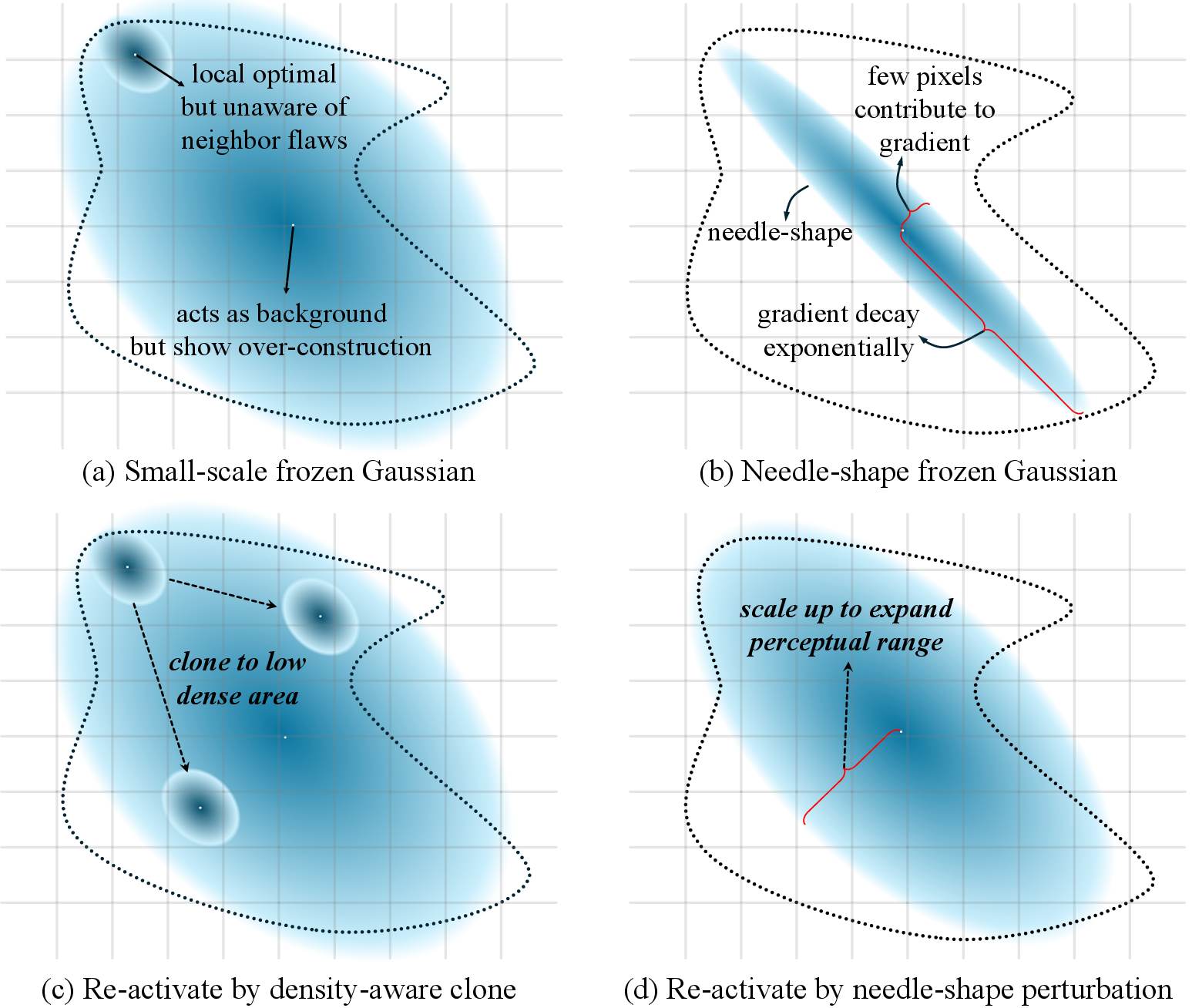
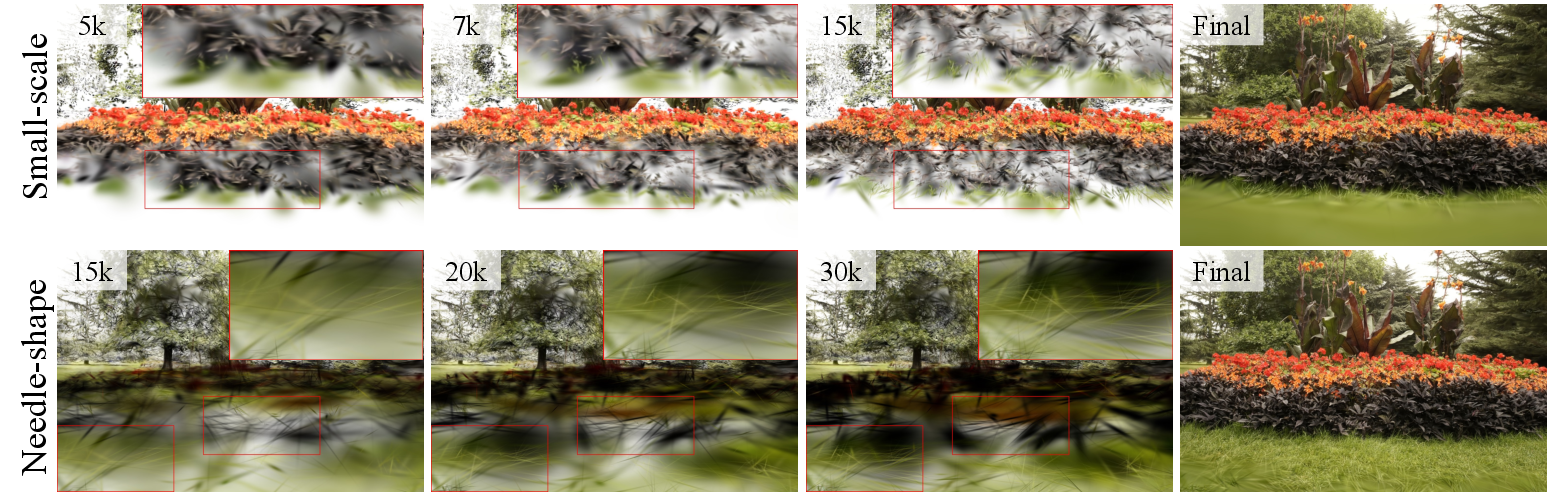
Primitive Frozen Phenomenon: Small-scale and needle-shape Gaussians often converge rapidly and become "frozen," with their contracted receptive fields and attenuated gradients preventing further optimization. These primitives persist as artifacts, as their gradients are too weak to trigger further densification or refinement.
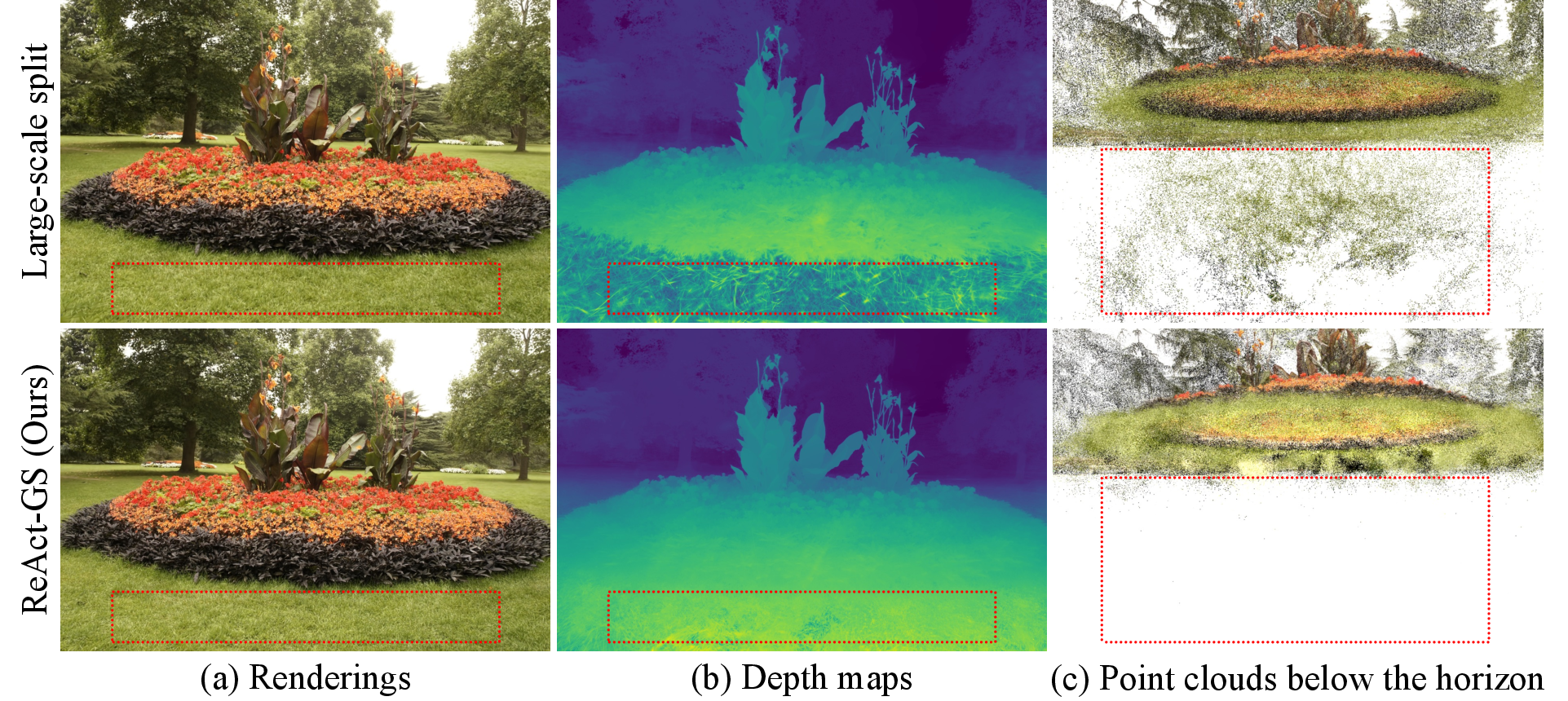
Figure 1: Visualization of renderings, depth maps, and point cloud distributions in an unbounded 3D scene. Abs-GS, which relies on large-scale splitting, leads to ill-positioned Gaussian growth in complex regions.
Importance-Aware Densification
To address gradient magnitude dilution, the authors propose an importance-aware densification criterion. This approach weights the gradient contributions from each viewpoint by the primitive's α-blending importance, ensuring that viewpoints where the primitive plays a significant rendering role have a proportionally larger influence on densification decisions.
Mathematically, for a Gaussian Gi and viewpoint k, the importance-aware gradient is computed as:
where ωik is the normalized rendering weight of Gi in viewpoint k.
This criterion ensures that densification is triggered in regions where a primitive is critical for rendering, even if its average gradient across all views is low. The normalization by the number of projected pixels prevents bias toward large-scale Gaussians, mitigating the risk of geometric inconsistencies.
Adaptive Re-Activation Mechanism
The primitive frozen phenomenon is addressed by an adaptive re-activation mechanism, which consists of two components:
Density-Guided Clone: For small-scale frozen primitives, the method clones and relocates them based on local density, using a K-nearest-neighbors approach to sample new positions in sparse regions. This enables the primitives to escape local optima and contribute to the representation of under-reconstructed areas.
Needle-Shape Perturbation: For needle-shape Gaussians, the method periodically perturbs their shape by magnifying the shorter principal axes, increasing their receptive field and enabling further optimization. This is applied at fixed intervals to minimize disruption to the overall optimization process.
Figure 2: Illustration of the primitive frozen phenomenon and the adaptive re-activation mechanism. (a) and (b) show the causes of freezing; (c) and (d) depict the re-activation strategies for small-scale and needle-shape primitives, respectively.
Figure 3: Visualization of the primitive frozen phenomenon across optimization stages. Small-scale Gaussians freeze locally during densification; needle-shape primitives persist post-densification.
Experimental Results
The method is evaluated on diverse real-world datasets, including Mip-NeRF 360, Tanks & Temples, and Deep Blending, with comprehensive comparisons against state-of-the-art NeRF-based and Gaussian Splatting methods. ReAct-GS consistently achieves superior performance across all standard novel view synthesis metrics (PSNR, SSIM, LPIPS), while maintaining comparable or lower memory consumption.
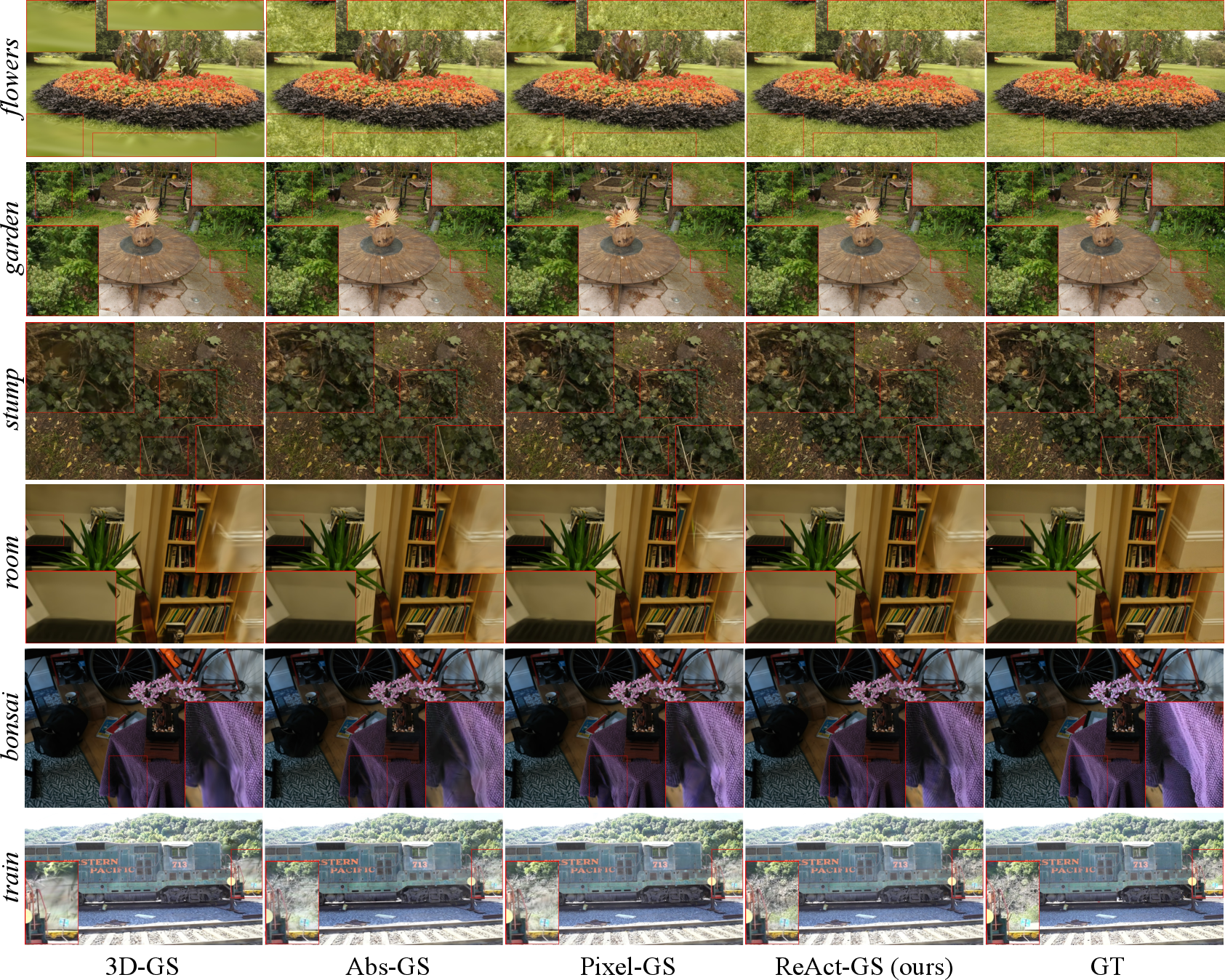
Qualitative results demonstrate that ReAct-GS effectively eliminates over-reconstruction blur and preserves fine geometric details, particularly in challenging high-frequency regions and at object boundaries.
Figure 4: Qualitative comparisons of different methods on scenes from the Mip-NeRF 360 and Tanks & Temples datasets. Close-up views highlight challenging areas with high-frequency details.
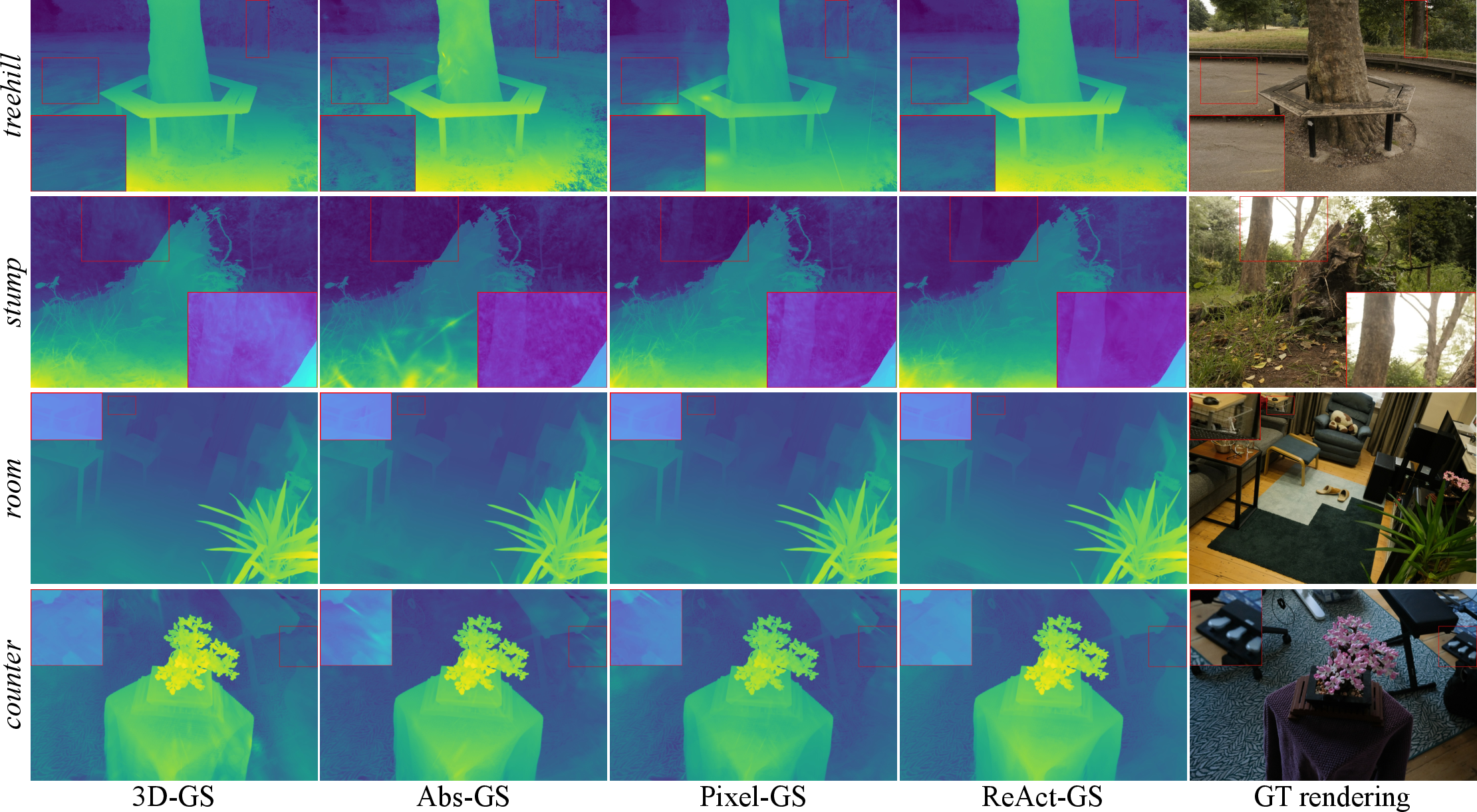
Figure 5: Comparison of depth map renderings across different methods on indoor/outdoor scenes from the Mip-NeRF 360 dataset. Enlarged views highlight areas where geometric consistency is crucial.
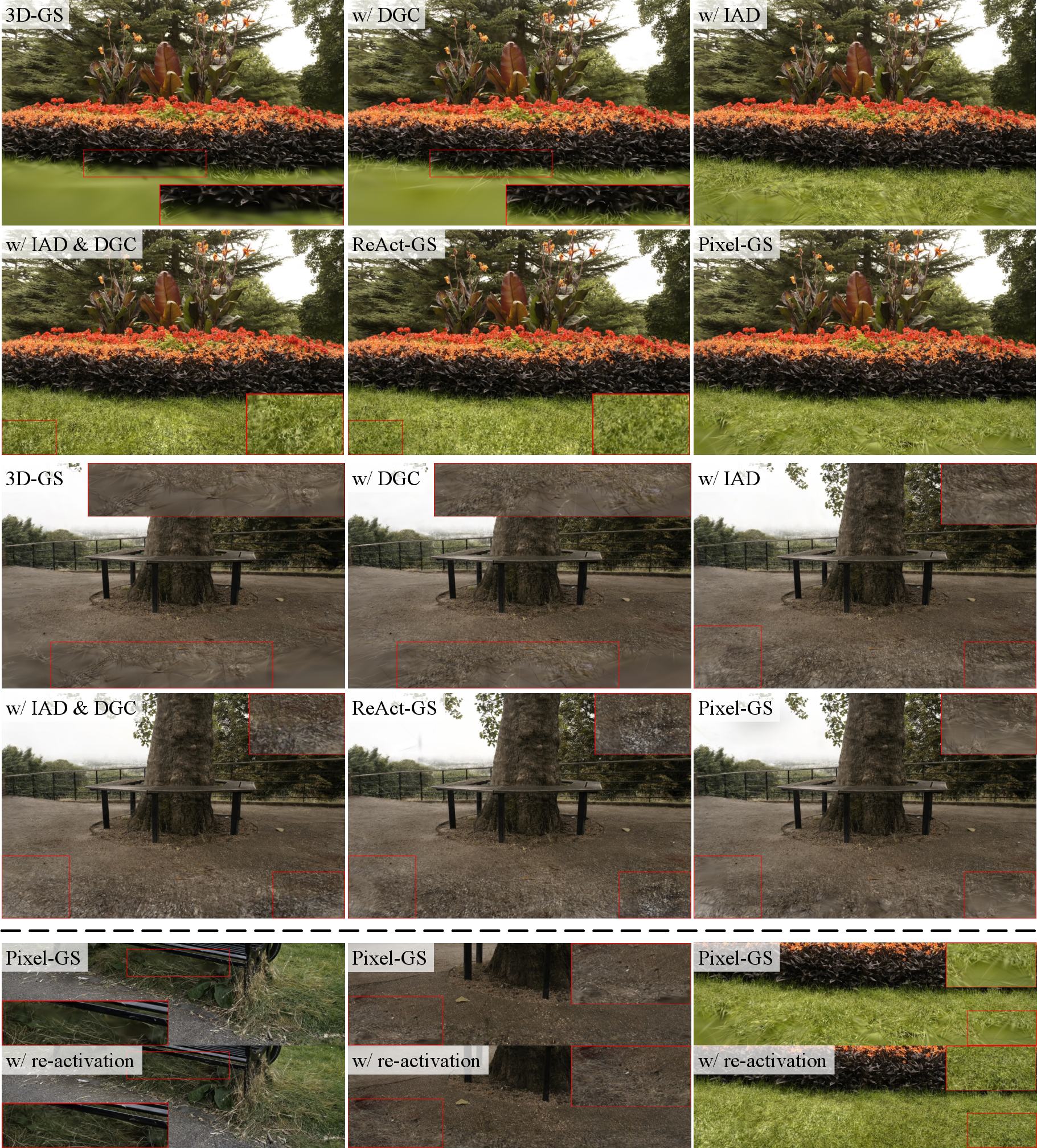
Ablation studies confirm the necessity and effectiveness of each proposed module. The importance-aware densification provides a substantial boost in rendering quality, while the re-activation mechanism resolves persistent artifacts that remain after densification alone. Notably, integrating the re-activation mechanism into other 3D-GS variants, such as Pixel-GS, yields consistent improvements, demonstrating the broad applicability of the approach.
Figure 6: Visualization of ablation experiments. Top: Visual improvements from each proposed module. Bottom: Performance enhancement of Pixel-GS when integrated with the re-activation mechanism.
Efficiency and Practical Considerations
ReAct-GS achieves these improvements with high parameter efficiency and moderate computational overhead. The method strategically densifies only in critical regions and recycles frozen primitives, avoiding unnecessary parameter inflation. Training times remain competitive with prior methods, and the approach is compatible with standard 3D-GS engines and hardware.
The method's modular design facilitates integration with existing 3D-GS pipelines and variants, making it suitable for deployment in real-world applications requiring high-fidelity, real-time 3D reconstruction and rendering.
Implications and Future Directions
The identification of gradient magnitude dilution and the primitive frozen phenomenon as fundamental bottlenecks in 3D-GS optimization provides a new perspective on the limitations of point-based neural representations. The proposed importance-aware densification and adaptive re-activation mechanisms offer a principled solution that generalizes across different architectures and scene complexities.
Practically, these advances enable more robust and accurate 3D scene reconstruction in challenging environments, with direct implications for VR/AR, robotics, and large-scale digital twin applications. Theoretically, the work suggests that further progress in explicit neural representations will require continued attention to the dynamics of optimization and the interplay between local and global scene structure.
Future research may explore more sophisticated re-activation strategies, adaptive scheduling of perturbations, and integration with pruning or compression techniques to further enhance efficiency. Additionally, extending these principles to dynamic scenes and multi-modal data remains an open and promising direction.
Conclusion
This paper provides a rigorous analysis of the over-reconstruction problem in 3D Gaussian Splatting and introduces ReAct-GS, a method that combines importance-aware densification with an adaptive re-activation mechanism for frozen primitives. The approach achieves state-of-the-art performance in novel view synthesis and geometric reconstruction, with strong parameter efficiency and transferability. The findings have significant implications for both the practical deployment and theoretical understanding of point-based neural scene representations.