- The paper provides a novel QFT-based framework showing that classical gravity can induce quantum entanglement.
- It proposes experimental setups with massive superpositions to test gravitationally-induced entanglement.
- It quantifies classical versus quantum gravity effects, offering a new avenue to potentially unify gravity with quantum mechanics.
Classical Theories of Gravity Produce Entanglement
The paper "Classical Theories of Gravity Produce Entanglement" addresses the intriguing question of whether classical theories of gravity can inherently generate quantum entanglement under certain conditions. It explores the implications of gravitational interactions on quantum systems, providing an analysis that extends traditional theorems to include quantum field theory (QFT) frameworks.
Unification of Gravity and Quantum Mechanics
The unification of gravity with quantum mechanics has eluded scientists, who have successfully combined other fundamental forces with quantum theory. The paper discusses an experimental setup, inspired by Richard Feynman's thought experiment, wherein massive objects placed in quantum superpositions interact gravitationally. If these interactions lead to entanglement between the objects, it could suggest that gravity has quantum properties.
Extending Classical Theories with Quantum Field Theory
The authors extend previous classical gravitational interaction models by incorporating QFT. This approach allows classically described gravity to transmit quantum information, leading to the generation of entanglement through local processes. The key finding is that such entanglement scales differently from quantum gravity predictions, providing a novel parameter regime to test in experiments.
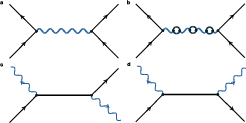
Figure 1: Feynman diagrams for QED or linear quantum gravity, illustrating photon or graviton interactions with matter.
Experimental Proposals
The feasibility of observing gravitationally-induced entanglement is supported by several experimental designs utilizing quantum technologies, such as matter-wave interferometry. The paper references ongoing advancements and proposals to empirically test these effects by manipulating massive particles into superpositions, ensuring any resulting entanglement can be attributed to gravitational interactions.
Perturbative Classical Gravity
Within the framework of QFT, this perturbative perspective on classical gravity allows for quantum communication across gravitational interactions. Through diagrams similar to those used in quantum electrodynamics (QED), the paper visualizes how virtual particles play a role in these interactions, despite the absence of quantized graviton exchange in classical gravity scenarios.
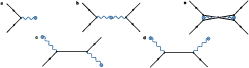
Figure 2: Diagrams representing the impact of virtual particles and classical fields/potentials on gravitational interactions.
Implications for Quantum Communication
A central argument posited is that classical theories can indeed facilitate quantum communication through virtual matter processes. This challenges assumptions that classical gravitational interactions are limited to classical information transfer, opening pathways for alternative mechanisms of entanglement that are independent of quantized gravitational fields.
Feynman's Experiment Revisited
A practical setup derived from Feynman's original thought experiment involves testing entanglement generated through gravitational interactions of massive spherical objects in superpositions. By analyzing these interactions, new insights into the potential quantum nature of gravity can be deduced, potentially challenging the no-go theorems that restrict classical gravity's role in entanglement production.
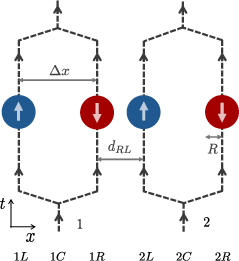
Figure 3: Visualization of a Feynman-inspired experiment, demonstrating potential gravitationally-induced entanglement scenarios.
Classical vs. Quantum Gravity Effects
The paper quantifies both classical and quantum gravity effects, suggesting that certain mass and distance parameters could reveal the underlying mechanism at play. Entanglement observed in experiments will need careful analysis of these effects to determine if the cause aligns with classical or quantum gravitational models.
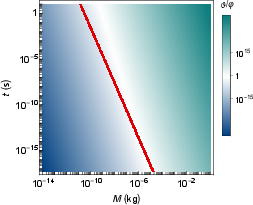
Figure 4: Comparison of effects, showing relative strength over various mass and time scales for gravitational experiments.
Conclusion
This research provides a foundational step toward understanding the potential quantum capabilities embedded within classical gravitational theories. By exploiting quantum field theoretical models, it demonstrates that classical gravity, under specific conditions, can indeed facilitate quantum activities like entanglement. Future experiments are crucial to verifying these predictions and distinguishing between classical and quantum gravitational interactions—a step closer to unifying gravity with quantum mechanics in a comprehensive theoretical framework.