- The paper presents HAPS as a cost-effective, energy-efficient node that bridges terrestrial networks with NTNs, offering low latency and wide coverage.
- The paper employs comparative analysis and advanced simulations to assess performance trade-offs among HAPS, LEO satellites, TN, and UAVs.
- The paper identifies key challenges and future research directions for HAPS integration, including spectrum sharing, mobility management, and AI-driven network control.
Bridging Earth and Space: A Survey on HAPS for Non-Terrestrial Networks
Introduction and Motivation
The integration of Terrestrial Networks (TN) and Non-Terrestrial Networks (NTN) is a central theme in the evolution toward 6G wireless systems, aiming to deliver ubiquitous, high-capacity, and low-latency connectivity. High-Altitude Platform Stations (HAPS), operating in the stratosphere (20–50 km), are positioned as a critical NTN node, complementing both TN and other NTN elements such as Low Earth Orbit (LEO) satellites and Unmanned Aerial Vehicles (UAVs). HAPS offer quasi-stationary positioning, wide-area coverage, low-latency, and energy-efficient operation, making them suitable for bridging connectivity gaps, supporting massive IoT, dynamic backhauling, and enabling advanced services such as URLLC and immersive applications.
Comparative Analysis: HAPS vs. TN, LEO, and UAV
HAPS platforms provide a unique trade-off between coverage, latency, operational flexibility, and cost. Unlike TN, which is limited by ground infrastructure and high deployment costs in remote areas, HAPS can rapidly extend coverage with lower operational costs. Compared to LEO satellites, HAPS offer lower latency and higher per-user data rates due to proximity to the ground and better spatial reuse. UAVs, while highly flexible, suffer from limited endurance and payload constraints; HAPS overcome these with solar-powered, weeks-to-months operational lifetimes and moderate-to-high payload capacities.
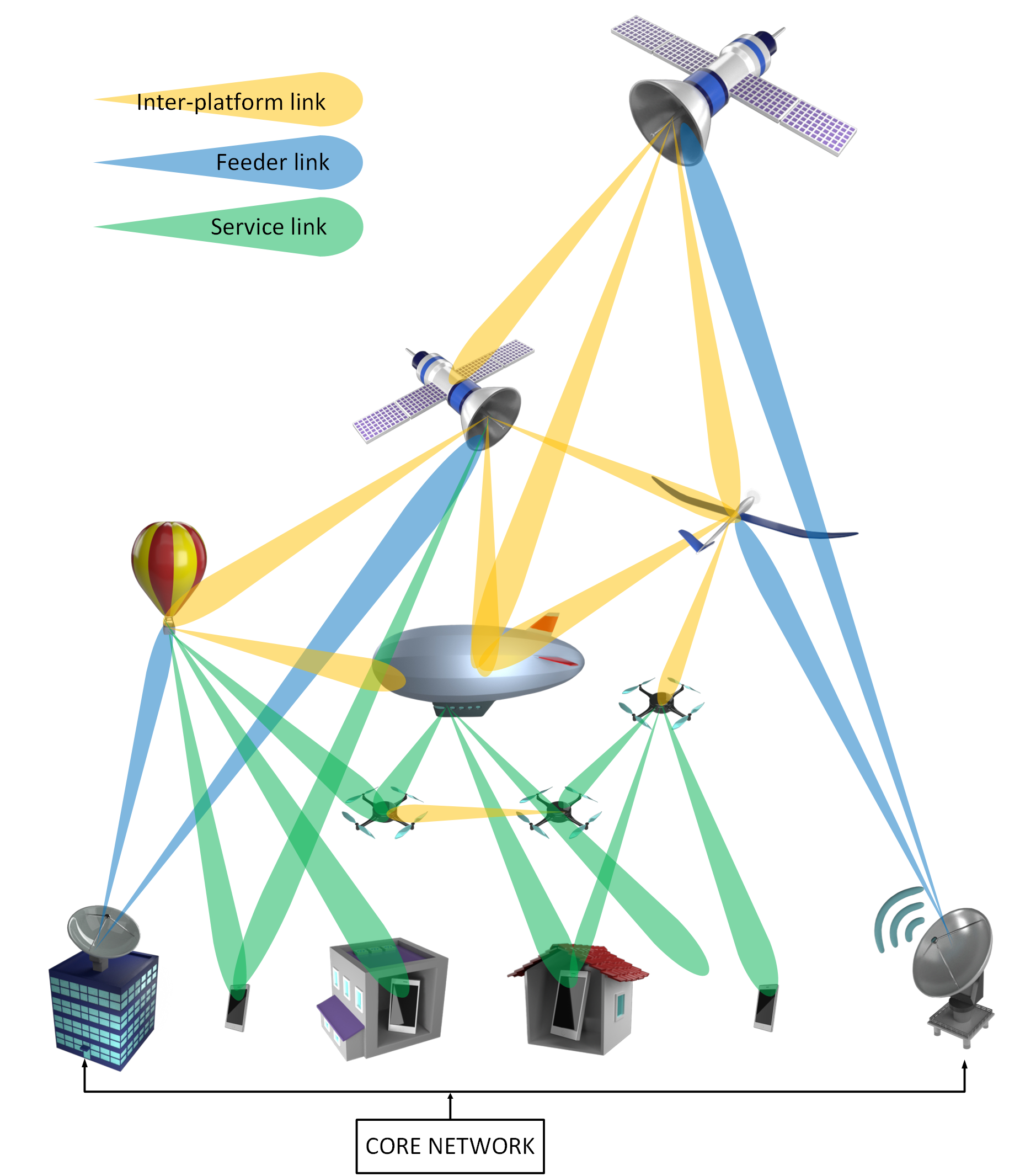
Figure 1: General NTN representation, illustrating the integration of space, aerial (HAPS/UAV), and ground layers for global connectivity.
HAPS Use Cases
Connectivity Enhancement
HAPS are instrumental in extending coverage to remote, rural, and disaster-affected regions, where TN infrastructure is impractical. They enable rapid deployment for emergency response, persistent surveillance, and real-time communication recovery. HAPS also address unexpected traffic events, providing on-demand capacity for large gatherings or dynamic urban environments, outperforming traditional small cell densification in flexibility and cost.
Network Infrastructure and Management
HAPS facilitate robust backhauling, leveraging near-line-of-sight (LoS) links with lower latency than satellite-based solutions. Hybrid RF/FSO architectures and multi-band backhaul strategies are emerging, with HAPS acting as aerial CPUs aggregating traffic from UAVs or terrestrial BSs. Handover management is improved via HAPS intermediaries, decoupling satellite mobility from ground procedures and reducing signaling overhead.
IoT, Edge Computing, and Emerging Applications
HAPS support massive IoT deployments with wide-area coverage and edge computing capabilities, enabling low-latency data processing for real-time applications. They function as aerial data centers, supporting AR/VR and vehicular edge computing (VEC), and facilitate collaborative frameworks with LEO satellites for optimized throughput and power efficiency.
Advanced Control and Special Applications
HAPS are well-suited for URLLC scenarios, such as remote driving and autonomous systems, due to their low-latency, high-reliability links. They also enable structured aerial highways for UAV control, providing backbone infrastructure for regulated airspace management.
Energy and Sustainability
HAPS contribute to energy-efficient network operation by offloading traffic from terrestrial macro BSs during low-demand periods, allowing TN infrastructure to enter low-power states. Simulation results indicate up to 29% weekly energy savings, with HAPS self-sufficiency via solar power further enhancing sustainability.
HAPS Architectures and Integration Strategies
HAPS platforms are categorized as aerostatic (balloons/airships), aerodynamic (fixed/rotary wing), or hybrid. Aerostatic platforms offer high payload and energy efficiency but are sensitive to weather; aerodynamic platforms provide mobility and resilience at higher cost and lower payload; hybrid designs balance these attributes but increase complexity.
Terminal Diversity
HAPS serve a broad spectrum of terminals: portable consumer devices, vehicular systems (with advanced antennas), and fixed IoT sensors. This diversity necessitates adaptable platform and gateway designs, with multi-band, multi-standard support for seamless TN–NTN handover and persistent connectivity.
Frequency Bands and Link Types
HAPS-enabled NTN architectures utilize a range of frequency bands:
- Sub-7 GHz (FR1): Robust coverage, limited data rates, direct satellite-to-UE links.
- cmWave (FR3): Improved throughput, manageable path loss, suitable for outdoor-to-indoor coverage.
- mmWave (FR2): Ultra-high data rates, short range, high susceptibility to blockage.
- Sub-THz/THz: Extreme bandwidth for backhaul/inter-platform links, limited by path loss and hardware constraints.
- FSO: Tbps backhaul, weather-dependent reliability.
Hybrid multi-band strategies are essential for balancing coverage, capacity, and resilience.
3GPP Architectures
Transparent (bent-pipe) and regenerative payloads define HAPS integration. Transparent architectures minimize onboard complexity but increase latency; regenerative payloads enable onboard processing, dynamic traffic management, and reduced round-trip time, at the cost of higher power and complexity. Recent 3GPP releases (Rel-17/18/19) standardize NTN operation, with regenerative architectures supporting advanced features such as store-and-forward for IoT and inter-platform handovers.
Key Enabling Technologies
Channel Modeling
HAPS channel modeling must account for stratospheric propagation, platform mobility, atmospheric effects, and non-stationarity. Advanced simulation techniques, ray tracing, and statistical models (e.g., Markov chains for fading states) are employed to predict path loss, delay spread, and Doppler effects across diverse environments and frequency bands.
Resource Management and User Association
Resource allocation (RA) in HAPS networks involves dynamic spatial–time–frequency coordination, spectrum sharing, and load balancing across multi-tier SAGIN architectures. Game-theoretic, RL-based, and optimization algorithms are used to maximize throughput, minimize interference, and adapt to user mobility and traffic patterns.
Multi-Link Connectivity and Mobility Management
Multi-connectivity (MC) frameworks, including CoMP and network-level MC, are critical for URLLC and high-mobility scenarios. Intelligent handover algorithms, predictive models, and graph-based approaches ensure seamless service continuity and minimize latency spikes.
Antenna Technologies
Massive MIMO, cylindrical/hemispherical arrays, and RIS integration enhance coverage, beamforming precision, and interference mitigation. Advanced precoding, null-forming, and spatial multiplexing techniques are deployed to optimize SINR and spectral efficiency.
Channel Estimation and Interference Control
Accurate channel estimation is vital for high-frequency operation; ML-based estimators, superimposed pilot sequences, and graph attention networks address channel variability and hardware impairments. Interference management leverages beamforming, ephemeris-based nulling, and coordinated scheduling to protect TN and NTN links.
Energy Efficiency
Energy-aware routing, adaptive power control, and trajectory optimization are central to sustainable HAPS operation. RL-based frameworks and federated learning approaches further reduce energy consumption and enhance system longevity.
Machine Learning and AI
ML/AI algorithms underpin topology management, RA, mobility prediction, and beamforming. RL, DRL, and federated learning are increasingly adopted for real-time optimization, privacy preservation, and scalable model training across distributed HAPS–LEO–TN networks.
Open Research Challenges
- Channel Modeling: Non-stationarity, environmental variability, and platform instability complicate accurate modeling.
- Spectrum Coordination: Efficient sharing and interference mitigation across congested bands.
- Mobility Management: Dynamic 3D positioning, seamless handovers, and low-latency protocols for time-sensitive applications.
- Interoperability: Unified standards and protocols for TN–NTN–HAPS integration.
- Energy Sustainability: Enhanced harvesting, storage, and power management for long-duration missions.
- Regulatory and Deployment Costs: Airspace management, collision avoidance, and scalable business models.
Conclusion
HAPS are positioned as intelligent, energy-efficient network nodes within standardized NTN frameworks, capable of bridging terrestrial and space-based infrastructures for 6G and beyond. Priorities for future research include multi-band operation strategies, cross-layer TN–NTN interoperability, AI-driven network control, sustainable platform design, and regulatory alignment. With continued innovation, HAPS can become a practical cornerstone of global wireless connectivity and a lever to narrow the digital divide.