- The paper introduces a variational quantum algorithm that transforms non-unitary dynamics into a weighted sum of unitary evolutions, enabling simulation on NISQ devices.
- It demonstrates accurate simulation of the dissipative Ising and interacting Hatano–Nelson models using parameterized quantum circuits and an optimized Hadamard test.
- Experimental results on a superconducting processor validate the method’s efficiency and scalability for exploring non-Hermitian many-body physics.
Variational Quantum Simulation of Many-Body Dissipative Dynamics on a Superconducting Quantum Processor
Introduction
The simulation of open quantum systems is a complex yet essential task due to the non-unitary nature of such dynamics and the exponential growth of the Hilbert space. The paper presents a variational quantum algorithm (VQA) capable of simulating non-unitary many-body dissipative dynamics, leveraging the linear combination of Hamiltonian simulation (LCHS) framework. By converting non-unitary dynamics into a weighted sum of unitary evolutions, the algorithm suits near-term quantum hardware, evidenced by implementation on a superconducting quantum processor for simulating models such as the dissipative transverse Ising and interacting Hatano-Nelson models.
Variational Quantum Simulation Algorithm
The VQA exploits the LCHS approach, where the non-Hermitian Hamiltonian is decomposed into unitary operators H=H0+iV, leading to e−iHt≈∑kckUk. The initial state undergoes evolution through parameterized quantum circuits (PQCs), evaluating the fidelity between the ansatz and time-evolved states using the Hadamard test. A significant advancement is the simplified quantum circuit design for the Hadamard test, reducing circuit depth and resources required on noisy intermediate-scale quantum (NISQ) devices.

Figure 1: Workflow of the variational quantum simulation algorithm, illustrating parameter sequences and hybrid quantum-classical loop.
Results
Simulating Dissipative Ising Model
The paper benchmarks the VQS algorithm on a dissipative Ising model using the Wukong superconducting quantum processor, focusing on spin dynamics under complex transverse fields. The experiments demonstrate accurate simulation of damped oscillations, consistent with theoretical predictions, validating the method's efficiency for near-term devices.
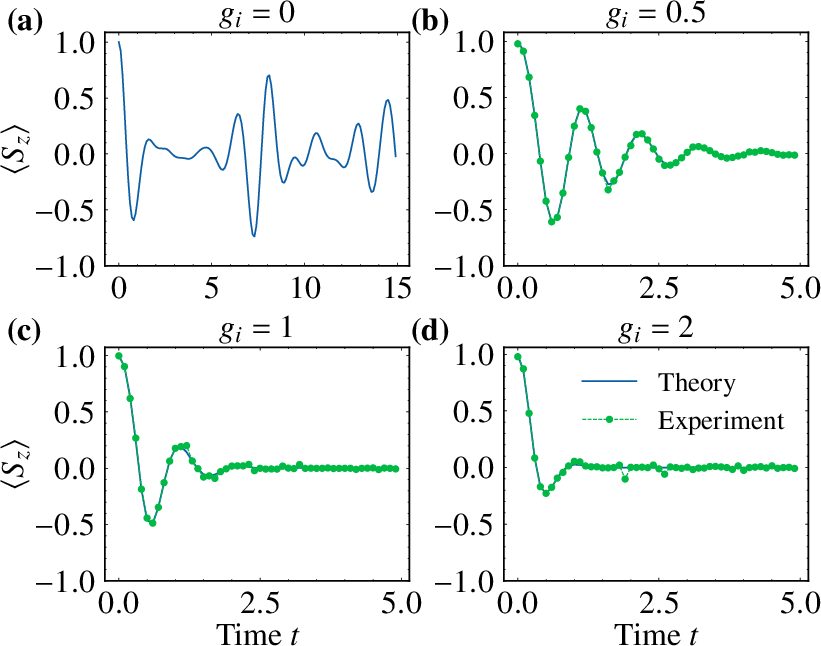
Figure 2: Simulating results of the dissipative Ising model with various $g_{\mathrm{i}$ values, comparing experimental data with theoretical predictions.
NHSE and Dynamic Symmetry of the Interacting Hatano–Nelson Model
Exploring the interacting HN model, the paper highlights its application in observing the many-body Non-Hermitian Skin Effect (NHSE) and dynamic symmetry. The experimental results achieved on a digital quantum simulator matched anticipated theoretical outcomes, showcasing the potential for scalable simulations and enhanced study of non-Hermitian physics at the many-body level.
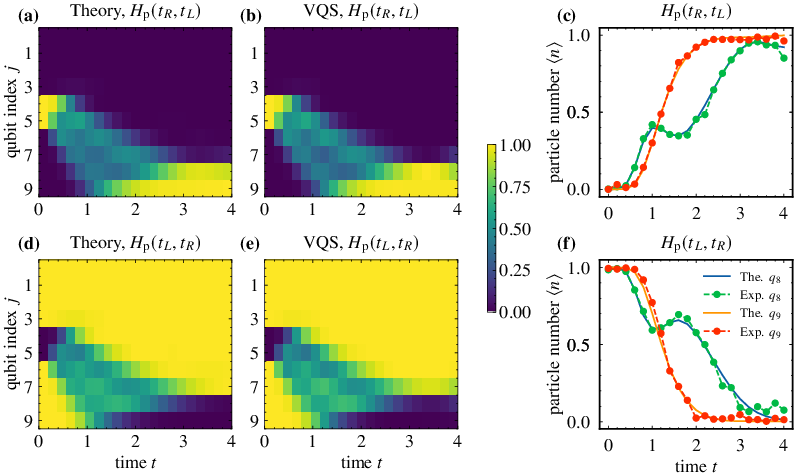
Figure 3: Simulation results of the interacting HN model, demonstrating particle-edge localization and agreement with theoretical expectations.
Discussion
The paper outlines the VQA's ability to simulate open quantum system dynamics efficiently and the optimization strategies to mitigate errors. The algorithm's dependency on LCHS allows it to handle non-unitary dynamics using unitaries, facilitating its implementation on NISQ devices. While current hardware limitations pose challenges, such as gate fidelity and noise, the simplification of the Hadamard test circuit is pivotal for robust performance. Future work may explore enhanced error mitigation and scaling techniques to further harness the potential of quantum simulations.
Conclusion
The experimental demonstration of a variational quantum simulation algorithm for many-body dissipative dynamics marks a significant advancement in quantum computing. The research underscores the feasibility of deploying VQAs for simulating complex non-unitary dynamics on current-generation quantum devices, paving the way for future explorations of quantum phenomena that remain classically intractable.