- The paper presents updated estimates showing a doubled anthropogenic mass influx from re-entry objects since 2015.
- It employs detailed elemental analysis of satellites and rocket stages to quantify metal contributions, with aluminum being dominant.
- The study highlights potential atmospheric impacts, including ozone depletion and altered radiative forcing, urging further interdisciplinary research.
Space Waste: An Update of the Anthropogenic Matter Injection into Earth's Atmosphere
The paper "Space Waste: An Update of the Anthropogenic Matter Injection into Earth's Atmosphere" explores the issue of space waste resulting from the re-entry of human-made objects such as satellites and rockets into Earth's atmosphere. This study analyzes the substantial increase in anthropogenic matter injected into Earth's mesosphere and lower thermosphere as space activities have surged, particularly due to large satellite constellations.
Introduction
With the rise of satellite constellations, the number of human-made objects entering low Earth orbit (LEO) has increased dramatically. These objects, after reaching the end of their operational lives, often re-enter Earth's atmosphere and ablate due to extreme temperatures, releasing various elements. This process injects a significant amount of anthropogenic matter into the atmosphere, notably exceeding natural meteoric injections for specific elements.
The implications of such a phenomenon are far-reaching, affecting atmospheric chemistry, ozone depletion, radiative forcing, and potentially altering cloud formation. Previous analyses have already indicated that human-made injections can surpass natural inputs for certain metals, affecting stratospheric aerosol composition and raising environmental concerns.
Mass Influx Estimates
The current study updates previous estimates, projecting data from 2015 through 2025. The annual mass influx to the atmosphere, differentiated by object types (satellites, rocket stages), has significantly increased since 2020.
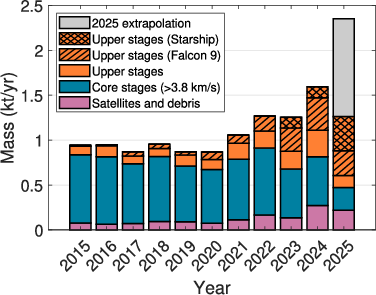
Figure 1: Annual mass influx to the top of the atmosphere, with differentiation of object type. The gray bar shows the mass influx expected for the rest of 2025 when extrapolating the current numbers (until July 16th 2025) to the end of year.
In 2024 alone, the anthropogenic mass injection doubled compared to 2015 levels. This rise is attributed to the increased launch activities primarily driven by satellite constellations, notably Starlink. Estimates for future scenarios predict even higher influxes by 2030, reaching levels comparable to predictions from previous studies.
Elemental Composition Analysis
A comprehensive analysis was conducted to assess the elemental composition of space waste. This involved detailed evaluations of satellites and rocket stages. Materials data, manufacturer insights, and literature contributed to average elemental compositions, providing more precise estimates than prior assessments.
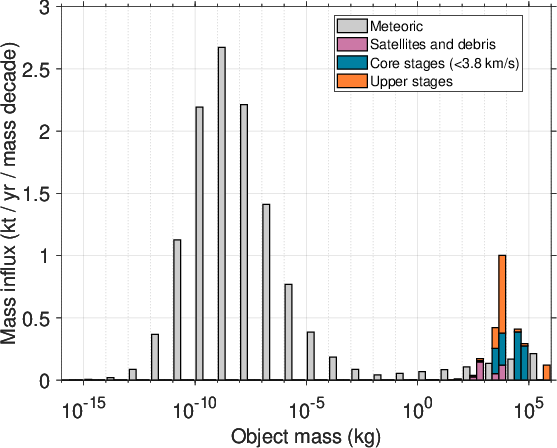
Figure 2: Variation of the annual mass influx to the top of the atmosphere with the object mass. The object mass is binned into mass decades. Three different mass influxes are shown.
Aluminum dominates the anthropogenic injection due to its prevalence in satellite structures. Other metals such as lithium, titanium, and transition metals also significantly impact atmospheric chemistry due to their catalytic properties.
Comparison with Natural Injection
The study compares anthropogenic injections with natural meteoric influxes. Certain metals such as aluminum, copper, and lithium show substantially higher anthropogenic concentrations compared to their natural contributions.
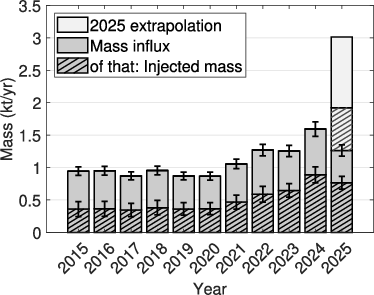
Figure 3: Annual space waste mass influx to the top of the atmosphere and the fraction of that, which ablated in the atmosphere.
Such elevated levels of transition metals and aluminum raise concerns regarding their potential long-term effects on atmospheric chemistry, particularly concerning ozone depletion and altered cloud nucleation processes. The study highlights the need for focused research into the environmental impacts arising from these anthropogenic injections.
Implications and Future Research
This paper underscores the urgency of investigating the atmospheric consequences of space waste re-entry. The dominance of human-made metal injections over natural sources suggests significant changes could occur in atmospheric chemistry and dynamics. There is a pressing need for research on the atmospheric accumulation of these elements and their complex chemical interactions with existing atmospheric constituents.
Further studies should aim to quantify long-term impacts on stratospheric and mesospheric chemistry, with particular focus on catalytic cycles involving transition metals. Modeling and observational campaigns are essential in understanding how these changes impact climate, radiative forcing, and ozone depletion.
Conclusion
The transition into an era of extensive space activities, marked by the proliferation of satellite constellations, has led to a noteworthy increase in anthropogenic matter injected into the atmosphere. The consequences of this shift, as detailed in this paper, highlight the potential risks posed to atmospheric composition and health. Enhanced attention to space waste management and its implications on Earth's atmosphere is crucial, calling for interdisciplinary research efforts to mitigate negative outcomes and ensure sustainable practices in space exploration.