- The paper presents a novel laboratory system that directly measures the complex mode transfer matrix of a photonic lantern using digital off-axis holography.
- It details a multi-wavelength and polarisation-resolved methodology that quantifies modal dispersion, reveals port asymmetries, and highlights manufacturing imperfections.
- The findings underscore the necessity of empirical device characterisation over simulation-only approaches, impacting beam shaping, astrophotonics, and computational imaging.
Coherent, Spectro-Polarimetric Characterisation of Photonic Lanterns
Introduction and Motivation
Photonic lanterns are adiabatic mode converters that map a set of input modes from a multimode waveguide to multiple single-mode outputs, or vice versa. Their utility spans telecommunications, astrophotonics, beam shaping, and computational imaging, where precise knowledge of the device’s mode transfer matrix is essential for optimal performance. However, manufacturing imperfections introduce significant deviations from idealised designs, rendering simulation-only approaches insufficient for accurate characterisation. This paper presents a laboratory system for direct measurement of the complex mode transfer matrix of a photonic lantern using digital off-axis holography, enabling multi-wavelength, polarisation-resolved characterisation of the device’s principal modes.
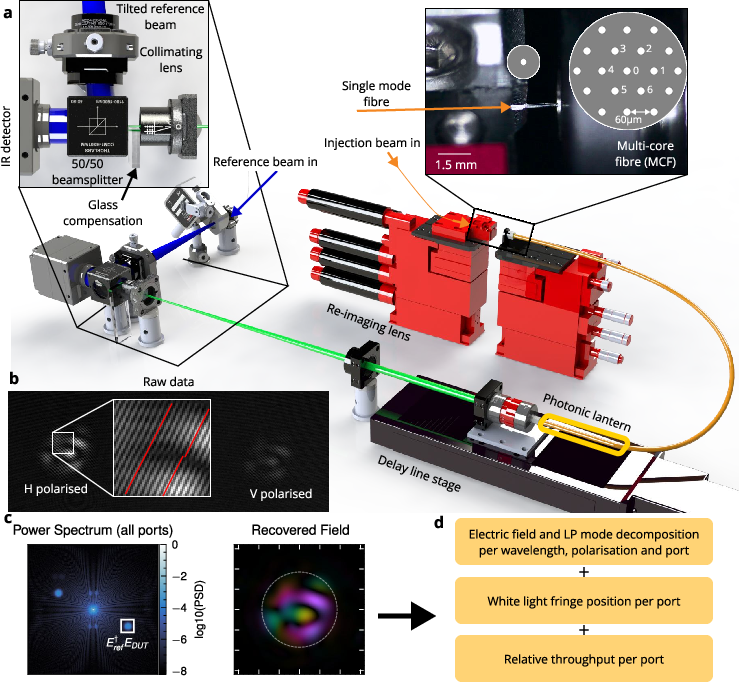
Figure 1: Visual overview of the photonic lantern characterisation system, showing the laboratory setup, raw data acquisition, holographic reconstruction, and mapping to LP modes.
Experimental Architecture and Data Acquisition
The characterisation system employs a wavelength-sweeping source split into reference and injection arms. The injection beam is precisely aligned to a single core of a multicore fibre (MCF), exciting a principal mode of the photonic lantern. The output mode field is re-imaged onto a detector, with a polarisation beam displacer providing simultaneous measurement of two orthogonal polarisations. The reference beam, collimated and tilted, produces interference fringes necessary for digital off-axis holography. A delay line in the interferometer maintains coherence during wavelength sweeps, and a broadband source is used for white light fringe finding.
Data acquisition is synchronised via electronic triggering, ensuring consistent exposure across 78 wavelength samples spanning 1507.5–1580.5 nm. The system is validated on a single-mode fibre before characterising a 19-port MCF-fed photonic lantern. The total data capture time is under 10 minutes per device, with the majority spent on fringe finding.
Holographic Reconstruction and Modal Decomposition
The reconstruction pipeline involves centring the mode field in image space, extracting the coherent component in Fourier space, and removing the reference beam’s electric field to recover the device’s output field. The reconstructed fields are then projected onto linearly polarised (LP) modes using overlap integrals, forming the empirical mode transfer matrix. The approach is robust to read noise and background contamination due to the filtering of off-axis components.
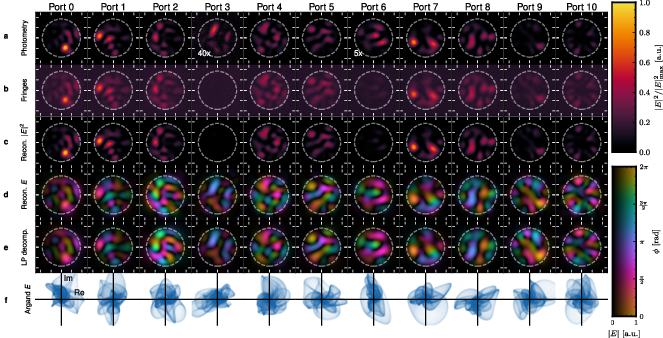
Figure 2: Data and reconstruction at a single wavelength and polarisation, showing photometry, fringe data, reconstructed intensity, electric field, LP mode decomposition, and Argand diagram visualisation.
The reconstructed fields exhibit high fidelity even at low SNR, with intensity maps matching photometric data and modal decompositions closely approximating the measured fields. The Argand diagram visualisation highlights the diversity of supported modes across ports.
Transfer Matrix Analysis and Wavelength Dependence
The measured transfer matrix is a three-dimensional cube indexed by port, wavelength, and polarisation. Slices through wavelength reveal smooth evolution of modal amplitudes and phases, with some oscillations attributed to system birefringence. Monochromatic transfer matrices show significant asymmetry between ports, in contrast to simulation predictions, underscoring the impact of manufacturing variations.
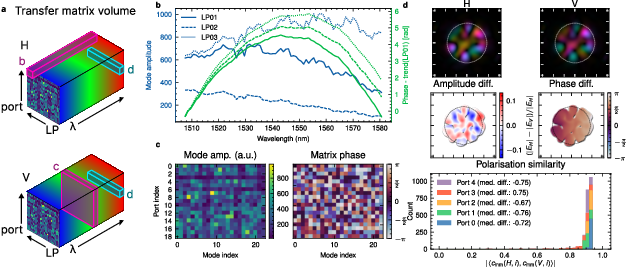
Figure 3: Slices through the transfer matrices of the 19-port lantern, illustrating mode evolution with wavelength, monochromatic transfer matrices, and polarisation-dependent field differences.
Comparison of fields across polarisations reveals amplitude differences up to 10% and near-uniform phase offsets, with port-dependent similarity statistics indicating weak polarisation-dependent effects not explained by imaging system limitations alone.
The wavelength scale of principal mode evolution is quantified by measuring the overlap integral of the field at a fixed wavelength with all other wavelengths. The characteristic scale for significant modal change is ~20 nm, with the rate of decay varying between ports and deviating from simulation symmetry.
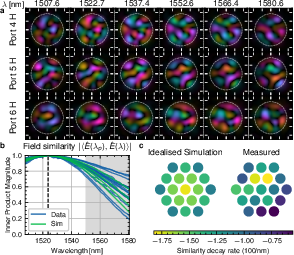
Figure 4: Wavelength evolution of modes, showing electric field plots over multiple ports, field similarity decay with wavelength, and gradient of similarity decay across ports.
Direct Measurement of Modal Dispersion
The system enables direct measurement of differential modal dispersion by fitting the phase evolution of each mode relative to LP01 across the swept wavelength range. The measured gradients are highly repeatable, with standard deviations below 10−4 rad/nm over six sweeps. Systematic errors from background contamination are negligible compared to observed inter-port and inter-mode differences. The measured modal dispersion deviates significantly from idealised scalar simulations, indicating the necessity of empirical characterisation for accurate device modelling.
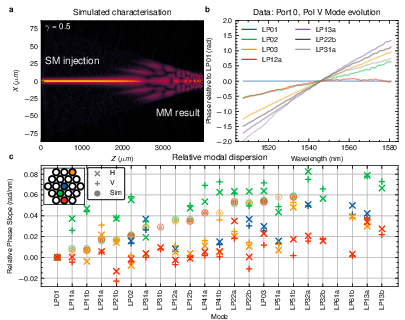
Figure 5: Relative modal dispersion measurements, showing simulated field amplitude, differential phase evolution, and gradient of phase slope for all modes and polarisations.
Implications and Future Directions
The findings have direct implications for applications requiring coherent combination of photonic lantern outputs, such as high-angular-resolution astrophotonics and microendoscopy. The measured modal dispersion necessitates spectral sampling finer than 1.6 nm to maintain coherence, and the typical wavelength scale for principal mode evolution is port-dependent. Data-driven approaches should incorporate empirical transfer matrices as priors to improve model generalisation and reduce data requirements.
The observed asymmetries and polarisation-dependent effects highlight the limitations of simulation-only design and the need for device-specific characterisation. The system is scalable to higher port counts, with projected data acquisition times remaining tractable for devices with up to 1000 ports. Further investigation into birefringence, polarisation-dependent loss, and manufacturing repeatability is warranted, with the characterisation system providing the necessary sensitivity and flexibility.
Conclusion
This work demonstrates a robust, efficient system for coherent, spectro-polarimetric characterisation of photonic lanterns, providing the first multi-wavelength, polarisation-resolved empirical mode transfer matrices. The results reveal significant deviations from idealised simulations in modal mapping, symmetry, and dispersion, reinforcing the necessity of empirical characterisation for all manufactured devices. The system and data products enable enhanced design, fabrication feedback, and application development in astrophotonics, computational imaging, and beam shaping. Future work will extend the approach to higher port counts, alternative device architectures, and comprehensive studies of polarisation effects.