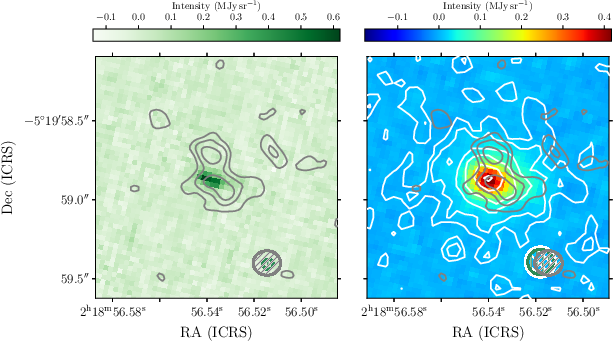
- The paper shows the discovery of a z=7.212 galaxy undergoing a very young starburst with a mass-weighted age of ∼1.8 Myr and an SFR of around 165 M⊙/yr.
- The paper employs JWST and ALMA data to spatially map high-velocity ionized gas outflows, detecting a broad [O III] component with velocities of approximately 535 km s⁻¹.
- The paper links extreme ISM conditions and rapid gas depletion to merger-driven assembly, suggesting these galaxies may evolve into massive quiescent systems at lower redshifts.
Young Starburst and Ionized Gas Outflows in a z=7.212 Galaxy: Insights from JWST NIRCam and NIRSpec Observations
Introduction
This study presents a comprehensive analysis of the z=7.212 galaxy SXDF-NB1006-2, leveraging JWST NIRCam imaging, NIRSpec IFU spectroscopy, and ALMA data as part of the RIOJA project. The work provides a detailed characterization of the galaxy's stellar populations, ISM conditions, ionized gas outflows, and evolutionary context within the reionization epoch. The analysis combines SED fitting, emission line diagnostics, spatial mapping, and comparative studies with other high-redshift galaxies, yielding new constraints on early starburst activity, feedback, and mass assembly.
Morphology and Photometry
NIRCam imaging reveals that the UV continuum of SXDF-NB1006-2 is elongated and clumpy, with a pronounced tail-like structure, suggestive of an edge-on disk or chain galaxy morphology. The optical emission is more extended and diffuse, likely due to a combination of lower spatial resolution at longer wavelengths and the presence of an ionized halo.
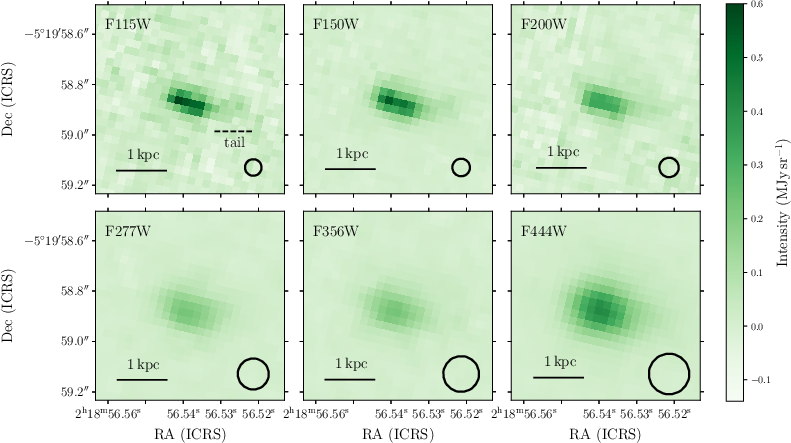
Figure 1: NIRCam images of SXDF-NB1006-2, showing the elongated, clumpy UV continuum and more extended optical emission.
Aperture photometry across six NIRCam filters (1−5μm) was performed using curve-of-growth analysis to capture the total flux, accounting for the extended emission. The F444W band, dominated by strong [O III] emission, exhibits the most extended morphology.
SED Fitting and Stellar Populations
The SED fitting, performed with BAGPIPES, incorporates NIRCam photometry, ALMA dust continuum non-detections, and [O III] line fluxes. Multiple SFH models were tested, with the lognormal SFH adopted as fiducial. The results indicate:
- A very young, bursty star-forming population with a mass-weighted mean age of ∼1.8 Myr.
- High instantaneous SFR (∼165 M⊙ yr−1), placing the galaxy well above the main sequence at this redshift and mass.
- Low dust attenuation (AV∼0.2 mag), consistent with the non-detection of dust continuum.
- Gas-phase metallicity of Z∼0.2Z⊙.
- High ionization parameter (logU∼−1.6), indicative of a hard radiation field from massive young stars.
The SED exhibits a prominent Balmer jump, consistent with strong nebular continuum and a very young stellar population.
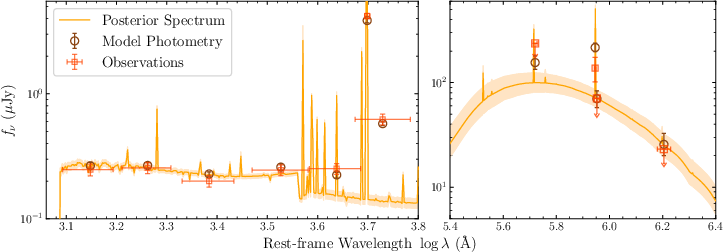
Figure 2: SED fit for SXDF-NB1006-2 with a lognormal SFH, showing the observed photometry, model fit, and predicted Balmer jump.
Emission Line Analysis and Outflow Diagnostics
NIRSpec IFU spectroscopy detects multiple nebular lines, including [O II], [Ne III], Hγ, Hβ, and [O III] λ4960, 5008. The [O III] λ5008 line exhibits a robust broad component (FWHM ∼630 km s−1), unambiguously indicating the presence of high-velocity ionized gas outflows.
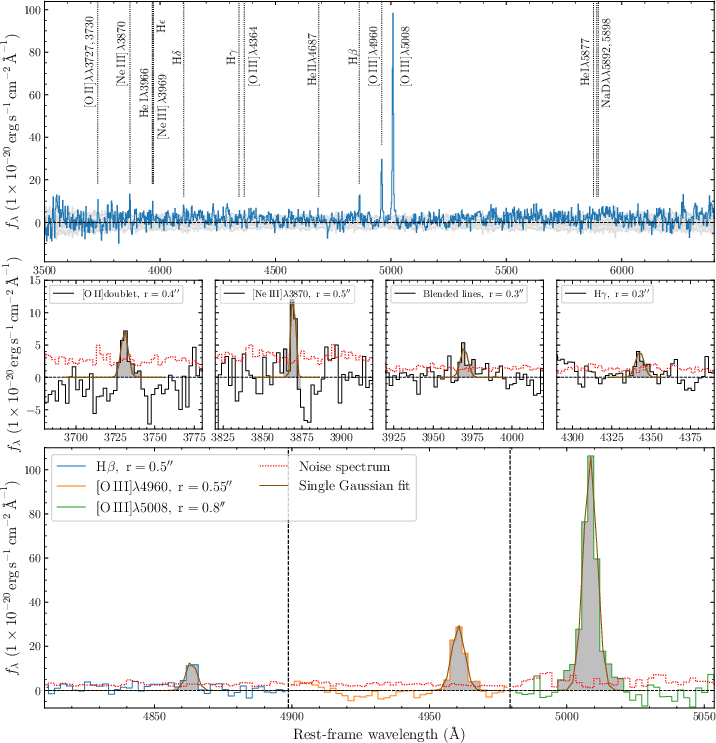
Figure 3: NIRSpec IFU spectra showing detected emission lines and the broad [O III] λ5008 component.
Double Gaussian fitting and residual analysis confirm the broad component's significance. The outflow velocity is estimated at 535±132 km s−1, exceeding the escape velocity of the host halo, though only a fraction of the outflowing material is likely to escape.
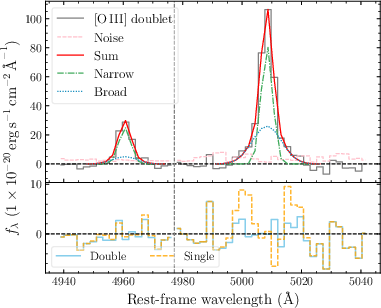
Figure 4: Double Gaussian decomposition of [O III] λ5008, with residuals demonstrating the necessity of a broad component.
Spatial mapping of the narrow and broad [O III] emission reveals that the outflowing gas is more extended (re∼1.9 kpc) than the star-forming regions traced by the UV continuum and narrow [O III].
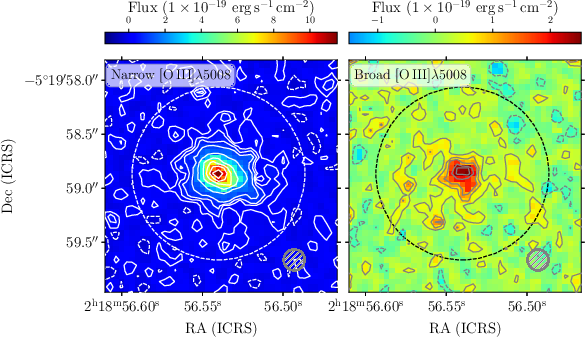
Figure 5: Moment-0 maps of the narrow and broad [O III] λ5008 components, highlighting the spatial extent of the outflow.
The mass outflow rate and mass loading factor are high, with the total (all phases) mass loading factor potentially exceeding unity, though uncertainties remain due to assumptions about the neutral and molecular outflow phases.
Strong-line diagnostics yield a gas-phase metallicity of 12+log(O/H)∼8.07 (Z∼0.2Z⊙), consistent with SED-based estimates. The galaxy exhibits extreme ISM conditions:
- O32 ratio (∼18) and Ne3O2 ratio (∼0.06) at the upper end of z>6 samples.
- Rest-frame EW([O III]+Hβ) ∼3700 Å, among the highest at this epoch.
- Ionizing photon production efficiency log(ξion)∼25.44.
These properties place SXDF-NB1006-2 among the most extreme starbursts known at z>6.
Gas Mass, Depletion Time, and Evolutionary Implications
ALMA [C II] data provide constraints on the molecular and atomic gas masses, yielding a total gas mass of ∼2×10¹⁰M⊙ and a gas fraction of ∼98%. The gas depletion time is short (∼114–445 Myr), implying rapid consumption of the gas reservoir and suggesting that SXDF-NB1006-2 could be a progenitor of massive quiescent galaxies observed at z∼4−5.
Spatial Structure and Merger Signatures
Comparisons of the spatial distribution of UV continuum, optical [O III], and FIR [O III] emission reveal:
Underlying Old Stellar Populations
Despite the extremely young mass-weighted age, the observed metallicity requires prior star formation episodes. SED modeling with non-parametric SFHs and constraints from the F356W band suggest a possible underlying old stellar population, with an upper limit on the old stellar mass of log(M∗old/M⊙)<9.5. Future JWST/MIRI F770W observations are predicted to be sensitive enough to confirm or rule out the presence of such populations.
Comparative Context: Mass Assembly and Metallicity Relations
A comparative analysis with other z>6 galaxies shows that ALMA-detected galaxies are systematically more massive, younger, and UV-brighter than JWST-selected samples, and exhibit a steeper mass-metallicity relation.
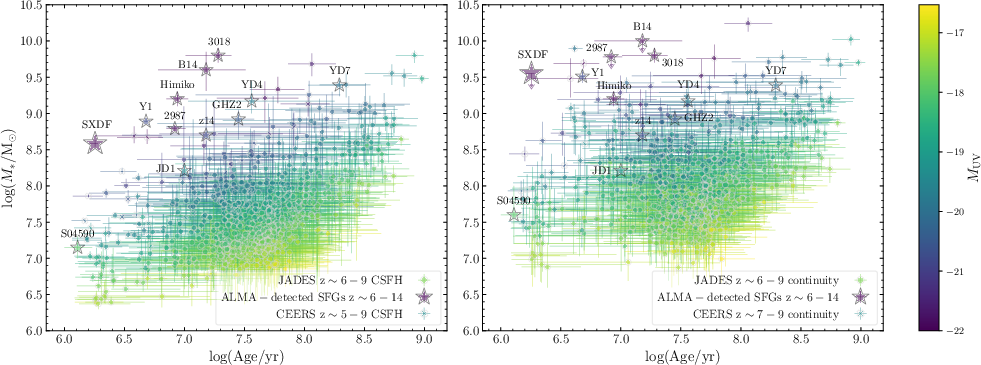
Figure 7: Age–mass relation for ALMA-detected and JWST-selected galaxies at z>6, color-coded by MUV.
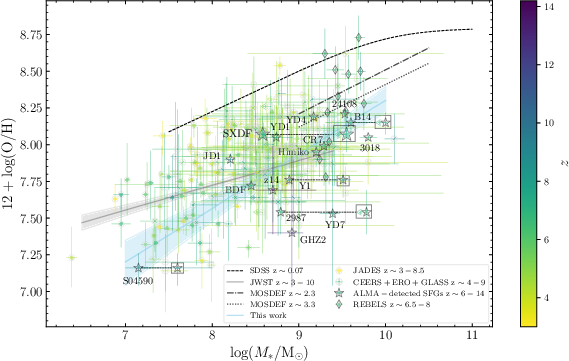
Figure 8: Mass–metallicity relation for ALMA-detected and JWST-selected galaxies, with the target highlighted.
This suggests that ALMA-detected galaxies have undergone more efficient and rapid mass assembly, likely driven by frequent mergers and intense starburst episodes.
Conclusion
This work provides a detailed physical characterization of a z=7.212 starburst galaxy, revealing:
- A dominant, extremely young starburst population with high SFR and ionization parameter.
- Robust detection of high-velocity ionized gas outflows, with spatially extended broad [O III] emission.
- ISM conditions and metallicity requiring prior star formation, despite the young observed age.
- Morphological and kinematic evidence for recent merger-driven assembly.
- A short gas depletion time, positioning the galaxy as a plausible progenitor of massive quiescent systems at lower redshift.
- ALMA-detected galaxies at z>6 are distinct in their mass, age, and metallicity scaling relations, reflecting more efficient early mass assembly.
The results underscore the power of joint JWST and ALMA observations for dissecting the physical processes governing early galaxy evolution. Future MIRI observations will be critical for constraining the presence of old stellar populations and refining the evolutionary pathways of massive galaxies in the reionization era.