The 2024 July 16 Solar Event: A Challenge To The Coronal Mass Ejection Origin Of Long-Duration Gamma-Ray Flares
Abstract: We present a multi-spacecraft analysis of the 2024 July 16 Long-Duration Gamma-Ray Flare (LDGRF) detected by the Large Area Telescope on the Fermi satellite. The measured >100 MeV $\gamma$-ray emission persisted for over seven hours after the flare impulsive phase, and was characterized by photon energies exceeding 1 GeV and a remarkably-hard parent-proton spectrum. In contrast, the phenomena related to the coronal mass ejection (CME)-driven shock linked to this eruption were modest, suggesting an inefficient proton acceleration unlikely to achieve the energies well-above the 300 MeV pion-production threshold to account for the observed $\gamma$-ray emission. Specifically, the CME was relatively slow (~600 km/s) and the accompanying interplanetary type-II/III radio bursts were faint and short-duration, unlike those typically detected during large events. In particular, the type-II emission did not extend to kHz frequencies and disappeared ~5.5 hours prior to the LDGRF end time. Furthermore, the associated solar energetic particle (SEP) event was very weak, short-duration, and limited to a few tens of MeV, even at magnetically well-connected spacecraft. These findings demonstrate that a very-fast CME resulting in a high-energy SEP event is not a necessary condition for the occurrence of LDGRFs, challenging the idea that the high-energy $\gamma$-ray emission is produced by the back-precipitation of shock-accelerated ions into the solar surface. The alternative origin scenario based on local particle trapping and acceleration in large-scale coronal loops is instead favored by the observation of giant arch-like structures of hot plasma over the source region persisting for the entire duration of this LDGRF.
Paper Prompts
Sign up for free to create and run prompts on this paper using GPT-5.
Top Community Prompts
Explain it Like I'm 14
What this paper is about
This paper looks at a big solar flare that happened on July 16, 2024. The flare produced very high‑energy gamma rays for more than seven hours. The authors compare what they saw in many kinds of space data (gamma rays, X‑rays, radio waves, images of hot gas, and particles in space) to figure out where those gamma rays came from. Their main conclusion is that the usual explanation—particles accelerated by a fast “solar blast wave” from a coronal mass ejection (CME)—doesn’t fit this event. Instead, the evidence points to particles being trapped and accelerated inside huge magnetic loops above the Sun.
What questions the paper tries to answer
- Can long‑lasting gamma‑ray flares (LDGRFs) happen without a very fast CME and a strong shock wave?
- Are the gamma rays most likely made by particles coming back from a far‑away shock, or by particles trapped and energized locally in large coronal loops?
- How do different measurements (gamma rays, radio bursts, X‑rays, images, and solar energetic particles) line up in time and energy to support one idea over the other?
How the researchers studied the event
Think of this as a solar “detective story” using many cameras and sensors around the Sun:
- Fermi‑LAT watched for gamma rays, which are the most energetic kind of light.
- GOES and Solar Orbiter (STIX) recorded X‑rays from the flare.
- SOHO/LASCO and STEREO took pictures of the CME to measure how fast and wide it was.
- SDO/AIA and GOES/SUVI imaged the Sun in extreme ultraviolet (EUV), showing hot plasma structures.
- Wind, STEREO, Parker Solar Probe (PSP), and ground stations listened for radio bursts, which tell us about shocks and fast electrons.
- GOES, SOHO, STEREO, PSP, and Solar Orbiter measured solar energetic particles (SEPs) traveling through space.
They lined up the timing of all these observations and checked how strong each signal was. For the gamma rays, they fit the energy spectrum (how many photons at each energy) to models that tell you what kind of proton energies are needed to make those gamma rays. For the CME, they estimated its speed and size. For radio bursts, they noted how long they lasted and at what frequencies they were detected (lower radio frequencies mean signals from farther away from the Sun). For SEPs, they checked whether nearby spacecraft saw strong, high‑energy particles.
To make technical terms clearer:
- Coronal Mass Ejection (CME): a huge bubble of gas and magnetic field blasted off the Sun.
- Shock: like a sonic boom in space that can energize particles.
- Gamma rays in flares: mainly made when super‑fast protons slam into the Sun’s lower atmosphere, create short‑lived particles called pions, and those pions decay into gamma rays.
- Coronal loops: giant magnetic “arches” filled with hot plasma, like roller‑coaster tracks for charged particles.
- Magnetic mirroring: the Sun’s magnetic fields can reflect particles, making it hard for them to travel back toward the dense lower atmosphere.
- Type II/III radio bursts: radio “signatures” of shocks (type II) and fast electron beams (type III) moving through space.
What they found and why it matters
Here are the key observations that make this event special:
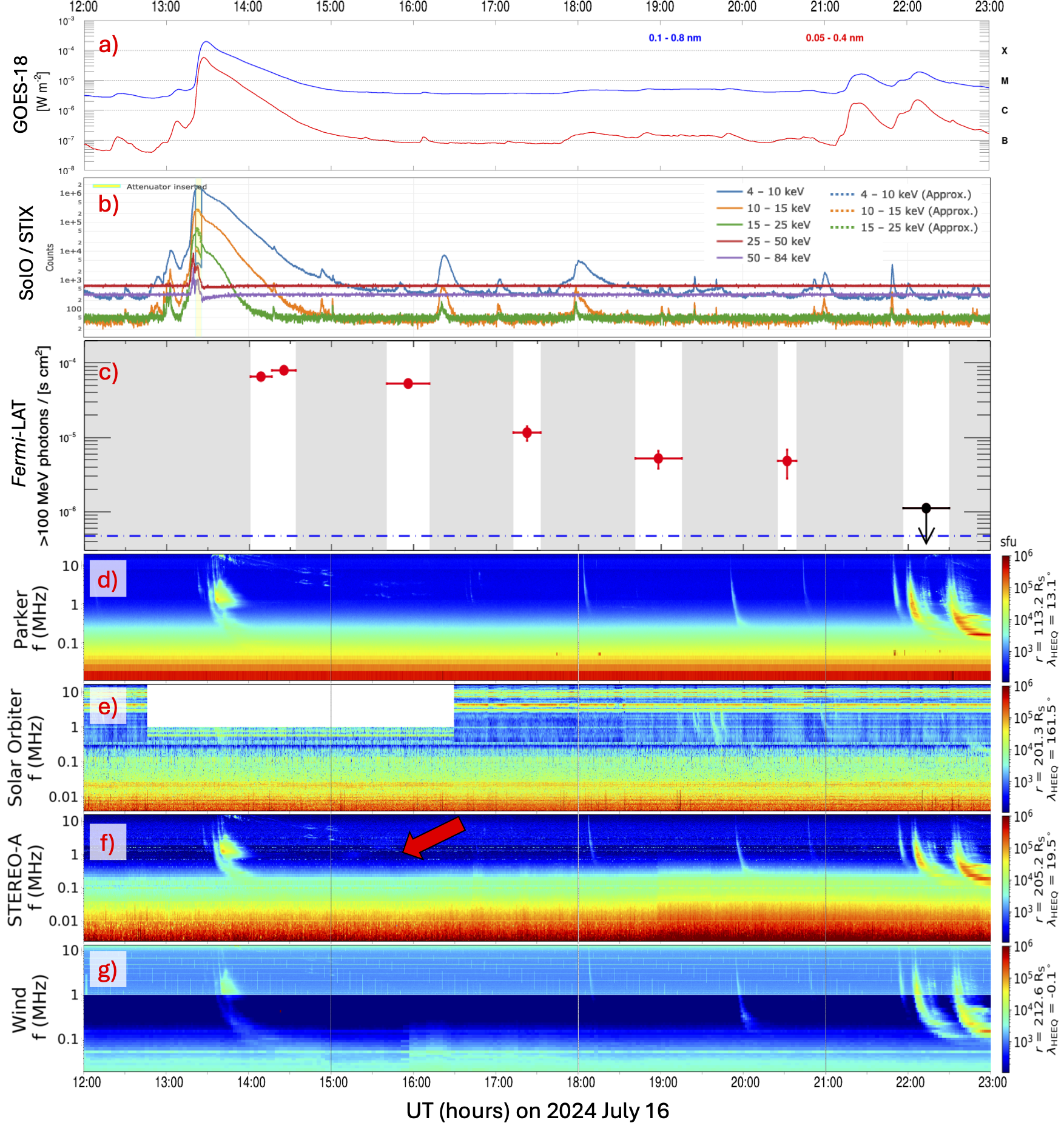
- Long‑lasting, very energetic gamma rays: Fermi‑LAT saw >100 MeV gamma rays for about 7.25 hours, including photons up to 1.68 GeV. The gamma‑ray spectrum showed lots of very high‑energy protons compared to lower‑energy ones (a “hard” spectrum).
- A slow, modest CME: The CME speed was only about 600 km/s, not the “very fast” kind often linked to powerful shock acceleration. It didn’t show signs of strong, long‑range shock activity.
- Weak shock radio signature: The type‑II radio burst (a sign of a shock) was faint, ended early (about 5.5 hours before the gamma rays stopped), and did not extend to very low frequencies (which would indicate a shock far out in space). This suggests the shock was not strong or long‑lived.
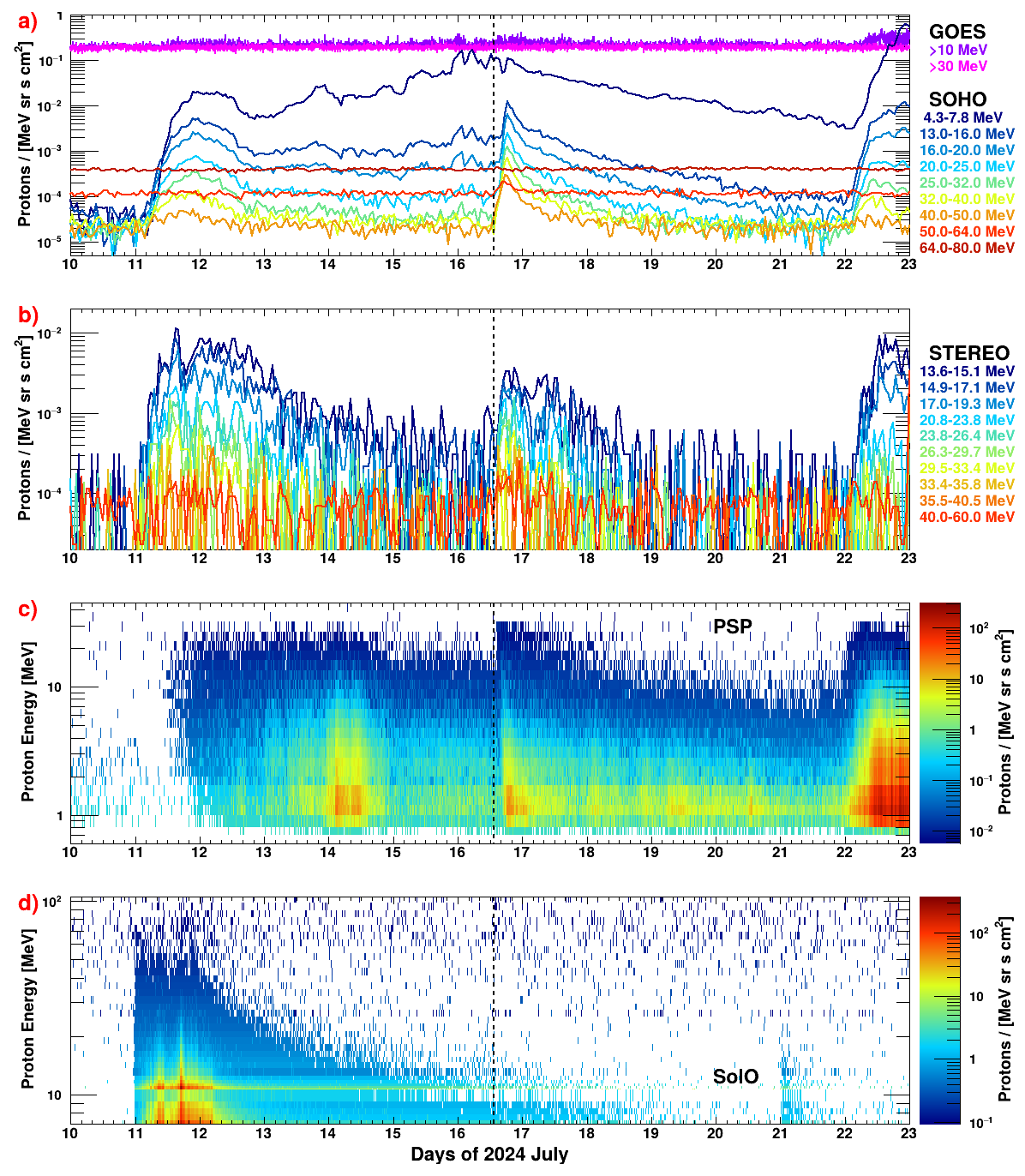
- Very weak SEPs: Spacecraft that were well connected magnetically to the flare region (so they should have seen strong particles if the shock was powerful) recorded only small increases, and only up to a few tens of MeV—much lower than the energies needed to make the observed gamma rays.
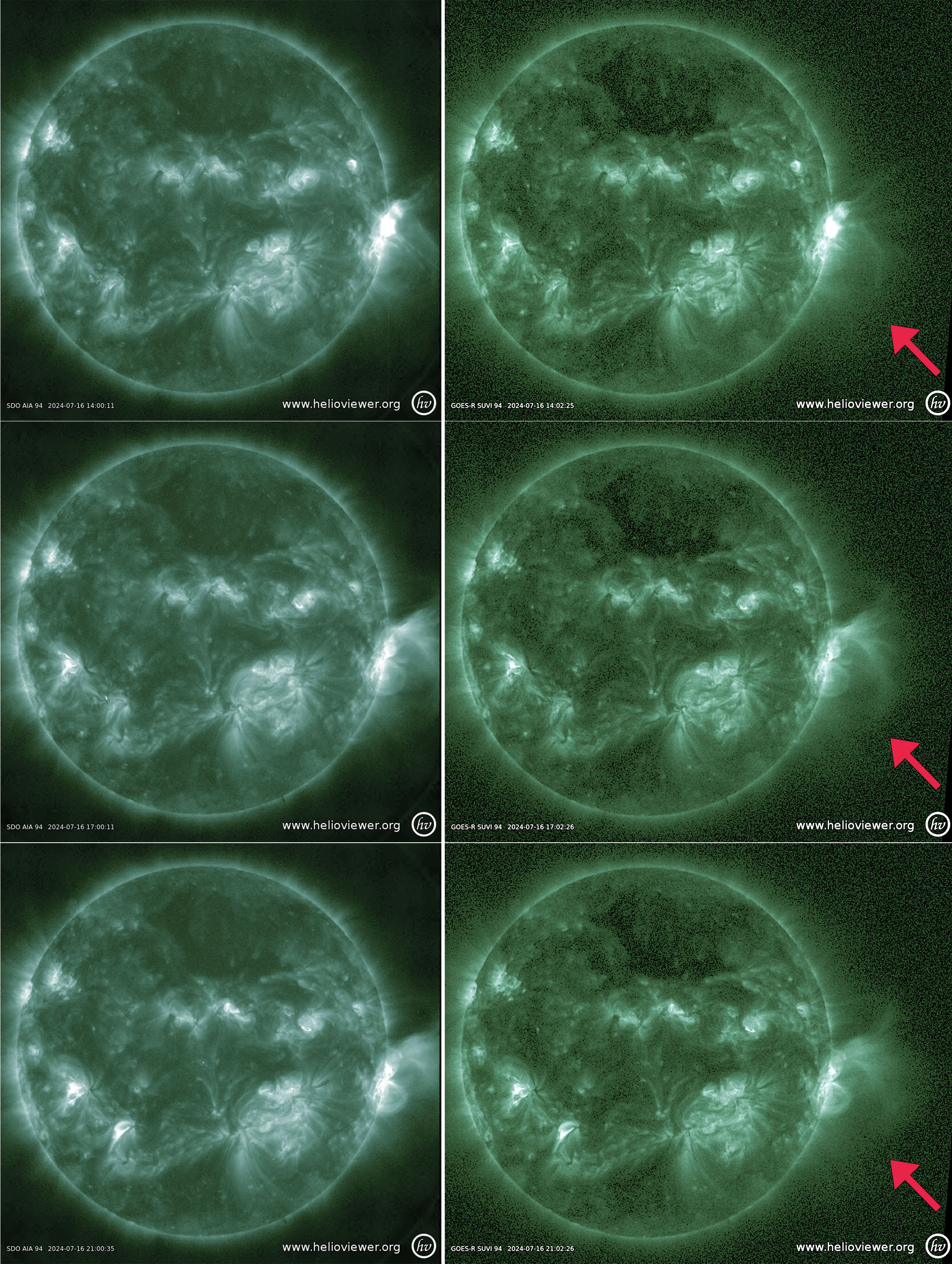
- Giant coronal loops visible the whole time: EUV images showed huge arch‑like structures of hot plasma lasting for the entire gamma‑ray flare. These long‑lived, hot loops are exactly what you’d expect if particles were trapped and gradually accelerated inside them.
Why this matters:
- It shows that you don’t need a very fast CME and a strong shock to get long‑lasting, high‑energy gamma rays.
- It challenges the popular idea that LDGRFs are mainly caused by shock‑accelerated particles falling back to the Sun.
- It supports a “local” acceleration picture: particles trapped inside giant coronal loops can be slowly energized by waves and turbulence, then leak out to the loop footpoints and make gamma rays.
What this means going forward
- Space weather models may need to include loop‑based particle acceleration, not just CME‑shock acceleration, when predicting high‑energy solar radiation.
- Observers should look for big, hot coronal loops during and after flares as potential signs of long‑lasting gamma‑ray emission.
- Not all strong gamma‑ray events will come with strong SEPs or fast CMEs; using multiple kinds of data together is essential.
- Future research should measure how “wavy” and turbulent these loops are (which helps accelerate particles), and how flare‑accelerated particles get injected into them.
In short, this event is a clear counterexample to the “CME shock does it all” idea. It suggests that the Sun can make long‑lasting, very energetic gamma rays by trapping and accelerating particles locally in huge magnetic loops—an important shift in how we understand the most powerful solar flares.
Knowledge Gaps
Knowledge gaps, limitations, and open questions
The following list summarizes what remains missing, uncertain, or unexplored in the paper and outlines concrete directions for future research:
- Early-phase gamma-ray coverage is missing: the Sun was in Fermi-LAT’s FoV for only ~33 minutes between 13:00–15:00 UT, leaving the onset and peak timing of the LDGRF’s delayed phase unconstrained; targeted strategies to fill FoV gaps or complementary instruments are needed to capture the prompt-to-delayed transition.
- Hard X-ray peak characterization is uncertain due to SolO/STIX attenuator insertion and the lack of Fermi/GBM coverage during the impulsive phase; reconstructing the flare’s nonthermal electron/proton energetics requires cross-calibration and additional HXR datasets.
- Radio diagnostics are incomplete: a major gap in SolO/RPW (>1 MHz) data from ~12:30–16:30 UT and reliance on cataloged Wind/STEREO-A labels limit robust determination of type-II properties, band-splitting, harmonic structure, and shock parameters; reprocessing with full dynamic spectra and multi-instrument cross-identification is needed.
- The CME’s 3D geometry and shock properties (Mach number, Alfvénic/fast-mode Mach, compression ratio, θBn) are not derived; apply multi-viewpoint reconstructions (e.g., GCS modeling), shock-fitting to coronagraph/EUV fronts, and radio band-splitting analyses to quantify acceleration capability.
- No spacecraft intercepted an interplanetary shock from this event; targeted modeling and IPS/radio scintillation constraints are needed to confirm shock existence, height–time evolution, and strength.
- The paper does not localize the high-energy gamma-ray emission centroid(s) relative to the solar disk and loop footpoints; perform LAT localization and temporal centroid tracking to test for spatial association with the observed coronal arches.
- The required number and energy distribution of >300 MeV (and >500 MeV) protons producing the LDGRF are not estimated for this event; derive N_LDGRF and compare with multi-point SEP counts (N_SEP) to quantify precipitation fractions and test CME-shock viability in this specific case.
- Atmospheric attenuation/hardening near the limb is acknowledged but not corrected; apply radiative transfer/attenuation models to recover intrinsic spectra and refine the inferred parent-proton indices.
- The seed population for loop acceleration remains unresolved; identify whether seeds are flare-accelerated or shock-accelerated via timing analyses (HXR/γ-ray delays), nuclear de-excitation lines, and early SEP release signatures.
- The loop scenario is not quantitatively modeled for this event: no calculation of required turbulence levels (δB/B), mean free paths, 2nd-order Fermi acceleration rates, precipitation rates, or energy budgets is provided; build event-specific transport/acceleration models to reproduce both spectral hardness and multi-hour decay.
- Coronal loop magnetic field strengths, topology, and connectivity are not constrained; use PFSS/NLFFF extrapolations and (where possible) gyro-synchrotron diagnostics or coronal seismology to estimate B, loop lengths, mirror ratios, and loss-cone angles.
- The estimated loop length/height from EUV imaging is subject to projection effects near the limb; perform 3D deprojection and DEM analyses across multiple EUV channels to refine loop geometry, temperature, and emission measure.
- Sustained heating in the 94 Å loops is inferred but not quantified; determine the energy input rates and wave/turbulence drivers (e.g., Alfvénic vs. compressive modes) using spectroscopic diagnostics (Hinode/EIS, IRIS), QPP analyses, and coronal wave observations.
- The absence of an EUV wave is stated qualitatively; apply running-difference techniques and automated wave-front detection across multiple passbands/vantage points to assess coronal shock/wave presence and kinematics.
- SEP characterization is limited: onset timing, velocity dispersion, anisotropy, and pitch-angle distributions are not analyzed; use these to constrain release times, source regions, and transport (shock vs. flare/loop) mechanisms.
- The relation of the moderate metric type-IV continuum to trapped electron populations and loop magnetic fields is not explored; analyze spectral shape, polarization, and temporal evolution to infer loop parameters and trapping conditions.
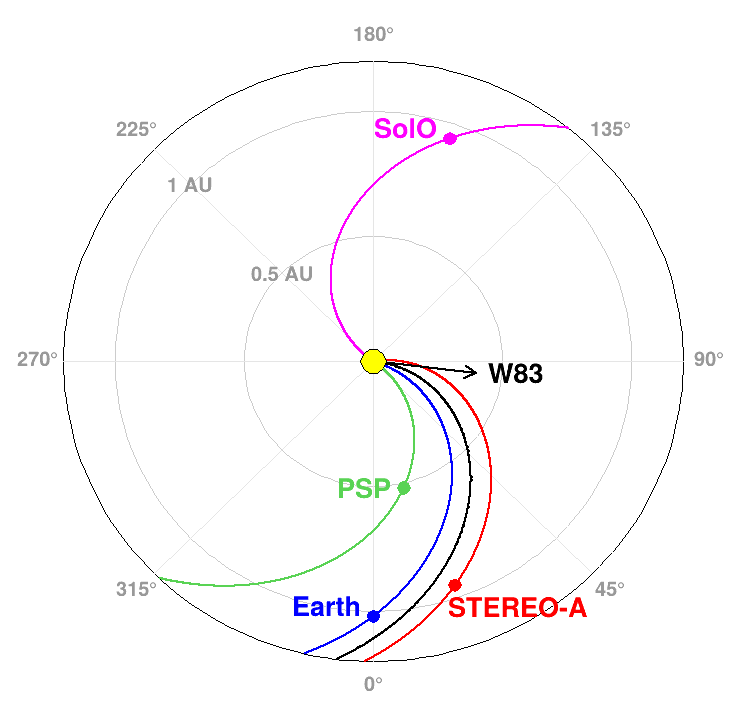
- Connectivity modeling relies on a simple Parker spiral; improve mapping with WSA/PFSS (and time-dependent MHD) to assess coronal/heliospheric field complexity, streamer belts, and uncertainties in footpoint locations for Earth, STEREO-A, PSP, and SolO.
- The end time of the LDGRF is estimated from LAT FoV gaps rather than continuous monitoring; quantify uncertainty on the duration and consider complementary instruments or campaigns to close coverage gaps.
- The paper dismisses precipitating shock-accelerated ions qualitatively but does not run event-specific 3D transport simulations (including mirroring and turbulence) to compute realistic precipitation fractions versus shock height; perform targeted test-particle modeling with the measured CME/shock geometry.
- Hybrid mechanisms (e.g., flare-accelerated seeds re-accelerated within loops or by a nearby shock) are suggested but not tested; build joint models combining reconnection/termination-shock acceleration with loop trapping/2nd-order Fermi processes.
- Energy budget comparisons are missing: there is no quantitative assessment of whether flare reconnection or loop turbulence can supply the power required for the measured γ-ray flux and proton numbers over >7 hours; perform energy partition analyses.
- Magnetic reconnection signatures (e.g., supra-arcade downflows, current sheet/termination shock diagnostics) are not examined; search for these features to evaluate alternative high-energy proton acceleration sites in the low corona.
- Statistical generalization is limited: similar slow/no-CME LDGRFs are cited but not consistently reanalyzed; conduct a comparative study of slow-CME LDGRFs to determine common conditions (loop visibility, SEP weakness, radio signatures).
- Constraints from high-energy SEPs near Earth (e.g., neutron monitor/GLE searches) are not reported; check NM networks and >700 MeV SEP proxies to strengthen the case for absent high-energy SEP populations.
- The radio type-II cessation height (“few tens of R_s”) is not quantitatively converted from frequency to radial distance with density models; derive shock height–time profiles to compare with LDGRF decay and test back-precipitation plausibility.
Practical Applications
Practical Applications Derived from the Paper’s Findings
The paper provides new evidence that many long-duration gamma-ray flares (LDGRFs) can arise from particle trapping and 2nd-order Fermi acceleration in large coronal loops, rather than from CME-driven shocks with back-precipitating ions. This has immediate implications for forecasting, operations, instrumentation priorities, and modeling across sectors.
Immediate Applications
- Space weather alerting rules that decouple LDGRFs from SEP hazards
- Sectors: space weather operations, aviation, satellite operations, power grid
- Application: Update operational heuristics so that the presence of an LDGRF (or its duration) is not used as a proxy for strong SEP risk. Likewise, avoid interpreting DH type-II duration/end-frequency as a predictor for LDGRF duration or for high-energy SEP hazard.
- Tools/workflows: Revise NOAA SWPC/ESA SWE playbooks and automated rules; add checks for CME speed, DH type-II strength, and actual SEP flux before issuing high-latitude flight advisories or satellite safe modes.
- Assumptions/dependencies: Access to near-real-time CME kinematics (SOHO/LASCO, STEREO), radio dynamic spectra (WIND/WAVES, RSTN), and SEP fluxes; organizational willingness to change rules-of-thumb.
- Mechanism-aware LDGRF classifier for operations
- Sectors: space weather forecasting, software
- Application: A real-time classifier that tags an LDGRF as “likely loop-driven” vs “likely shock-driven” using features such as: CME speed/width; presence/strength and frequency extent of type-II; SEP onset and energy extent; EUV 94 Å evidence of giant loops; magnetic connectivity.
- Tools/products: An ML or rule-based module integrated into forecast pipelines (e.g., at SWPC/ESA SWE); confidence scoring to guide advisories.
- Assumptions/dependencies: Timely EUV imagery (AIA/SUVI), radio spectrograms, and robust loop-detection preprocessing; data continuity.
- Reduced false-positive aviation radiation advisories during LDGRFs
- Sectors: aviation, policy
- Application: Base polar reroutes and altitude changes on measured SEP flux/energy rather than LDGRF presence or type-II duration alone; explicitly treat LDGRFs as poor predictors of high-energy SEP risk when CME is slow and DH type-II is weak or short-lived.
- Tools/workflows: Updated ICAO space weather advisory guidance; airline decision-support dashboards incorporating real-time SEP data and mechanism tags.
- Assumptions/dependencies: Regulatory alignment; near-real-time GOES/other SEP data; risk acceptance by operators.
- Satellite operations: smarter safe-mode triggers and scheduling
- Sectors: aerospace, satellite operations
- Application: Use the mechanism classifier and measured SEP spectra to avoid unnecessary safe-modes or sensor shutdowns when LDGRFs occur without strong SEP evidence.
- Tools/workflows: On-console decision aids that combine connectivity, SEP levels, and CME/radio diagnostics; automated guardrails in anomaly response playbooks.
- Assumptions/dependencies: Accurate asset-specific risk thresholds; operator training; real-time data feeds.
- Enhanced EUV-based loop monitoring layer in space weather dashboards
- Sectors: software, space weather operations
- Application: Add an automated “giant-loop likelihood” indicator to operational dashboards using 94 Å (and related) channels and high-dynamic-range image processing to flag long-lived, large-scale arches associated with LDGRFs.
- Tools/products: Image-processing plug-ins (e.g., multiscale filtering, limb-sensitive enhancement) running on AIA/SUVI streams; loop length estimation with uncertainty.
- Assumptions/dependencies: Limb bias (loops are easier to see near the limb); adequate cadence and calibration; false positive management.
- Connectivity-aware SEP expectation service
- Sectors: space weather operations, software
- Application: Operational service that computes Parker-spiral connectivity to active regions/CME shocks and contrasts it with measured SEP levels to calibrate hazard expectations.
- Tools/products: Real-time footpoint mapping service using measured solar-wind speed; alert overlays for operator consoles.
- Assumptions/dependencies: Reliable in-situ solar-wind data; simplified connectivity modeling limitations are understood by users.
- Analyst training to avoid “big-flare syndrome”
- Sectors: education, operations
- Application: Incorporate evidence from this and similar events into training modules emphasizing that energetic phenomena co-occur statistically without implying causality; reduce over-reliance on type-II and LDGRF duration as hazard predictors.
- Tools/workflows: Updated curricula for forecasters; case-based exercises including the 2024-07-16 event.
- Assumptions/dependencies: Adoption by SWPC/ESA SWE/Met offices; continuous professional development cycles.
- Benchmark dataset and reproducible pipeline for LDGRF spectral inversion
- Sectors: academia, software
- Application: Provide a standardized, open workflow (3ML, pion-decay templates) and curated multi-point dataset from this event for comparative modeling and validation.
- Tools/products: Public GitHub repository with LAT analysis scripts, spectral fits, radio/CME/SEP co-registrations.
- Assumptions/dependencies: Data rights and latencies; community maintenance.
- Communication guidance for stakeholders
- Sectors: policy, public communication
- Application: Clear messaging that GeV gamma rays at the Sun are not, by themselves, indicators of increased radiation risk at Earth or in flight; emphasize observed SEP conditions.
- Tools/products: Fact sheets, quick-reference guides for decision-makers.
- Assumptions/dependencies: Coordination between agencies; consistent terminology.
Long-Term Applications
- Physics-informed hybrid SEP hazard models
- Sectors: space weather forecasting, software
- Application: Next-generation SEP nowcast/forecast models that incorporate (a) loop-based acceleration with strong mirroring suppression of back-precipitation; (b) declining shock efficiency with distance; and (c) event-to-event “hybrid” contributions.
- Tools/products: Data-assimilative models blending MHD CME propagation, particle transport, and loop acceleration modules; probabilistic hazard outputs.
- Assumptions/dependencies: Community model development; validation on multi-event catalogs; computational resources.
- Routine coronal turbulence and loop-acceleration diagnostics
- Sectors: academia, instrumentation, software
- Application: Derive turbulence levels and loop mean free paths from gamma-ray decay constants and radio/EUV diagnostics to infer 2nd-order Fermi acceleration parameters.
- Tools/products: Inversion toolkits linking LAT time profiles and loop morphology to coronal diffusion coefficients; uncertainty quantification.
- Assumptions/dependencies: Theory-to-observation mapping maturity; sufficient gamma-ray temporal coverage.
- High dynamic-range, large-FoV EUV/soft X-ray imagers optimized for giant loop visibility
- Sectors: instrumentation, space agencies
- Application: Future instruments (e.g., SUVI successors) configured to reveal faint, off-limb arches (≥1 Rs scale) during bright disk conditions to operationalize loop diagnostics.
- Tools/products: Instrument design requirements (sensitivity, dynamic range, off-limb stray light control); onboard/ground processing for faint structure enhancement.
- Assumptions/dependencies: Mission funding; trade-offs with other instrument priorities.
- Continuous solar gamma-ray monitoring capability
- Sectors: instrumentation, space agencies
- Application: Dedicated solar gamma-ray sensors (e.g., GEO/HEO or multi-CubeSat constellation) to eliminate Fermi-LAT FoV gaps and enable true operational use of LDGRF timing and spectra.
- Tools/products: Instrument concepts and ground segment for near-real-time processing; integration with space weather centers.
- Assumptions/dependencies: Technology readiness; downlink bandwidth; space environment background management.
- Low-frequency radio imaging and spectro-imaging for shock and turbulence tracking
- Sectors: instrumentation, radio astronomy, space weather
- Application: Next-gen radio facilities (space-based or lunar-farside concepts) that image CME shocks to kHz and quantify turbulence, disentangling shock vs loop contributions in real time.
- Tools/products: Radio imaging spectrographs; data fusion pipelines linking radio maps to CME fronts and EUV loops.
- Assumptions/dependencies: Mission feasibility and budgets; RFI mitigation.
- Real-time “loop acceleration nowcast” via data assimilation
- Sectors: software, operations
- Application: Assimilate EUV loop morphology, gamma-ray light curves, and radio diagnostics to estimate loop length and turbulence, outputting a mechanism probability and expected gamma-ray decay.
- Tools/products: Bayesian/variational assimilation frameworks; operator-facing confidence metrics.
- Assumptions/dependencies: Robust priors for loop physics; continuous multi-instrument data.
- Refined cost/risk models for aviation and satellite operators
- Sectors: finance, aviation, aerospace
- Application: Decision models that account for the demonstrated decoupling between LDGRFs and strong SEP events, reducing costly precautionary actions when CME and DH type-II signatures are weak.
- Tools/products: Risk engines with scenario testing using historical LDGRF–SEP decoupling; cost-of-action vs cost-of-inaction analytics.
- Assumptions/dependencies: Access to historical operations and cost data; regulator acceptance.
- Asset-specific connectivity and exposure mapping for constellations
- Sectors: satellite operations, software
- Application: On-orbit constellation managers receive per-satellite connectivity maps to shock/AR regions and expected SEP exposure, updating autonomously with solar-wind speed.
- Tools/products: Fleet-level dashboards; API endpoints for mission autonomy.
- Assumptions/dependencies: Reliable solar-wind inputs; Parker-spiral model adequacy for operations.
- Materials and shielding design guidance informed by SEP–LDGRF decoupling
- Sectors: aerospace, materials
- Application: Prioritize shielding/performance trade-offs using SEP-driven risk rather than LDGRF occurrence; recognize that GeV gamma production at the Sun does not guarantee extreme SEP exposure.
- Tools/products: Design standards and reference environments updated with mechanism-aware statistics.
- Assumptions/dependencies: Broader statistical confirmation across cycles; coordination with standards bodies.
- Standardized LDGRF catalogs and cross-event comparisons
- Sectors: academia, data infrastructure
- Application: Community-maintained catalogs that unify LAT spectral inversions, CME kinematics, radio metrics, EUV loop measures, and SEP outcomes to benchmark models and drive AI training.
- Tools/products: FAIR datasets; event feature schemas; challenge problems for model validation.
- Assumptions/dependencies: Data policy and stewardship; sustained community engagement.
Notes on feasibility and dependencies across applications:
- Loop visibility is geometry-dependent and favored near the limb; robust proxies are needed for disk-center events.
- Data latency and continuity (Fermi-LAT coverage gaps; RPW/WAVES outages) can limit real-time use; redundancy helps.
- Hybrid events exist; mechanism classifiers should provide probabilistic outputs with uncertainty quantification.
- Adoption requires updates to operational doctrine and training; policy alignment (e.g., ICAO advisories) may take time.
- Further research is needed to constrain turbulence levels and wave-particle coupling in loops and to validate inversion methods across many events.
Glossary
- back-precipitation: Return of accelerated charged particles from the corona/interplanetary space back into the dense solar atmosphere. "back-precipitation of shock-accelerated ions into the solar surface."
- big-flare syndrome: Statistical tendency for large solar eruptions to exhibit many energetic phenomena concurrently, without requiring a causal link among them. "the so-called ``big-flare syndrome''"
- chromosphere: A lower, relatively dense layer of the solar atmosphere above the photosphere where ion–neutral interactions and line emissions are significant. "photosphere and chromosphere"
- coronal loops: Arch-like, magnetically confined plasma structures in the solar corona, often sites of trapping and acceleration. "large-scale coronal loops"
- coronal mass ejection (CME): A large ejection of plasma and magnetic field from the solar corona into interplanetary space. "coronal mass ejection (CME)-driven shock"
- coronagraph: A telescope designed to block the bright solar disk to image the faint corona. "Large Angle and Spectrometric Coronagraph (LASCO) C2"
- decameter-hectometric (DH): Radio wavelengths/frequencies in the decametric to hectometric range, used to track interplanetary radio bursts. "decameter-hectometric (DH) wavelengths"
- emission-centroid localization: Estimation of the spatial center of observed high-energy emission on/near the Sun. "emission-centroid localization"
- Extreme-ultraviolet (EUV): High-frequency ultraviolet radiation used to image hot coronal plasma. "Extreme-ultraviolet images at 94 \r{A}"
- Fermi-LAT: The Large Area Telescope on the Fermi satellite, sensitive to high-energy gamma rays. "measured by Fermi-LAT"
- field of view (FoV): The angular extent of sky observable by an instrument at once. "field of view (FoV) of the Large Angle and Spectrometric Coronagraph (LASCO) C2"
- footpoints: The photospheric anchoring regions of coronal magnetic loops. "footpoints of a large coronal loop"
- ground-level enhancements (GLEs): SEP events energetic enough to produce secondary particles detectable by ground-based neutron monitors. "ground-level enhancements (GLEs)"
- gyro-synchrotron emission: Nonthermal radio emission produced by relativistic electrons spiraling in magnetic fields. "gyro-synchrotron emission"
- heliocentric distance: Distance measured from the center of the Sun. "with increasing heliocentric distance"
- interplanetary magnetic field (IMF): The Sun’s magnetic field carried outward by the solar wind through interplanetary space. "interplanetary magnetic field (IMF) lines"
- kilometric wavelengths: Very long radio wavelengths (kilometer-scale) associated with distant interplanetary phenomena. "extends to kilometric wavelengths"
- L1 Lagrange point: A gravitational equilibrium point between the Earth and Sun used for space observatories. "Earth / L1 Lagrange point"
- Large Angle and Spectrometric Coronagraph (LASCO): A suite of space-based coronagraphs imaging CMEs in the solar corona. "LASCO C2/C3"
- loss cone: The range of pitch angles that allows trapped particles to precipitate into the denser solar atmosphere. "in a narrow loss cone"
- magnetic mirroring: Reflection of charged particles due to increasing magnetic-field strength along field lines, impeding precipitation. "effect of magnetic mirroring"
- mean free path: Average distance a particle travels between scattering events. "predicted mean free path"
- neutral pions: Short-lived mesons that decay into gamma rays, key to >50 MeV solar gamma-ray production. "decay of neutral pions"
- Parker-spiral model: A model describing the spiral shape of the IMF due to solar rotation and outflowing wind. "Parker-spiral model"
- photosphere: The visible “surface” of the Sun where most optical photons originate. "photosphere and chromosphere"
- pion-production threshold: The minimum particle energy needed to produce pions in nuclear interactions. "pion-production threshold"
- pion templates: Spectral models of gamma rays from pion decay used to infer parent proton spectra. "pion templates"
- pitch-angle scattering: Randomization of particle directions relative to the magnetic field due to turbulence/waves. "strong pitch-angle scattering"
- power-law (PL): A spectral model where flux scales as a power of energy. "simple power-law (PL)"
- power-law with an exponential cut-off (PLEXP): A curved spectral model combining a power law with a high-energy cut-off. "power-law with an exponential cut-off (PLEXP)"
- quasi-linear diffusion theory: Framework describing particle diffusion and acceleration by small-amplitude waves/turbulence. "quasi-linear diffusion theory"
- radio type-II burst: Slow-drifting radio emission produced by shock-accelerated electrons near the plasma frequency. "DH type-II burst"
- radio type-III burst: Fast-drifting radio emission from electron beams escaping along open magnetic field lines. "type-III burst"
- radio type-IV burst: Broadband, long-lasting radio emission associated with trapped nonthermal electrons in post-flare structures. "type-IV burst"
- reconnection (field-line reconnection): Topological reconfiguration of magnetic fields that releases energy and forms loops/CMEs. "field-line reconnection"
- sheath: The turbulent, compressed region downstream of a CME-driven shock, ahead of the CME body. "the sheath and compression-enhanced turbulence"
- shock nose: The apex region of a CME-driven shock, often associated with strongest acceleration. "shock ``nose''"
- Solar Energetic Particles (SEPs): High-energy ions and electrons accelerated by flares or CME-driven shocks and observed in situ. "solar energetic particle (SEP) events"
- Stonyhurst coordinates: A heliographic coordinate system used to specify positions on the Sun relative to Earth. "Stonyhurst coordinates"
- test statistic (TS): A likelihood-ratio-based measure of detection significance in gamma-ray analyses. "test statistic TS"
- test-particle simulations: Numerical models tracking particle trajectories in prescribed electromagnetic fields. "3D test-particle simulations"
- unbinned likelihood: A statistical method using individual event data rather than histograms to fit models. "unbinned likelihood analysis"
- wave energy: Energy carried by plasma waves/turbulence that can scatter and accelerate particles. "Wave energy is continually provided from below"
Collections
Sign up for free to add this paper to one or more collections.

