Published 30 Oct 2025 in gr-qc and astro-ph.HE | (2510.26772v1)
Abstract: The thermodynamic properties of black holes have been extensively studied through analogies with classical systems, revealing fundamental connections between gravitation, entropy, and quantum mechanics. In this work, we extend the thermodynamic framework of black holes by incorporating charge and analyzing its role in entropy production. Using an analogy with charged rotating soap bubbles, we demonstrate that charge contributes to the total angular momentum and affects the entropy-event horizon relationship. By applying the Gouy-Stodola theorem, we establish a consistent thermodynamic formulation for charged black holes, showing that the first law of thermodynamics remains valid in this context. Furthermore, we explore the behavior of the partition function from the perspective of a distant observer, revealing that charge effects diminish with increasing distance. These findings reinforce the thermodynamic interpretation of black holes and provide insights into the interplay between charge, rotation, and entropy in gravitational systems.
The paper demonstrates that including charge in rotating black holes preserves the first law by modifying angular momentum and the entropy-area relationship.
It employs an analogy with charged rotating soap bubbles to elucidate how electromagnetic contributions interplay with mechanical rotation.
The analysis reveals that the influence of charge diminishes with distance, impacting local observables and the dynamics of accreting matter.
Thermodynamics of Charged Rotating Black Holes: Charge, Angular Momentum, and the First Law
Introduction
This work extends the thermodynamic analysis of black holes (BHs) by incorporating electric charge into the framework of rotating black holes, specifically within the context of the Kerr-Newman solution. The study leverages analogies between charged rotating soap bubbles and black holes, employing the Gouy-Stodola theorem to establish a consistent thermodynamic formulation. The analysis demonstrates that charge contributes to the total angular momentum and modifies the entropy-event horizon relationship, while the first law of thermodynamics remains valid in the presence of charge. The behavior of the partition function for distant observers is also examined, revealing the diminishing influence of charge with increasing distance.
Analogy Between Charged Rotating Soap Bubbles and Black Holes
The analogy between soap bubbles and black holes is rooted in the equilibrium of charged, rotating systems. For a charged soap bubble, the balance between electrostatic and surface tension forces determines the maximum sustainable charge before instability. The total angular momentum of such a bubble comprises both mechanical and electromagnetic contributions, with the latter arising from the interaction of electric and magnetic fields generated by rotation.
The total angular momentum for a rotating charged spherical shell is given by:
LT=Lm+Le=(32mr2+18πϵ0q2r)ω
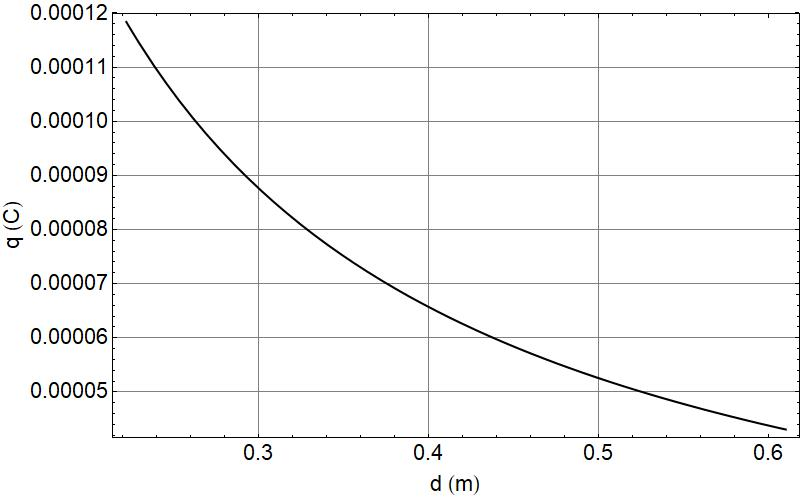
where Lm is the mechanical angular momentum and Le is the electromagnetic angular momentum. The stored charge associated with the electromagnetic angular momentum decreases as the distance from the bubble increases, vanishing for a distant observer.
Figure 1: Charge stored by the electromagnetic angular momentum for a spherical soap bubble, showing the decrease in stored charge with increasing distance from the bubble.
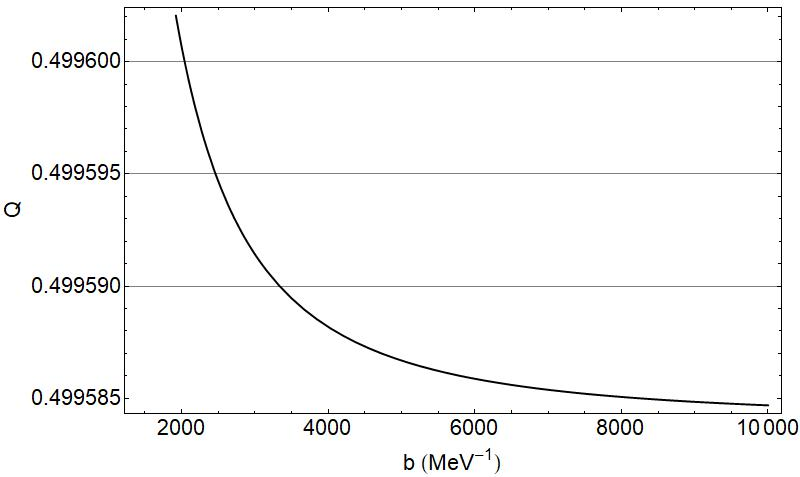
For black holes, the electromagnetic angular momentum similarly depends on the distance between the black hole and a test charge. The Garfinkle-Rey result for the electromagnetic angular momentum in a system comprising a charged black hole and a distant test charge is:
Le=eQ[1−b22rH(2rH−MM2−Q2)]
where b is the distance to the test charge, rH is the event horizon radius, M is the black hole mass, and Q is its charge. As b→∞, Le→0, and the charge stored by the electromagnetic angular momentum becomes negligible.
Figure 2: Charge stored by the electromagnetic angular momentum for a black hole, illustrating the decrease in stored charge as the distance to the test charge increases.
This analogy underscores the universality of the interplay between charge, rotation, and angular momentum in both classical and gravitational systems.
Charge Distribution and Angular Dependence on the Event Horizon
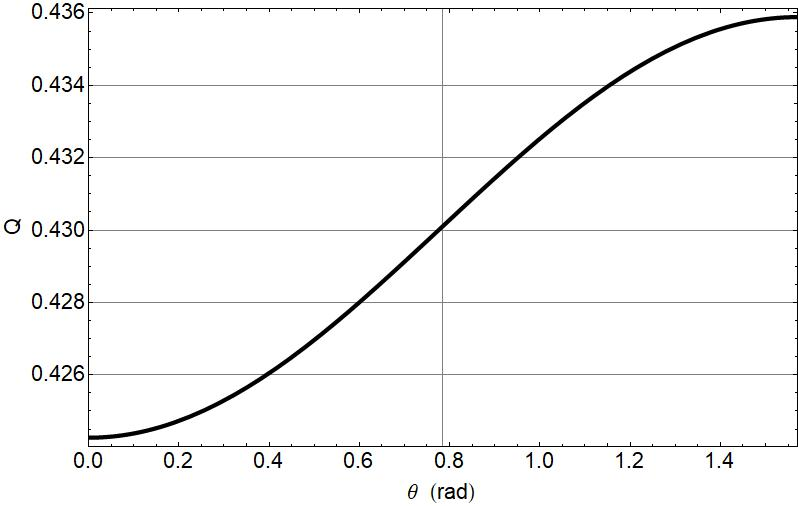
The charge distribution on the event horizon of a Kerr-Newman black hole is not uniform. The total charge as a function of the polar angle θ is given by:
Q(θ)=2MRf−(Rf2+a2cos2θ)
where Rf is the event horizon radius and a=J/M is the Kerr parameter. The constraint
(J/M)2cos2θ+Rf2≤2MRf
ensures the reality of the charge. The charge variation with respect to θ is maximal at the equator (θ=±π/2), indicating a non-uniform distribution.
Figure 3: Charge variation on the event horizon as a function of polar angle θ for fixed J, Rf, and M.
This non-uniformity has implications for the local electromagnetic environment near the event horizon and may influence the dynamics of accreting plasma and the emission of charged particles.
The First Law of Thermodynamics for Charged Rotating Black Holes
The first law for a charged rotating black hole generalizes the standard thermodynamic relation by including contributions from charge and angular momentum:
dM=8πκdA+ΩdJ+ΦdQ
where M is the mass, κ is the surface gravity, A is the event horizon area, Ω is the angular velocity, J is the angular momentum, Φ is the electric potential, and Q is the charge.
The Gouy-Stodola theorem is invoked to relate entropy production to the difference between reversible and irreversible work, leading to the identification of the ΦdQ term as the work associated with charge transfer. The analysis shows that the chemical potential term in the first law can be interpreted as the electrochemical potential for charged particles crossing the event horizon, with the total work done given by:
dW=ΦdQ
This formalism confirms that the inclusion of charge does not violate the thermodynamic consistency of black hole mechanics.
Partition Function and Observational Implications
The partition function for a charged rotating black hole, derived from the thermodynamic potential, is:
Z≈exp[TM−ΩJ+ΦQ]
For a distant observer, as the distance b increases, the contribution of charge to the partition function becomes negligible, and Z approaches a constant. This implies that, at large distances, the thermodynamic properties of the black hole are dominated by mass and angular momentum, with charge effects suppressed.
The entropy production rateS˙ also vanishes for distant observers, indicating that entropy dynamics are only locally relevant near the event horizon. This has implications for the detectability of Hawking radiation and the entanglement structure of emitted quanta, suggesting that charge-dependent effects are confined to the near-horizon region.
Discussion and Implications
The extension of black hole thermodynamics to include charge, supported by the soap bubble analogy and the Gouy-Stodola theorem, reinforces the robustness of the entropy-area law and the first law of black hole mechanics. The results indicate that charge contributes to the total angular momentum and modifies the local entropy dynamics, but its influence diminishes with distance.
From an astrophysical perspective, the findings are relevant for scenarios involving charged black holes, such as those in plasma-rich environments or with significant magnetic fields. The suppression of charge effects at large distances suggests that electromagnetic signatures of black hole charge are likely to be subtle, but may still play a role in local plasma dynamics, jet formation, and the detailed structure of Hawking radiation.
Theoretically, the work provides a consistent thermodynamic framework for charged rotating black holes, supporting the view that black holes are thermodynamic objects obeying generalized laws. The approach may inform future studies of black hole phase transitions, stability, and the interplay between gravity, thermodynamics, and quantum theory.
Conclusion
This study demonstrates that the inclusion of charge in the thermodynamic analysis of rotating black holes preserves the validity of the first law and the entropy-area relationship. The analogy with charged rotating soap bubbles provides physical intuition for the role of electromagnetic angular momentum and the spatial dependence of charge effects. The results have implications for both the theoretical understanding of black hole thermodynamics and the interpretation of astrophysical observations, particularly in environments where charge accumulation is possible. Future work may explore the impact of charge on black hole evaporation, gravitational wave signatures, and the quantum statistical properties of black holes.