GW241011 and GW241110: Exploring Binary Formation and Fundamental Physics with Asymmetric, High-Spin Black Hole Coalescence
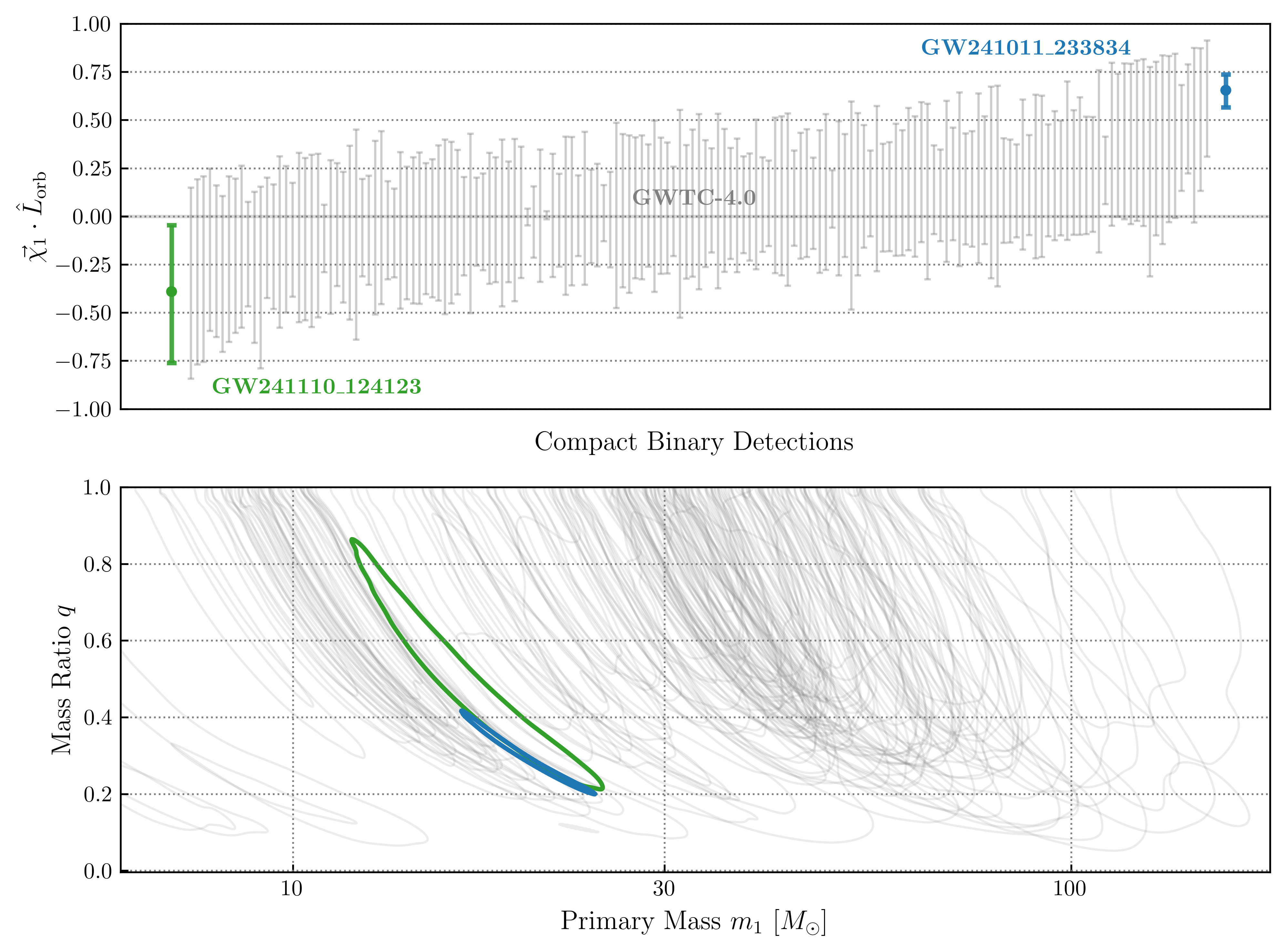
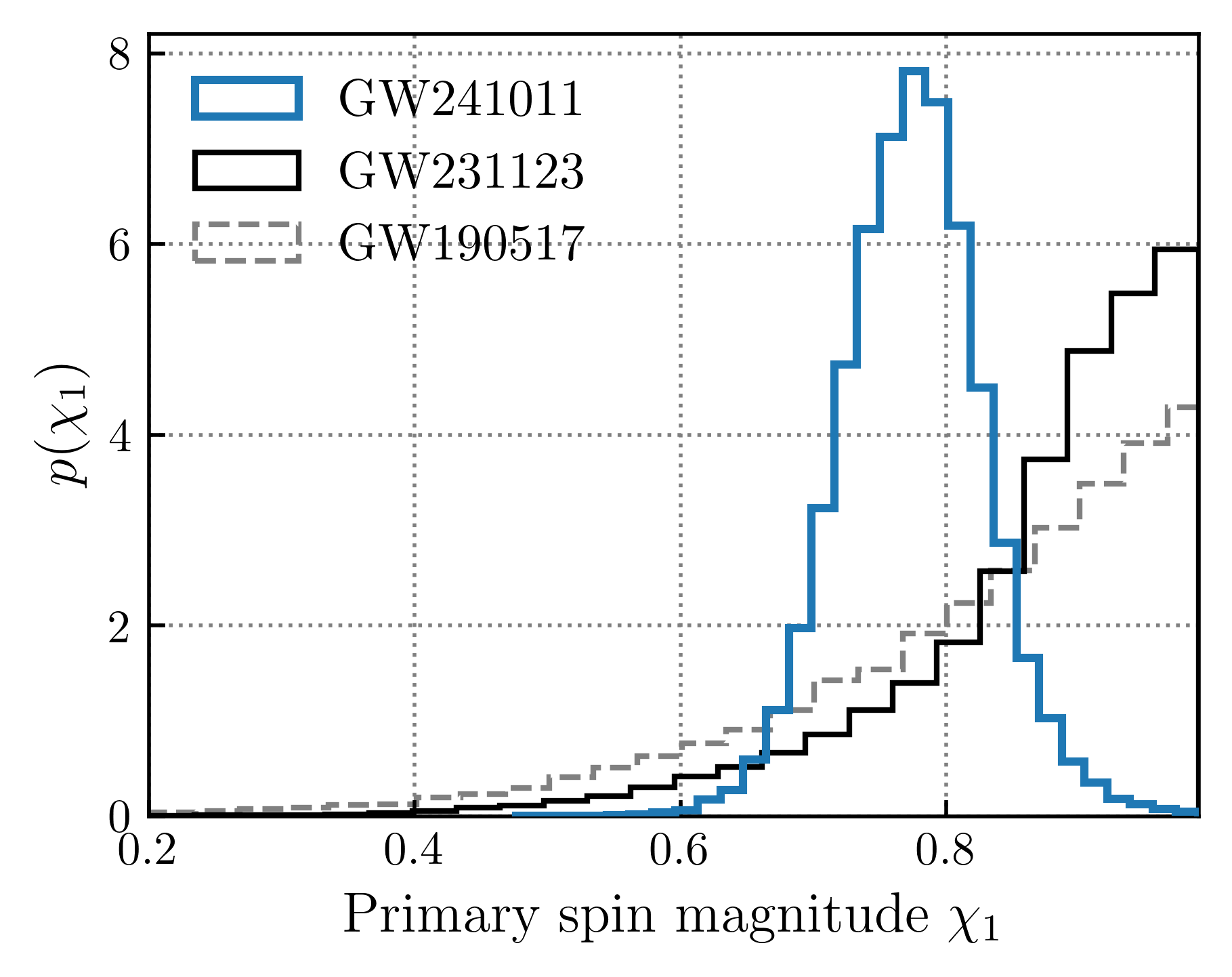
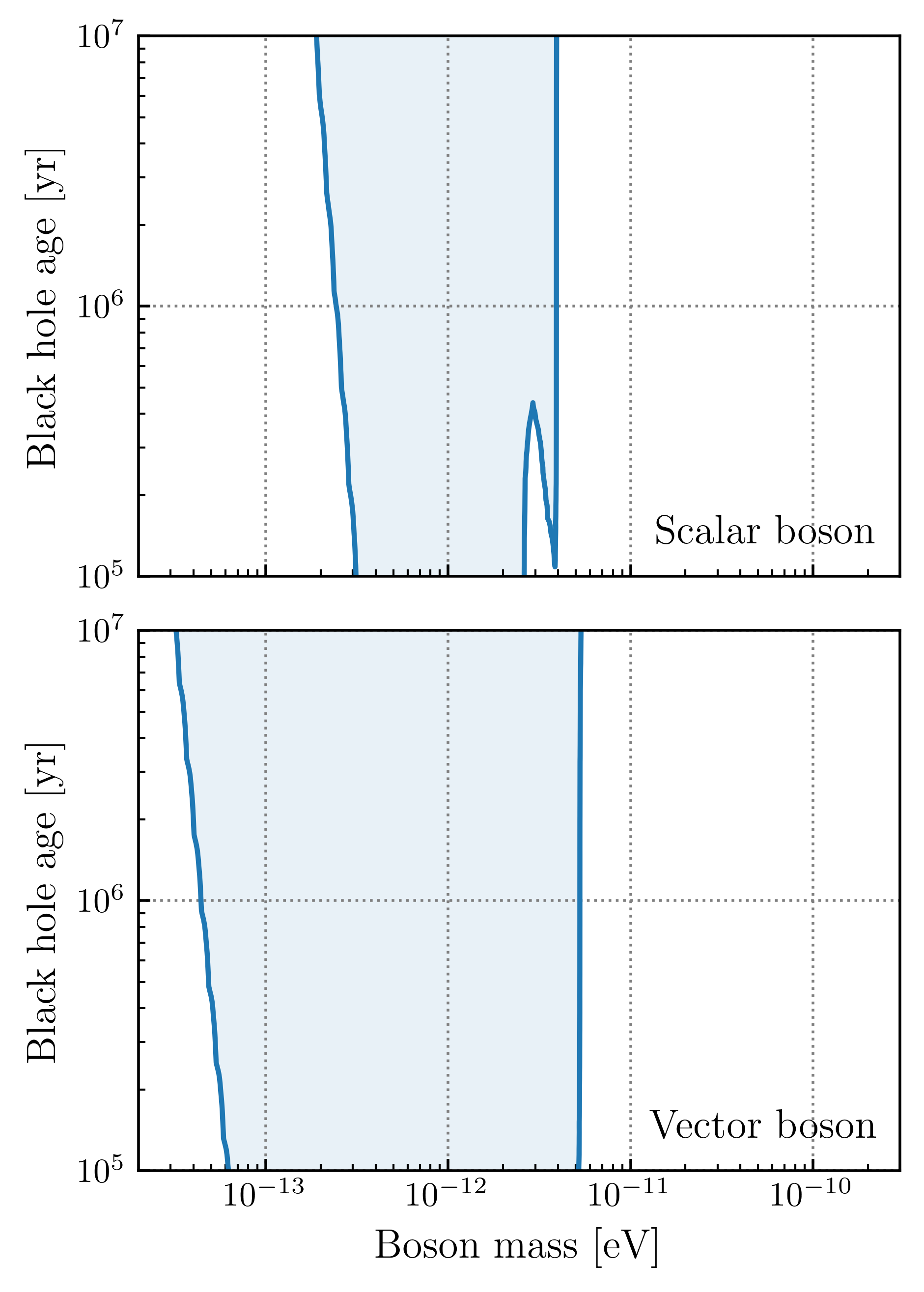
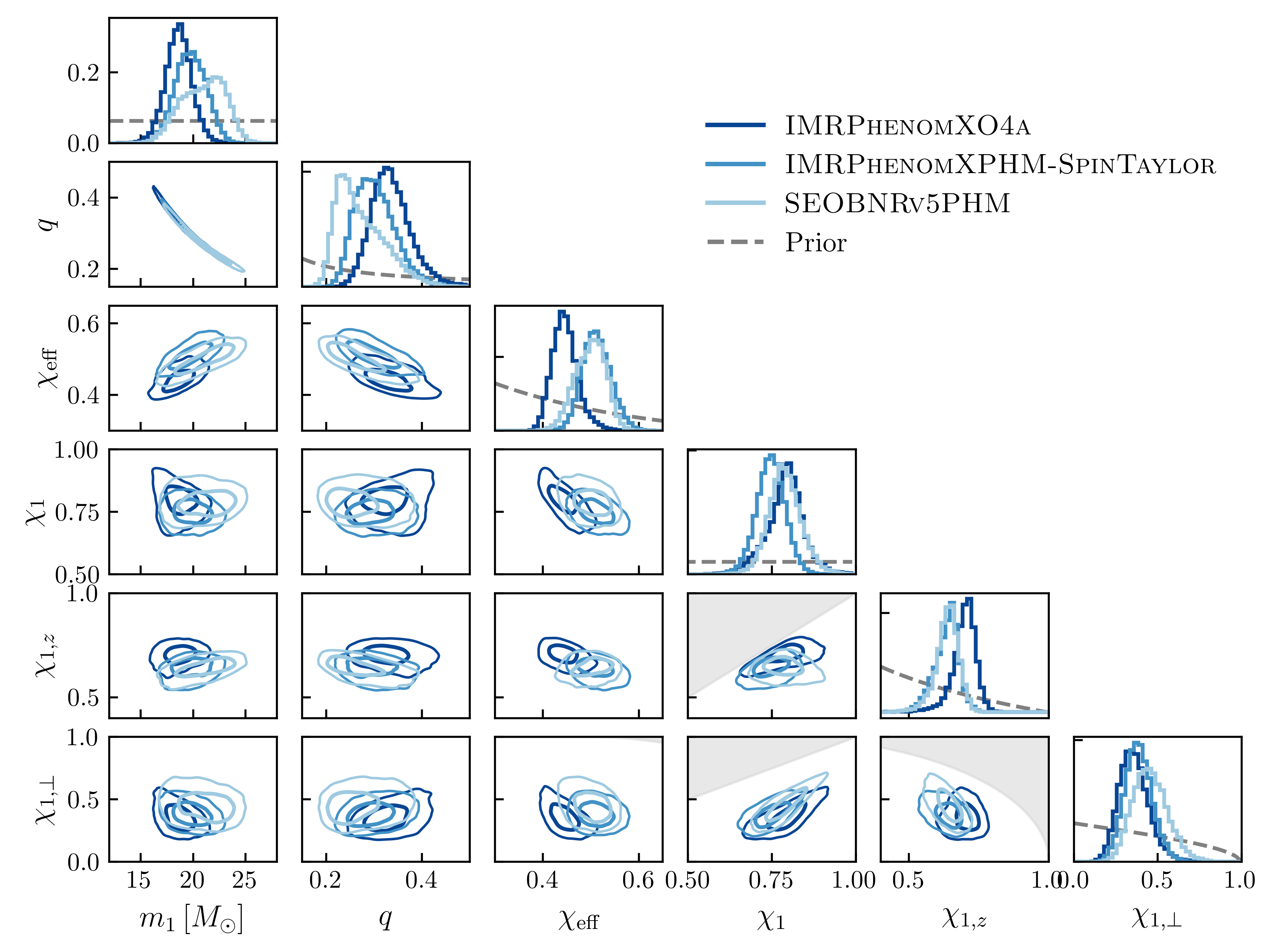
Abstract: We report the observation of gravitational waves from two binary black hole coalescences during the fourth observing run of the LIGO--Virgo--KAGRA detector network, GW241011 and GW241110. The sources of these two signals are characterized by rapid and precisely measured primary spins, non-negligible spin--orbit misalignment, and unequal mass ratios between their constituent black holes. These properties are characteristic of binaries in which the more massive object was itself formed from a previous binary black hole merger, and suggest that the sources of GW241011 and GW241110 may have formed in dense stellar environments in which repeated mergers can take place. As the third loudest gravitational-wave event published to date, with a median network signal-to-noise ratio of $36.0$, GW241011 furthermore yields stringent constraints on the Kerr nature of black holes, the multipolar structure of gravitational-wave generation, and the existence of ultralight bosons within the mass range $10{-13}$--$10{-12}$ eV.

Paper Prompts
Sign up for free to create and run prompts on this paper using GPT-5.
Top Community Prompts
Explain it Like I'm 14
GW241011 and GW241110: what this paper is about
This paper is about two special signals called GW241011 and GW241110. These signals are “gravitational waves,” tiny ripples in space made when two black holes spin around each other and crash together. The team used giant, super-sensitive detectors (LIGO, Virgo, and KAGRA) to listen for these ripples. These two crashes were unusual because the black holes had very different sizes (asymmetric) and were spinning fast (high spin). The paper asks: how did these black holes form, and do their signals match Einstein’s theory of gravity?
What questions are the scientists trying to answer?
The researchers focus on a few simple ideas:
- How big were the black holes, and how different were their sizes?
- How fast were they spinning, and in what directions?
- Where in the universe did the crashes happen (how far away)?
- What do these properties tell us about how black hole pairs form?
- Do the waves match what Einstein’s theory (general relativity) predicts, or do we see any hints of new physics?
How did they study the signals?
Think of it like detective work with sound:
- The detectors record a lot of “noise” (random vibrations). Finding a real signal inside it is like spotting a familiar song playing softly during a loud party.
- The team used “templates,” which are computer-made patterns of what black hole crashes should sound like. This matching process is called “matched filtering”—like using a song fingerprint to spot your favorite track in the noise.
- Once they find the signal, they run “parameter estimation,” which is like trying many combinations of puzzle pieces to figure out the exact masses, spins, distance, and direction of the black holes that best explain the measured waves.
- They also check how likely it is that the signal was just noise pretending to be real. This is measured with the “false alarm rate” (FAR). A low FAR means it’s very unlikely to be random noise.
- They compare different models (ways of calculating wave patterns) to make sure the results don’t depend too much on one specific method.
- Finally, they test general relativity by checking if the different parts of the signal (the spiral-in, the crash, and the final “ringing” of the new black hole) all agree with Einstein’s predictions.
What did they find, and why does it matter?
Here’s the big picture, explained simply:
- Both GW241011 and GW241110 came from pairs of black holes with noticeably different sizes (asymmetric). That’s interesting because many earlier detections involved more equal-sized pairs.
- The black holes were spinning fast (high spin). Spin is like how quickly a black hole is rotating. Fast spin affects the shape and timing of the waves we see.
- The direction of those spins (whether they line up with the orbit or tilt around) can hint at how the pair formed. If spins are aligned, it might mean the black holes grew up together as stars in a quiet system. If spins are tilted or very different, it might mean they were paired later inside busy places like star clusters, where black holes can meet and capture each other.
- The signals fit well with Einstein’s theory—no strong evidence of new physics. That’s a powerful test because these are extreme conditions (super strong gravity).
- These events add to the growing “family album” of black hole mergers. Seeing more asymmetric, high-spin systems helps scientists refine theories about where and how black holes form. For example, they consider:
- Isolated binary evolution: two massive stars live together, collapse into black holes, and eventually merge.
- Dynamical assembly: black holes meet and pair inside dense star clusters.
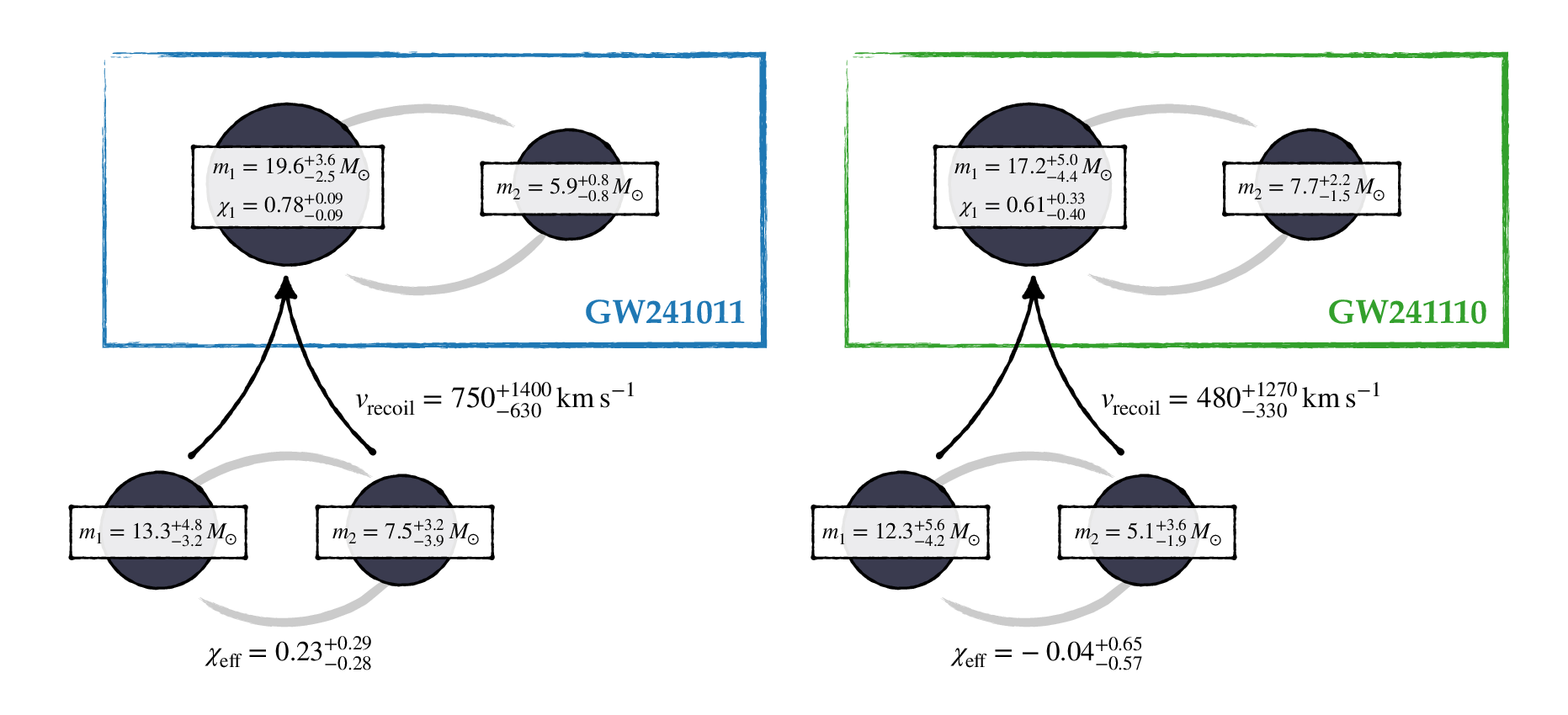
- Hierarchical mergers: a black hole formed from a previous merger later merges again, possibly leading to very high spins.
Even without exact numbers here, the main takeaways are clear: these two events look unusual and informative, and they still agree with general relativity.
What could this mean for the future?
- Black hole origin stories: Asymmetric masses and fast spins push scientists to improve models of how black hole pairs are made. More events like these will help decide which formation paths are most common.
- Better tests of gravity: Extreme systems give strong tests of Einstein’s theory. So far, it holds up. If future data ever show tiny mismatches, we might learn something new about how gravity works.
- Detector upgrades and more discoveries: As LIGO, Virgo, and KAGRA get more sensitive, we’ll catch fainter and stranger signals, building a clearer picture of black hole populations across the universe.
- Cosmic history: Each merger tells us about the life and death of stars, the environments of galaxies, and how often such events happen. That helps map out the universe’s past.
In short, GW241011 and GW241110 are like two rare, exciting tracks on a cosmic playlist. They teach us about how black holes form and spin, and they give Einstein’s theory another tough workout—one it still passes.
Knowledge Gaps
Knowledge gaps, limitations, and open questions
The following items highlight what is missing, uncertain, or left unexplored and could guide targeted follow-up research on asymmetric, high-spin binary black hole coalescences like GW241011 and GW241110:
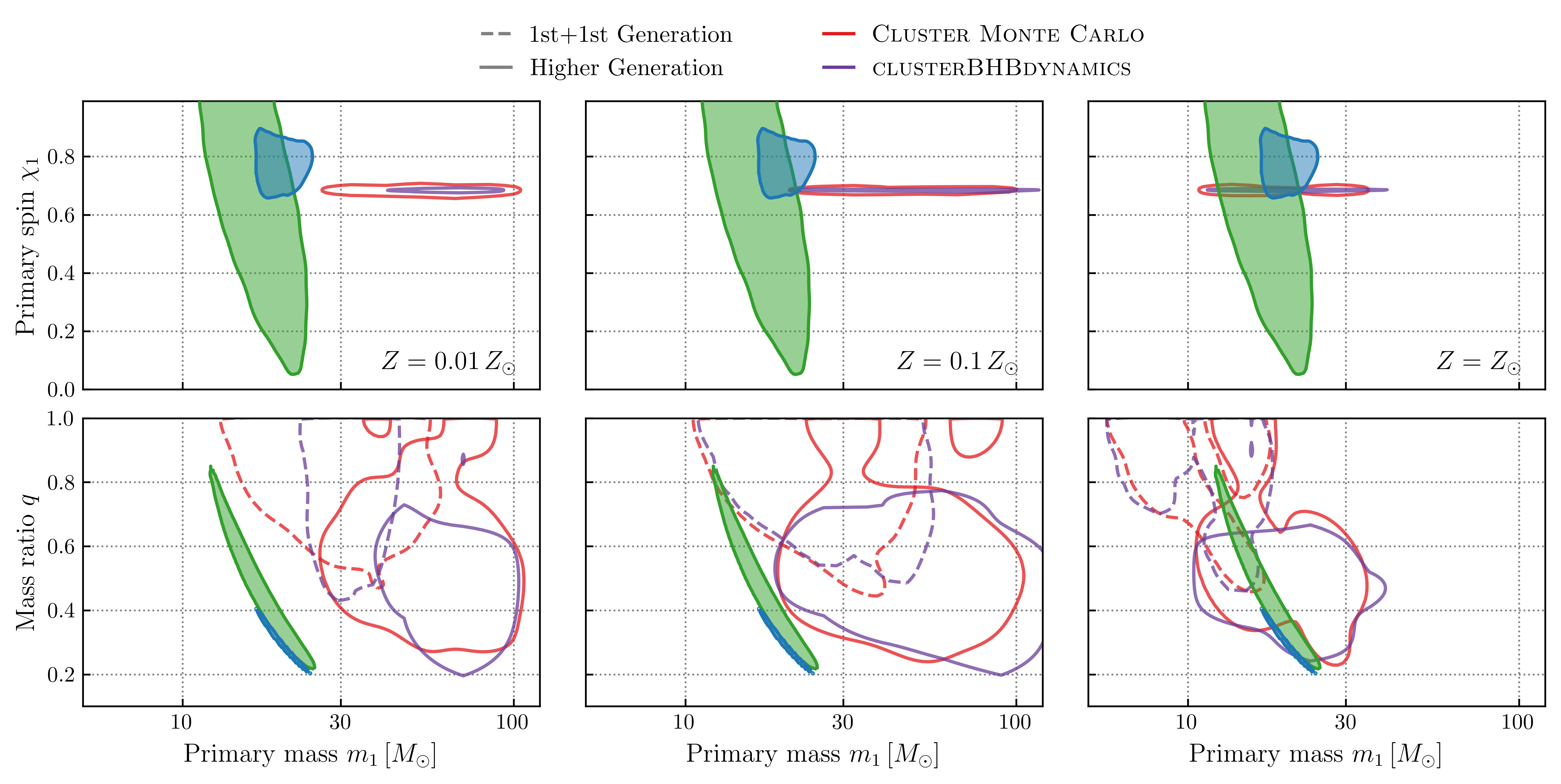
- Insufficient model comparison for formation channels: no quantitative Bayes-factor ranking among isolated binary evolution, dynamical assembly (globular/nuclear clusters), AGN disk migration, and hierarchical mergers under consistent selection effects and prior-sensitivity studies.
- Unclear origin of high spins: lacks a robust disentangling of natal spins versus accretion-induced spins versus hierarchical-merger spins using spin magnitudes, tilt angles, and precession signatures under realistic evolutionary priors.
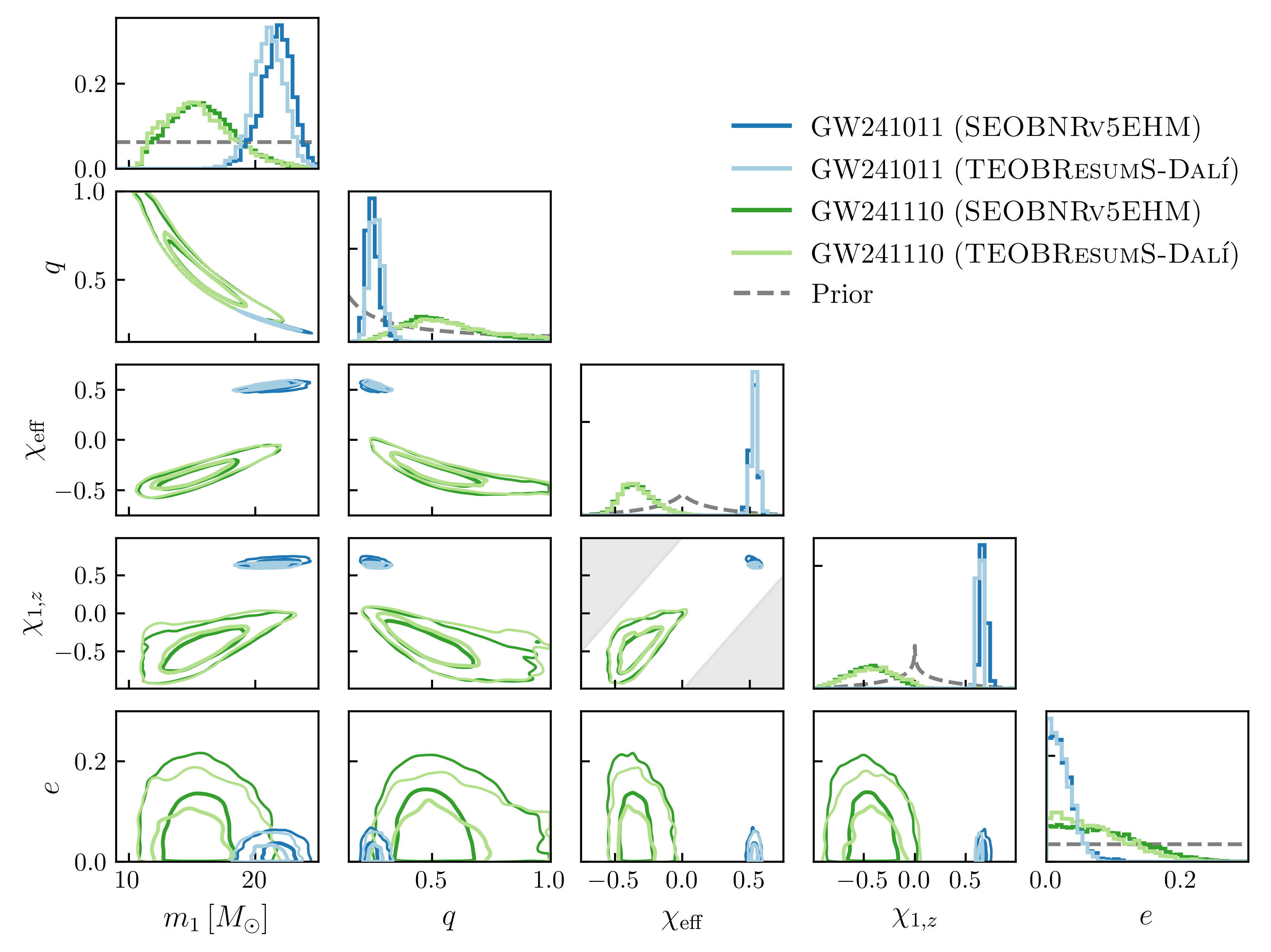
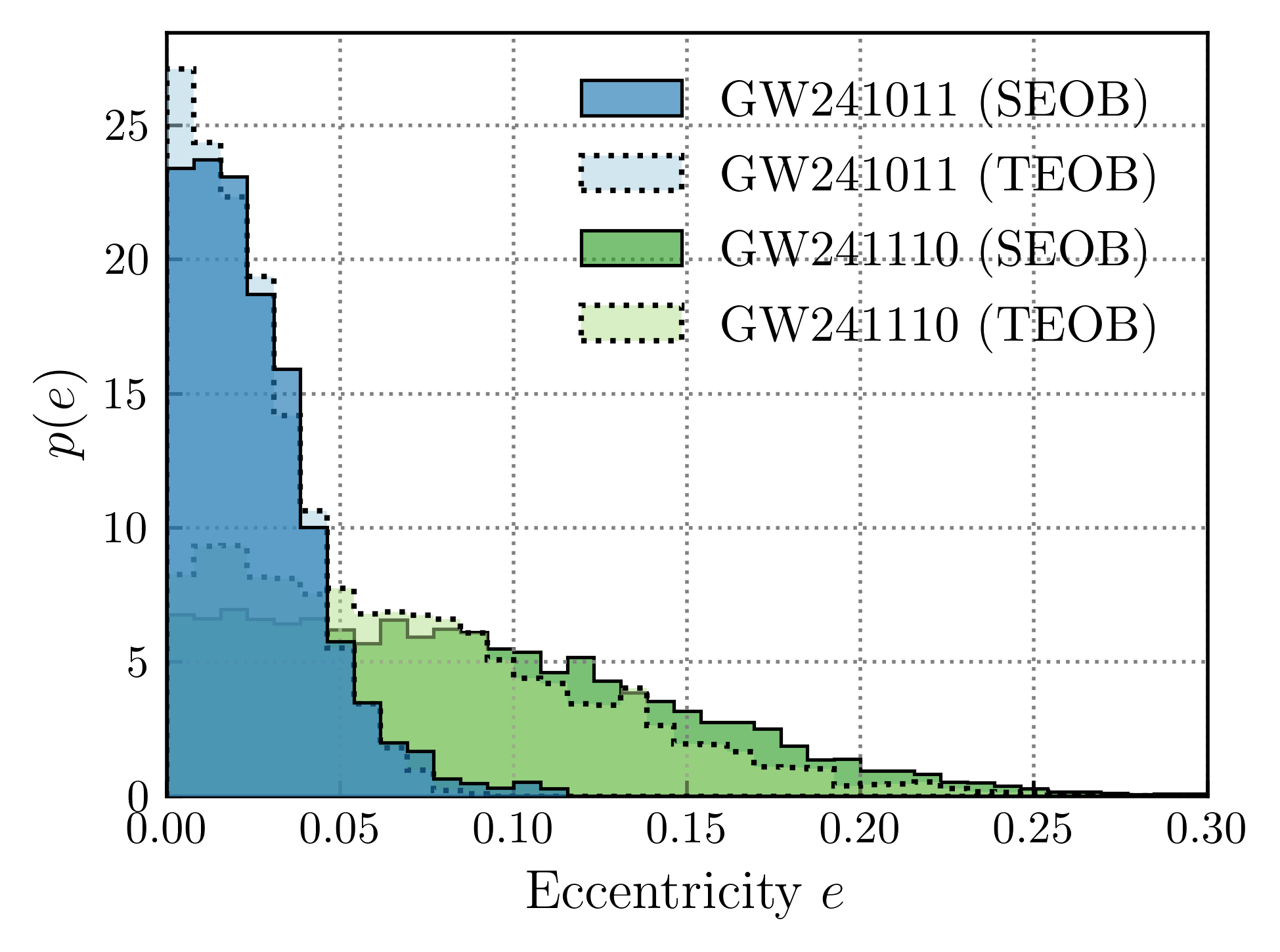
- Limited eccentricity constraints: absence of a well-posed posterior on orbital eccentricity at 10–20 Hz and formal model selection against eccentric waveform families; need explicit upper limits that account for waveform systematics and noise non-stationarity.
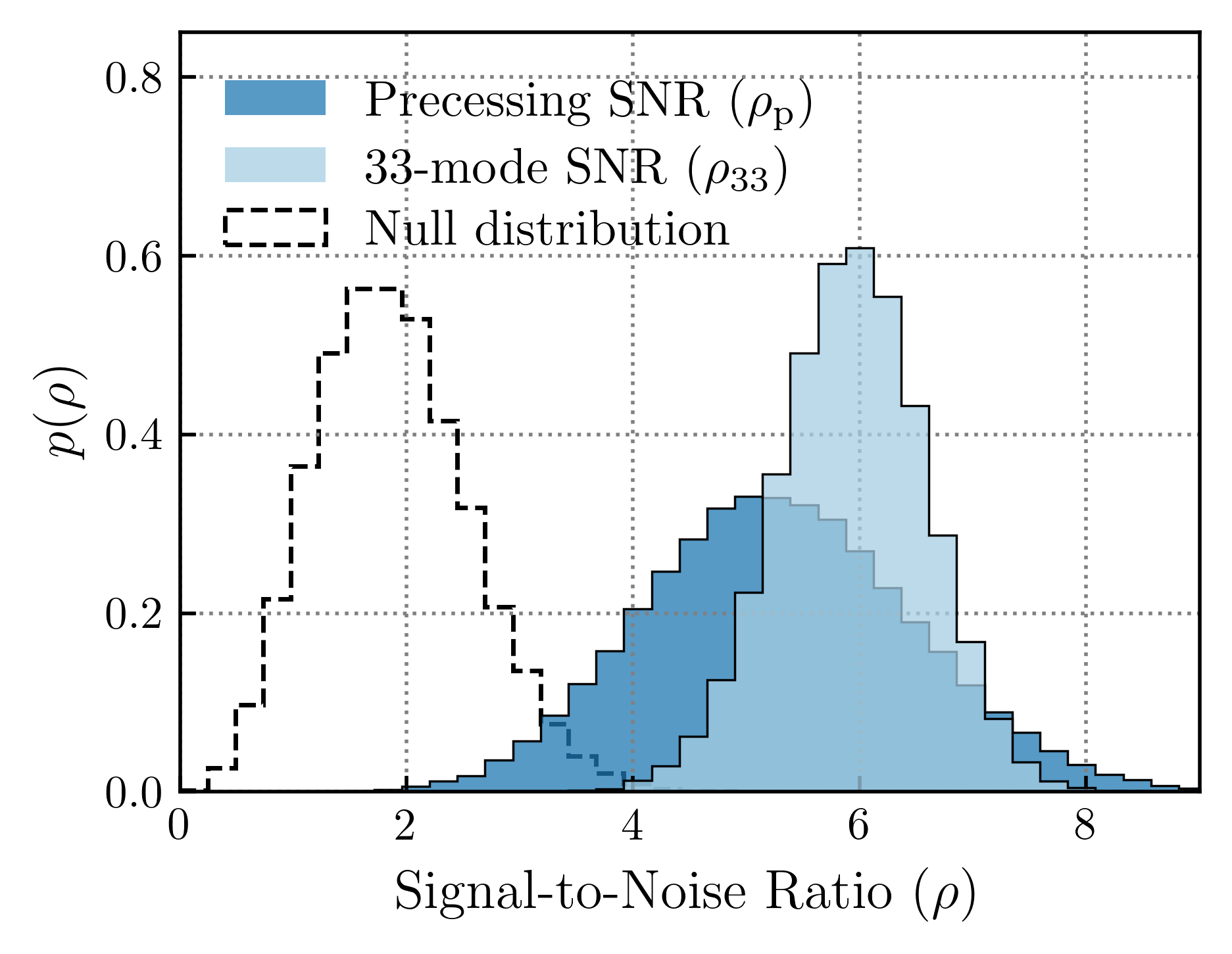
- Precession evidence not quantified: missing Bayes factors for precessing versus aligned-spin models, and absence of posterior constraints on the effective precession parameter
χ_pand component spin tilt angles that would inform formation scenarios. - Higher-mode content underexplored: no measurement of evidence for
ℓ > 2modes (e.g.,ℓ=3,4) and their impact on inclination, mass ratio, and distance posteriors, especially critical for asymmetric mass ratios. - Waveform systematics for high spin/high mass-ratio: lacks a sensitivity study showing how different IMR/EOB/NR-calibrated models bias
q,χ_eff,χ_p, and final-spin estimates for near-extremal component spins and moderate-to-highq. - Numerical relativity coverage gaps: no assessment of whether parameter posteriors sit outside regions densely covered by NR catalogs (e.g., extremal spins, high precession), and the consequent uncertainty budget.
- Calibration and data-quality impacts: missing quantification of amplitude/phase calibration uncertainties and transient noise artifacts on spin and mass measurements; no residual-analysis audit across frequency bands to ensure GR-consistent residuals.
- Ringdown tests of GR incomplete: absence of multi-mode QNM consistency checks (independent mass/spin from ringdown), overtone searches, and bounds on parameterized deviations from GR in merger/ringdown regimes.
- Remnant properties and cosmic censorship: no explicit constraints on remnant spin relative to extremality (spin < 1), nor bounds on potential naked singularity formation in alternative gravity scenarios.
- Gravitational-wave recoil (kick) not constrained: missing posterior on remnant kick velocities and implications for retention in clusters or AGN disks versus ejection, which directly tie to formation environment hypotheses.
- Misclassification risk for the lighter component: no formal test against NSBH hypotheses (e.g., if the secondary mass is near the maximum NS mass), with explicit EoS priors and tidal signatures to rule in/out a neutron star.
- Lensing tests absent: no analysis excluding or quantifying macrolensing/microlensing probabilities that could bias inferred masses/spins and event rates at higher redshift.
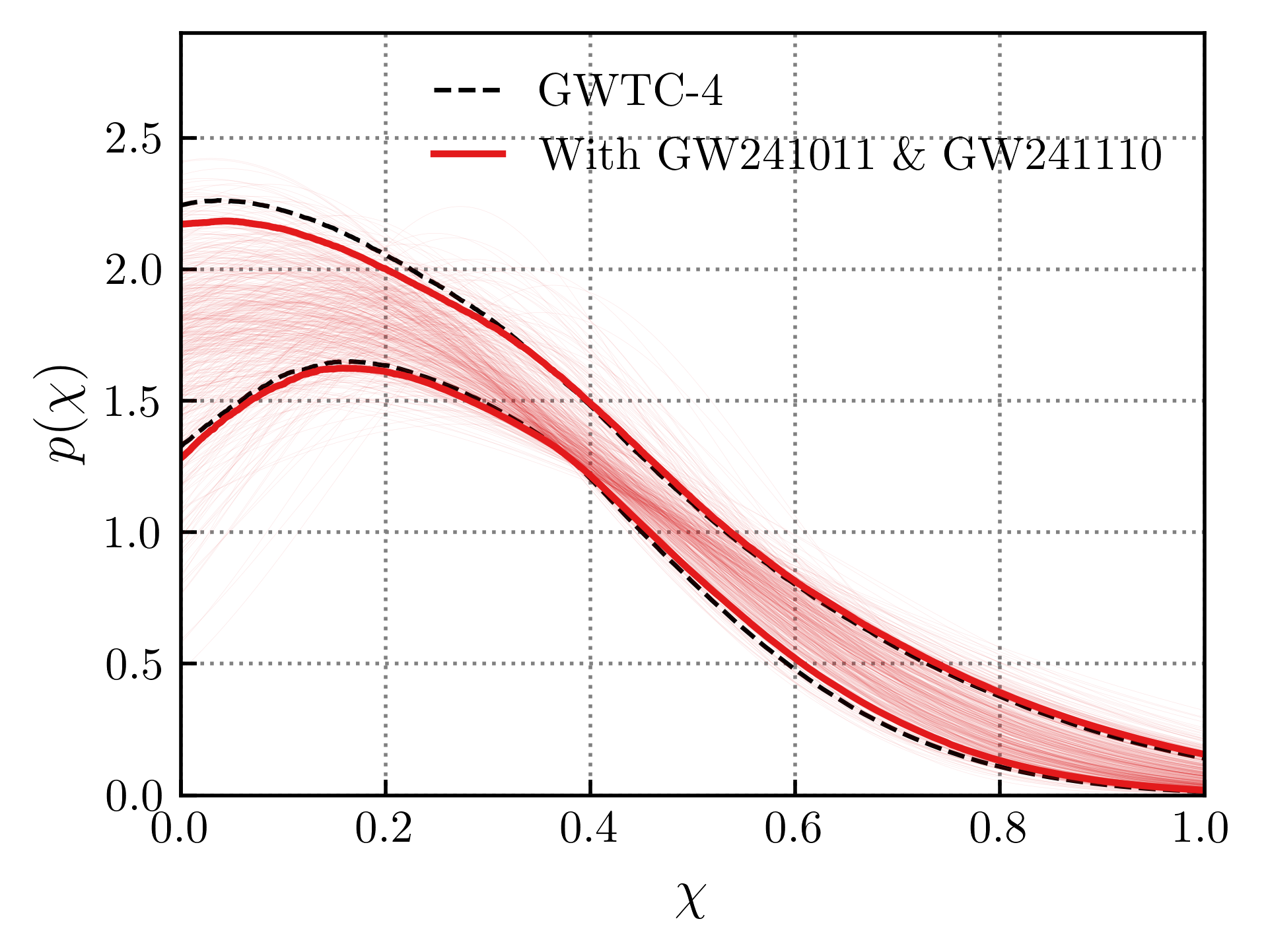
- Selection-bias aware population inference: missing integration of these events into a hierarchical population model (spin magnitudes, tilt-isotropy, mass-ratio distribution) with a documented selection function and sensitivity to astrophysical priors.
- Metallicity and redshift dependence: no constraints tying component masses/spins to metallicity/stellar-age distributions and their redshift evolution, which could distinguish isolated vs dynamical channels.
- Environmental signatures untested: lack of cross-correlation with EM/neutrino/AGN catalogs for environmental association (AGN disks, nuclear star clusters) and consequent constraints on gas-assisted evolution.
- Degeneracies not mapped: no systematic exploration of key parameter degeneracies (e.g., inclination–distance–higher modes;
χ_eff–mass ratio) via alternative priors and waveform families to identify robustly inferred quantities. - Eccentric-precession joint modeling: absence of joint eccentric-and-precessing waveform tests to evaluate whether residual eccentricity biases precession/spin inference in asymmetric systems.
- Event-level reproducibility: no cross-pipeline validation (different PE engines, priors, and waveform models) demonstrating consistent posteriors and robustness to analysis choices.
- Data products for reanalysis: lack of publicly curated posterior samples, priors, PSDs, and calibration models to enable independent community reanalyses and waveform-systematics studies.
- Cosmological implications not assessed: no evaluation of how these events impact BBH merger-rate evolution with redshift or constraints on cosmological parameters via dark sirens (even if only illustrative).
- Hierarchical-merger diagnostics: missing tests for second-generation components (e.g., unusually high component spins, masses in the pair-instability gap) and consistency with retention in dense environments.
- Spin-tilt distribution versus channel models: no statistical comparison of inferred tilt angles with predictions from isolated binary evolution (near-aligned) versus dynamical channels (isotropic), accounting for measurement uncertainties and selection effects.
- Post-merger remnants and IMBH growth: no analysis of whether remnant masses/spins contribute to intermediate-mass black hole assembly pathways, with retention probabilities in candidate environments.
- Impacts of non-Gaussian noise on GR tests: missing robustness checks of GR-deviation bounds against realistic noise modeling (glitches, spectral lines), including injection campaigns to calibrate test sensitivity.
Practical Applications
Immediate Applications
The paper reports and analyzes two asymmetric, high-spin binary black hole coalescences (GW241011, GW241110), using state-of-the-art gravitational-wave detection, parameter estimation, and model-selection workflows. The methods and infrastructure underpinning these results already enable practical uses across sectors.
- Advanced time-series anomaly detection and denoising
- Sectors: healthcare, finance, industrial IoT, telecom
- What to use: matched filtering, coherent burst detection (e.g., cWB), PSD-estimation under nonstationarity, glitch classification, Bayesian model selection, low-latency signal vetting; toolchains akin to LALSuite, PyCBC, Bilby, GstLAL; sampling methods (nested sampling, HMC), and GPU-accelerated inference
- Workflow: adapt GW-style pipelines to monitor streaming sensor/market data, detect weak signals amid non-Gaussian, nonstationary noise, quantify false alarm rates (FAR) and detection confidence, and deliver actionable low-latency alerts
- Assumptions/dependencies: domain adaptation to non-astrophysical noise; access to compute; integration with enterprise data governance; model calibration on sector-specific data
- Precision vibration isolation and active feedback control
- Sectors: semiconductor manufacturing, precision metrology, robotics, microscopy (SEM/TEM), aerospace
- What to use: LIGO-class seismic isolation, suspension control, active alignment and feedback strategies; control-theory tuned for sub-Hz to kHz disturbances
- Workflow: retrofit high-stability assembly lines, lithography stages, and robotic end-effectors with active isolation stacks; apply auto-alignment routines to maintain nanometer-scale tolerances
- Assumptions/dependencies: environmental characterization; mechanical integration; supplier ecosystem for precision sensors/actuators
- Laser stabilization, photonic metrology, and coating technologies
- Sectors: LiDAR/AD sensors, coherent optical communications, quantum sensing, spectroscopy
- What to use: frequency-stabilized high-power lasers, low-loss dielectric coatings, squeezed-light readiness, optical cavity control algorithms
- Workflow: improve LiDAR range/precision, reduce phase noise in coherent comms, enhance quantum sensor SNR using stabilized sources and low-thermal-noise optics
- Assumptions/dependencies: supply of low-loss coatings; thermal management in compact devices; cost-benefit in automotive/industrial deployments
- Open, reproducible data science workflows at scale
- Sectors: software/ML, MLOps, cloud computing, research IT
- What to use: end-to-end pipelines spanning low-latency event detection to Bayesian parameter estimation, provenance tracking, posterior aggregation (e.g., PESummary), FAIR data release models
- Workflow: adopt GW-style CI/CD for data/ML, automated uncertainty quantification, statistical guardrails (IFAR/FAP), and rapid human-in-the-loop review
- Assumptions/dependencies: organizational culture for reproducibility; cloud/HPC access; compliance (privacy/security) alignment
- Multimodal alerting and resource scheduling
- Sectors: astronomical facilities, remote sensing, satellite tasking
- What to use: low-latency sky localization, event brokers, VOEvent-style alert standards, follow-up prioritization heuristics
- Workflow: schedule follow-ups and allocate telescope time opportunistically based on posterior skymaps and merger properties; generalize to any real-time resource management under uncertainty
- Assumptions/dependencies: standards interoperability; partner coordination; API governance
- Workforce upskilling in Bayesian inference and uncertainty quantification
- Sectors: education, R&D across industries
- What to use: courseware built around GW event inference; hands-on with real datasets and open-source software (Bilby, PyCBC, LALSuite)
- Workflow: capstone projects on signal detection in noise, model comparison, hierarchical population inference
- Assumptions/dependencies: dataset curation; licensing and training resources; institutional adoption
- Environmental and infrastructure monitoring using GW-inspired sensors and analytics
- Sectors: civil engineering, energy, transportation
- What to use: techniques for monitoring nonstationary backgrounds (microseisms, anthropogenic noise), outlier detection, sensor fusion
- Workflow: deploy networks of accelerometers/seismometers on bridges/turbines/rail; apply FAR/SNR-style metrics to trigger maintenance
- Assumptions/dependencies: sensor placement and calibration; data backhaul; thresholds tuned to operational risk
- Astrophysical modeling and population inference for academic/industry simulation stacks
- Sectors: academia, HPC software vendors, scientific simulation
- What to use: hierarchical Bayesian population inference; model selection over formation channels (isolated binaries, dynamical assembly, hierarchical mergers); waveform surrogate models (IMRPhenom, EOBNR, NRSur)
- Workflow: integrate event posteriors into stellar/galactic evolution models; propagate uncertainties to forecast merger rates and parameter distributions
- Assumptions/dependencies: access to posterior samples; consistent selection effects modeling; reproducible pipelines
- Collaboration and data-sharing governance patterns
- Sectors: policy, research consortia, regulated industries
- What to use: LVK-style MOUs, open data releases with embargoes, provenance and audit trails, international coordination templates
- Workflow: structure multi-institution projects with clear data-access tiers, alert protocols, and credit mechanisms
- Assumptions/dependencies: legal/compliance harmonization; funding agency alignment
Long-Term Applications
The findings on asymmetric, high-spin black hole mergers sharpen questions on binary formation channels and fundamental physics, motivating next-generation detectors, algorithms, and cross-disciplinary technologies.
- Standard-siren cosmology at scale (dark and bright sirens)
- Sectors: space/ground-based astronomy, cosmology, policy (scientific roadmapping)
- What to develop: statistical “dark siren” H0 and growth-of-structure constraints using galaxy catalogs; improved sky localization and host association; joint modeling with large-scale surveys
- Potential products/workflows: cosmology services integrating GW posteriors with photometric/spectroscopic surveys; public H0 forecasts with uncertainty dashboards for planners
- Assumptions/dependencies: higher detector sensitivity/density; complete galaxy catalogs; robust selection-effect modeling; cross-survey data sharing
- Fundamental physics constraints as a service
- Sectors: high-energy theory, particle/astro-phenomenology
- What to develop: platformized constraints on beyond-GR effects (dispersion, ringdown tests), ultralight bosons via spin distributions/superradiance, graviton mass bounds
- Potential products/workflows: an API delivering continuously updated bounds from event catalogs; sandbox for hypothesis testing against posteriors
- Assumptions/dependencies: waveform systematics control; diverse event populations (extreme spins/mass ratios); community consensus on priors
- Next-generation precision sensing and quantum-enabled metrology
- Sectors: quantum tech, navigation, medical imaging, geology
- What to develop: cryogenic low-loss optics, squeezed-light sources in compact form factors, quantum-enhanced inertial sensors
- Potential products/workflows: portable quantum gravimeters/gyros for subsurface mapping and navigation; low-dose interferometric biomedical sensors
- Assumptions/dependencies: materials breakthroughs (coatings, silicon/sapphire optics), robust squeezing outside lab conditions, manufacturability at scale
- Active isolation and autonomous alignment for ultra-precision manufacturing 2.0
- Sectors: advanced packaging, EUV lithography, biotech instrumentation
- What to develop: AI-assisted control leveraging GW-grade feedback architectures and simulation-in-the-loop digital twins
- Potential products/workflows: self-calibrating assembly lines achieving picometer–nanometer stability; predictive disturbance rejection
- Assumptions/dependencies: integration with vendor control stacks; safety certifications; ROI vs complexity trade-offs
- Global multi-messenger early-warning networks
- Sectors: astronomy networks, satellite tasking, emergency coordination (for EM-bright events)
- What to develop: sub-minute end-to-end alerting with confidence-weighted follow-up orchestration; autonomous decision engines for telescope fleets
- Potential products/workflows: broker platforms prioritizing tiles/filters dynamically; SLA-backed alert services for observatories
- Assumptions/dependencies: detector duty cycles; standardized APIs; high-uptime compute/latency budgets
- Population-informed stellar evolution and star-cluster dynamics
- Sectors: academia, HPC, edtech
- What to develop: data-driven constraints on natal spins, kicks, metallicity effects, and dynamical assembly in clusters; refined initial condition generators for simulations
- Potential products/workflows: libraries delivering posterior-informed priors to N-body/BSE codes; curriculum modules tied to live catalogs
- Assumptions/dependencies: larger, more diverse event catalogs; consistent hierarchical analyses; improved waveform systematics
- Surrogate modeling and reduced-order inference for real-time engineering digital twins
- Sectors: aerospace, energy, automotive
- What to develop: physics-informed surrogate models and ROM techniques adapted from waveform modeling to accelerate high-fidelity simulations
- Potential products/workflows: sub-second digital twins for structural dynamics and acoustics with quantified uncertainty
- Assumptions/dependencies: transfer learning efficacy; validation datasets; coupling with legacy solvers
- Environmental intelligence from large-scale precision observatories
- Sectors: climate/earth sciences, smart infrastructure
- What to develop: repurposing environmental channels (seismic, magnetic, acoustic) and analytics to create high-fidelity background models for urban/industrial planning
- Potential products/workflows: city-scale disturbance atlases; policy tools for zoning around precision facilities
- Assumptions/dependencies: data access policies; sensor network density; model generalizability
- Governance blueprints for mega-science and federated AI
- Sectors: policy, international organizations, AI consortia
- What to develop: templates for cross-border data trusts, credit allocation, security incident response, and FAIR compliance derived from LVK practices
- Potential products/workflows: governance kits enabling rapid stand-up of secure, interoperable, multi-institution AI/science collaborations
- Assumptions/dependencies: international legal harmonization; stakeholder buy-in; sustainable funding
Notes on applicability to this paper’s specifics:
- The emphasis on asymmetric, high-spin BBHs directly informs formation-channel classifiers and priors used in population inference—immediately useful for academic modeling and, indirectly, for any domain requiring hierarchical Bayesian cohort analysis.
- The paper’s reliance on low-latency alerts, robust FAR/IFAR calibration, and cross-pipeline validation underpins the immediate software and operational applications listed above.
- Long-term physics outcomes (e.g., beyond-GR constraints, dark siren cosmology) depend on larger catalogs, improved detector sensitivity (O5 and beyond, plus LIGO-India, Cosmic Explorer, Einstein Telescope), and tighter waveform/systematic controls.
Glossary
- Advanced Laser Interferometer Gravitational-Wave Observatory: The second-generation LIGO instruments designed to detect gravitational waves with higher sensitivity. "\acrodef{aLIGO}{Advanced Laser Interferometer Gravitational-Wave Observatory}"
- Advanced Virgo: The upgraded Virgo gravitational-wave interferometer in Europe. "\acrodef{aVirgo}{Advanced Virgo}"
- Binary black hole: A gravitationally bound system of two black holes that can merge and emit gravitational waves. "\acrodef{bbh}[BBH]{binary black hole}"
- Binary neutron star: A binary system of two neutron stars whose merger produces characteristic gravitational-wave signals. "\acrodef{BNS}[BNS]{binary neutron star}"
- Black hole: A region of spacetime with gravity so strong that nothing, not even light, can escape. "\acrodef{BH}[BH]{black hole}"
- Black hole–neutron star binaries: Binary systems composed of one black hole and one neutron star. "\acrodef{BHNS}[BHNS]{black hole--neutron star binaries}"
- Coherent WaveBurst: An unmodeled burst search algorithm for detecting generic transient gravitational-wave signals. "\acrodef{cwb}[cWB]{coherent WaveBurst}"
- Compact binary coalescence: The inspiral and merger of two compact objects (black holes or neutron stars). "\acrodef{CBC}[CBC]{compact binary coalescence}"
- Credible level: A Bayesian measure indicating the probability content of an interval (e.g., 90% credible level). "\acrodef{CL}[CL]{credible level}"
- Effective-one-body: A relativistic framework that maps a two-body problem into an effective one-body system to model binary dynamics and waveforms. "\acrodef{EOB}[EOB]{effective-one-body}"
- Equation of state: A relation describing how pressure, density, and other properties of matter are connected (important for neutron-star matter). "\acrodef{EOS}[EoS]{equation of state}"
- False alarm probability: The probability that a detected event is due to noise rather than a true signal. "\acrodef{FAP}[FAP]{false alarm probability}"
- False alarm rate: The expected rate at which noise fluctuations mimic signals above a given threshold. "\acrodef{FAR}[FAR]{false alarm rate}"
- General relativity: Einstein’s theory of gravitation describing gravity as the curvature of spacetime. "\acrodef{GR}[GR]{general relativity}"
- Gravitational wave: A ripple in spacetime generated by accelerating masses, such as merging compact binaries. "\acrodef{gw}[GW]{gravitational wave}"
- Gravitational-wave: Hyphenated form used as a compound modifier (e.g., gravitational-wave detectors). "\acrodef{GWH}[GW]{gravitational-wave}"
- Inspiral–merger–ringdown: The three main phases of a compact-binary gravitational-wave signal. "\acrodef{IMR}[IMR]{inspiral--merger--ringdown}"
- Interferometer: An instrument that measures tiny changes in distance via interference of light, used to detect spacetime strain. "\acrodef{IFO}[IFO]{interferometer}"
- Intermediate-mass black hole: A black hole with mass between stellar and supermassive ranges (roughly 102–105 solar masses). "\acrodef{IMBH}[IMBH]{intermediate-mass black hole}"
- Inverse false alarm rate: A significance measure equal to the reciprocal of the false alarm rate; higher values indicate more significant events. "\acrodef{IFAR}[IFAR]{inverse false alarm rate}"
- Jensen–Shannon divergence: A symmetrized, bounded measure of dissimilarity between probability distributions. "\acrodef{JSD}[JSD]{Jensen--Shannon divergence}"
- Kullback–Leibler divergence: An information-theoretic measure quantifying how one probability distribution diverges from another. "\acrodef{KLD}[KLD]{Kullback--Leibler divergence}"
- Laser Interferometer Gravitational-Wave Observatory: A pair of kilometer-scale interferometers in the U.S. designed to detect gravitational waves. "\acrodef{LIGO}[LIGO]{Laser Interferometer Gravitational-Wave Observatory}"
- LIGO Algorithm Library: A software suite implementing gravitational-wave data analysis tools and waveform models. "\acrodef{LAL}[LAL]{LIGO Algorithm Library}"
- Neutron star: An extremely dense stellar remnant composed primarily of neutrons. "\acrodef{NS}[NS]{neutron star}"
- Neutron star–black hole binary: A binary system consisting of a neutron star and a black hole. "\acrodef{NSBH}[NSBH]{neutron star--black hole binary}"
- Numerical relativity: The use of computational methods to solve Einstein’s equations for strong-field, dynamical spacetimes. "\acrodef{NR}[NR]{numerical relativity}"
- Parameter estimation: Inferring source properties (masses, spins, etc.) from data using statistical inference, typically Bayesian. "\acrodef{PE}[PE]{parameter estimation}"
- Post-Newtonian: An approximation scheme expanding general relativity in powers of (v/c) for weak-field, slow-motion regimes. "\acrodef{PN}[PN]{post-Newtonian}"
- Power spectral density: The distribution of noise power as a function of frequency, used to characterize detector noise. "\acrodef{PSD}[PSD]{power spectral density}"
- Primordial black hole binaries: Binaries formed from black holes originating in the early Universe rather than from stellar collapse. "\acrodef{PBH}[PBH]{primordial black hole binaries}"
- Probability density function: A function describing the relative likelihood of a continuous random variable taking on a value. "\acrodef{PDF}[PDF]{probability density function}"
- Reduced-order model: A surrogate model that accelerates computations by projecting high-dimensional models onto lower-dimensional bases. "\acrodef{ROM}[ROM]{reduced-order model}"
- Signal-to-noise ratio: A measure of signal strength relative to background noise; higher values indicate more confident detections. "\acrodef{snr}[SNR]{signal-to-noise ratio}"
Collections
Sign up for free to add this paper to one or more collections.