String-induced vacuum decay
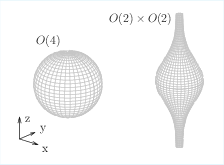
Abstract: False vacuum decay typically proceeds via the nucleation of spherical bubbles of true vacuum, described by $O(4)$ symmetric field configurations in Euclidean time. In this work, we investigate how the presence of cosmic strings can catalyze the decay process. To this end, we consider a complex scalar field charged under a global or local $U(1)$ symmetry. Assuming a non-trivial vacuum manifold, realizable for example in a simple sextic potential, we derive relativistic bounce solutions with $O(2) \times O(2)$ symmetry, corresponding to elongated bubbles seeded by a cosmic string of the same scalar field. Building up on earlier results in the literature, we identify the region of parameter space where vacuum decay predominantly proceeds via this alternative channel, thereby providing an explicit mechanism for the quantum decay of cosmic strings. Finally, we present an initial discussion of the gravitational wave signal associated with this type of vacuum decay and its possible connection to the recently observed stochastic signal in pulsar timing arrays.
Paper Prompts
Sign up for free to create and run prompts on this paper using GPT-5.
Top Community Prompts
Explain it Like I'm 14
String‑induced vacuum decay — a simple explanation
Overview
This paper studies a new way the Universe can change from a “false vacuum” (an unstable state) to a “true vacuum” (a more stable state). Normally, this change happens by forming round, expanding bubbles. The authors show that if long, thin objects called cosmic strings are present, they can “seed” a different kind of bubble that’s stretched along the string. This can make the change happen faster and in a new shape, and it can also produce a special kind of gravitational‑wave signal.
Key questions the paper asks
- Can a cosmic string make the false vacuum decay (change) into the true vacuum more easily?
- What do the new bubbles look like when a string is present?
- In which conditions does this “string‑induced” decay beat the usual, string‑less decay?
- How big and how fast are these new bubbles?
- What kind of gravitational waves would this process make, and could current experiments (like pulsar timing arrays) notice them?
How the authors studied it (methods, in plain language)
To keep ideas clear, here are a few quick translations:
- False vs. true vacuum: Imagine a ball resting on a high, shallow plateau (false vacuum) with a deeper valley nearby (true vacuum). The ball can “tunnel” through the hill (by quantum effects) and roll into the deeper valley.
- Bubble: A tiny patch that has already made it to the deeper valley. If it’s big enough, it grows and converts space around it to the true vacuum.
- Cosmic string: Think of a hairline crack running through space, like a thread. It stores energy and can guide how bubbles form.
- Thin‑wall approximation: The bubble is like a soap bubble with a very thin skin. That makes its math simpler.
- Symmetry shorthand:
- O(4): Perfectly round bubble in 4D space (three space directions + Euclidean time) — the standard case without strings.
- O(2)×O(2): A bubble that’s stretched along the string, like a capsule instead of a sphere.
What they did:
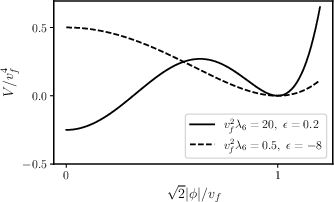
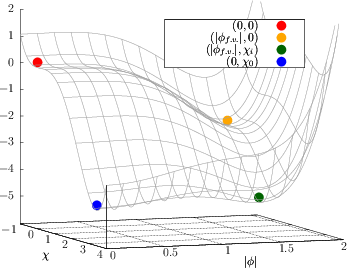
- They set up a simple particle‑physics model with one complex field (think: a field with a size and a direction) and a potential shaped so there’s a false vacuum separated from the true vacuum by a barrier.
- They considered two types of cosmic strings:
- Global strings (no gauge field; energy spreads far out).
- Local (gauge) strings (come with a magnetic‑like field that keeps energy localized).
- They converted the complicated “field in all of space” problem into a much simpler “track the bubble’s radius” problem. This is like replacing a complex storm map with the position and speed of a storm front.
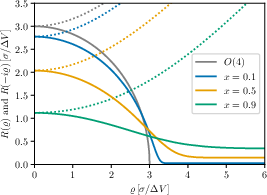
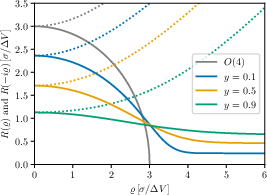
- They kept important relativistic effects: as the bubble wall moves fast, its thickness “Lorentz contracts” (shrinks), so they included a factor called γ (gamma) to account for that. This improves accuracy compared to earlier work that assumed slow walls.
- They solved the resulting equations numerically (using a “shooting method,” a standard way to nail the correct starting value) and also gave compact, semi‑analytic formulas you can plug numbers into.
Main findings and why they matter
- New bubble shape exists and is important:
- The team found clear solutions for elongated bubbles seeded by cosmic strings (O(2)×O(2) symmetry) for both global and local strings.
- When strings speed things up:
- They identified wide regions of parameters where string‑seeded bubbles form more easily than the usual round ones. In plain terms: if strings are around and the model’s numbers fall in these ranges, the false vacuum will mostly decay via the string‑assisted route.
- Accurate, relativistic treatment matters:
- Including the relativistic “gamma” factor changes the predicted bubble size and decay rate noticeably, especially when the new solution approaches the standard round bubble. This makes the results more reliable.
- Handy formulas:
- They provide simple fitting formulas for the bubble’s initial size and the “difficulty rating” (the bounce action) of tunneling. Lower action means faster decay. These formulas help others quickly estimate rates without redoing the heavy math.
- Gravitational waves:
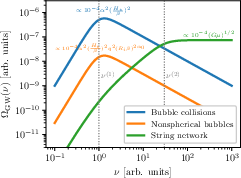
- Spherical bubbles don’t radiate gravitational waves by themselves (they’re too symmetric). But the string‑seeded, elongated bubbles do have a changing “quadrupole moment,” so they emit gravitational waves. This signal is usually smaller than the one from bubble collisions, but it can be comparable if bubbles appear quickly or are very non‑spherical.
- Cosmic string networks and pulsar timing arrays:
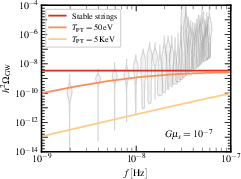
- If strings are metastable (they last for a while and then decay through this new bubble process), the low‑frequency gravitational‑wave background gets suppressed. That can help avoid current bounds from pulsar timing arrays (like NANOGrav) that are tough on permanently stable strings. The authors outline a simple model where strings form with sizable tension and later decay via this mechanism—potentially producing a gravitational‑wave signal relevant to recent observations.
What this could mean going forward
- New decay channel: Cosmic strings can act like “escape hatches,” letting the Universe transition faster and in a different shape than previously thought. This changes how we think about early‑Universe phase transitions.
- Better predictions: The relativistic improvements and plug‑in formulas help researchers quickly check whether string‑induced decay dominates in their models.
- Gravitational‑wave clues: The special shape of the bubbles gives a new source of gravitational waves. In the future, the mix of signals from string networks (and their delayed decay) plus these elongated bubbles could help us tell different early‑Universe stories apart.
- Observations and tests: As pulsar timing arrays and other gravitational‑wave detectors improve, they might pick out features predicted by this mechanism, helping to confirm or rule out models with metastable cosmic strings.
In short: the paper shows that cosmic strings can seed long, capsule‑shaped bubbles that speed up vacuum decay, provides accurate tools to calculate when this happens, and points to distinctive gravitational‑wave signals that future observations could test.
Knowledge Gaps
Below is a single, focused list of concrete knowledge gaps, limitations, and open questions that remain unresolved in the paper. Each item is phrased to be actionable for future work.
- Quantify the accuracy of the thin-wall approximation across the claimed parameter space by solving the full Euclidean field equations (scalar and gauge) for the bounce without thin-wall assumptions, especially for unit winding () and for local strings at moderate or large .
- Compute the fluctuation determinant (prefactor) for the bounce to obtain absolute tunneling rates, including proper treatment of zero modes, collective coordinates, and renormalization; current results provide only the exponential action .
- Assess robustness to potential shape: repeat the analysis for more general EFT potentials (with additional higher-dimensional operators) and quantify how the bounce action and dominance region change; identify model-independent conditions for the existence and dominance of bounces.
- Provide thick-wall corrections: derive systematic corrections to the wall profile and action beyond , including the $1/R$ and terms retained in the derivations, and estimate the associated error on and .
- For local strings, solve the coupled scalar–gauge field PDEs for the bounce to validate the piecewise ansatz for and quantify deviations (e.g., gauge-field gradients in the wall, flux redistribution, and any additional wall tension contributions).
- Include gravitational backreaction on both the string and the bounce (CDL-type corrections) when and/or vacuum energy are non-negligible; determine how gravity modifies , , and the dominance of the string-induced channel.
- Extend the analysis to finite temperature (thermal bounces with Euclidean time periodicity), clarifying the symmetry breaking pattern of the bounce at and how strings catalyze thermal tunneling compared to quantum tunneling.
- Generalize from an infinite straight string to realistic network geometries: quantify tunneling on loops, curved segments, and wiggly strings; determine how curvature, loop size, and small-scale structure alter the bounce and the decay rate.
- Develop network-level simulations that implement string-induced bubble nucleation (with geometry), percolation, and subsequent dynamics, to compute the global decay history of the network and space filling of the true vacuum.
- Compute the full GW spectrum from a single bubble (beyond quadrupole scaling) and from an ensemble in a network, including wall acceleration, anisotropic expansion, bubble–bubble interactions, and interference with standard collision signals.
- For local strings, quantify non-GW radiation channels (gauge bosons, scalar radiation) during the string-induced decay and post-nucleation dynamics; determine how these channels compete with GW emission and affect energy budgets.
- Determine the parameter region where the channel dominates over monopole–antimonopole induced fragmentation for local strings (as per Vilenkin’s mechanism) and over classical dissociation; provide sharp comparative rate estimates.
- Provide a full treatment of tunneling in cosmological spacetimes (FRW) including Hubble expansion, redshifting, and friction effects on wall motion; quantify their impact on , percolation timescales, and GW signals.
- Characterize the impact of approximate or explicitly broken symmetries (e.g., small explicit breaking creating domain walls attached to strings) on the existence, stability, and decay pathways of strings via bounces.
- Verify the claimed universality by mapping and fitting functions onto microscopic parameters for different UV completions; provide error bars and validity ranges for the semi-analytic formulas given in Eq. (semi-analytic) and their local-string counterparts.
- Explore the dynamics for (near classical instability): characterize the crossover from quantum tunneling to classical roll/dissociation and provide criteria delineating these regimes for both global and local strings.
- Compute the bounce action and dynamics for multi-winding strings () and quantify whether string-induced decay preferentially occurs for higher or unit winding states in realistic formation histories.
- Develop and present the promised two-field cosmological model in full detail (potential, couplings, evolution, and parameter choices), demonstrating consistent string formation, delayed decay via tunneling, and compatibility with cosmological constraints.
- Produce PTA-ready predictions: calculate the metastable network’s GW spectrum across frequencies, include abrupt/smooth shut-off scenarios, and perform parameter scans confronting NANOGrav/EPTA/PPTA datasets and CMB bounds; identify distinctive features separating this scenario from other sources.
- Investigate environmental and plasma effects (post-reheating friction, scattering with ambient particles) on wall velocities and thickness during decay, and quantify their impact on the bounce dynamics and GW signatures.
- Analyze how percolation speed, bubble nucleation rate heterogeneity along strings, and initial geometric deviations affect the relative magnitude of intrinsic (single-bubble) GW emission versus collision-induced GWs; identify regimes where intrinsic emission could be observationally relevant.
- Provide a systematic uncertainty budget: identify dominant theoretical errors (thin-wall, non-relativistic approximations in prior literature, neglect of prefactors, gauge-field ansatz) and control them through targeted numerics and analytic corrections.
Practical Applications
Immediate Applications
The following use cases can be deployed now by leveraging the paper’s relativistic thin-wall formalism for string-induced vacuum decay, its semi-analytic fits for bounce actions/radii, and its implications for gravitational-wave (GW) phenomenology.
- GW data analysis: template construction and inference for PTA/LISA
- Sector: astrophysics, data science, scientific software
- Use case: Build and integrate template components for metastable cosmic-string networks decaying via O(2)×O(2) bubbles into PTA Bayesian pipelines (e.g., Enterprise, PTMCMCSampler), including:
- Modified stochastic spectra for decaying local/global strings (suppressed low-frequency power).
- Additional contribution from single-bubble quadrupole radiation (distinct from spherical bubble collisions).
- Tools/products/workflows:
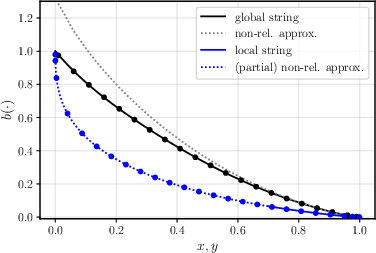
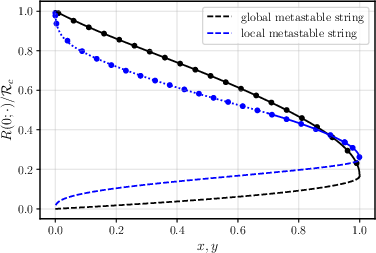
- Implement the paper’s semi-analytic fits for normalized bounce action b(x) and b(y), and central radius R(0)/Rc to rapidly evaluate nucleation rates and percolation criteria.
- Provide a Python/Julia module to map model parameters to effective ΔV, σ, v_f and then to x (global) or y (local), returning rates and spectral amplitudes.
- Generate template banks for likelihood evaluations and model comparison against supermassive black-hole binaries (SMBHB) scenarios.
- Assumptions/dependencies: thin-wall regime validity; mapping of microscopic model to effective parameters is accurate; degeneracy with SMBHB spectra requires joint model selection; negligible gravitational backreaction of strings; network modeling uncertainties.
- Rapid model filtering for BSM cosmology with U(1) sectors
- Sector: high-energy theory, cosmology, scientific computing
- Use case: Prune beyond-the-Standard-Model (BSM) parameter spaces by fast evaluating whether string-induced decay dominates over standard Coleman decay (via x or y regions), thereby:
- Identifying models consistent with PTA/CMB constraints when strings are metastable.
- Flagging parameter sets that would overproduce or underproduce GW backgrounds.
- Tools/products/workflows:
- Drop-in routines implementing the paper’s thin-wall bounce with relativistic γ-factor to avoid the ≈25% bias of non-relativistic treatments.
- HPC parameter scans using semi-analytic fits to avoid repeated PDE solves.
- Assumptions/dependencies: EFT truncation (sextic potential) reliably captures low-energy dynamics; thin-wall limit applicable; unit-winding subtleties for global strings; accurate network lifetime modeling.
- Updating existing cosmic-string GW forecasts
- Sector: astrophysics, GW astronomy
- Use case: Re-compute GW spectra for cosmic strings including a metastability cutoff (network lifetime), and compare to PTA datasets to refine bounds on Gμ and decay timing.
- Tools/products/workflows:
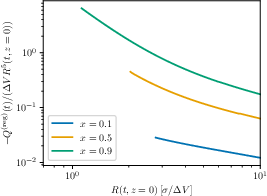
- Extend existing forecasting codes to include the paper’s decay channel and quadrupole emission scaling with bubble radius R(t).
- Assumptions/dependencies: extrapolation from single-bubble dynamics to network-averaged signals; duty cycle and percolation dynamics.
- Cold-atom analog experiments: defect-catalyzed tunneling
- Sector: AMO/quantum technologies, condensed-matter analog simulation
- Use case: Design BEC/superfluid experiments in which vortices (string analogs) catalyze bubble nucleation between metastable phases to test aspects of the theory (as motivated by cited cold-atom literature).
- Tools/products/workflows:
- Quench protocols and phase imprinting to prepare vortex lines.
- Diagnostics for density/phase profiles and emitted phonons (analogs of GWs).
- Use relativistic wall dynamics (γ-factor) for more accurate thin-wall analog modeling.
- Assumptions/dependencies: mapping of relativistic field theory to nonrelativistic analogs; achievable parameter regimes approximating thin-wall limit; dissipation and finite-temperature effects in lab systems.
- Curriculum and training modules (graduate/advanced undergraduate)
- Sector: education
- Use case: Incorporate O(2)×O(2) bounces, relativistic wall dynamics, and defect-catalyzed tunneling into courses on QFT, cosmology, and phase transitions; create problem sets and visualization notebooks.
- Tools/products/workflows: Jupyter notebooks implementing the semi-analytic fits and shooting methods for bounce profiles; assignments comparing O(4) vs O(2)×O(2).
- Assumptions/dependencies: None beyond standard academic deployment.
- Observatory strategy and white papers
- Sector: science policy, observatory planning
- Use case: Inform PTA/LISA/SKA planning and interpretation by highlighting how metastable strings evade conventional bounds and produce distinctive spectral features, motivating:
- Broader priors in multi-model fits (SMBHB + cosmic strings with decay).
- Cross-band strategies combining PTA with mid-frequency GW detectors.
- Tools/products/workflows: Short technical briefs summarizing the decay-dominated parameter regimes; cross-correlation strategies to disambiguate sources.
- Assumptions/dependencies: Community replication and adoption; model/systematics uncertainties acknowledged.
- Code augmentation for lattice/continuum simulations
- Sector: HPC, scientific software
- Use case: Update wall-dynamics modules to include relativistic γ-factor and O(2)×O(2) geometry for bubble expansion along strings; calibrate against the paper’s thin-wall results.
- Tools/products/workflows: Pull requests to public codes; benchmarking scripts versus semi-analytic b(x), b(y).
- Assumptions/dependencies: Thin-wall still relevant for the simulated regimes; lattice artifacts controlled.
Long-Term Applications
These applications require further research, scaling, or development—particularly full network simulations, disentangling source degeneracies in GW data, and cross-disciplinary translation to lab systems or other fields.
- Full 3D simulations of metastable string networks and GW synthesis
- Sector: HPC, astrophysics
- Use case: Large-scale simulations incorporating O(2)×O(2) nucleation, percolation, and network collapse to produce robust, end-to-end GW spectra and anisotropies.
- Tools/products/workflows: GPU-accelerated PDE solvers; surrogate models trained on simulation outputs for fast inference.
- Assumptions/dependencies: Accurate modeling of loop production, intercommutation, decay timing; inclusion of backreaction; substantial compute resources.
- Detector design optimization for metastable-string signatures
- Sector: engineering, science policy
- Use case: Use forecasted spectra to guide the sensitivity and frequency coverage of future observatories (e.g., SKA phases, μAres, LISA), optimizing for turnover features induced by network decay and bubble quadrupole emission.
- Tools/products/workflows: Design studies with mission simulations that include metastable-string templates.
- Assumptions/dependencies: Predictive convergence of network simulations; funding and international coordination.
- Advanced PTA/LISA search methodologies for transients and anisotropies
- Sector: GW data analysis
- Use case: Develop searches for transient bursts or anisotropic features associated with rapid percolation or partial network collapse; multi-component stochastic background modeling (SMBHB + decaying strings).
- Tools/products/workflows: Hierarchical Bayesian model selection; template-free burst searches repurposed for string-decay events.
- Assumptions/dependencies: Event-rate predictions; sensitivity to departures from isotropy.
- Materials science analogs: defect-catalyzed phase control
- Sector: materials/nanotechnology
- Use case: Explore whether line defects can be used to deliberately seed phase transformations (analog of string-induced decay) to engineer switching behavior, pattern formation, or fabrication pathways in thin films or 2D materials.
- Tools/products/workflows: Phase-field modeling inspired by relativistic thin-wall dynamics; controlled defect injection; in situ microscopy to observe nucleation along dislocations.
- Assumptions/dependencies: Translation from relativistic field theory to dissipative, finite-temperature materials; availability of materials with metastable-to-stable barriers amenable to line-defect catalysis.
- Quantum simulation platforms for field theory with defects
- Sector: quantum computing/simulation (Rydberg atom arrays, trapped ions, superconducting circuits)
- Use case: Digital-analog quantum simulators implementing scalar fields with vortices and metastable potentials to study defect-induced tunneling and wall dynamics in a controllable setting.
- Tools/products/workflows: Hamiltonian engineering to realize multi-well landscapes and topological line defects; measurement of excitation emission (GW analogs).
- Assumptions/dependencies: Hardware scale, coherence, and programmability; mapping continuum fields to discretized quantum systems.
- Model-driven collider/astroparticle searches linked to metastable U(1) sectors
- Sector: particle physics experiments
- Use case: Connect cosmological metastability (e.g., local U(1) with small gauge coupling) to collider-accessible signatures (light gauge bosons, scalars) or axion-like sectors; prioritize parameter regions favored by PTA/LISA fits.
- Tools/products/workflows: Global fits combining collider, precision, and GW constraints; EFT-to-UV model translation.
- Assumptions/dependencies: Concrete UV completions; experimental reach in the suggested parameter space.
- Early-Universe model building for baryogenesis and dark-sector dynamics
- Sector: theoretical cosmology, particle theory
- Use case: Use defect-catalyzed, strongly first-order transitions to design scenarios for baryogenesis or dark-sector phase histories that are otherwise difficult to realize with standard Coleman bubbles.
- Tools/products/workflows: Coupled multi-field potentials where strings form, then trigger delayed decay; joint analysis of GW signals and relic abundances.
- Assumptions/dependencies: Realistic, anomaly-free models; compatibility with BBN and CMB constraints.
- Cross-disciplinary signal processing techniques
- Sector: data science, signal processing
- Use case: Develop methods to disentangle multiple stochastic backgrounds with overlapping slopes by leveraging subtle spectral turn-overs and time-domain features expected from metastable networks.
- Tools/products/workflows: Source-separation algorithms; Bayesian nonparametrics for composite backgrounds.
- Assumptions/dependencies: Sufficient SNR; robust priors on source populations.
- Public engagement and educational technology
- Sector: education/outreach
- Use case: Interactive visualizations of string-induced bubble nucleation and GW emission for museum exhibits, MOOCs, and outreach, illustrating symmetry, topology, and phase transitions.
- Tools/products/workflows: WebGL simulations; classroom toolkits built from the paper’s thin-wall solutions.
- Assumptions/dependencies: Funding and collaboration with outreach organizations.
- Standards for reporting thin-wall parameter regimes
- Sector: academic community practices
- Use case: Establish community norms for reporting (ΔV, σ, v_f, ε, x, y) alongside lattice/continuum results to facilitate reproducibility and cross-comparison across models and codes.
- Tools/products/workflows: Minimal metadata schemas for preprints/codes; benchmark suites.
- Assumptions/dependencies: Community adoption.
Notes on Key Assumptions and Dependencies
- Thin-wall approximation: Requires ΔV/Vmax ≪ 1; more reliable for local strings with small gauge coupling g; borderline for unit-winding global strings.
- Effective potential and EFT truncation: Sextic potential used as a minimal EFT; higher operators may modify σ, ΔV, ε; mapping from UV models must be validated.
- Relativistic wall dynamics: Inclusion of γ-factor is essential; non-relativistic approximations can bias bounce action by O(10–30%) near the Coleman limit.
- Network modeling: Translating single-string/bubble dynamics to full network behavior (loop production, decay timing, percolation rate) remains a leading uncertainty.
- GW source degeneracies: Metastable-string spectra can mimic or blend with SMBHB backgrounds; multi-component inference and cross-band observations are needed.
- Gravitational backreaction: Neglected here; may matter for very high Gμ regimes.
- Laboratory analogs: Require careful mapping between relativistic field theory and dissipative, finite-temperature, nonrelativistic systems.
Glossary
- Abelian Higgs model: A gauge field theory with a complex scalar field and U(1) symmetry, used to study strings and symmetry breaking. "proved their existence within the Abelian Higgs model"
- analytic continuation: Extending functions to complex domains; here, continuing Euclidean solutions to real time by taking a coordinate imaginary. "We analytically continue \varrho \rightarrow -\,i\varrho"
- axionic (global) cosmic strings: Strings arising from axion fields with global symmetry, relevant for thermal tunneling. "high-temperature thermal tunneling induced by axionic (global) cosmic strings"
- bounce: A Euclidean-time solution describing quantum tunneling from a false vacuum. "the bounce, which is an symmetric solution of the Euclidean equations of motion"
- bounce action: The Euclidean action difference that controls the exponential suppression of tunneling. "computed the bounce action in the thin-wall limit"
- bounce radius: Characteristic size of the nucleated bubble in the bounce solution. "explicit semi-analytic expression for the bounce action and the bounce radius"
- bubble nucleation: The formation of a true-vacuum bubble during a first-order phase transition. "Induced bubble nucleation was also studied in the context of other topological defects"
- Coleman bounce: The standard -symmetric tunneling solution for false vacuum decay. "Coleman bounce (left)"
- complex scalar field: A scalar field with real and imaginary parts, often carrying U(1) charge. "we consider a complex scalar field charged under a global or local symmetry."
- cosmic microwave background (CMB): Relic radiation from the early Universe used to constrain cosmology. "cosmic-microwave-background (CMB) observations"
- cosmic string: A one-dimensional topological defect formed during symmetry breaking. "A simple and well-motivated example is a straight cosmic string"
- cosmic string network: A population of strings in the Universe that evolve, intercommute, and emit radiation. "our scenario can also be relevant for cosmic string networks"
- covariant derivative: A derivative that includes gauge fields to preserve local symmetry. "denotes the covariant derivative with gauge coupling ."
- deficit angle: The angular shortfall around a string due to its gravitational effect. "taking into account the string's deficit angle of order "
- domain walls: Two-dimensional topological defects separating distinct vacua. "such as monopoles~\cite{Kumar:2010mv, Agrawal:2022hnf}, domain walls~\cite{Blasi:2022woz, Blasi:2023rqi, Agrawal:2023cgp}"
- effective field theory (EFT): A framework describing physics at a given scale using relevant operators. "arises naturally in an effective field theory (EFT) framework."
- Euclidean action: The action evaluated in imaginary time, used in tunneling calculations. "the Euclidean action is defined as ."
- Euclidean equations of motion: Field equations in imaginary time governing bounce solutions. "solution of the Euclidean equations of motion"
- Euclidean time: Imaginary time coordinate used to analyze tunneling processes. "in Euclidean time"
- false vacuum: A metastable state local minimum of the potential that can decay quantum mechanically. "spontaneously broken false vacuum separated by a barrier"
- false vacuum decay: Quantum transition from the false to the true vacuum via bubble nucleation. "False vacuum decay typically proceeds via the nucleation of spherical bubbles of true vacuum"
- first homotopy group: The group characterizing non-contractible loops of a manifold; nontrivial values allow strings. "the first homotopy group of the (true or false) vacuum manifold must be non-trivial, i.e.\ ."
- gauge coupling: The parameter controlling the strength of interactions between fields and gauge potentials. "with gauge coupling "
- gauge potential: The vector field whose derivatives give the field strength in a gauge theory. "associated with the gauge potential "
- global cosmic string: A string arising from spontaneously broken global symmetry without gauge screening. "For the global cosmic string ()"
- global U(1) symmetry: A continuous phase symmetry not gauged by a field. "charged under either global or local symmetry."
- gravitational waves (GW): Ripples in spacetime produced by accelerating masses or anisotropic stress. "gravitational waves (GW)"
- instanton solutions: Finite-action Euclidean solutions representing tunneling processes. "a new class of instanton solutions with symmetry"
- Lorentz contraction: The reduction in length in the direction of motion at relativistic speeds; affects wall thickness. "including the effects of Lorentz contraction"
- Lorentz symmetry: The symmetry of spacetime under rotations and boosts. "restoration of full Lorentz symmetry."
- magnetic flux: The integral of the magnetic field over a surface; quantized inside local strings. "a non-vanishing magnetic flux along the string quantized in units of ."
- metastable cosmic string: A string configuration that can decay via quantum tunneling. "rendering the cosmic string metastable (solid line)."
- Minkowski vacuum: The Lorentz-invariant vacuum state in flat spacetime. "the trivial Minkowski vacuum"
- monopole–antimonopole pairs: Particle-antiparticle pairs with magnetic charge that can nucleate along strings. "monopole–antimonopole pairs nucleate along the string core"
- non-relativistic approximation: An approach neglecting relativistic effects such as Lorentz factors. "We will refer to this later as the ‘non-relativistic approximation’."
- oscillons: Long-lived, localized, oscillatory scalar field configurations. "oscillons~\cite{Gleiser:2007ts}"
- O(2) × O(2) symmetry: Combined cylindrical and Euclidean radial symmetry of string-induced bounces. "derive relativistic bounce solutions with symmetry"
- O(4) symmetry: Four-dimensional rotational symmetry of standard Coleman bounces. "an symmetric solution"
- percolation: The stage when bubbles overlap sufficiently to complete the phase transition. "when percolation proceeds rapidly"
- pulsar timing arrays (PTA): Networks measuring pulsar arrival times to detect low-frequency GWs. "pulsar timing arrays (PTA)"
- Q-balls: Non-topological solitons stabilized by conserved charges. "Q-balls~\cite{Metaxas:2000qf}"
- quadrupole moment: A measure of the second-order mass distribution causing GW emission. "a non-vanishing and time-dependent quadrupole moment "
- sextic operator: A dimension-six term in the potential, often irrelevant at low energies. "the coefficient of the (irrelevant) sextic operator"
- sextic potential: A scalar potential including up to sixth-order terms in the field magnitude. "a simple sextic potential"
- Stokes' theorem: A relation connecting line integrals and surface integrals of fields. "we used Stokes' theorem for the last equality."
- string tension: Energy per unit length of a cosmic string, denoted . "string tension "
- thin-wall approximation: Assumes bubble or string walls are much thinner than their radii to simplify dynamics. "While the thin-wall approximation is widely used in the literature"
- thin-wall limit: Regime where the energy difference between vacua is small compared to the barrier height. "We will first discuss the thin-wall limit of (straight) cosmic strings and bounce solutions"
- topological defects: Stable or metastable configurations arising from nontrivial topology of the vacuum manifold. "Cosmic strings are topological defects similar to domain walls or monopoles"
- tunneling rate: Probability per unit time and volume for vacuum decay via quantum tunneling. "the corresponding tunneling rate"
- vacuum manifold: The set of field values minimizing the potential; its topology governs defect formation. "the vacuum manifold "
- vacuum metastability: The condition where a vacuum is a local but not global minimum and can decay. "In the standard treatment of vacuum metastability"
- winding number: An integer counting how many times the field phase wraps around the string. "a non-vanishing winding number "
Collections
Sign up for free to add this paper to one or more collections.