- The paper demonstrates that the interplay of parametric resonance and tachyonic instability during preheating produces a characteristic double-peak gravitational wave spectrum.
- The study employs both linearized analysis and lattice simulations to quantify field fluctuations and energy transfer dynamics in α-attractor models.
- The findings suggest that post-inflation dynamics in this framework necessitate ultra-high-frequency gravitational wave detectors for potential observational tests.
Gravitational Wave Production from Preheating and Tachyonic Instabilities in α-Attractor Inflation
Introduction and Theoretical Framework
This paper presents a comprehensive analysis of gravitational wave (GW) production during preheating in α-attractor inflationary models, focusing on scenarios where inflation terminates in the positive-curvature regime of the potential. The study incorporates a trilinear interaction hϕχ2 between the inflaton ϕ and a light scalar daughter field χ, leading to a complex interplay between parametric resonance in ϕ and tachyonic instability in χ. The α-attractor class is motivated by supergravity and conformal field theory, featuring an exponentially flat plateau at large field values and a positively curved minimum, which is crucial for the post-inflationary dynamics.
The analysis begins by establishing the initial conditions for preheating, derived from CMB constraints and the structure of the α-attractor potential. The potential is given by Vinf(ϕ)=pΛ4tanhp(Mϕ), with p=4 in this work. Inflation ends when the slow-roll parameter ϵv reaches unity, and the field value at this point is determined analytically. The inflection point of the potential, separating negative and positive curvature regimes, is also identified, ensuring that preheating commences in the region where the Bunch-Davies vacuum is a valid initial state.
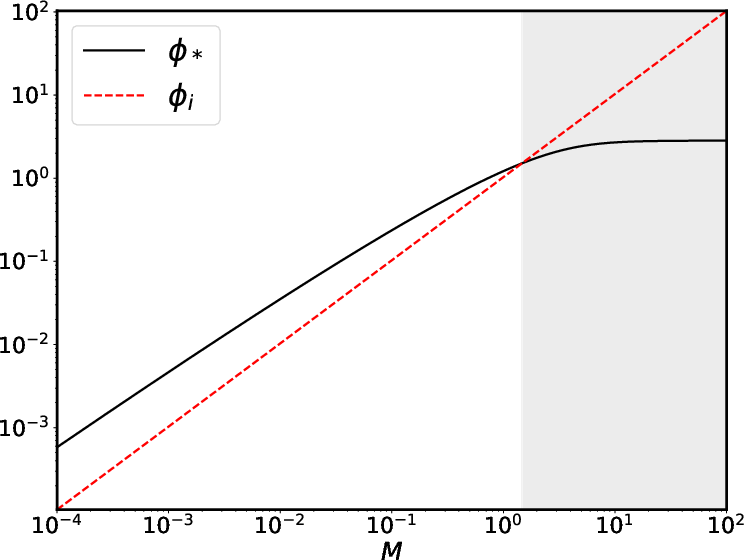
Figure 1: The field value at the inflection point (red dashed line) and the field value at the end of inflation (black solid line) as functions of M in units of Mpl.
Preheating Dynamics with Trilinear Interaction
The post-inflationary potential is augmented by a trilinear interaction and quartic self-coupling for χ to ensure stability:
V(ϕ,χ)=41λϕϕ4+21hϕχ2+41λχχ4+const.
Dimensionless variables are introduced for numerical efficiency, and the equations of motion for both fields are solved using the CosmoLattice framework. The time evolution of the spatially averaged fields reveals that ϕ oscillates around its minimum, while χ exhibits more complex behavior due to the shifting minima in its potential, leading to intervals of negative curvature and tachyonic instability.
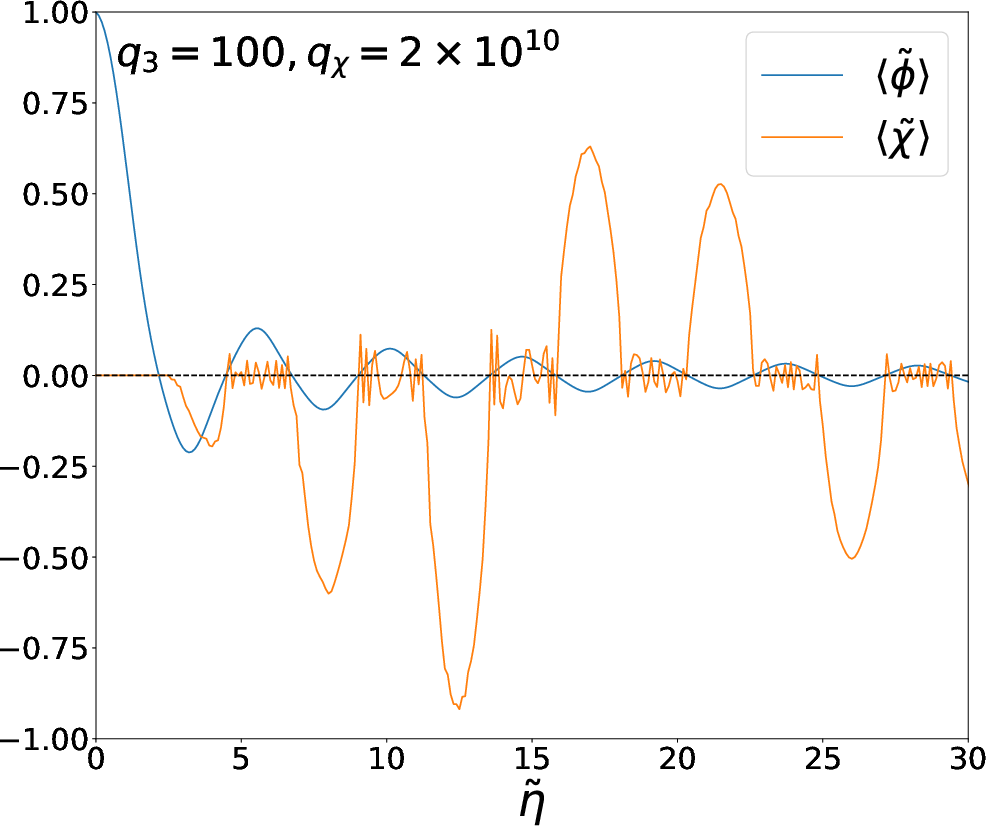
Figure 2: Time evolution of the spatially averaged inflaton field ⟨ϕ~⟩ and daughter field ⟨χ~⟩.
Resonance Analysis: Parametric and Tachyonic Instabilities
Linearized analysis and lattice simulations are employed to study the growth of fluctuations. The inflaton field undergoes parametric resonance, characterized by exponential amplification of modes within a narrow band, quantified by the Floquet exponent. The daughter field χ experiences tachyonic bursts when its effective mass squared becomes negative, leading to rapid growth of long-wavelength modes.
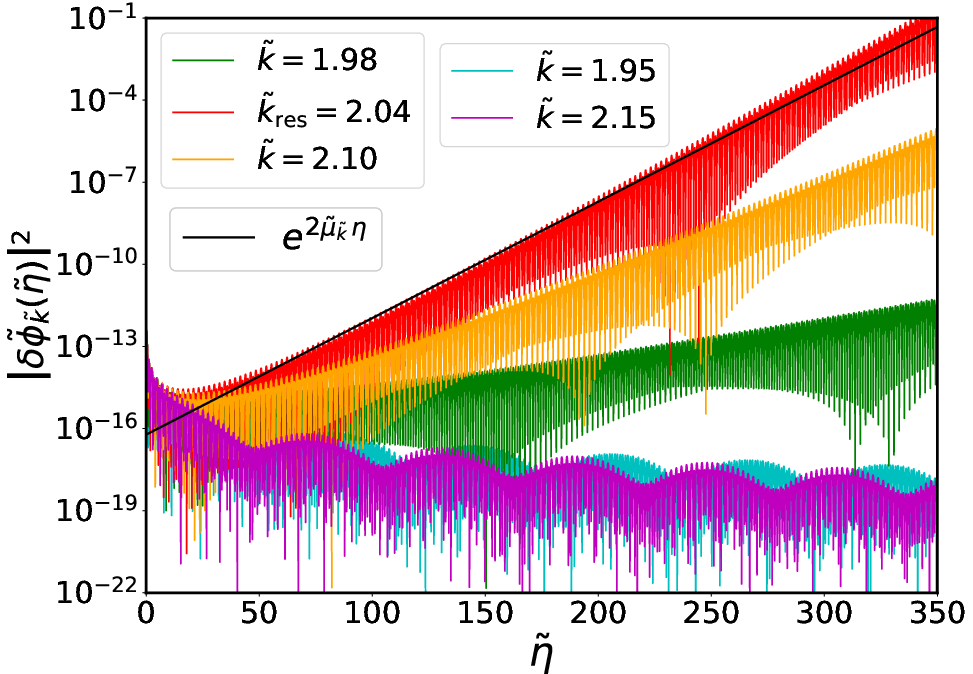
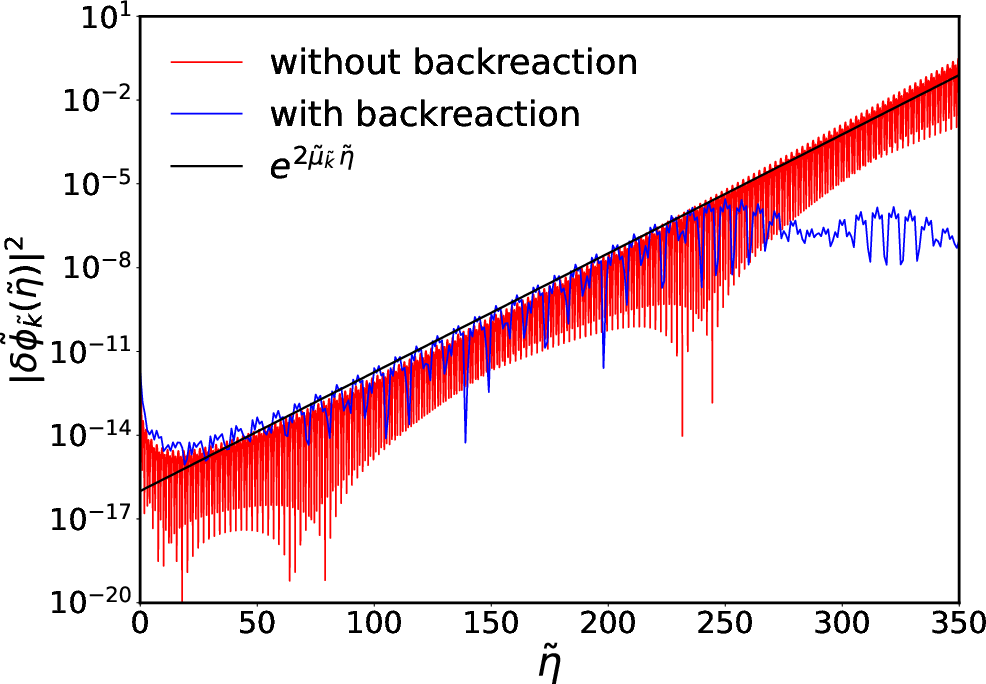
Figure 3: Time evolution of the inflaton field fluctuation δϕ~k~ for different modes and comparison between linear analysis and lattice simulation for the resonant mode.
The onset of tachyonic instability is marked by the condition k~<∣m~χ~,eff∣, with the occupation number nk~,χ~ growing as eη~3/2 until backreaction halts further amplification.
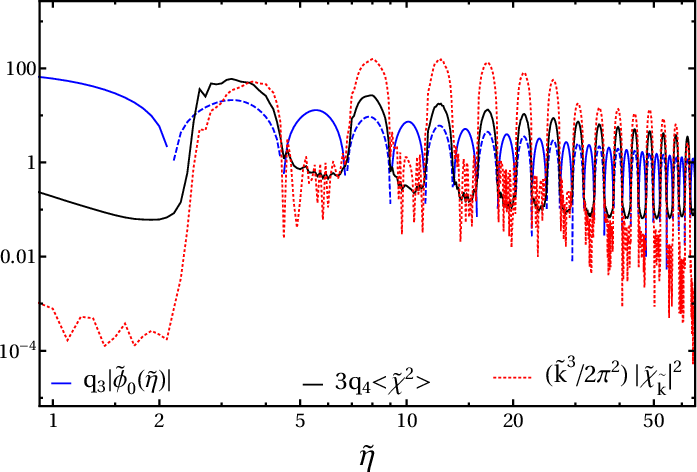
Figure 4: Time evolution of q3ϕ~0 and 3q4⟨χ~2⟩ (left), and occupation number and effective frequency of the daughter field (right).
Power spectra for both fields demonstrate that parametric resonance in ϕ leads to broader and more sustained amplification compared to the transient tachyonic growth in χ. The resonance parameter q3 controls the efficiency and momentum range of mode excitation.
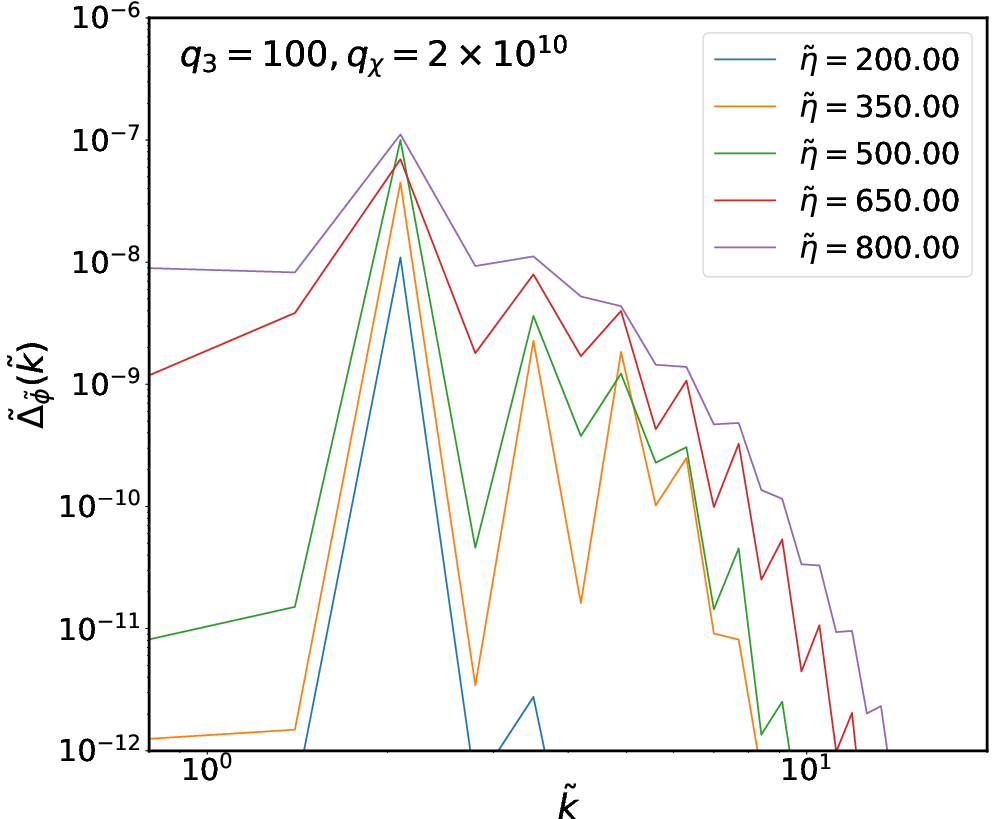
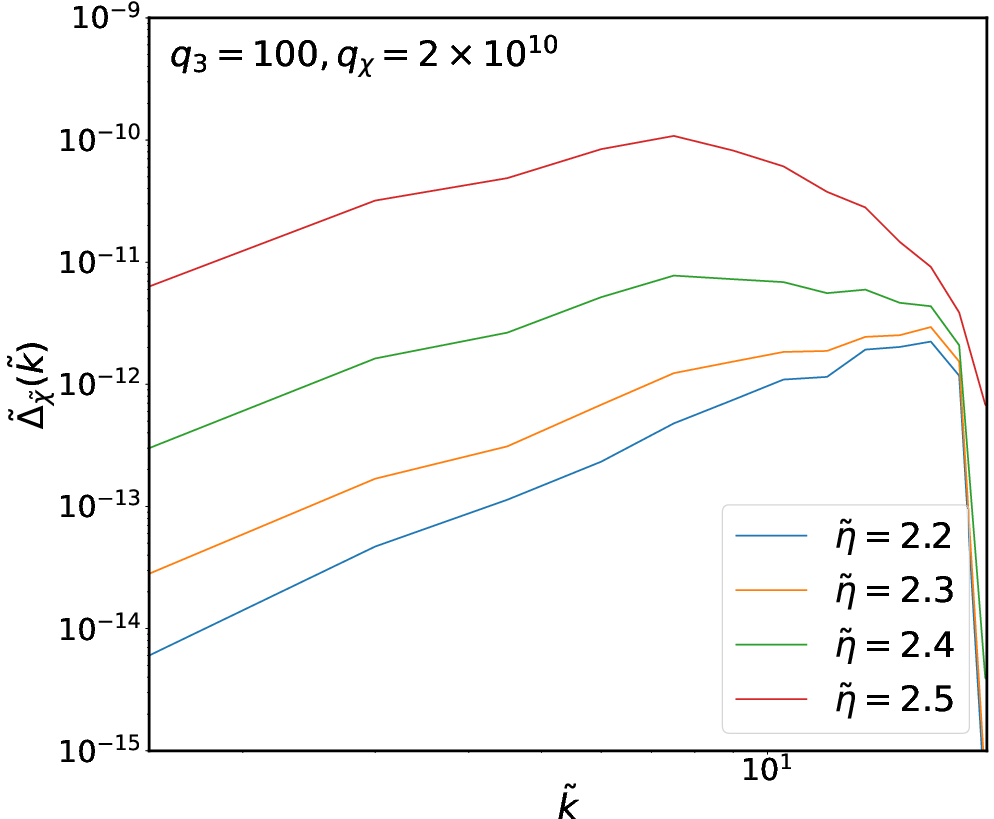
Figure 5: Power spectrum of the inflaton field ϕ~ (left) and daughter field χ~ (right) at different times.
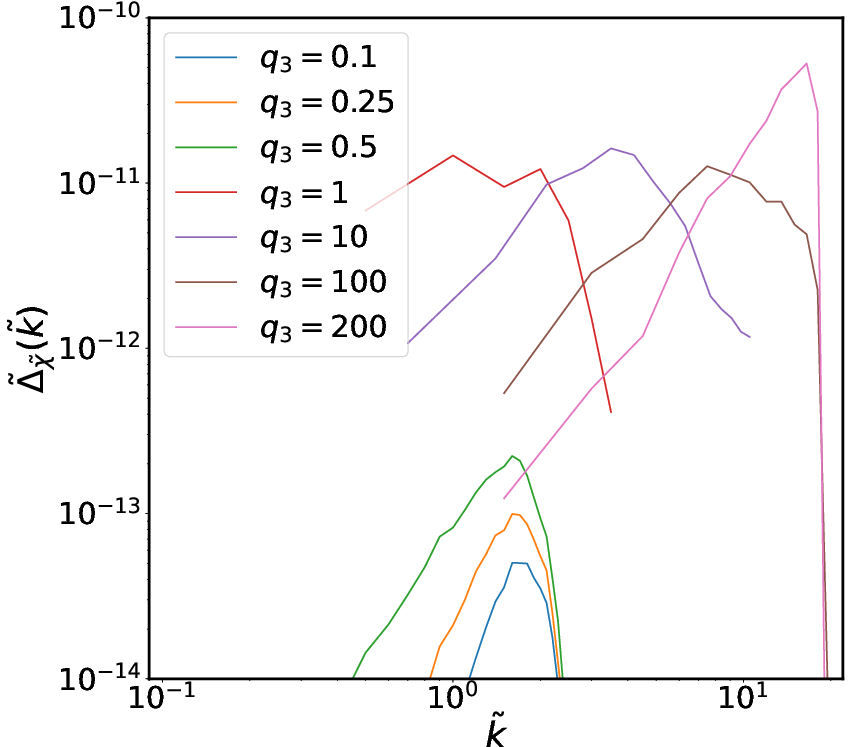
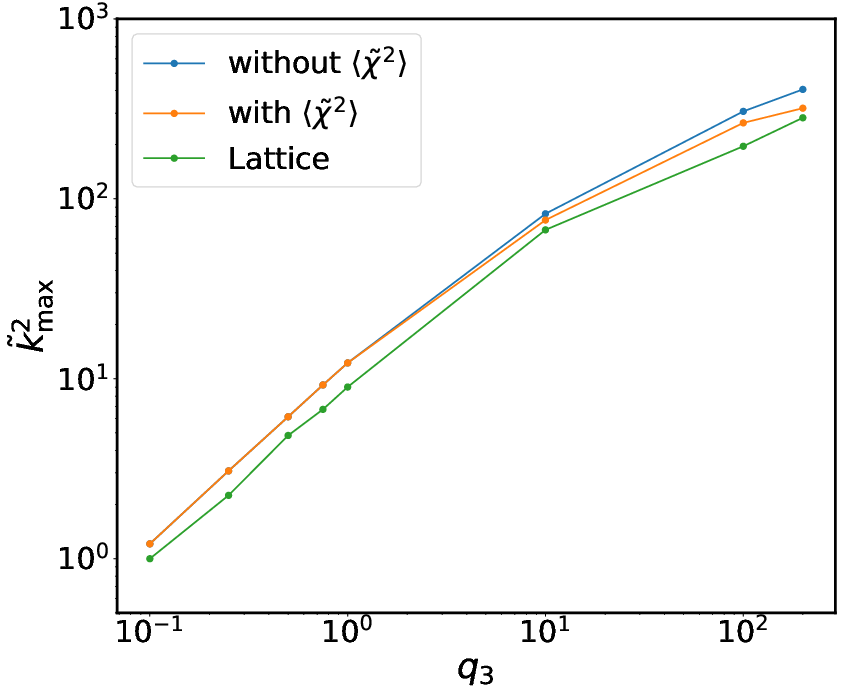
Figure 6: Power spectrum as a function of k~ for different q3 values (left), and spectral peak mode squared versus q3 (right).
The variance of field fluctuations confirms that parametric resonance dominates energy transfer, with inflaton variance exceeding that of the daughter field throughout the evolution.
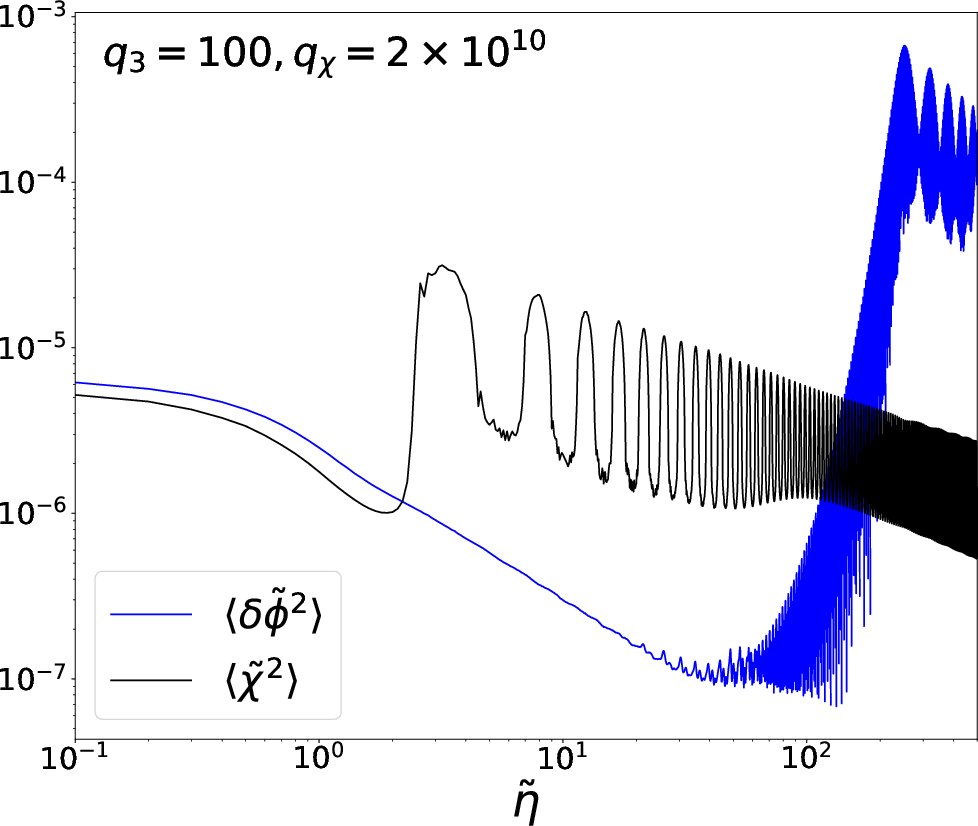
Figure 7: Time evolution of the variance of the inflaton field ϕ~ and daughter field χ~.
Gravitational Wave Production and Spectral Features
The amplified inhomogeneities in both fields source tensor perturbations, generating a stochastic GW background. The GW energy density spectrum is computed from the TT part of the anisotropic stress tensor, with the evolution of metric perturbations solved numerically. The GW spectrum exhibits a distinctive double-peak structure: a dominant low-frequency peak from parametric resonance and a subdominant high-frequency peak from tachyonic bursts.
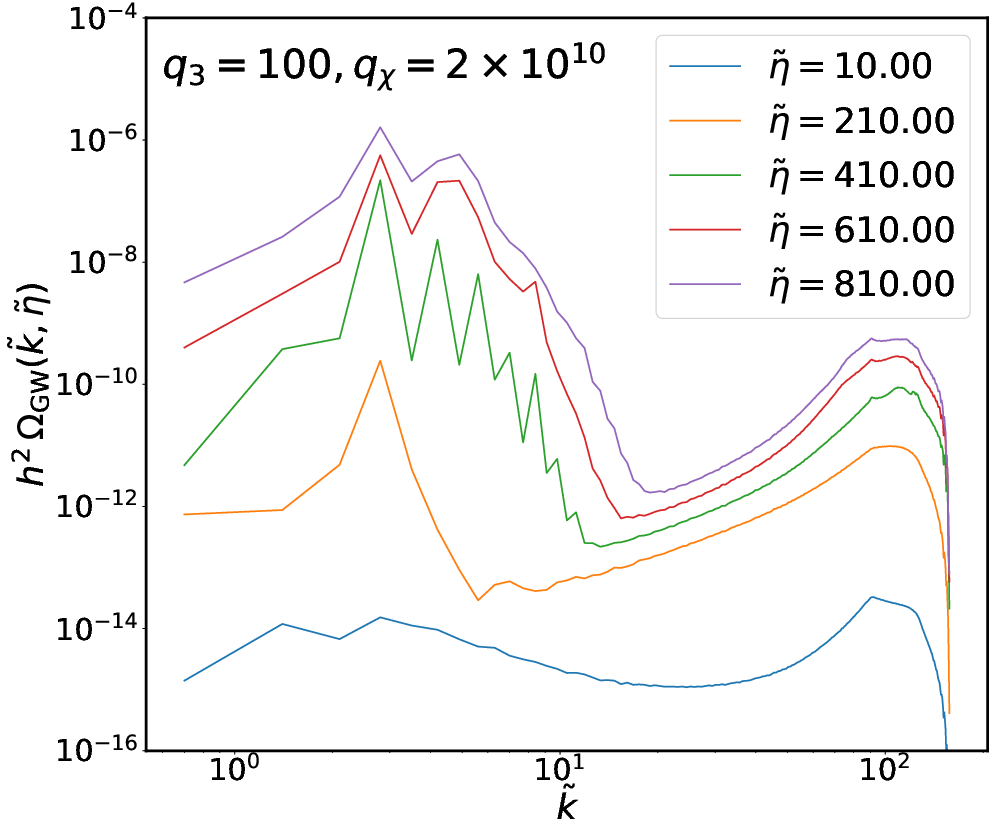
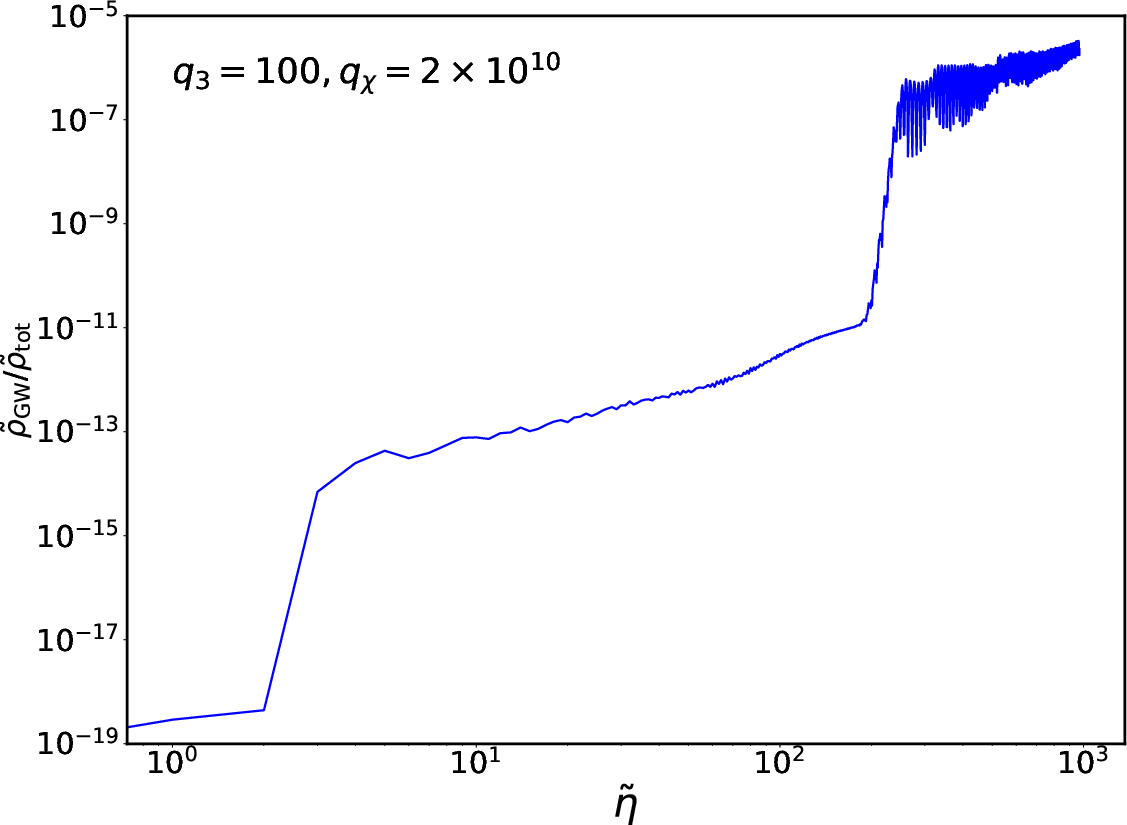
Figure 8: Energy density power spectrum of GWs as a function of comoving momentum k~ (left), and fractional GW energy density versus time (right).
The dependence of the GW spectral peaks on the resonance parameter q3 is analyzed, showing that the parametric peak is largely independent of q3, while the tachyonic peak shifts to higher momenta with increasing q3.
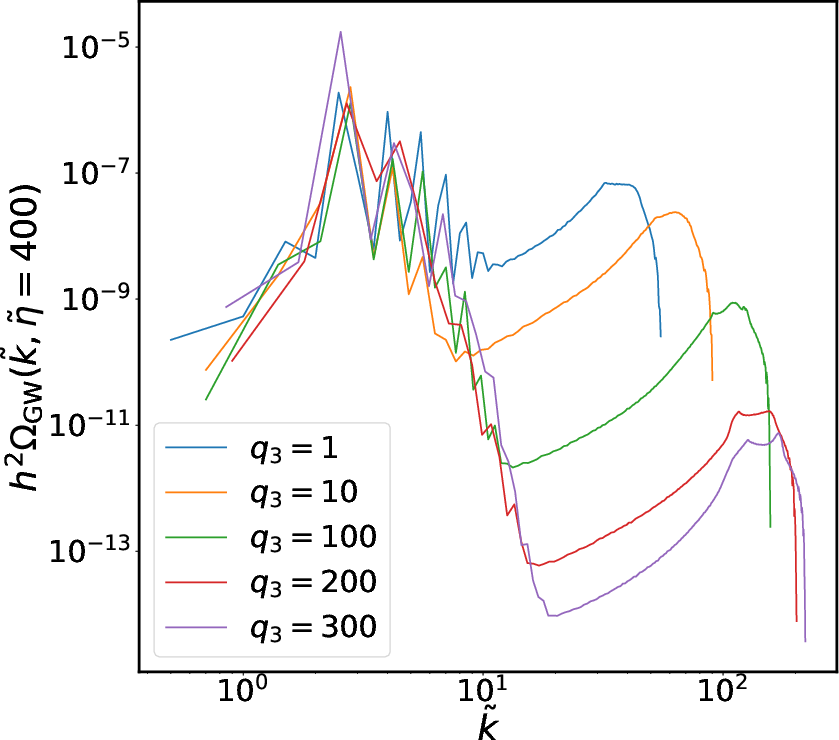
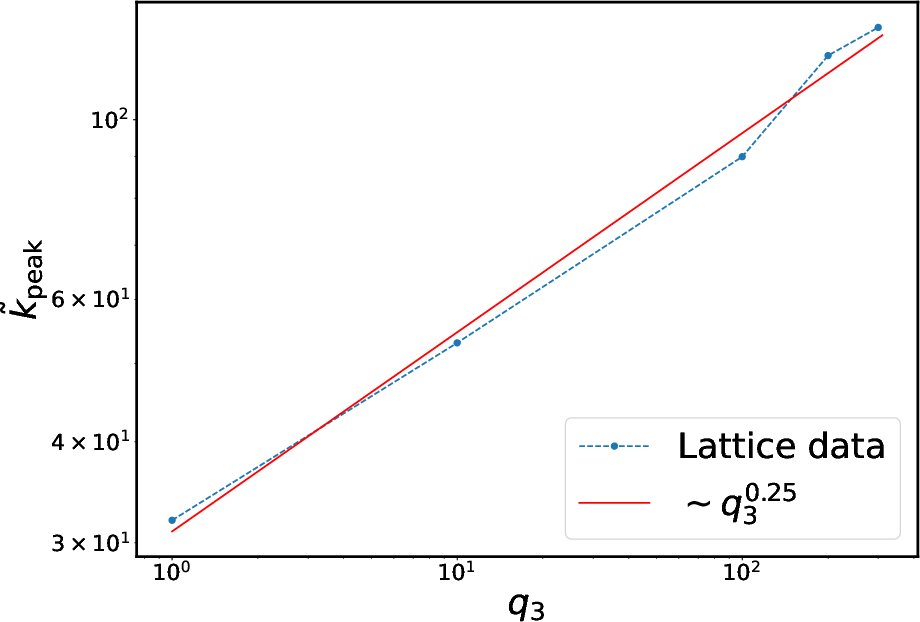
Figure 9: Power spectrum of GWs for different q3 values at η~=400 (left), and tachyonic peak mode versus q3 (right).
Redshifting the GW spectrum to the present epoch yields a peak frequency fp(0)∼107 Hz and amplitude h2ΩGW(0)∼10−11. These ultra-high-frequency GWs are beyond the reach of current detectors but may be accessible to future MHz-GHz experiments.
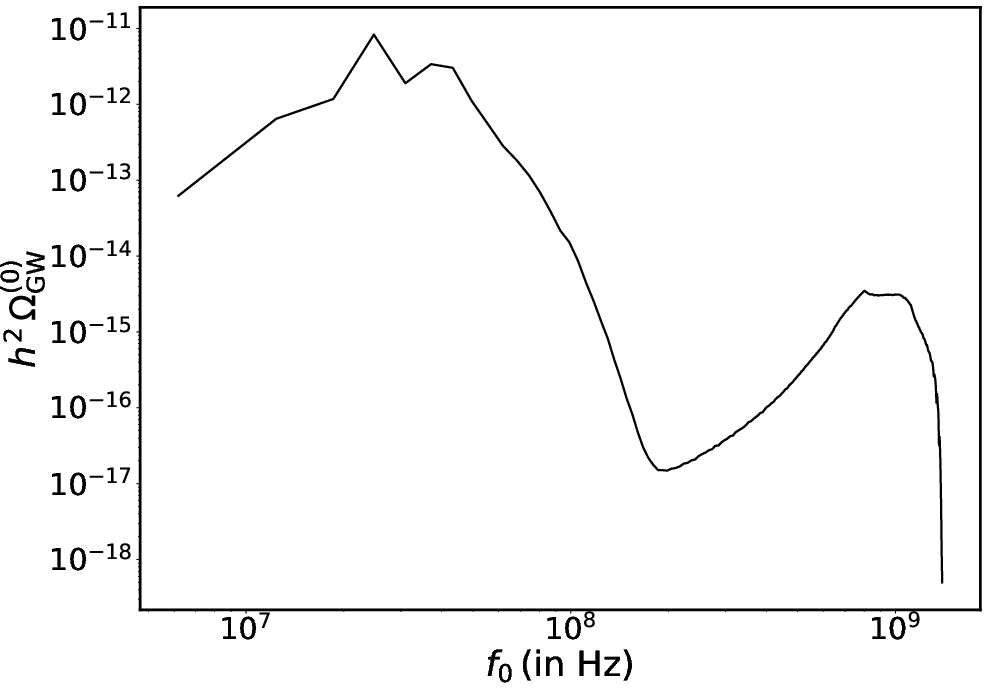
Figure 10: Present-day power spectrum of GWs as a function of frequency.
Implications and Future Directions
The results demonstrate that trilinear preheating in α-attractor models naturally produces a multi-channel instability pattern and a multi-peak GW signal. The coexistence of parametric and tachyonic resonance provides a robust mechanism for efficient post-inflationary energy transfer. The double-peak GW spectrum is a distinctive signature of this scenario, with the parametric channel dominating the amplitude.
From a practical perspective, the predicted GW frequencies and amplitudes challenge current experimental capabilities, motivating the development of ultra-high-frequency GW detectors. Theoretical implications include the need for refined modeling of reheating, inclusion of additional sectors (gauge, fermionic), and improved mapping between inflationary parameters and observable signatures.
Lattice simulations are shown to be indispensable for capturing nonlinear dynamics and backreaction effects, which are essential for accurate predictions of GW spectra. Future work should address the thermalization process, explore alternative couplings, and investigate the impact of additional fields on GW production.
Conclusion
This study provides a detailed account of GW production during preheating in α-attractor inflation with trilinear interactions. The interplay of parametric and tachyonic resonances leads to a characteristic double-peak GW spectrum, with strong dependence on model parameters. While current detectors cannot probe the predicted signals, future advancements in high-frequency GW detection may open a new observational window on the post-inflationary universe. The work underscores the importance of nonlinear dynamics in early-universe cosmology and sets the stage for further theoretical and experimental exploration.