- The paper demonstrates that modular coils can generate sharp-edged, X-point divertor surfaces with significantly reduced chaos compared to traditional helical configurations.
- The paper employs three optimization strategies—squared flux minimization, weighted squared flux, and manifold optimization—to refine coil performance while meeting engineering constraints.
- The paper quantifies chaos suppression using Greene's residue analysis, highlighting trade-offs between reduced stochasticity and sensitivity to coil perturbations.
Modular Coil Optimization for Stellarator Divertors with Sharp-Edged Surfaces
Introduction
This paper presents a methodology for designing stellarator divertors by directly optimizing modular coils to produce plasma surfaces with sharp corners, specifically targeting X-point topologies analogous to the Large Helical Device (LHD) helical divertor. The approach leverages advanced coil optimization techniques to achieve clean separatrices with minimal chaos, challenging the prevailing assumption that helical divertor configurations require continuous helical coils. The work demonstrates that modular coils can generate LHD-like divertor topologies with substantially reduced stochasticity, offering new strategies for divertor design in stellarators.
Coil Optimization Methods
Three distinct optimization strategies are employed:
- Standard Squared Flux Minimization: Coils are optimized to minimize the normal component of the magnetic field (Bn) on a target surface with sharp corners, using a composite objective function that includes engineering constraints such as coil length, coil-coil distance, coil-plasma distance, curvature, and Gauss linking number.
- Weighted Squared Flux (WSF): To address persistent Bn errors near sharp corners, a spatially weighted flux objective is introduced, emphasizing field accuracy near the corners and de-prioritizing smoother regions. The weight function is inversely proportional to the distance from the corners, allowing tunable locality via a power-law exponent.
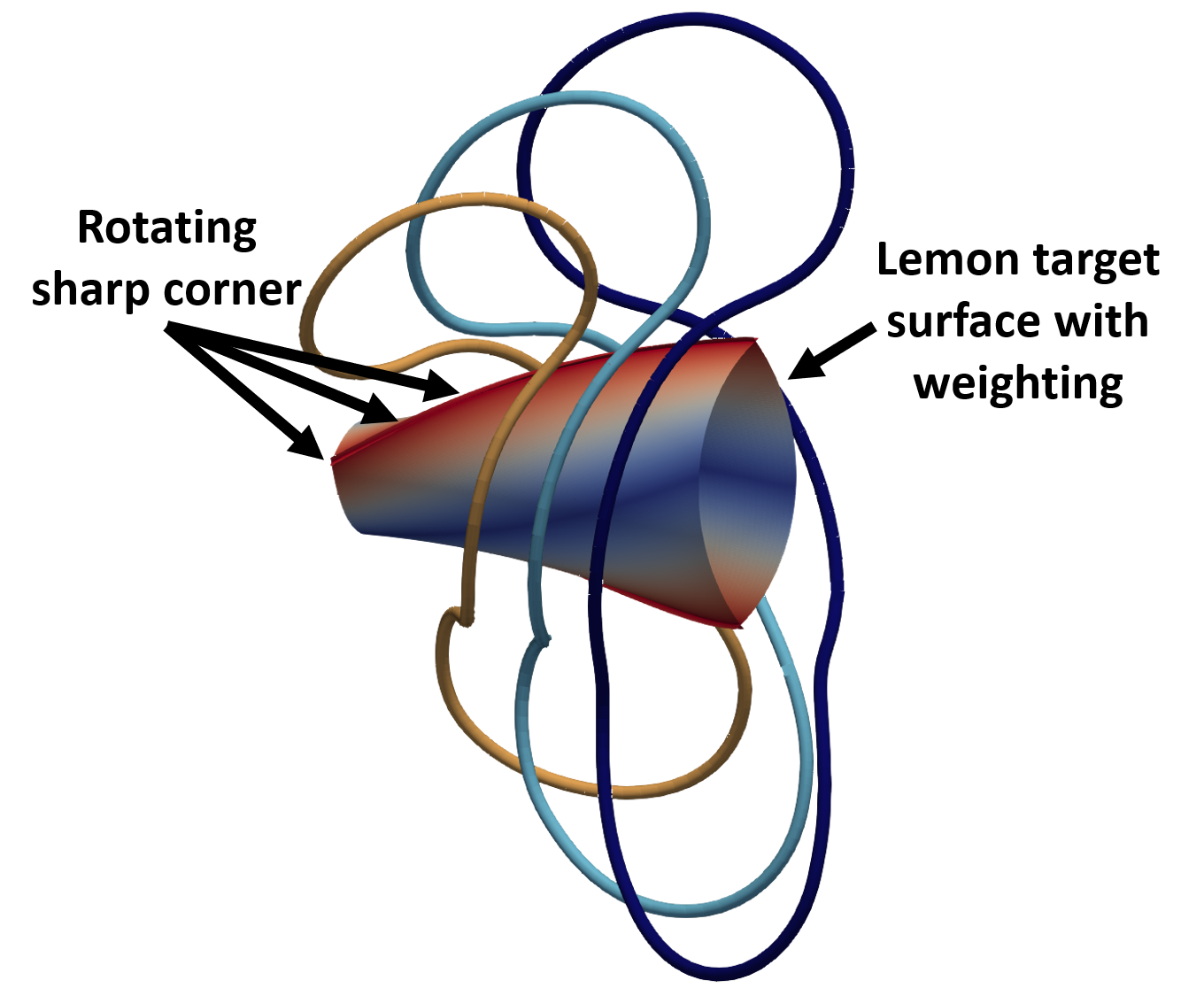
Figure 1: Lemon target surface showing the weight used for the weighted squared flux objective and an optimized coil set. Near the sharp corners, the weight approaches 1 (red); away from the corners, the weight decreases (blue).
- Manifold Optimization: A novel technique penalizes the deviation of field lines from the target surface after tracing through one field period, directly targeting the suppression of resonant errors that induce chaos. This method is computationally efficient and can be incorporated into existing coil optimization frameworks.
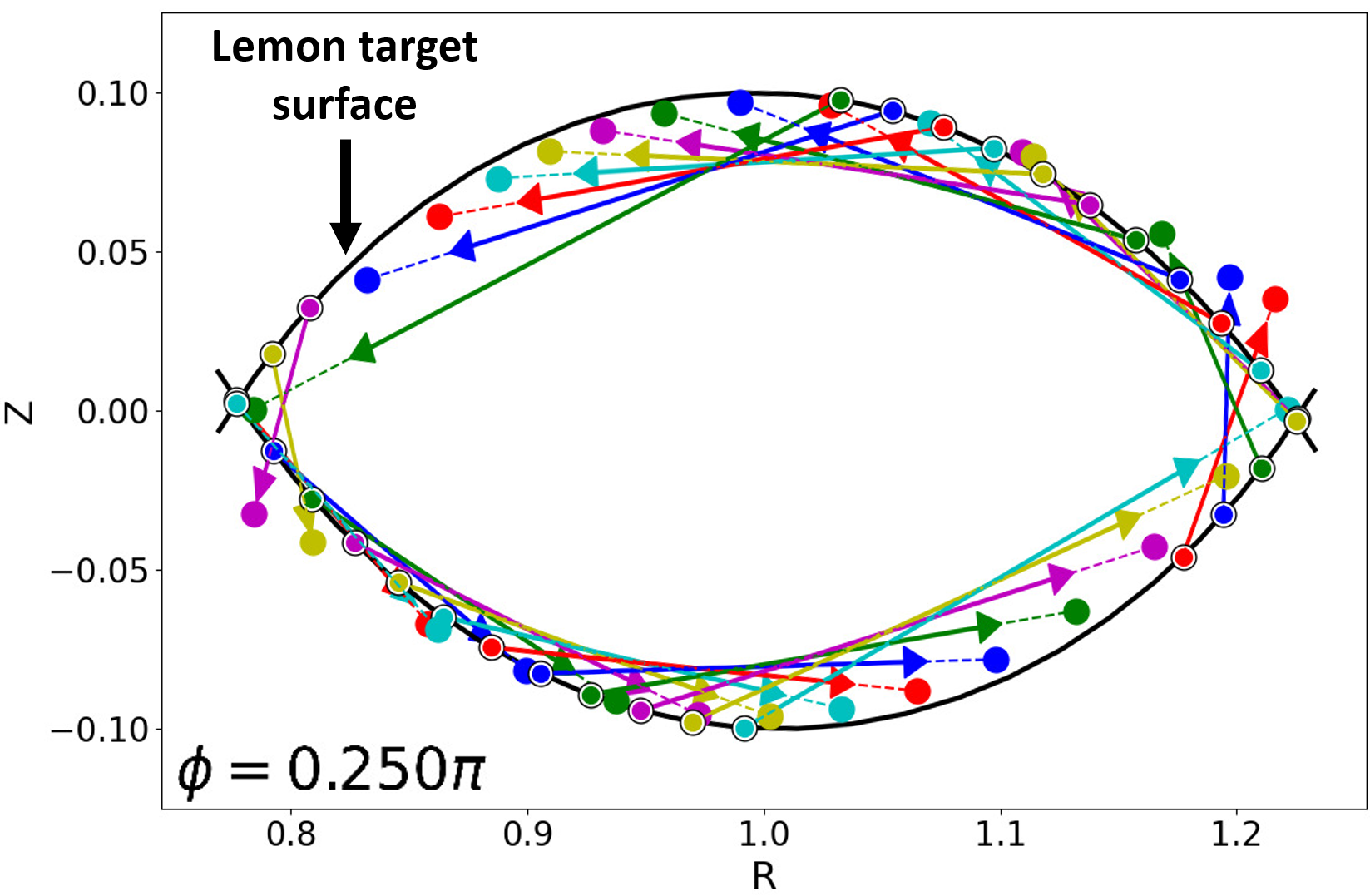
Figure 2: Illustration of manifold optimization, showing field line tracing and deviation minimization on the lemon surface.
Target Surface Geometry: The Rotating Lemon
The target plasma surface is constructed by toroidally rotating a lemon-shaped cross-section, resulting in a surface with continuous sharp edges. This geometry is inspired by the LHD helical divertor but is realized here with modular coils. The parameterization allows precise control over the location and sharpness of the corners, which become the X-lines of the separatrix. The optimization ensemble is generated via randomized search over objective weights and thresholds, using the SIMSOPT framework.
Results: Divertor Topology and Chaos Suppression
Baseline Lemon Coil Set
The standard Bn minimization yields a coil set (the "lemon coil set") with well-separated, non-chaotic divertor legs. The diverted field line topology closely resembles a tokamak X-point divertor, with crisp separatrix legs emanating from the sharp edge.
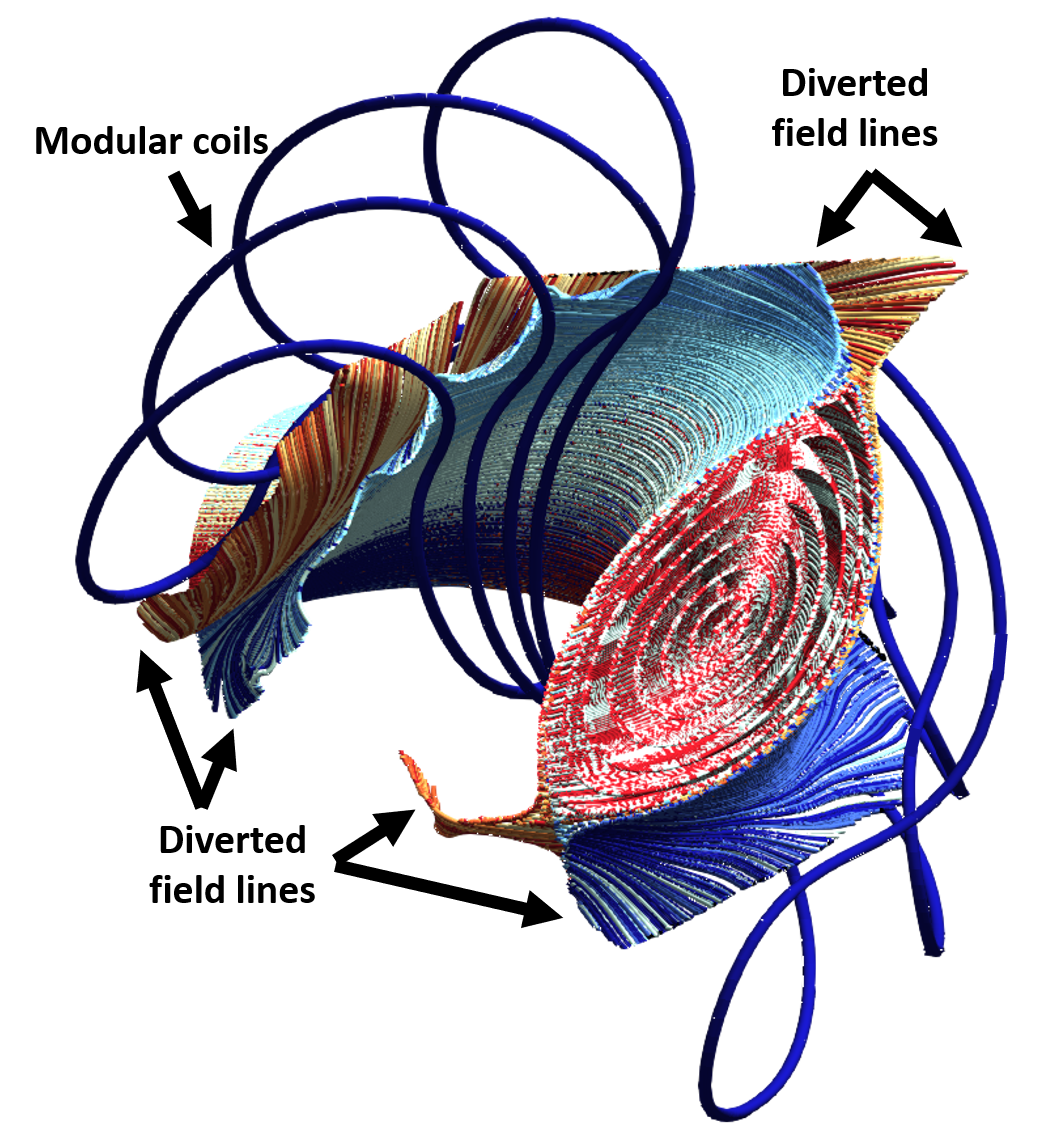
Figure 3: Three-dimensional rendering of the rotating lemon divertor structure. The divertor legs are well-separated and non-chaotic.
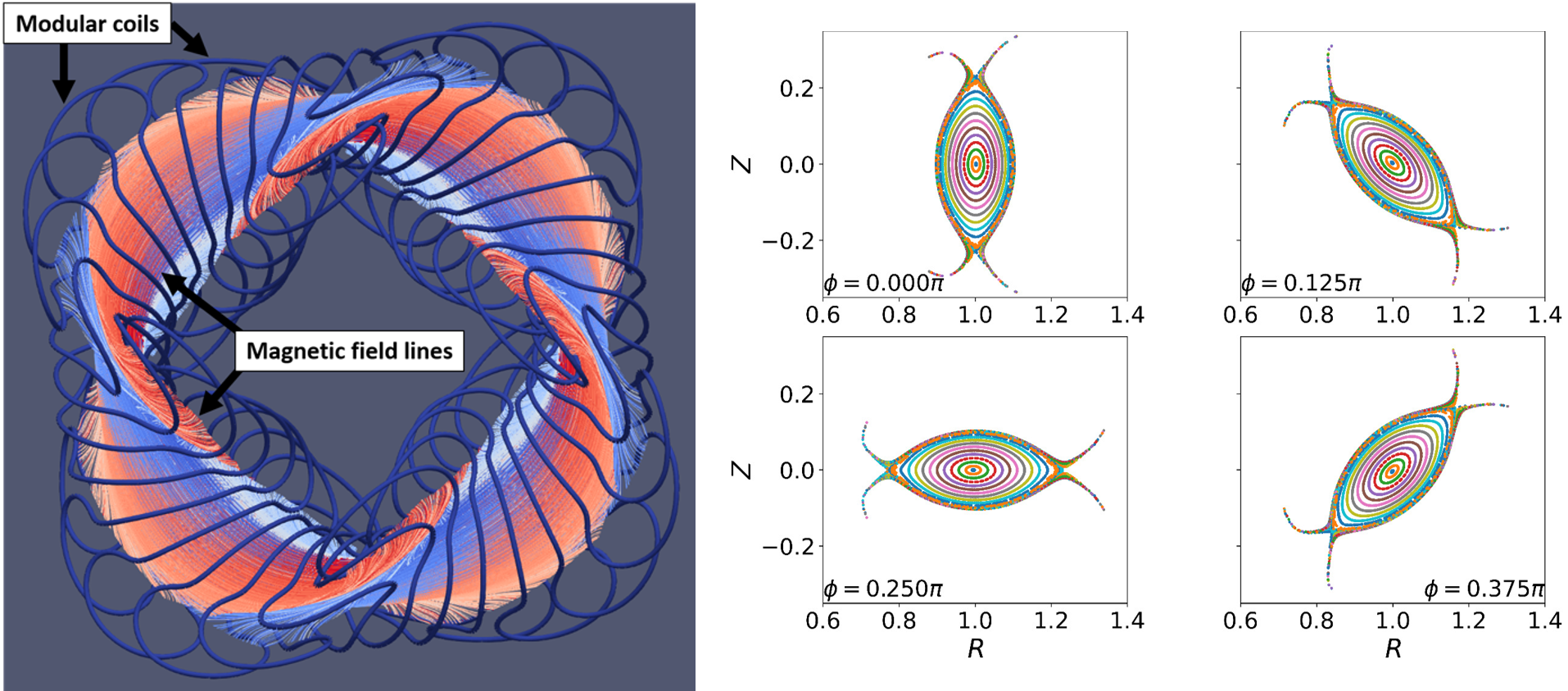
Figure 4: (a) Coil set of the rotating lemon after typical Bn minimization with field lines shown. (b) Poincare sections for the lemon coil set at several toroidal angles.
Comparison with LHD and Alternative Optimizations
Poincare sections reveal that the lemon coil set produces a diverted region with significantly less chaos than the LHD helical divertor. The WSF coil set, optimized for engineering feasibility, exhibits higher separatrix chaos, similar to LHD, but with improved coil metrics (lower curvature, increased coil-coil clearance).
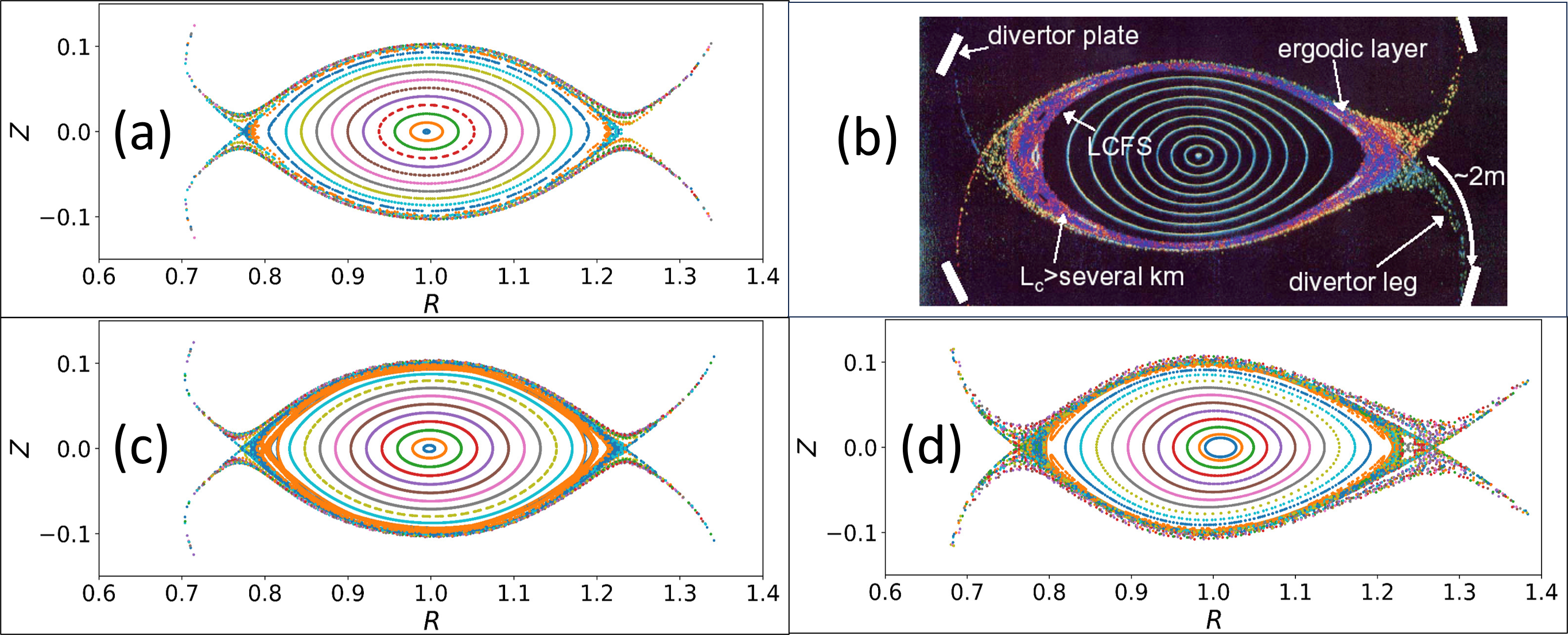
Figure 5: Poincare sections of (a) the lemon, (c) manifold-optimized, (d) weighted squared flux coil sets, and (b) the LHD divertor for comparison.
The manifold-optimized coil set further reduces chaos in the separatrix, as quantified by Greene's residue analysis of fixed points. However, this configuration is highly sensitive to coil perturbations, indicating fragility in the diverted field line topology.
Fixed Point and Chaos Analysis
Fixed points of the Poincare map (X-points and O-points) are identified and grouped by spatial proximity. Greene's residue is computed for each resonance, providing a quantitative measure of local stability and chaos. The lemon coil set exhibits large residues for primary fixed points, indicating rapid field line transit but low overall chaos. The manifold-optimized set achieves several orders of magnitude reduction in residue for primary fixed points, but at the expense of increased sensitivity.
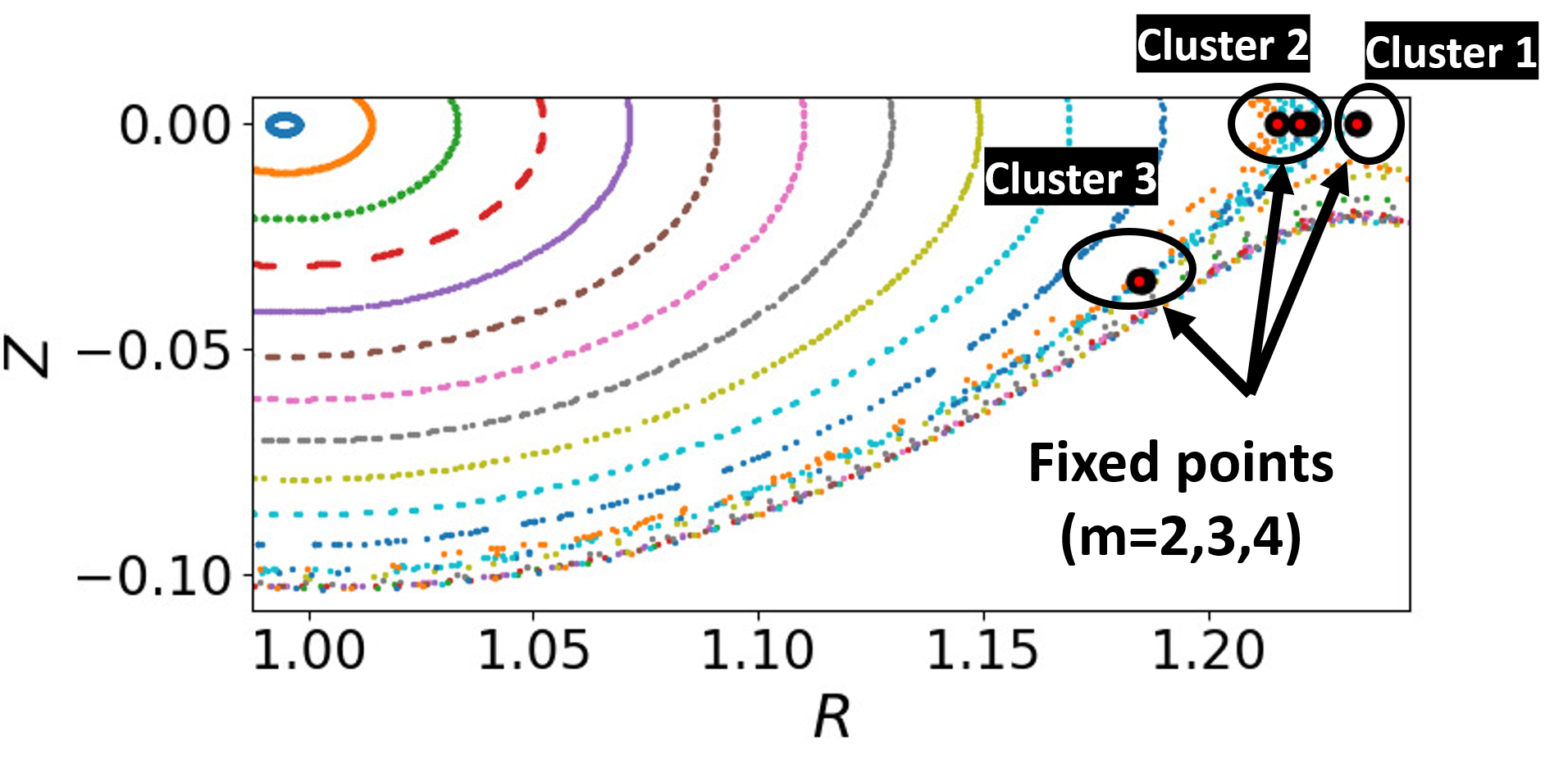
Figure 6: Locations of selected fixed points for quantifying divertor chaos, grouped into clusters by spatial proximity.
A comparative analysis of coil engineering metrics demonstrates that the WSF coil set achieves superior values for coil length, minimum coil-coil distance, and curvature, making it more feasible for practical construction. The lemon and manifold-optimized sets, while achieving lower chaos, retain higher complexity.
Implications and Future Directions
The results establish that modular coils can realize helical divertor topologies with tunable chaos, refuting the notion that wide stochastic layers are intrinsic to the helical divertor. The ability to tightly baffle the divertor region with modular coils enhances reactor relevance, as modular coils are more amenable to factory fabrication and transport.
The introduction of manifold optimization provides a new tool for chaos suppression in divertor design, though its sensitivity to coil perturbations highlights the need for robust optimization strategies. The work raises several open questions:
- Compatibility with Core Physics: The target surfaces were not optimized for confinement or stability. Integrating sharp-edged divertor surfaces with quasisymmetric or quasi-isodynamic core geometries remains an open challenge.
- Optimal Chaos Level: The trade-off between chaos-induced heat flux spreading and detachment access requires further investigation to determine the optimal separatrix stochasticity.
- Robustness and Engineering Integration: Ensuring divertor robustness to coil perturbations and integrating realistic wall and baffle geometries are critical for reactor-scale deployment.
Conclusion
This study demonstrates that modular coil optimization targeting sharp-edged plasma surfaces enables the design of stellarator divertors with X-point topologies and controllable chaos, previously thought achievable only with helical coils. The manifold optimization technique offers a promising avenue for further chaos reduction. Future work should focus on integrating core physics optimization, enhancing robustness, and exploring the practical limits of chaos tuning in divertor separatrices.