- The paper presents robust multi-wavelength evidence of multi-episodic, aspherical mass loss and binary interactions shaping the circumstellar environment.
- High-cadence photometry and spectropolarimetry tightly constrain the explosion timing, light curve evolution, and progenitor properties, indicating an extended envelope.
- The study highlights the need for multi-dimensional models and high-cadence monitoring to further elucidate mass-loss mechanisms in evolved supergiant progenitors.
SN 2024cld: Probing the Mass-Loss Histories of Evolved Supergiant Progenitors to Core Collapse Supernovae
Introduction and Context
The study of SN 2024cld provides a comprehensive multi-wavelength and polarimetric dataset for a transitional core-collapse supernova (CCSN) that bridges the phenomenological gap between Type II and Type IIn SNe. The event was discovered within 12 hours of explosion in the spiral arm of NGC 6004, enabling high-cadence follow-up and detailed characterization of its circumstellar material (CSM) interaction, photometric evolution, and spectropolarimetric properties.
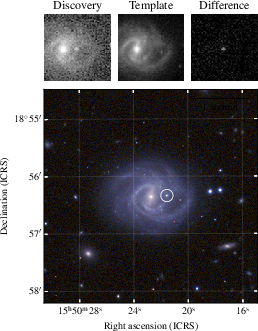
Figure 1: SN 2024cld (circled) embedded in the spiral arm of NGC 6004, with GOTO discovery, template, and difference images above.
The host environment, as revealed by CALIFA/PMAS data, is a solar-metallicity region adjacent to an H II region, with negligible host extinction. The explosion site spectrum confirms a redshift of z=0.01252 and a metallicity 12+log(O/H)=8.85±0.12, consistent with solar or slightly super-solar abundance.
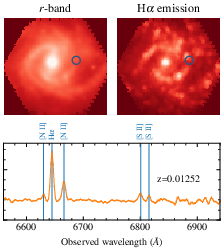
Figure 2: Reconstructed r-band and Hα images of NGC 6004, with the SN site aperture and explosion site spectrum.
Photometric Evolution and Bolometric Properties
The light curve of SN 2024cld is characterized by a rapid rise to peak (∼10 days), followed by two distinct plateau phases: the first between 50–100 days and the second commencing at ∼110 days post-explosion. The peak absolute magnitude in g-band is Mg=−17.58 at 14.65 days, with a pseudo-bolometric peak luminosity of logL=43.02±0.09 ergs−1.
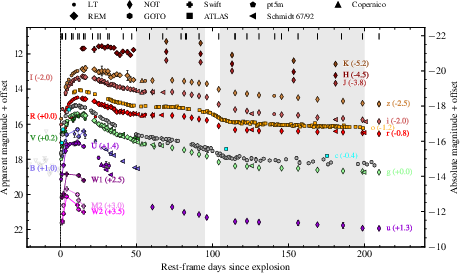
Figure 3: Host-subtracted light curve showing rapid rise, two plateau phases, and non-detections as downward triangles.
The explosion epoch is tightly constrained to MJD 60,352.74±0.03 (2024 Feb 12 17:45 UT) via hierarchical Bayesian modeling of early survey photometry.
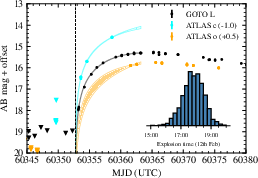
Figure 4: Pre-peak detections, upper limits, and model light curve fits for explosion epoch inference.
Blackbody fits to multi-band photometry reveal an initial photospheric radius of 2100±200R⊙, exceeding typical RSG radii and indicating a highly extended envelope. The temperature evolution peaks at ∼15,000 K and stabilizes at ∼5,000 K during the plateau phases.
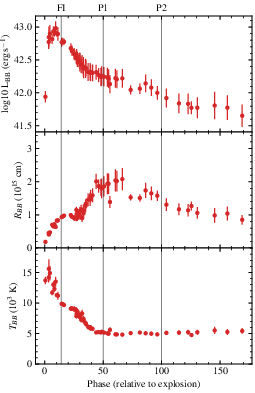
Figure 5: Pseudo-bolometric light curve, blackbody radius, and temperature evolution with phase markers for FI, P1, and P2.
Archival pre-explosion imaging sets stringent limits on precursor outbursts, ruling out events brighter than M=−11 mag within 100 days prior to explosion.
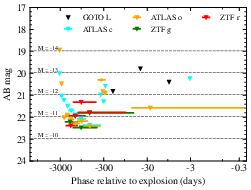
Figure 6: Photometric limits on pre-explosion variability, with seasonal binning and absolute magnitude thresholds.
Spectroscopic Evolution and CSM Diagnostics
The spectral series reveals a prolonged flash-ionized (FI) phase lasting ∼14 days, with early spectra dominated by high-ionization lines (C III, N IV) that dissipate rapidly, leaving H and He features. The FI duration is significantly longer than the mean for SNe II, indicating a dense, extended CSM.
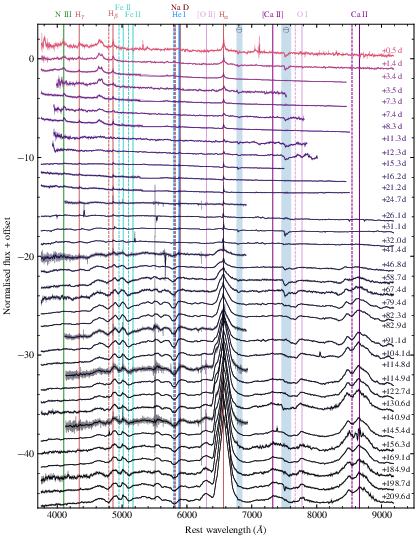
Figure 7: Full spectral series, showing evolution from FI phase to late-time interaction signatures.
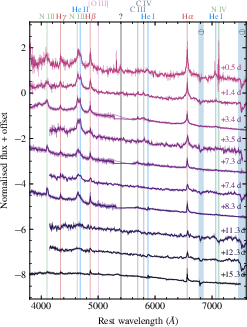
Figure 8: Early-time spectral series highlighting high-ionization lines and their rapid disappearance.
Comparative analysis with other flash-ionized SNe (SN 2013fs, SN 2013cu, SN 1998S, PTF11iqb) places SN 2024cld between SN 2013fs and SN 2013cu in terms of FI phase and line strengths.
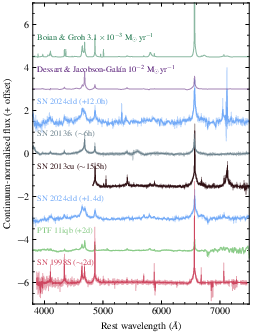
Figure 9: Continuum-normalized early-time spectra of flash-ionized SNe and model comparisons.
Ejecta velocities, measured from Fe II λ5169 and other lines, are typical for SNe II, with initial velocities of $8700$ and $6700$ km/s for Hβ and He I, respectively. The Hα profile evolves to show multi-component structure: a narrow CSM emission, broad ejecta emission, and high-velocity blue/red shoulders (∼6000 km/s), consistent with interaction with an aspherical CSM.
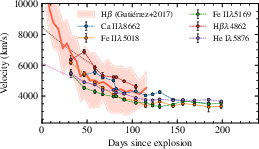
Figure 10: Ejecta velocity evolution for multiple species, with extrapolated zero-phase velocities and literature comparison.
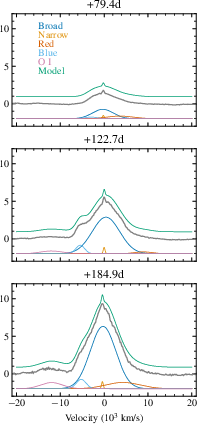
Figure 11: Gaussian decomposition of Hα profile into narrow, broad, and high-velocity components.
Medium-resolution spectroscopy reveals a persistent narrow Hα P Cygni feature (FWHM ∼60 km/s), with a marked transition in absorption velocity around +30 days, interpreted as the ejecta sweeping through distinct CSM layers.
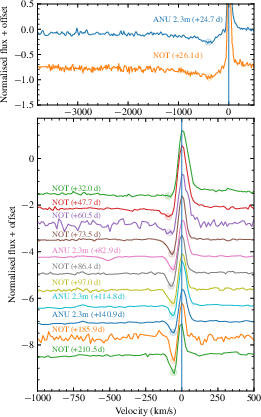
Figure 12: Zoom-in on the narrow Hα component, showing transition in absorption width and velocity.
The absorption velocity declines post-transition, approaching the terminal wind velocity, but remains above typical RSG wind speeds.
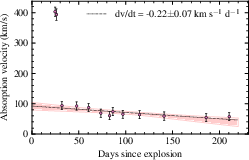
Figure 13: Hα absorption velocity evolution, with linear fit to post-transition decline.
Polarimetric Evolution and CSM Geometry
Dense polarimetric coverage in B and V bands reveals complex evolution: initial low polarization, a rapid rise to P≈2% at ∼10 days, and a rotation of ∼60∘ in polarization angle as the ejecta interacts with more distant CSM. This behavior is consistent with aspherical CSM configurations inferred in SN 1998S and PTF11iqb.
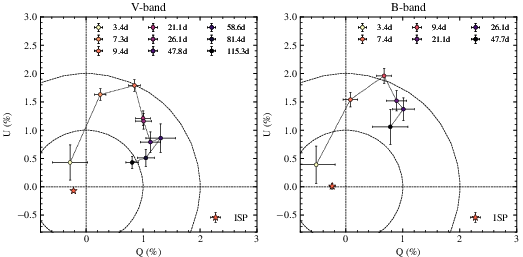
Figure 14: B and V-band polarization measurements, showing rise and rotation in polarization angle.
Comparative Analysis with 98S-like SNe
SN 2024cld is compared to other 98S-like SNe (PTF11iqb, SN 1998S, SN 2008fq, SN 2013fc) and normal SN II (SN 2004et). The light curve morphology, plateau durations, and late-time interaction signatures are broadly similar, with differences attributable to CSM density and geometry.
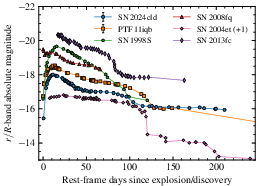
Figure 15: Light curve comparison between SN 2024cld, other 98S-like SNe, and normal SN II.
Spectral comparison further underscores the similarity in late-time Hα profile evolution and CSM interaction features.
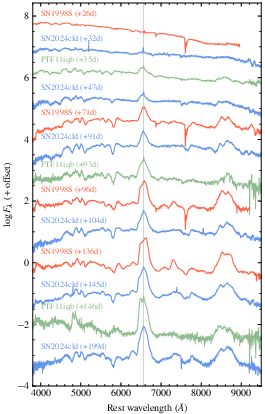
Figure 16: Spectral comparison between SN 2024cld, PTF11iqb, and SN 1998S.
CSM Structure and Progenitor Scenarios
The multi-component CSM structure inferred for SN 2024cld comprises a dense, inner aspherical envelope, a disk/torus-like component, and an extended wind. The mass-loss rates during the second plateau are estimated at ∼6×10⁻⁴M⊙yr−1, with the CSM shed 25–50 years prior to explosion. The persistent wind-like CSM is traced by the narrow Hα absorption, with velocities declining toward the RSG wind regime.
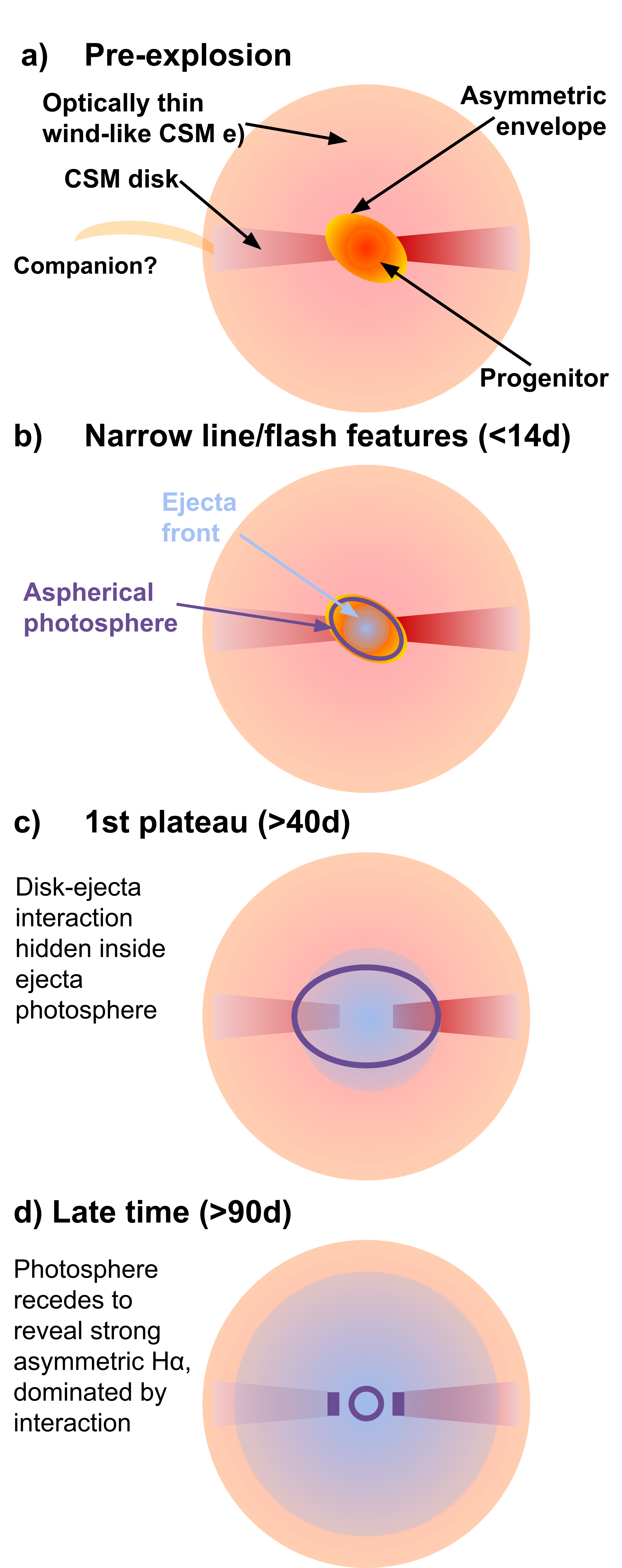
Figure 17: Schematic of the inferred CSM structure and key observed phases in SN 2024cld.
The progenitor is most plausibly an evolved RSG or yellow supergiant in a binary system, with binary interaction responsible for the disk-like CSM. Analogous Galactic systems (WOH G64, Hen 3-1379, NML Cyg) exhibit similar multi-component CSM morphologies and outflow velocities.
Swift XRT non-detections place upper limits on X-ray luminosity, with LX/Lbol≲0.005 at +10 days and LX/Lbol≲0.07 at +220 days, consistent with high CSM opacity. NIR photometry and blackbody fits show no evidence for warm dust formation, in contrast to SN 1998S and SN 2013fc.
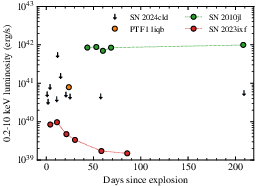
Figure 18: X-ray luminosity limits for SN 2024cld compared to other X-ray detected SNe.
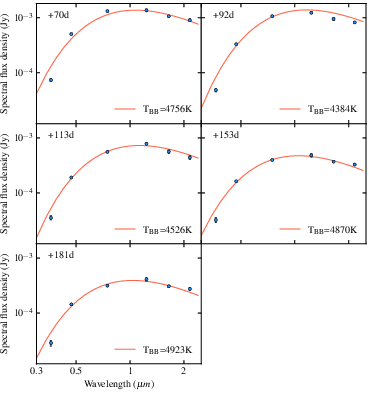
Figure 19: Blackbody fits to JHK photometry, indicating absence of warm dust in SN 2024cld.
Implications and Future Directions
The dataset for SN 2024cld provides robust constraints on the mass-loss history, CSM geometry, and progenitor system for transitional CCSNe. The evidence for multi-episodic, asymmetric mass loss and disk-like CSM strongly supports binary interaction as a dominant mechanism in shaping the pre-explosion environment of 98S-like SNe. The persistent wind component and absence of dust formation further refine models of late-stage stellar evolution and CSM interaction.
Theoretical implications include the need for multi-dimensional hydrodynamic and radiative transfer models that incorporate binary mass transfer, episodic eruptions, and aspherical CSM. Practically, the results motivate high-cadence, multi-wavelength, and polarimetric monitoring of CCSNe, as well as targeted pre-explosion imaging to directly identify progenitor systems.
Conclusion
SN 2024cld exemplifies the complex mass-loss histories and CSM geometries of evolved supergiant progenitors to CCSNe. The event's photometric, spectroscopic, and polarimetric evolution reveals a multi-component, asymmetric CSM structure shaped by multiple mass-loss episodes, likely driven by binary interaction. The findings underscore the importance of early discovery and dense follow-up in constraining progenitor properties and mass-loss mechanisms, with broader implications for stellar evolution theory and the diversity of CCSN outcomes. Continued late-time observations and comparative studies with Galactic analogs will further elucidate the pathways to core collapse in massive stars.