- The paper establishes that the extremely luminous flare, with ~10^54 erg radiated, results from a tidal disruption of a massive (≥30 M⊙) star in an AGN disk.
- It employs extensive multi-band light curves and spectroscopy to detail a rapid 40-day rise, a 140-day decline, and persistent high flux, supporting a model of sustained high accretion and strong outflows.
- The detection at z=2.554 implies a population of high-mass tidal disruption events in AGN disks, challenging conventional models of SMBH accretion and stellar dynamics.
An Extremely Luminous Flare from a Supermassive Black Hole: Evidence for a Massive Tidal Disruption Event
Introduction
The paper presents the discovery and analysis of an exceptionally luminous flare from the active galactic nucleus (AGN) J224554.84+374326.5 (hereafter J2245+3743) at z=2.554. The event, detected in 2018, exhibited a flux increase by a factor of 40, with a total radiated energy in the UV/optical of ∼1054 erg—equivalent to the complete conversion of a solar mass into electromagnetic radiation. This energy output is at least an order of magnitude greater than any previously reported AGN transient. The authors systematically evaluate possible physical mechanisms and conclude that the most plausible scenario is the tidal disruption of a massive (≳30M⊙) star in the AGN disk.
Observational Properties
Photometric Evolution
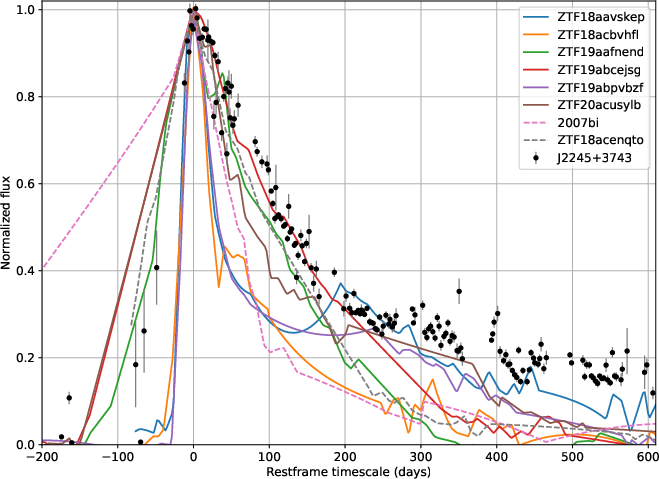
The flare was detected by multiple time-domain surveys (CRTS, ZTF, ATLAS, PS1, WISE), providing a well-sampled, multi-band light curve spanning over a decade. The event rose rapidly (restframe τrise∼40 days) and decayed over ∼140 days, with the flux remaining elevated above the pre-flare level for over 650 restframe days.
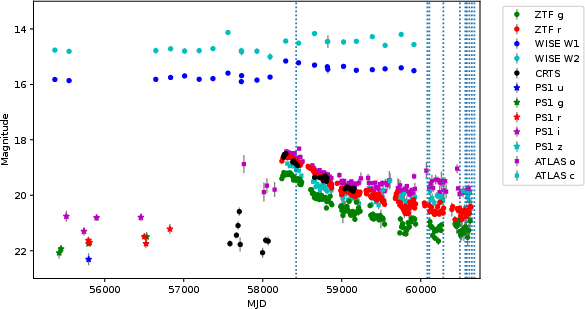
Figure 1: Photometric data for J2245+3743 from PS1, CRTS, ZTF, ATLAS, and WISE, showing the flare and epochs of spectroscopic follow-up.
The peak absolute r-band magnitude reached Mr=−27.2, and the total radiated energy, integrating the host-subtracted light curves, is robustly ∼1054 erg. The mid-IR (WISE) light curve shows a contemporaneous rise with the optical, with a dust covering fraction of 0.34, consistent with AGN activity.
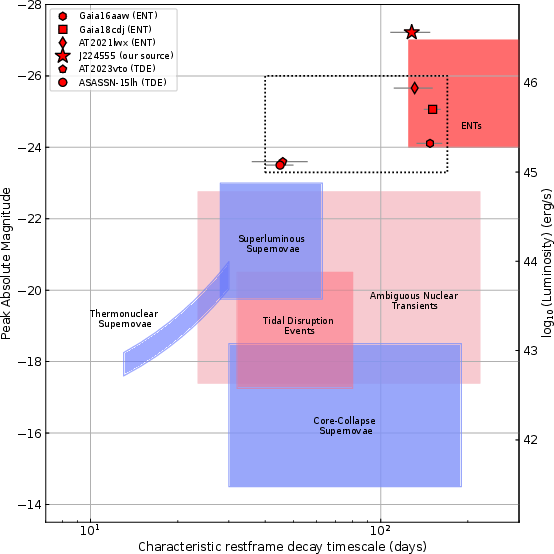
Figure 2: Peak absolute magnitude vs. restframe timescale to fade to 50% peak flux, situating J2245+3743 in the extreme nuclear transient (ENT) regime.
Spectroscopic Evolution
Multi-epoch optical and near-IR spectroscopy reveals the gradual development of broad emission lines (Lyα, C IV, Mg II, Hβ, [O III]), consistent with AGN activity. The broad UV lines have FWHM 3000–4000 km/s, while Balmer lines are narrower (∼1000 km/s). P-Cygni absorption features are present in Lyα and C IV, indicative of outflows.
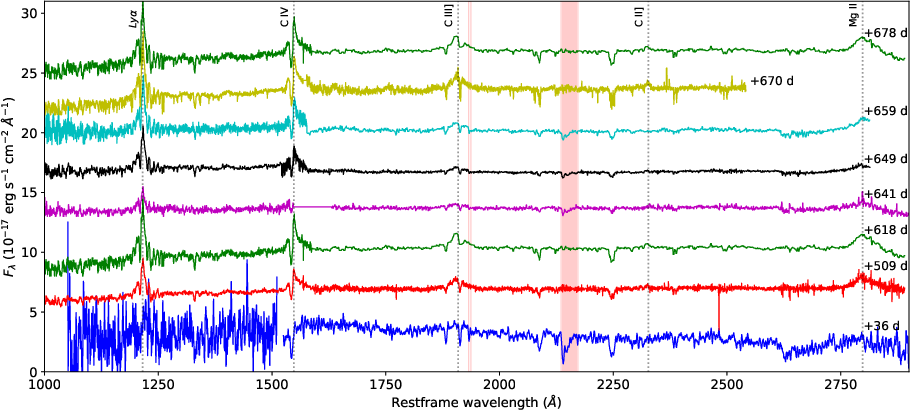
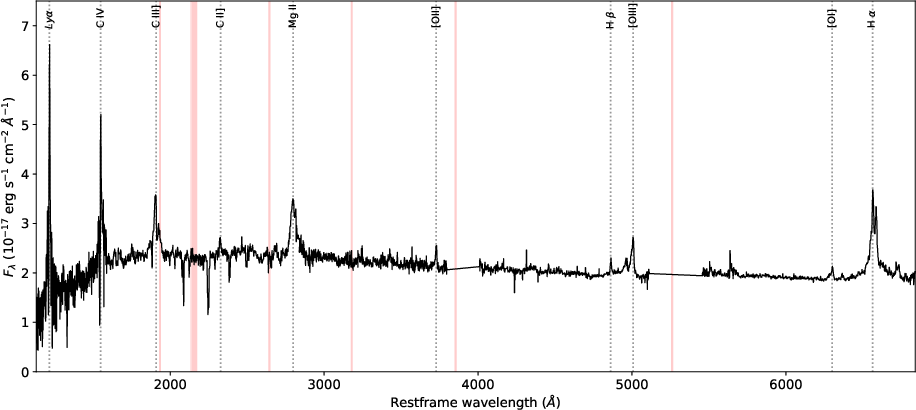
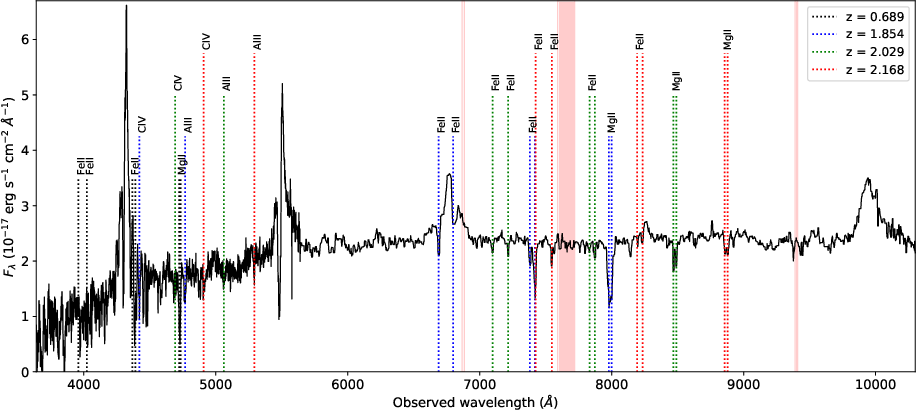
Figure 3: Spectroscopic data for J2245+3743, showing multi-epoch spectra, a composite spectrum, and absorption systems along the line of sight.
Forbidden oxygen lines ([O II], [O III], [O I]) exhibit blueshifted wings, further supporting the presence of strong winds.
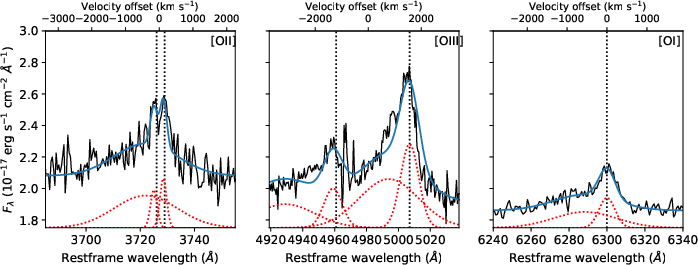
Figure 4: Zoom-in on forbidden oxygen features, all showing blueshifted wings indicative of strong winds.
Imaging and Multiwavelength Constraints
High-resolution imaging (Keck/LRIS, KCWI) shows the flare is coincident with the AGN nucleus, with no evidence for multiple components or a lensing galaxy. The source is undetected in X-rays and radio post-flare, and no neutrino emission is associated. The lack of X-ray emission and the absence of a radio jet are inconsistent with beamed or jetted scenarios.
Physical Interpretation
Exclusion of Alternative Scenarios
Tidal Disruption Event in an AGN Disk
The energetics, timescales, and spectral evolution are most consistent with a TDE involving a massive star (≳30M⊙) in the AGN disk. The required accreted mass, assuming 10% radiative efficiency, is ≳11M⊙. The inferred SMBH mass (108.5±0.3M⊙) is compatible with the Hills mass for disruption of such a star, especially if the SMBH is spinning.
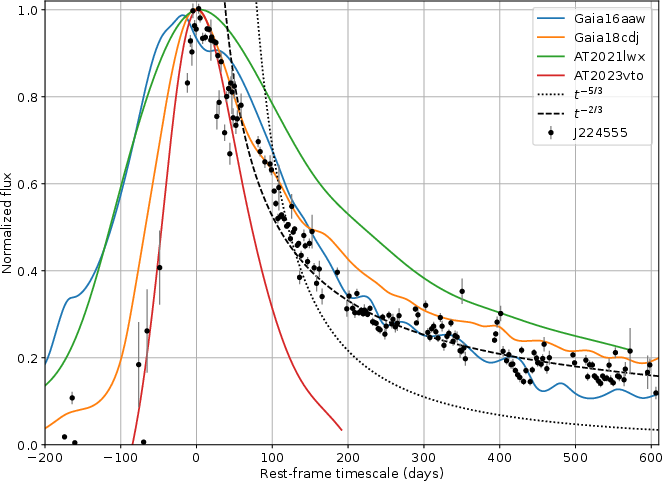
Figure 6: Comparison of the normalized light curve of J2245+3743 with other ENTs, including AT2021lwx, showing the similar fast rise and slow decline.
The long duration and slow decline of the flare are consistent with a scenario where the TDE debris interacts strongly with the AGN disk, leading to sustained high Eddington accretion and optically thick outflows. The lack of a return to the pre-flare continuum level suggests a prograde, in-plane or modestly inclined orbit for the disrupted star.
Implications for AGN and TDE Populations
The detection of such an event at z=2.554—the highest redshift TDE candidate to date—implies a population of high-redshift, high-mass TDEs in AGN disks. The inferred event rate (∼3×10⁻⁴ Gpc−3 yr−1) is consistent with expectations for a top-heavy stellar mass function in AGN disks, as predicted by theoretical models and supported by observations of the Galactic center.
The existence of massive stars in AGN disks is supported by simulations of star formation and evolution in dense, gas-rich environments, which can produce stars up to several hundred solar masses over Myr timescales. TDEs of such stars provide a unique probe of the embedded stellar population and the dynamical processes in AGN disks.
Theoretical and Observational Prospects
The event challenges current models of AGN variability and TDEs, particularly in the regime of high SMBH mass and massive stellar progenitors. The lack of strong X-ray or radio emission, the slow photometric evolution, and the spectroscopic signatures of outflows and winds provide constraints on the accretion physics and the interaction between TDE debris and the AGN disk.
Future wide-field, deep time-domain surveys (e.g., Rubin Observatory, Roman Space Telescope) are expected to uncover more such events, enabling statistical studies of the high-mass end of the TDE population and the demographics of massive stars in AGN disks. High-cadence, multiwavelength follow-up will be essential to distinguish TDEs from other nuclear transients and to constrain the physical mechanisms at play.
Conclusion
J2245+3743 represents the most luminous AGN flare observed to date, with a total radiated energy of ∼1054 erg. The data strongly favor a scenario in which a massive star (≳30M⊙) was tidally disrupted by a 108.5M⊙ SMBH in an AGN disk. This event provides compelling evidence for the existence of massive stars in AGN disks and demonstrates the potential of time-domain surveys to probe the extreme physics of SMBH accretion and stellar dynamics in galactic nuclei. The discovery opens new avenues for understanding the interplay between star formation, stellar evolution, and SMBH growth in the early universe.