- The paper demonstrates that dynamical friction timescales from Chandrasekhar’s formula conflict with the long-term survival of DM halos in systems like UFDs and galactic bars.
- Simulation and semi-analytical models reveal that observed features in wide binaries, globular clusters, and satellite galaxies are inconsistent with typical DM-induced orbital decay.
- The findings challenge the standard dark matter hypothesis and bolster the case for alternative models, including modified gravity frameworks.
Dynamical Friction Constraints on the Dark Matter Hypothesis Across Astronomical Scales
Introduction and Theoretical Framework
The paper rigorously examines the implications of Chandrasekhar dynamical friction (DF) for the dark matter (DM) hypothesis across a wide range of astronomical systems. The central argument is that the introduction of DM halos to explain observed kinematics under Newtonian gravity necessarily implies orbital decay via DF, with timescales that must be consistent with the lifetimes of the systems in question. The authors systematically apply this self-consistency test to systems ranging from ultrafaint dwarf galaxies (UFDs) and binary stars to galactic bars, satellite galaxies, and galaxy groups.
The DF force is derived from the classical Chandrasekhar formula, which quantifies the drag experienced by a massive perturber moving through a background of DM particles. The DF timescale, τDF, is shown to depend sensitively on the mass and orbital radius of the perturber, as well as the density and velocity dispersion of the DM halo. The analytical estimates are validated against semi-analytical integrations and full N-body simulations, establishing the robustness of the approach.
Dynamical Friction in Ultrafaint Dwarf Galaxies
The analysis of UFDs reveals that their small sizes (r1/2∼20 pc) and low velocity dispersions (σ∼2 km/s) place them in a regime where DF timescales become comparable to or shorter than their stellar ages (∼13 Gyr). For systems such as Ursa Major III, the inferred DF timescale is <2 Gyr, which is incompatible with the survival of a dominant cuspy DM halo.
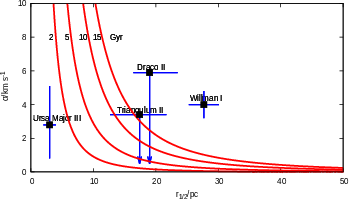
Figure 1: Red curves show loci of constant τDF in the (r1/2,σ) parameter space for UFDs; several observed systems fall below the critical threshold, indicating inconsistency with DM-dominated models.
The authors highlight that future discoveries of UFDs with r1/2<20 pc will exacerbate this inconsistency, as the strong radial dependence of τDF implies even shorter decay timescales. The possibility that some UFDs are actually dark star clusters dominated by stellar remnants is discussed as a potential mitigation, but this does not resolve the tension for systems requiring DM halos with de Broglie wavelengths much larger than their physical extents.
Binary Stars and Internal Orbital Decay
Wide binaries in UFDs, such as those detected in Reticulum II, provide a stringent test of the DM hypothesis. The DF-induced tightening of binary orbits is calculated, showing that binaries with separations sob>0.56 pc should have decayed within the age of the stellar population, yet such wide binaries are observed.
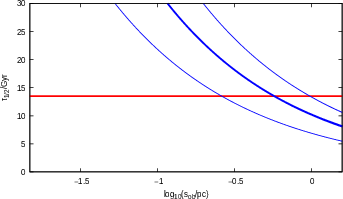
Figure 2: DF-induced internal binary orbital decay timescales as a function of separation for wide binaries in Reticulum II; observed binaries with sob>0.56 pc are inconsistent with DM-induced decay.
This result is robust against uncertainties in stellar mass and DM density, and is further supported by independent detections of wide binaries in other UFDs. The presence of such binaries rules out not only standard DM particles but also primordial black holes as DM candidates.
Globular Clusters in Dwarf Galaxies
The survival of globular clusters (GCs) in dwarf spheroidal galaxies, notably Fornax, is a well-studied DF constraint. Analytical and numerical studies show that DF timescales for GCs in cuspy DM halos are much shorter than their ages, necessitating the presence of large DM cores. However, the formation of such cores via feedback is inefficient at these scales, and alternative DM models that produce cores suppress structure formation below the core scale, conflicting with the existence of UFDs.
Galactic Bars and Pattern Speed Constraints
The fraction and properties of galactic bars in disk galaxies provide a population-level test of DF. Observational samples show a high fraction of fast bars (R≈1), whereas cosmological simulations (Illustris, EAGLE) based on ΛCDM produce predominantly slow bars (R>2), in strong statistical contradiction (>9σ) with observations.
Satellite Galaxies and the MW/LMC/SMC System
The capture and survival of satellite galaxies in the MW halo are examined using DF timescale estimates. The required pre-infall DM halo masses for satellites to be captured are significantly larger than allowed by ΛCDM abundance matching, and the observed phase-space correlations (e.g., the disk of satellites) cannot be reproduced.
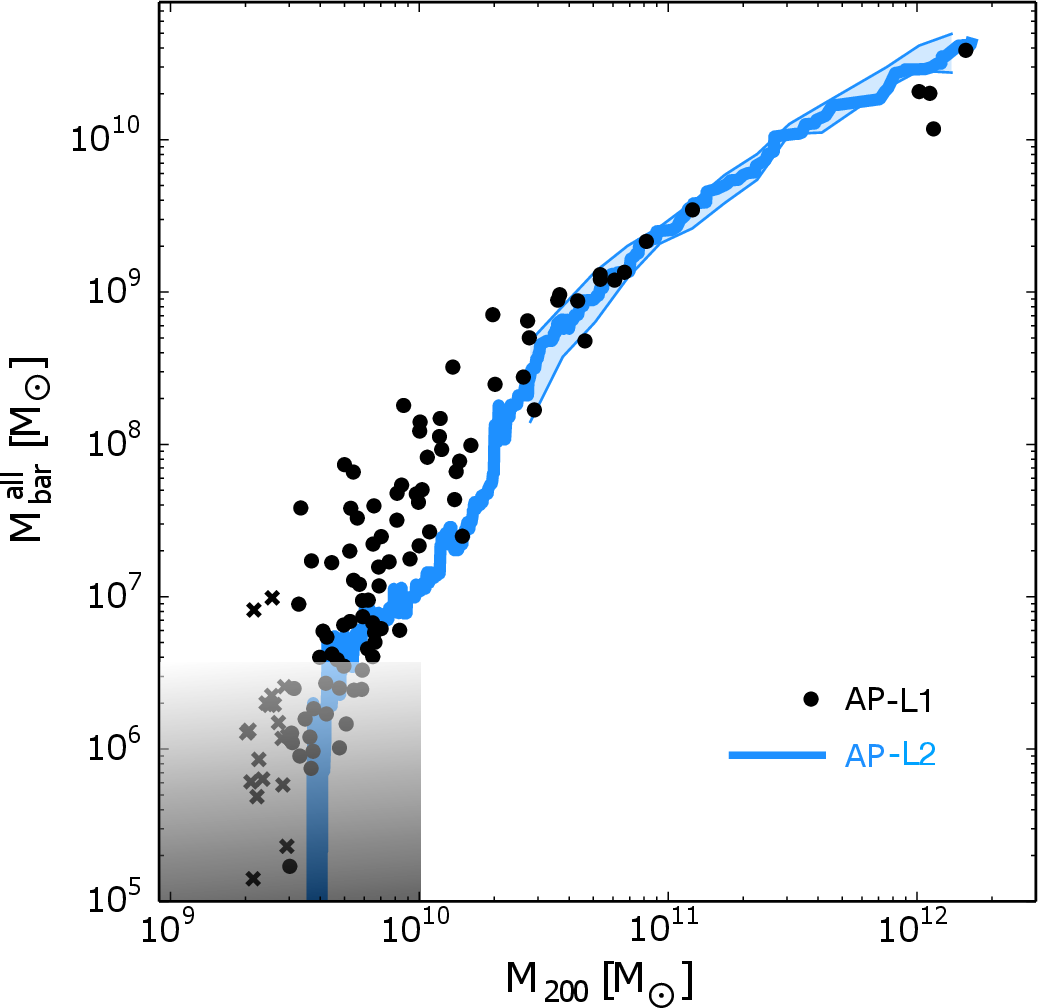
Figure 3: Baryonic mass vs. DM halo mass from APOSTLE simulations; the required DM masses for satellite capture are excluded by the model.
The MW/LMC/SMC triple system is analyzed using semi-analytical orbit integrations and analytical DF timescales. The observed synchronised star formation histories and multiple close passages of the SMC around the LMC over the past ∼3.5 Gyr are incompatible with the rapid orbital decay expected from DM-induced DF, which would merge the system within ∼1 Gyr.
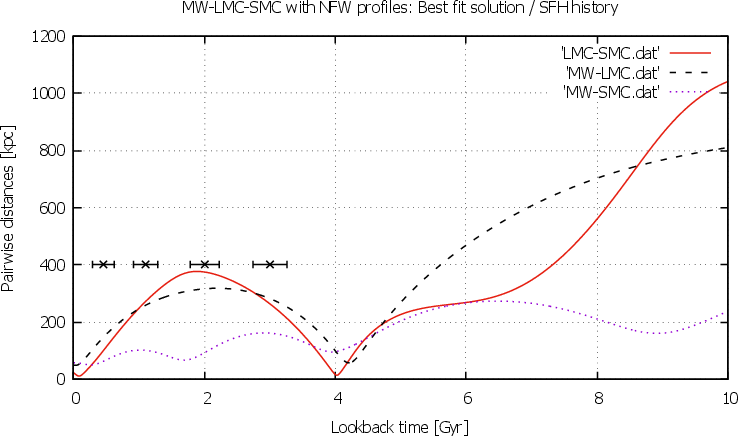
Figure 4: Pairwise distances vs. time in the MW/LMC/SMC system; the best-fit DM-based solution fails to reproduce the required orbital history.
Galaxy Groups: The M81 System
The M81 group, comprising M81, M82, and NGC 3077, is modeled using both restricted N-body and semi-analytical methods. All live DM halo simulations result in rapid mergers, failing to reproduce the observed configuration and tidal features. Only models neglecting DF can match the data, further falsifying the DM hypothesis at group scales.
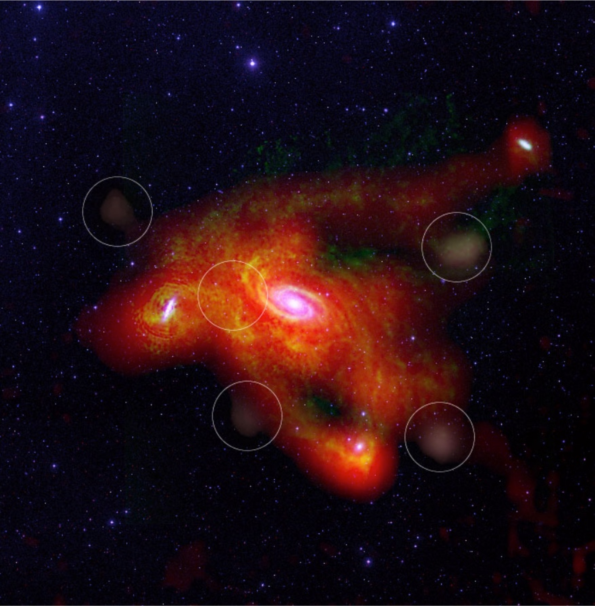
Figure 5: Composite radio-optical image of the M81 group, showing the spatial configuration and hydrogen gas trails indicative of recent interactions.
Implications and Theoretical Consequences
The paper presents a comprehensive falsification of the DM particle hypothesis across multiple astronomical scales, based on the unavoidable consequences of DF. The authors argue that alternative DM models (self-interacting, ultralight, superfluid) can resolve specific problems (e.g., GC survival) only at the cost of erasing structure at smaller scales, which is inconsistent with the observed galaxy population. Modified gravity models (e.g., MOND) are discussed as alternatives, with preliminary evidence suggesting that they can alleviate some DF constraints, but detailed simulations are required for a definitive assessment.
The broader implications include the lack of environmental dependence in galaxy properties, the persistence of thin disks, the absence of significant merger-driven evolution, and the early formation of massive galaxies and disks at high redshift, all of which are inconsistent with hierarchical structure formation in ΛCDM.
Conclusion
The dynamical friction self-consistency test provides a stringent and robust falsification of the DM particle hypothesis across a wide range of astronomical systems. The observed survival and properties of UFDs, wide binaries, globular clusters, galactic bars, satellite galaxies, and galaxy groups are incompatible with the rapid orbital decay predicted by DM-induced DF. Alternative DM models and modified gravity theories offer potential resolutions but face their own challenges in reproducing the full spectrum of observed structures. The results underscore the necessity of re-evaluating the foundations of galactic dynamics and cosmology, with future work required to explore the viability of non-particle DM and modified gravity frameworks.