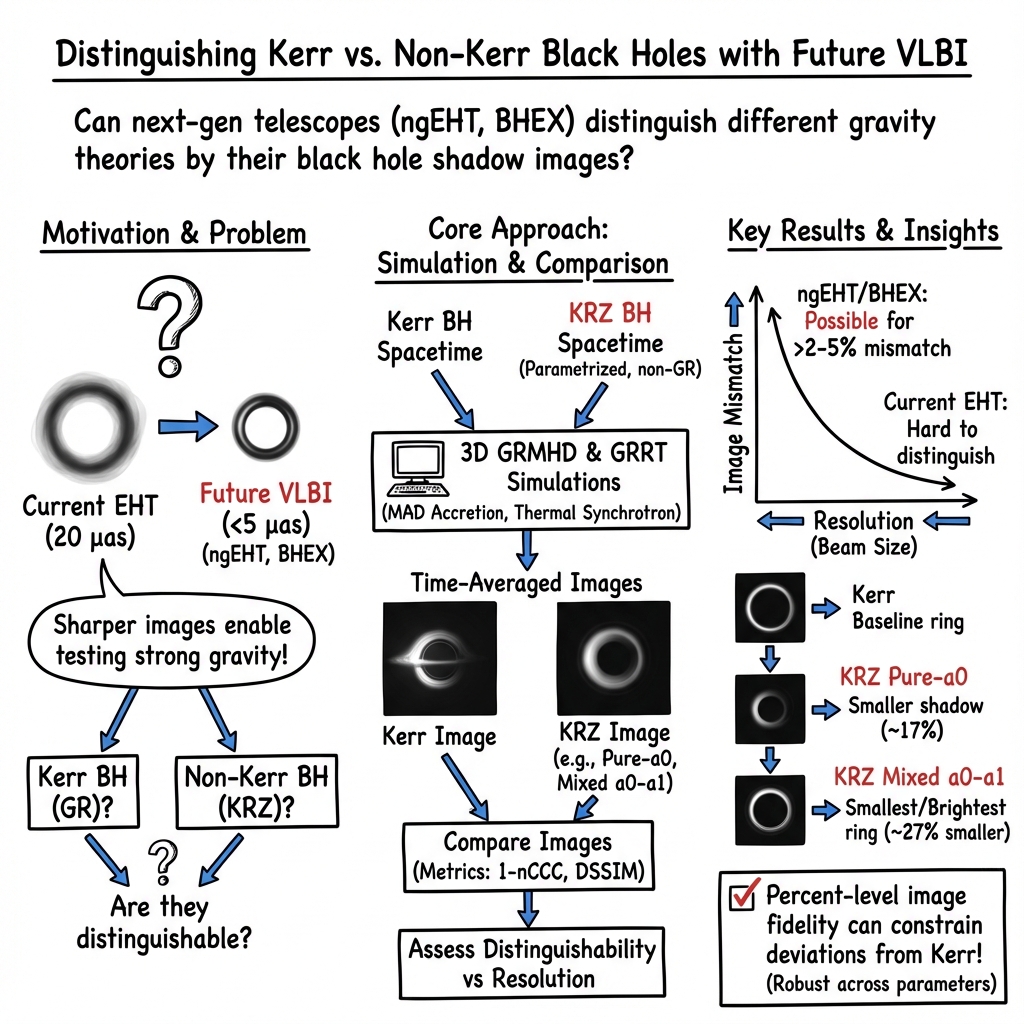
- The paper demonstrates how advanced imaging can detect deviations over 2% to 5% in black hole shadows when compared to the Kerr metric.
- It employs GRMHD and radiative-transfer simulations to model deviations, revealing unique features such as narrower jets and altered photon rings.
- Future observational technologies like ngEHT and BHEX are expected to enhance the empirical testing of gravitational theories beyond General Relativity.
Analyzing the Future Capability to Test Gravity Theories with Black Hole Shadows
Introduction and Context
The ongoing exploration of black hole (BH) shadows has been heightened by the Event Horizon Telescope (EHT), providing unprecedented opportunities to test General Relativity (GR) and other gravitational theories. Aspects of this study involve examining deviations from the Kerr solution, the standard GR description of black holes, by employing general-relativistic magnetohydrodynamic (GRMHD) simulations. This research is poised to exploit future technological advancements such as the next-generation Event Horizon Telescope (ngEHT) and Black-Hole Explorer (BHEX) to further refine our understanding of BH properties and their accordance with predicted gravitational theories.
Simulations and Methodology
The study utilizes GRMHD and radiative-transfer simulations to explore deviations in BH shadow imagery when compared to the Kerr solution. These simulations are crucial for accurately modeling the extreme environments and complex dynamics near black holes. The methodology involves adjusting the Konoplya-Rezzolla-Zhidenko (KRZ) metric parameters, which allow the exploration of deviations from the standard Kerr spacetime in a comprehensive manner (2511.03789).
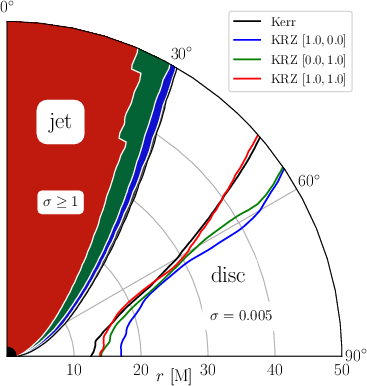
Figure 1: sigma Contours for Kerr and KRZ BHs. The σ=1.0 contours indicate the jet region for different black hole spacetimes.
One of the key metrics evaluated is the mismatch between the images of different BH solutions and the classic Kerr solution. This approach quantifies the ability of future technologies to discern variations and potentially identify alternative theories of gravity.
Results and Analysis
Significant results indicate that future observational technologies, like ngEHT and BHEX, will substantially enhance the precision of BH shadow imaging. The simulations show that image mismatches exceeding 2% to 5% can be discerned, presenting a meaningful threshold for testing deviations from the Kerr metric.
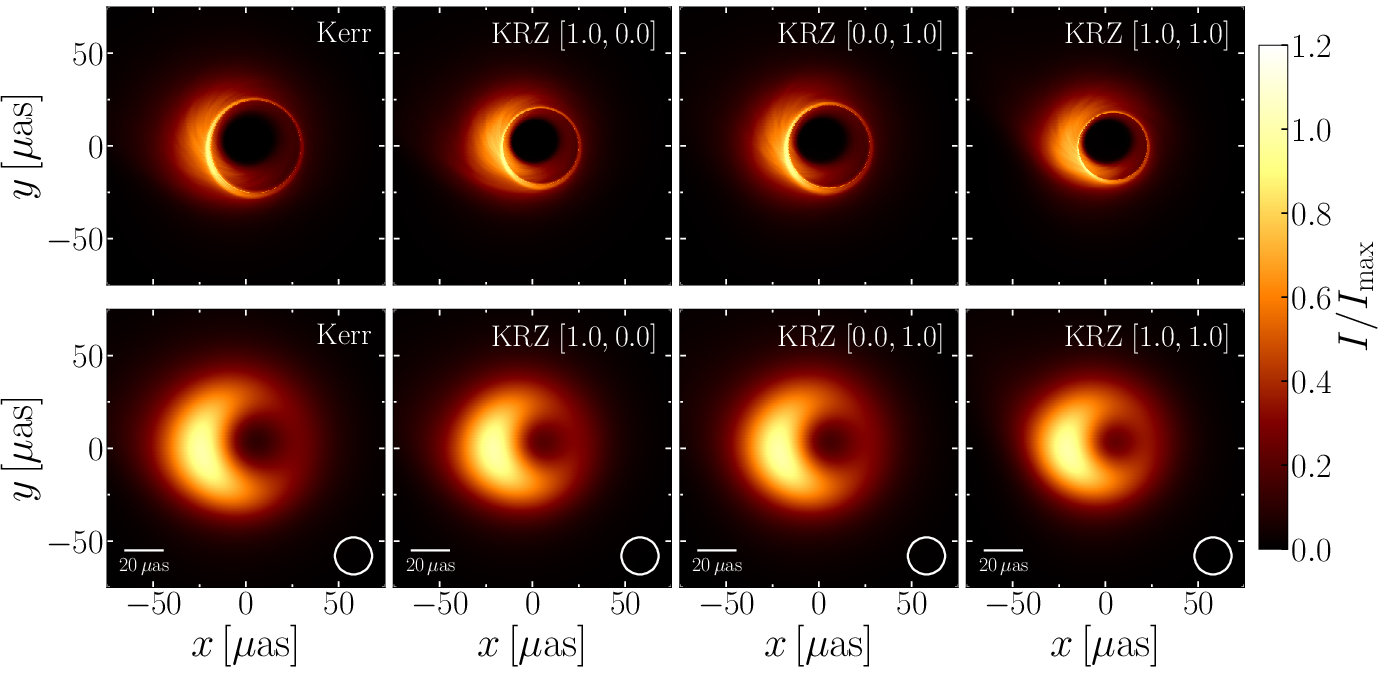
Figure 2: 230\,{\rm GHz time-averaged images: Kerr vs. KRZ BHs. Black hole image comparisons illustrating variances with different fields of view.
Despite the complex dynamics leading to turbulence around BHs, particularly in magnetized accretion flows, the discrepancies are quantifiable. The evaluation reveals systematic deviations in the geometry of jets and magnetization between Kerr and KRZ spacetimes, emphasizing narrower jets in KRZ BHs.
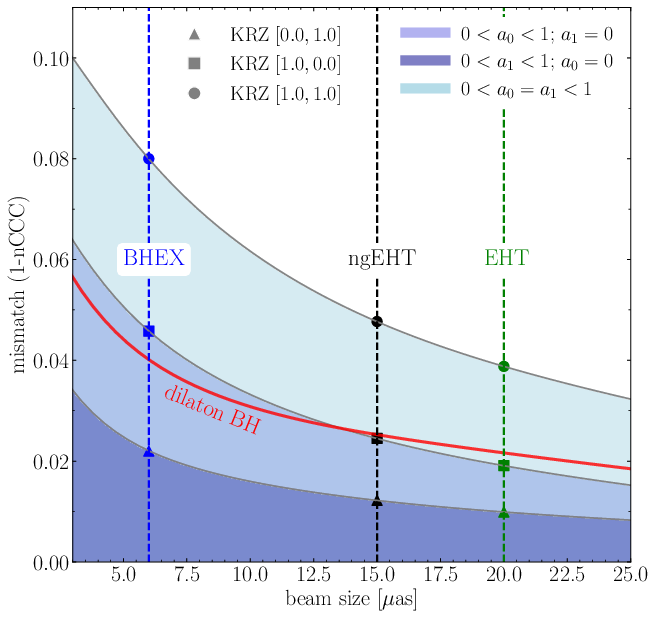
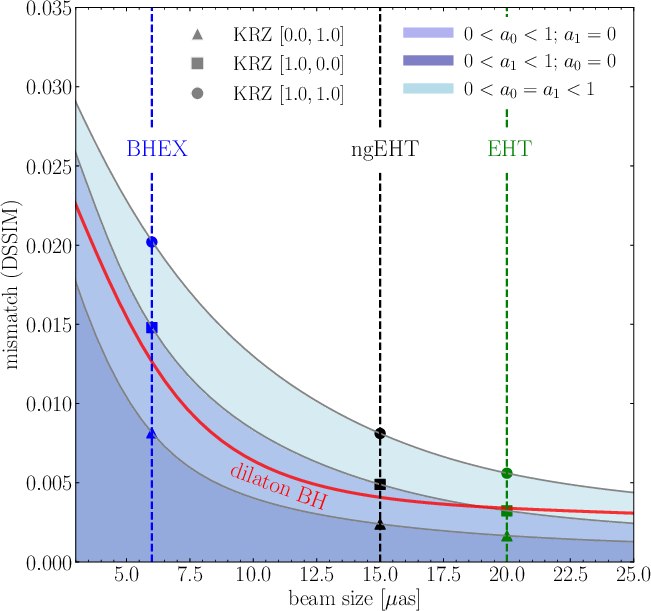
Figure 3: Image-Comparison metrics as a function of beam size, highlighting the mismatch variations across different spacetimes.
The studies also demonstrate substantial, yet nuanced, differences in observational features such as the photon ring size and brightness, essential for authentication against GR predictions.
Implications and Future Directions
The implications of these findings are profound, as they suggest that future horizon-scale imaging could robustly test GR and potentially support alternative gravitational theories. This anticipates advancements not only in observational precision but in the underlying theoretical frameworks guiding black hole physics.
The analysis emphasizes that while current technology, like the EHT, provides baseline understanding, it is the next generation of observational tools that will more decisively determine deviations in black hole spacetimes.
Conclusion
This study asserts that horizon-scale imaging with incredible fidelity will soon enable empirical testing of strong-field predictions of GR through image mismatches. Thus, delineating deviations in black hole characteristics could validate or challenge modern gravitational theories. The integration of GRMHD simulations with enhanced imaging technology will propel this field, refining our cosmic understanding and potentially leading to revolutionary insights into gravity itself.