- The paper quantifies HBC 722’s spectral type as M3.3 by matching archival red optical spectra with M-dwarf templates.
- It employs synthetic SED modeling combining photospheric, accretion, and dust components to constrain accretion rates and extinction.
- The analysis reveals significant pre-outburst accretion variability and anomalous Ca II emission, questioning standard extinction assumptions.
Pre-Outburst Properties of the FU Ori Object HBC 722: Detailed Stellar and Accretion Diagnostics
Introduction
The characterization of young stellar objects (YSOs) prior to episodic accretion outbursts provides essential boundary conditions for pre-main sequence stellar evolution and disk accretion theory. The FU Orionis phenomenon, marked by large luminosity outbursts driven by sudden enhancements in disk accretion rates (M˙∼10−5−10−4 M⊙ yr−1), models a critical phase of stellar mass assembly and protoplanetary disk evolution. Most FU Ori events lack pre-outburst spectral coverage, hindering the direct measurement of progenitor stellar and accretion properties. HBC 722 (V2493 Cyg), embedded in the L935 cloud between the North America and Pelican Nebulae, constitutes a unique case with available pre-outburst spectra and photometric monitoring. This paper presents a robust analysis of archival optical spectra and multi-band photometry of HBC 722 preceding its FU Ori outburst, yielding refined constraints on its spectral type, accretion rate, physical parameters, and extinction.
Spectral Classification and Accretion Diagnostics
A low-resolution red optical spectrum (6000−9000A˚) obtained in 2002, seven years prior to the outburst, is compared to FRAPPE X-Shooter M-dwarf templates with variable veiling and extinction. Optimal matching yields a spectral type of M3.3±0.4 (Teff=3350±75\,K), establishing a clear M-dwarf progenitor for HBC 722. Molecular absorption bands (notably TiO) dominate the photosphere, and strong Hα (EW∼60\,\AA) and Ca II IR triplet emission (EW $6.3-7.8$\,\AA) confirm active accretion prior to the FU Ori event.
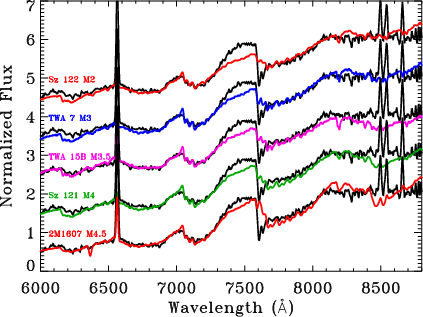
Figure 1: WFGS2 red spectrum of HBC 722 compared with M-dwarf FRAPPE templates, showing tailored veiling and extinction for optimal matching and notable emission features indicating pre-outburst accretion.
The veiling is negligible (<0.2 at $6600-6700$\,\AA), indicating relatively weak continuum excess consistent with moderate accretion rates. Spectral diagnostics corroborate photometric fits and constrain the extinction (AV<1\,mag in spectral fitting, see photometric analysis below).
Photometric SED Modeling: Photosphere, Accretion, and Dust Disk
Simultaneous fitting of SDSS ugriz, 2MASS/UKIDSS JHKs, and Spitzer/IRAC photometry is performed with composite synthetic spectra including an M3.25 photospheric template, a slab model accretion continuum, and a dust disk component (Tmax=1400\,K, T∝r−1). Emission lines (Balmer and Ca II IR) are added at measured strengths. The free parameters comprise extinction and scaling factors for the accretion and photosphere, with dust continuum fixed to K-band. The key constraint arises from the u-band, which limits allowable veiling and extinction to low values: high veiling solutions overpredict u-band flux, thus the best fit is AV=1.45±0.3\,mag and moderate accretion.
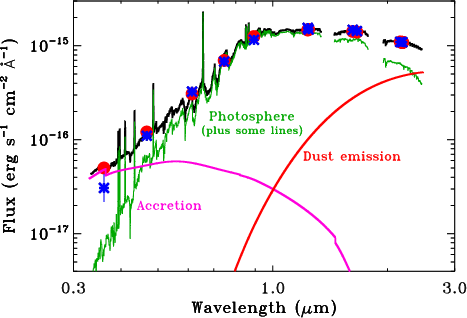
Figure 2: Synthetic photometry and spectrum fit to SDSS, 2MASS, UKIDSS data, decomposing the total emission into photosphere, accretion, and dust continuum.
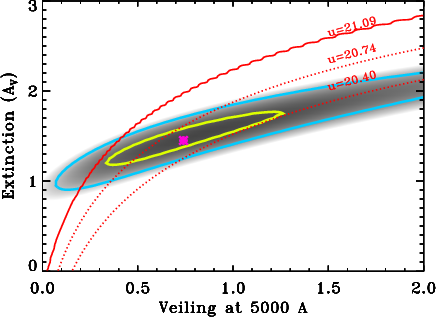
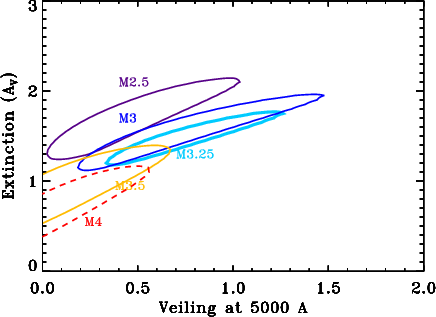
Figure 3: Contour diagrams of acceptable veiling/extinction parameter space for photometric fits: left panel includes u-band, right panel explores spectral type dependencies; u-band critically excludes high veiling/extinction solutions.
Variability Analysis: Accretion Versus Extinction
Pre-outburst photometric monitoring (Semkov BVRI dataset, 80 epochs) reveals pronounced variability (max/min ratio ∼5 in B, σB=0.19\,mag, σI=0.08\,mag). Color-magnitude trends are reproduced with variable accretion continuum only, excluding significant extinction variability. Synthetic photometry, with only accretion scaled, matches the observed color-magnitude relations, whereas the extinction vector does not.
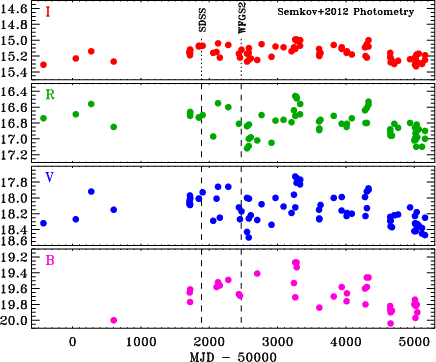
Figure 4: Pre-outburst BVRI light curves showing substantial variability in B-band, with epochs of SDSS and spectral coverage marked.
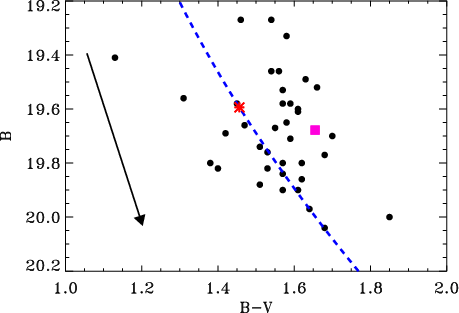
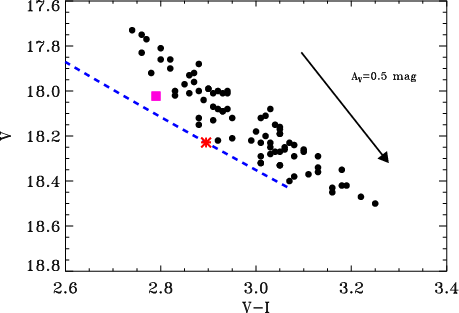
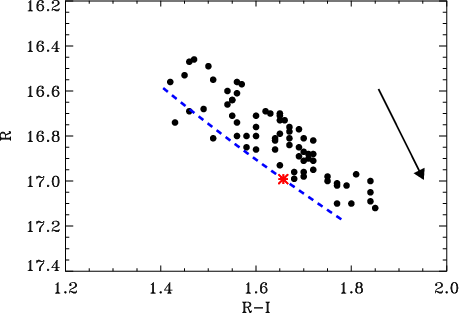
Figure 5: BVRI color-magnitude diagrams; synthetic photometry with variable accretion tracks the observational slope. Extinction vector direction is distinct, indicating minimal line-of-sight extinction variability.
Stellar and Accretion Properties
Adopting a distance of 782±5\,pc (Gaia DR3 YSO aggregate), the J-band based luminosity (L⋆=0.53 L⊙) and photospheric temperature yield a large stellar radius (R⋆=2.15 R⊙), approximately twice typical for M3 accreting YSOs, and mass estimates of M⋆=0.24−0.39 M⊙ (spot coverage dependent). The derived age is $0.15-0.51$ Myr per SPOTS models, reflecting extreme youth or prior accretion-driven inflation.
The SDSS-fit accretion luminosity (Lacc=0.034 L⊙) implies M˙=7×10⁻⁹ M⊙ yr−1, one order above the typical rate for M3 disks, but within known population dispersions. Accretion variability measured in Semkov photometry agrees (factor $5$ range, σacc=0.16 dex), falling in line with other T Tauri accretion variability studies.
Ca II IR triplet lines are anomalously strong: an accretion luminosity estimate from these lines (Lacc=0.11 L⊙) is thrice higher than photometric or Hα results. This is potentially indicative of chemical anomalies (e.g., Ca/Fe overabundance due to rapid radial drift, or physical modifications of the accretion flow or inner disk structure preceding the outburst), although abundance-driven Ca line enhancement is not widely established in literature.
Extinction Before and After Outburst: Contradictory Trends
Pre-outburst extinction (AV=1.45±0.3) is significantly lower than the AV=2.5−3.7 mag found during the FU Ori outburst, contradicting prior assumptions of constant line-of-sight extinction across eruptions. Increased extinction during outburst may arise from accelerated dusty winds or disk thickening altering the optical depth along the line of sight. This trend opposes the scenario observed in other YSOs, where outbursts often coincide with decreased extinction due to envelope clearing; thus, caution should be exercised in extrapolating pre-burst conditions.
Implications and Prospects
The availability of a high-S/N pre-burst spectrum for HBC 722, coupled with time-resolved photometry, establishes direct observational evidence for the scale of accretion enhancement (M˙ increased by a factor of ∼15,000 during outburst), robust constraints on progenitor properties, and challenges for extinction modeling across major accretion events. The results force revisitation of assumptions underlying pre/post outburst spectral energy distribution fitting, particularly regarding extinction variability and accretion's contribution to broadband photometry. Progenitor stars of FU Ori objects may exhibit inflated radii and chemical anomalies due to prior accretion activity, with implications for early stellar evolution and the timing and physics of the FU Ori instability.
Prospectively, the methodology detailed here (particularly the use of u-band data for veiling/extinction discrimination and the exploitation of multi-epoch photometry to bracket accretion variability) offers a template for future YSO monitoring campaigns and pre-burst diagnostics in the LSST and WFST era. The necessity of multi-band (including blue/UV) observations and accretion continuum inclusion in SED fitting is underscored for robust parameter inference in young accreting stars.
Conclusion
This study delivers a comprehensive pre-outburst characterization of HBC 722, quantifying its spectral type, stellar parameters, accretion rate, variability, and extinction. Key findings include the identification of an M3.3 progenitor, an accretion rate at the high end for its spectral type yet orders of magnitude below outburst levels, anomalously strong Ca II emission, and a demonstrable increase in extinction during the FU Ori event. These results emphasize the importance of direct pre-burst observations for testing stellar accretion models and provoke reevaluation of extinction and disk/wind structure evolution across FU Ori outbursts. The fitting procedure advanced here should be adopted as standard practice for next-generation YSO monitoring efforts.