- The paper provides an updated yield forecast of Gaia's exoplanet detections through robust semi-analytic modeling and Monte Carlo simulations integrating new empirical data.
- It reveals that DR4 is expected to detect about 7,500 planets and DR5 up to 120,000, with only a subset having precise mass and orbital period constraints.
- It also highlights the impact of unresolved binary contaminants on detection purity, particularly for close-in planets around M dwarfs.
Exoplanet Yield Predictions from Gaia Astrometry: A Rigorous Quantitative Assessment
Overview
This paper provides an updated, quantitatively robust forecast of the exoplanet yield from Gaia astrometry by integrating new empirical data on giant planet occurrence, the local stellar initial mass function, and demonstrated Gaia precision. Employing both semi-analytic models and large-scale Monte Carlo simulations, the authors present a comprehensive yield estimate for the anticipated Gaia DR4 (5.5-year baseline) and the final DR5 (10.5-year baseline). The analysis explores algorithmic detection thresholds, parameter recovery fidelity, and the impact of astrophysical contaminants, notably unresolved near-equal-mass binaries, producing public mock catalogs to calibrate future observational and algorithmic pipelines.
Modeling Framework and Methodological Details
Semi-Analytic Model Structure
The central yield estimate is built upon a separable formalism where the expected number of detected exoplanets, ΓM⋆,mp,adet, is constructed as a triple integral over the local stellar volume density (parameterized as a function of the stellar mass and position), the planet occurrence function (dependent on both stellar and planetary properties), and Gaia's detection efficiency. The local stellar volumetric mass function (VMF⋆) is inferred by integrating empirical mass-luminosity (MG-M⋆) and main-sequence G-band luminosity function constraints, leveraging modern Gaia datasets:
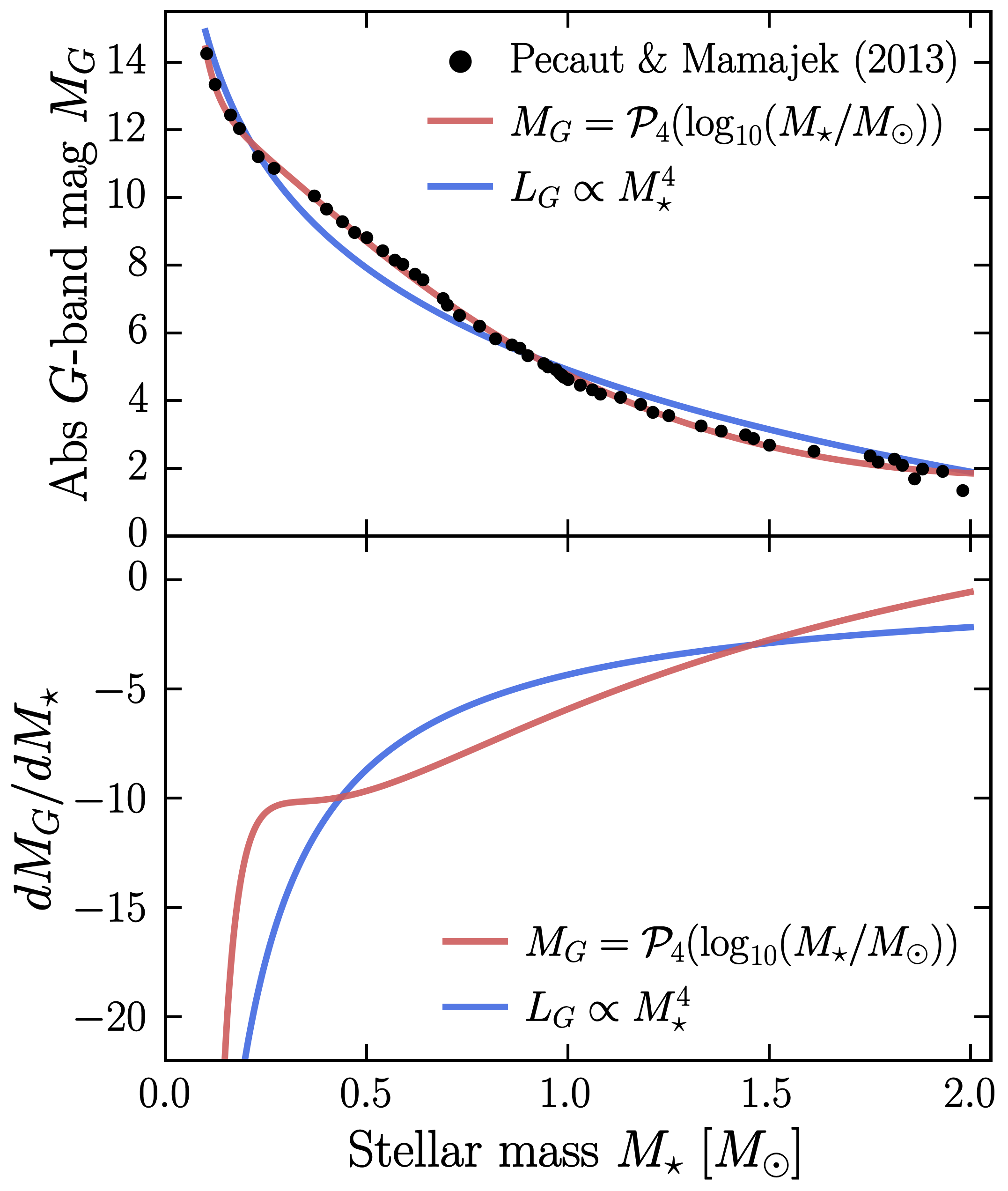
Figure 1: The absolute G-band magnitude versus stellar mass for main-sequence stars, establishing the base for mass-magnitude conversions in the detection model.
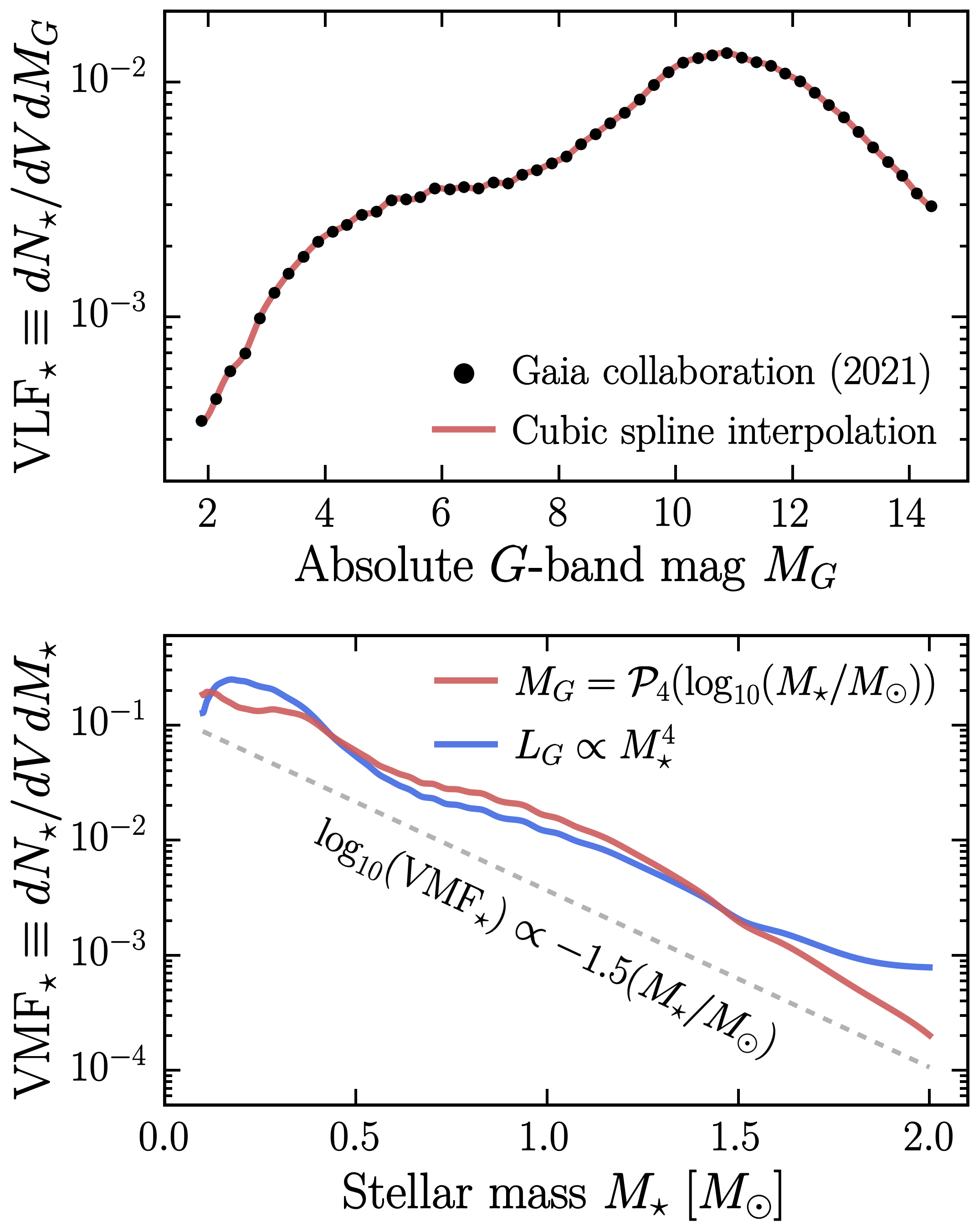
Figure 2: The G-band volumetric luminosity function for main-sequence stars within 100 pc, forming the empirical input to calculate the VMF⋆.
Astrometric SNR per measurement is modeled as a piecewise function of G magnitude, with a noise floor σ0=54μas for G<14 and photon-dominated scaling for fainter sources:
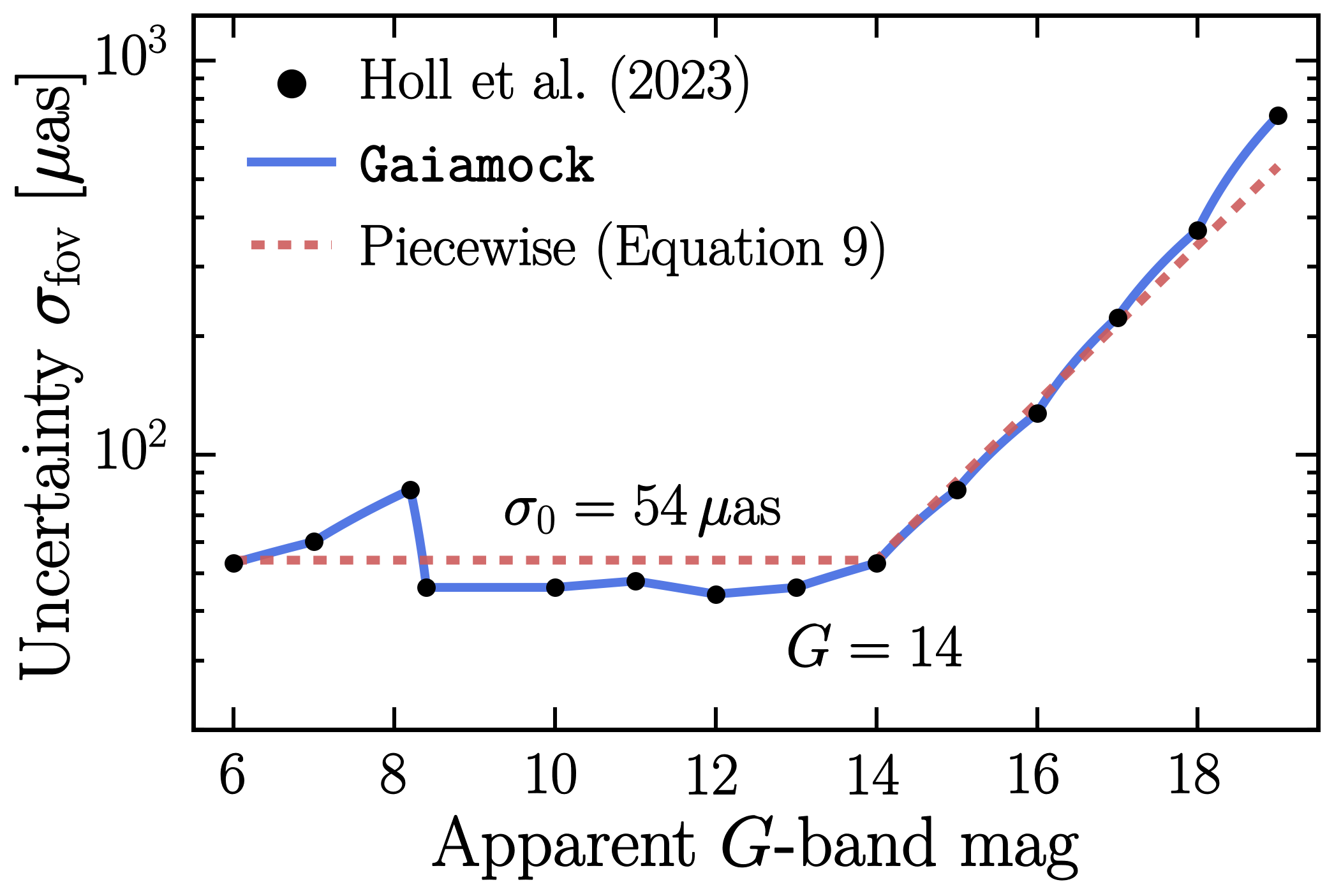
Figure 3: Astrometric precision per Gaia observation as a function of G, directly constraining detection horizons across the HR diagram.
Period recovery fidelity is incorporated via injection-recovery experiments using Gaiamock, revealing that orbital periods can be robustly recovered when the planet's period is less than ∼70–90% of the observational baseline (4.0 years for DR4, 9.5 years for DR5).
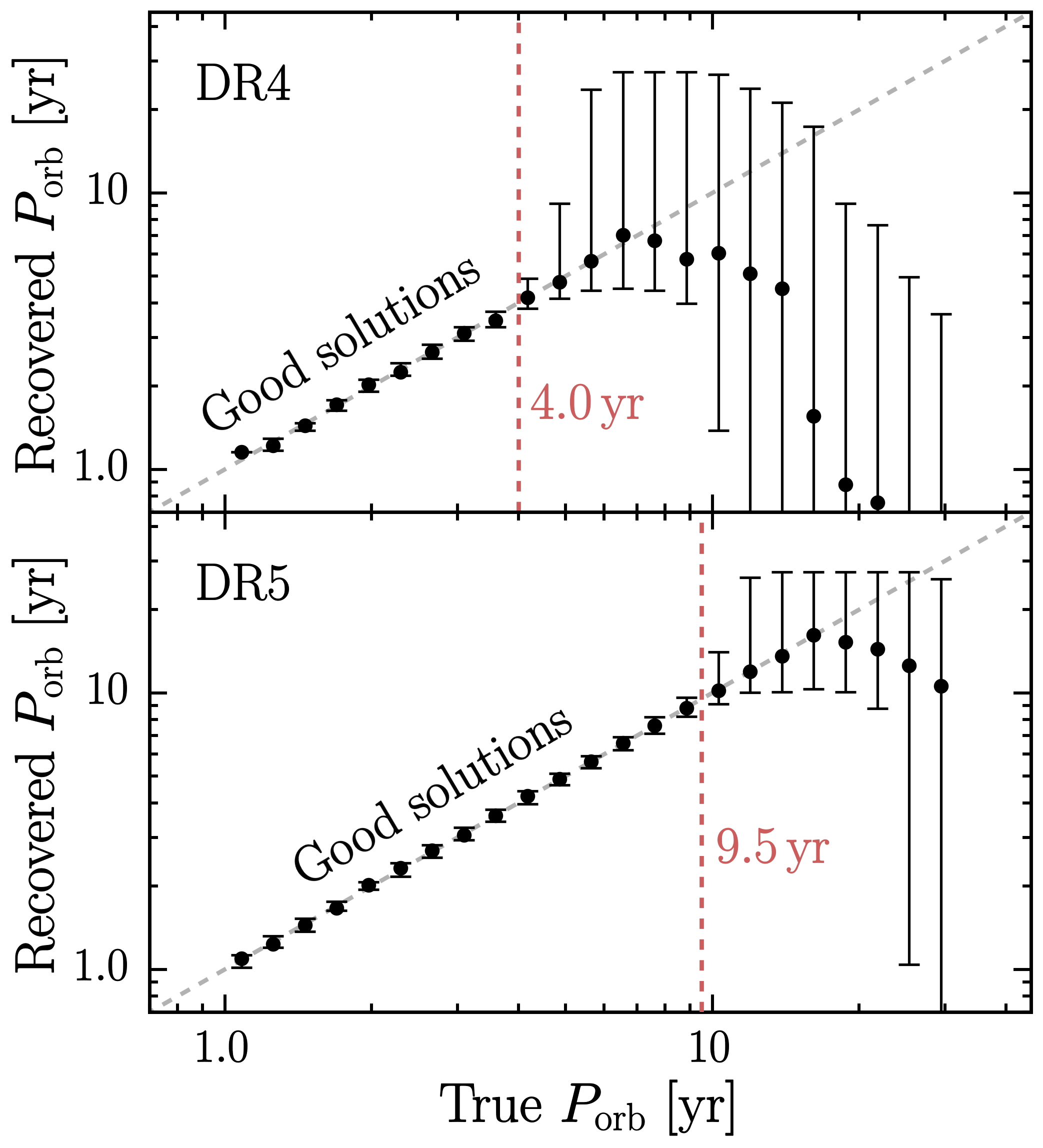
Figure 4: Accuracy of fitted orbital periods from simulated Gaia astrometric data versus true period, defining maximum recovery baselines for planet detections.
Planet Occurrence Model
Empirical planet occurrence is modeled following the broken power-law parametrization provided by the California Legacy Survey, with a moderate stellar mass scaling C(M⋆)∝M⋆/0.9M⊙. The adopted occurrence function is validated to be compatible over relevant (a, mp, M⋆) ranges with previous RV and microlensing constraints.
Sensitivity Mapping and Star Sample Selection
The maximum volume and limiting apparent magnitude for detection as a function of (M⋆, mp, a) are computed, finding that sensitivity volumes for super-Jupiters extend to several hundred parsecs but drop rapidly for true Jupiters or close-in planets.
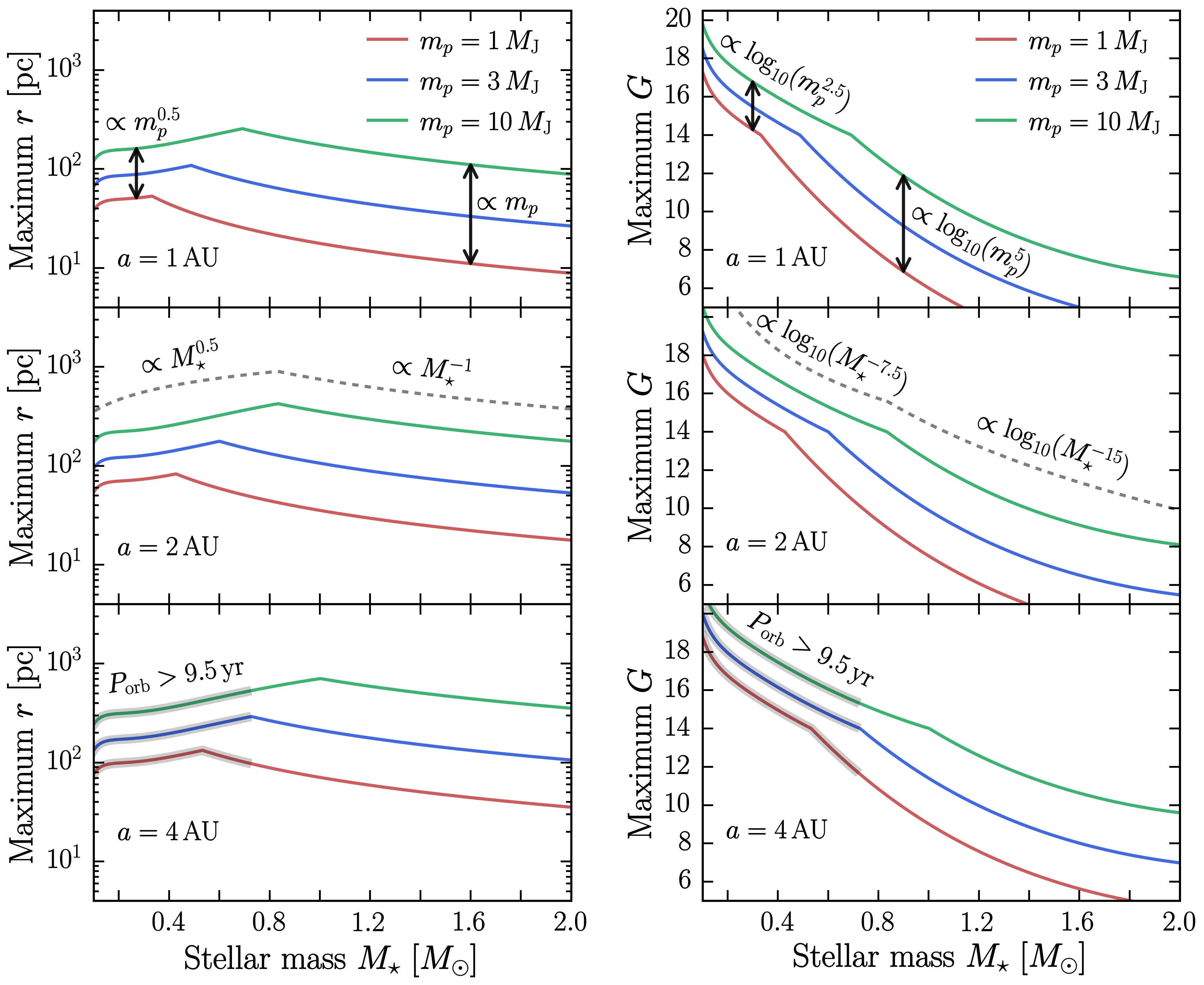
Figure 5: Limiting distance and limiting G magnitude as a function of stellar mass and orbital parameters, sharply demarcating Gaia's true survey capability.
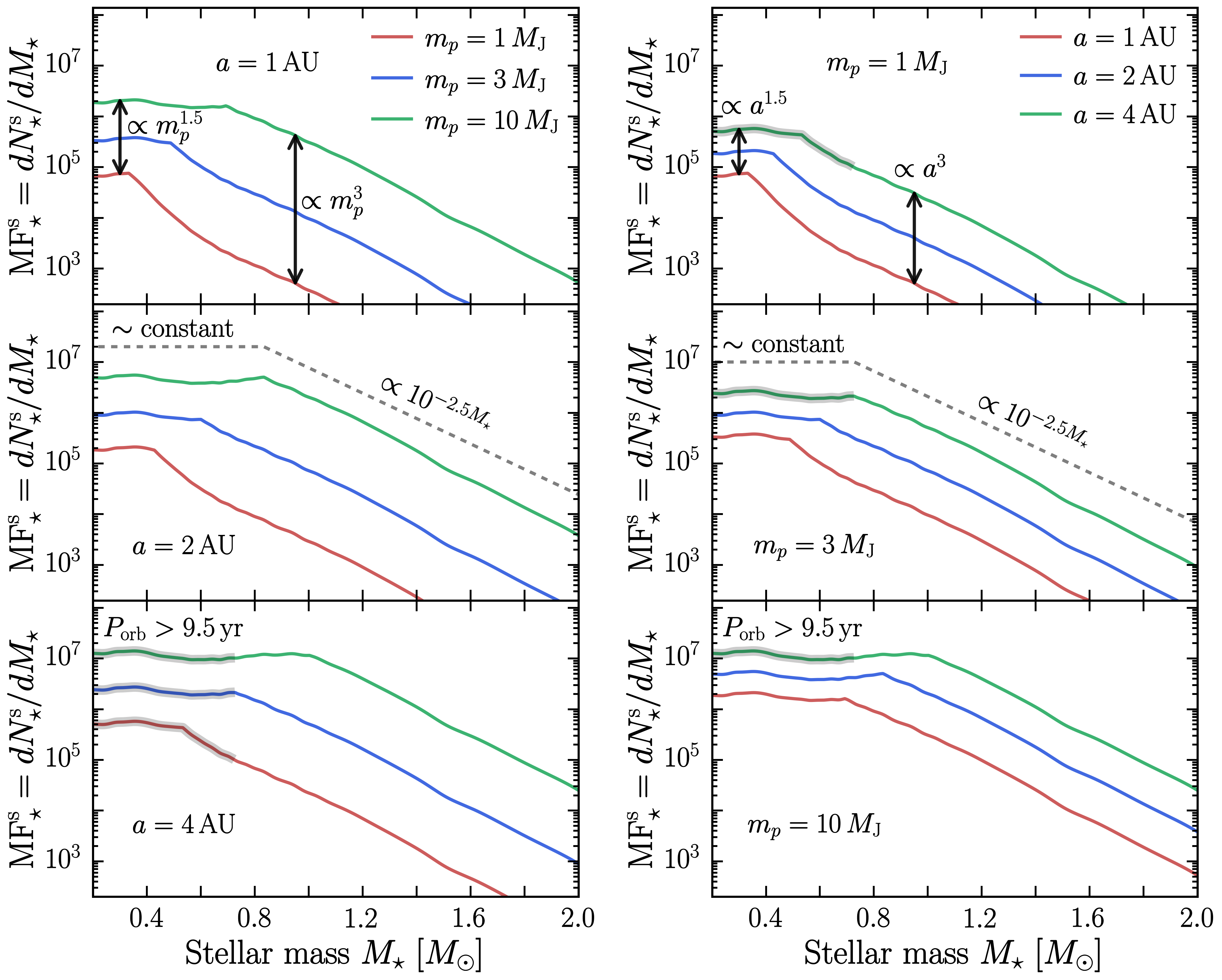
Figure 6: The mass function of stars that could host a Gaia-detectable planet, indicating the dominant contribution from sub-solar mass main-sequence stars.
Astrometric Orbit Simulations and Parameter Recovery
Analytical models are validated and calibrated via direct orbit injection and Bayesian recovery on synthetic astrometric timeseries, sampling over the full Gaia scanning law. Relationships between recovery precision on Porb, mp, i, and per-point SNR1 are derived:
δPorb∼SNR10.03,δmp∼SNR10.12,δi∼SNR10.11
The SNR1 detection threshold (nominally Nσ=1.0 for DR5, $1.5$ for DR4) is mapped directly to Δχ2 improvement in model fits, suggesting Δχ2>50 as a practical detection criterion. Importantly, robust mass and period constraints (better than 20%) demand SNR1 values of at least 2.5–4, so a substantial subset of detected planets will have poorly constrained true masses.
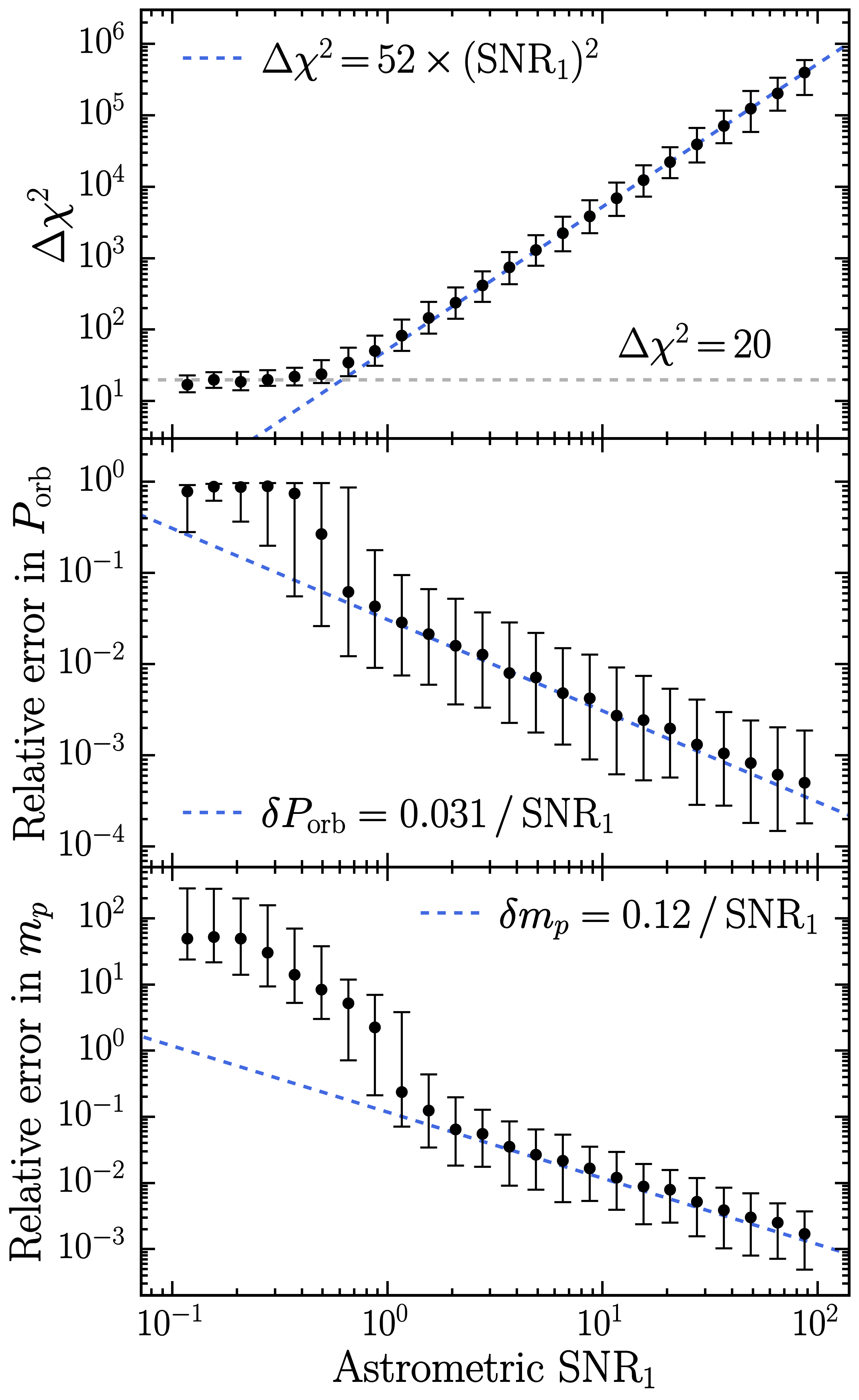
Figure 7: Results of orbit-fitting from simulated Gaia data, characterizing the relationship between SNR, model fit improvement, and parameter recovery accuracy.
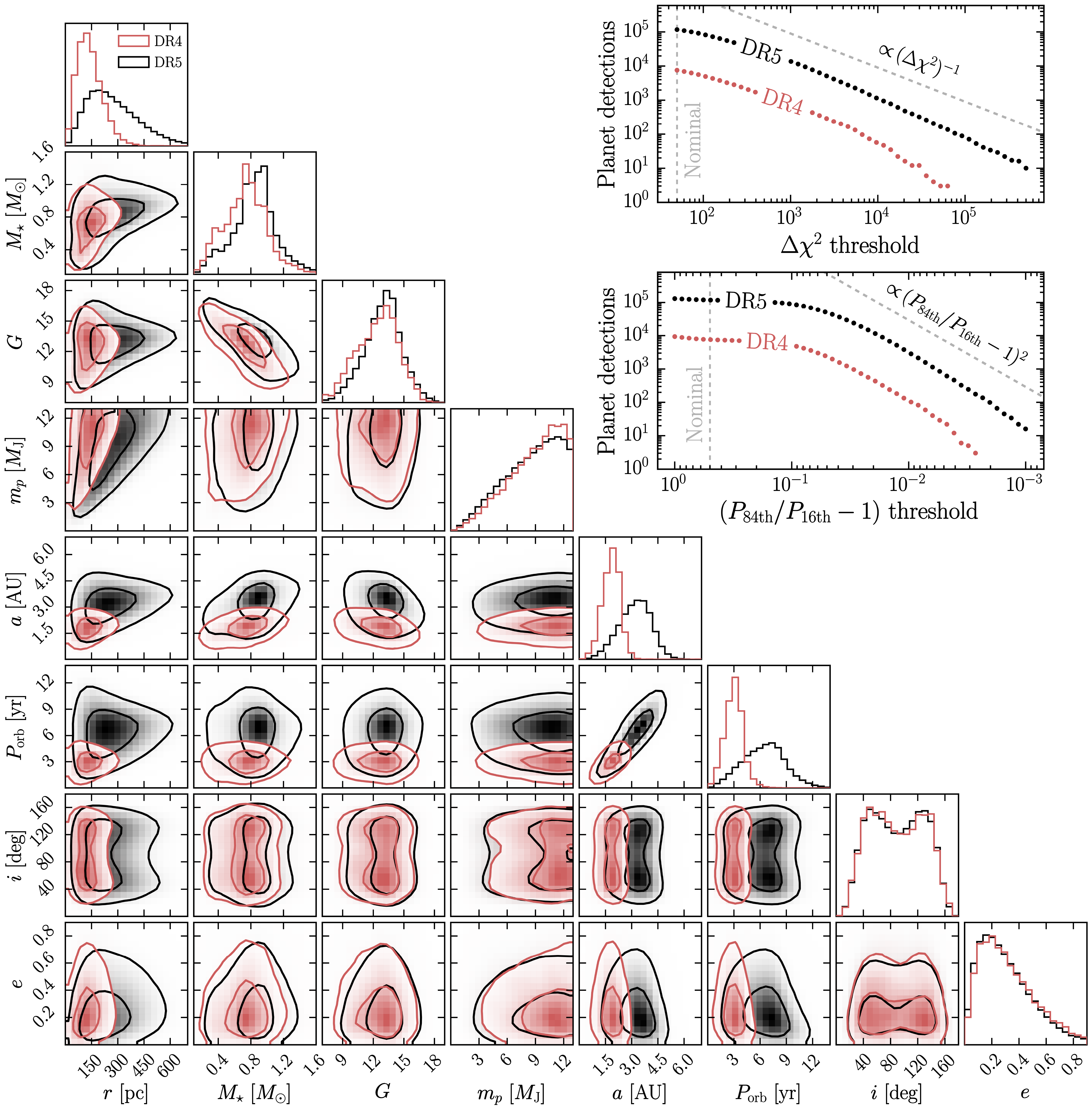
Figure 8: Parameter distributions for detected planets, including constraints on mass, orbital period, and host star properties for both DR4 and DR5.
Main Numerical Results and Yield Projections
- DR4 (5.5-year): 7,500±2,100 planet detections, of which ∼1,900 have mp and Porb constrained to better than 20%.
- DR5 (10.5-year): 120,000±22,000 planet detections, with ∼38,000 having precise mass and period constraints.
False Positive Assessment:
- Most candidates will be genuine planets, with planet-to-binary impostor ratios ≳5 for DR5 overall.
- However, for close-in candidates (a<1 AU) around M dwarfs, the impurity rises to ∼50%, offering a direct source of likely contaminants in the Gaia catalog.
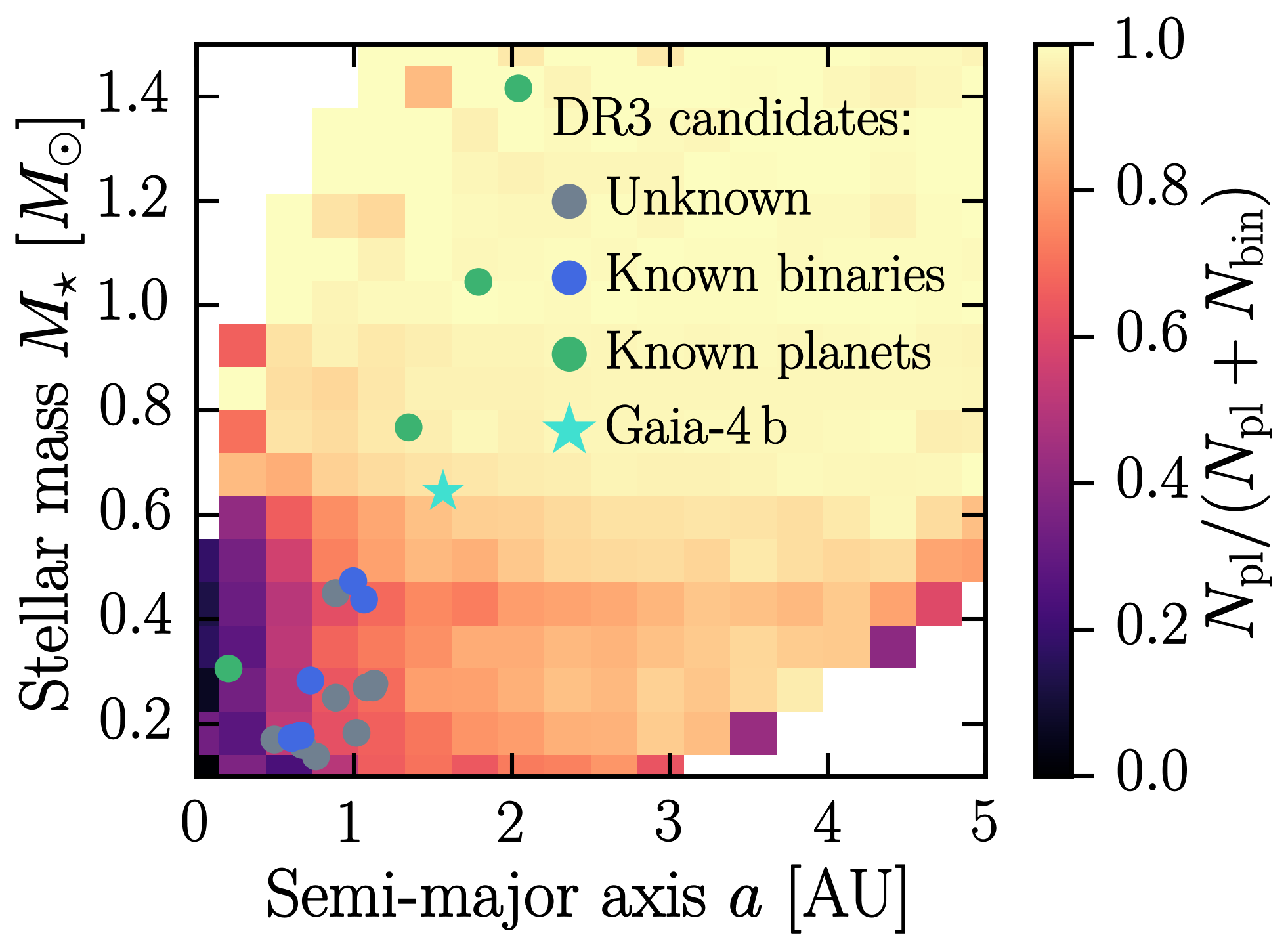
Figure 9: The expected fraction of candidates that are genuine planets as a function of mass, G-band mag, and semi-major axis, highlighting elevated impostor rates for M⋆≲0.6M⊙ and a≲1 AU.
Figure 10: DR5 candidate purity as a function of host mass and separation, overlaid with actual Gaia DR3 candidates and their confirmation status.
Comparison with Previous Work and Detection Thresholds
The projected yields are lower than earlier estimates (notably Perryman 2014) primarily due to:
- Updated, more conservative assumptions for per-measurement noise at the bright end.
- Stricter detection criteria emphasizing orbital constraint, not just formal signal detection.
- Rigorous accounting for unresolved binary contamination, which was not treated in detail in prior works.
The model's satellite SNR scaling, detection thresholds, and mass-period recovery curves are corroborated by independent analytical arguments and benchmarking against Gaiamock-based injection-recovery on synthetic time series.
Implications and Deployment Considerations
Astrophysical Insights
- The majority of Gaia-detected exoplanets will be super-Jupiters (3–13 MJ) in 2–5 AU orbits around GKM dwarfs within 500 pc.
- Relatively few Jupiter-mass planets will be detected, and close-in exoplanets will be a tiny minority due to astrometric baseline requirements.
- Detection purities are significantly compromised for M dwarfs and close-in planets; follow-up resources should focus accordingly.
Observational and Community Support
- Comprehensive mock catalogs and codebases have been released for both candidates and expected binary false positives, supporting precision planning for ground-based radial velocity or direct imaging follow-up, and facilitating algorithmic tuning for the upcoming Gaia data releases.
- The public release of both "planet" and "impostor" catalogs is critical for calibration, statistical validation, and optimization of cross-survey vetting pipelines.
Directions for Future Work
- The mass measurement precision for detected exoplanets is limited for most candidates; integrating multi-wavelength astrometric constraints or concurrent RV campaigns will be pivotal for dynamical mass calibration.
- Multi-planet systems and the influence of hierarchical stellar multiples remain underexplored in both detection and false-positive modeling pipelines.
- Future improvements in astrometric error models (especially at the bright and faint ends) and more precise 3D extinction maps could further refine absolute yield forecasts.
Conclusion
This work sets a new standard for exoplanet yield forecasts from astrometric surveys, providing a quantitatively detailed, empirically anchored, and algorithmically transparent assessment of Gaia's legacy for planetary science. The findings strongly shape both theoretical modeling of giant planet populations and pragmatic strategies for ground- and space-based follow-up in the Gaia era.
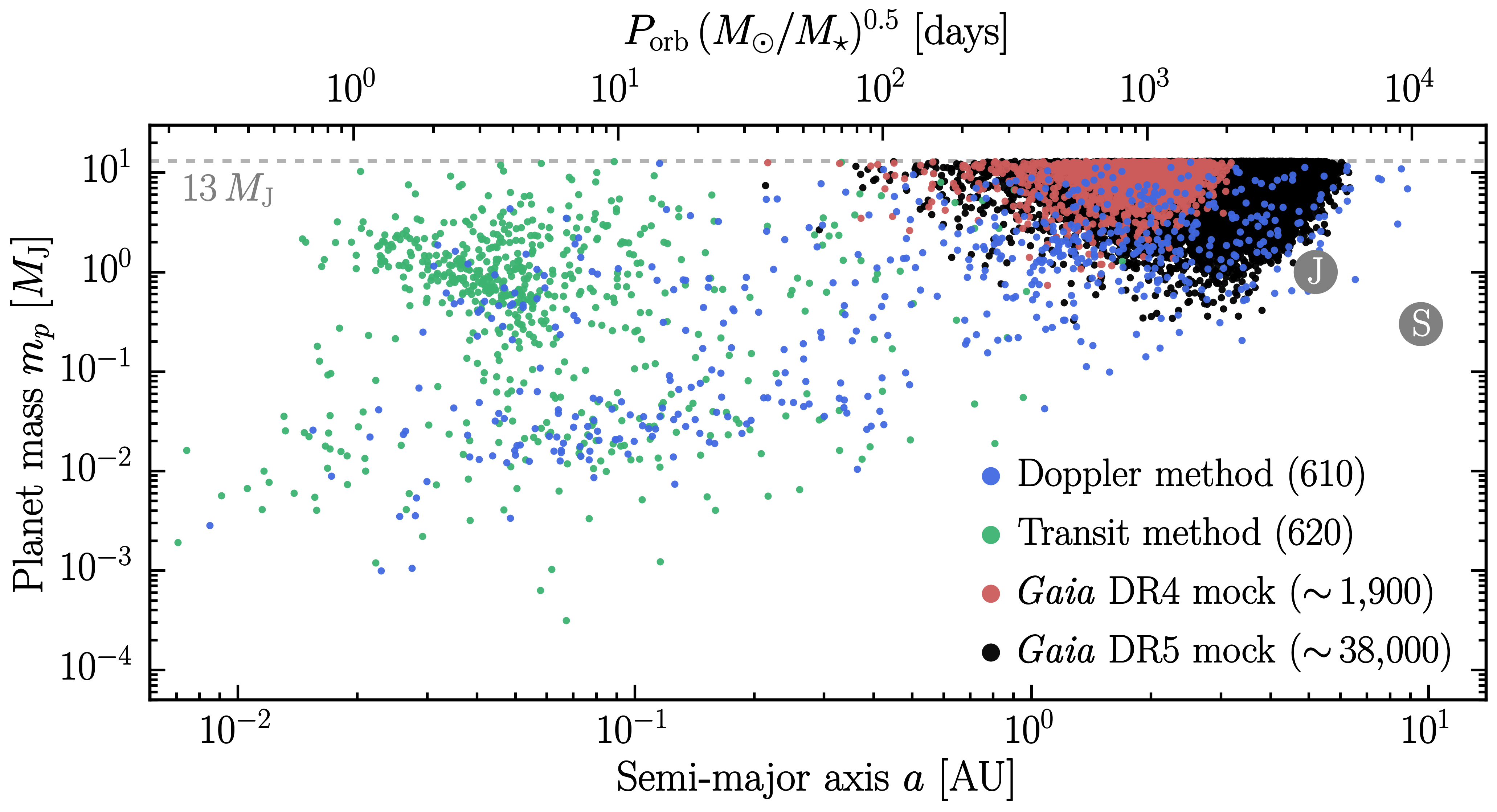
Figure 11: Mass and semi-major axes for known planets and simulated Gaia detections, showing Gaia's power as an all-sky, multi-year astrometric survey to dramatically enlarge the sample of directly mass-measured long-period super-Jupiters.