Stable and Robust SLIP Model Control via Energy Conservation-Based Feedback Cancellation for Quadrupedal Applications
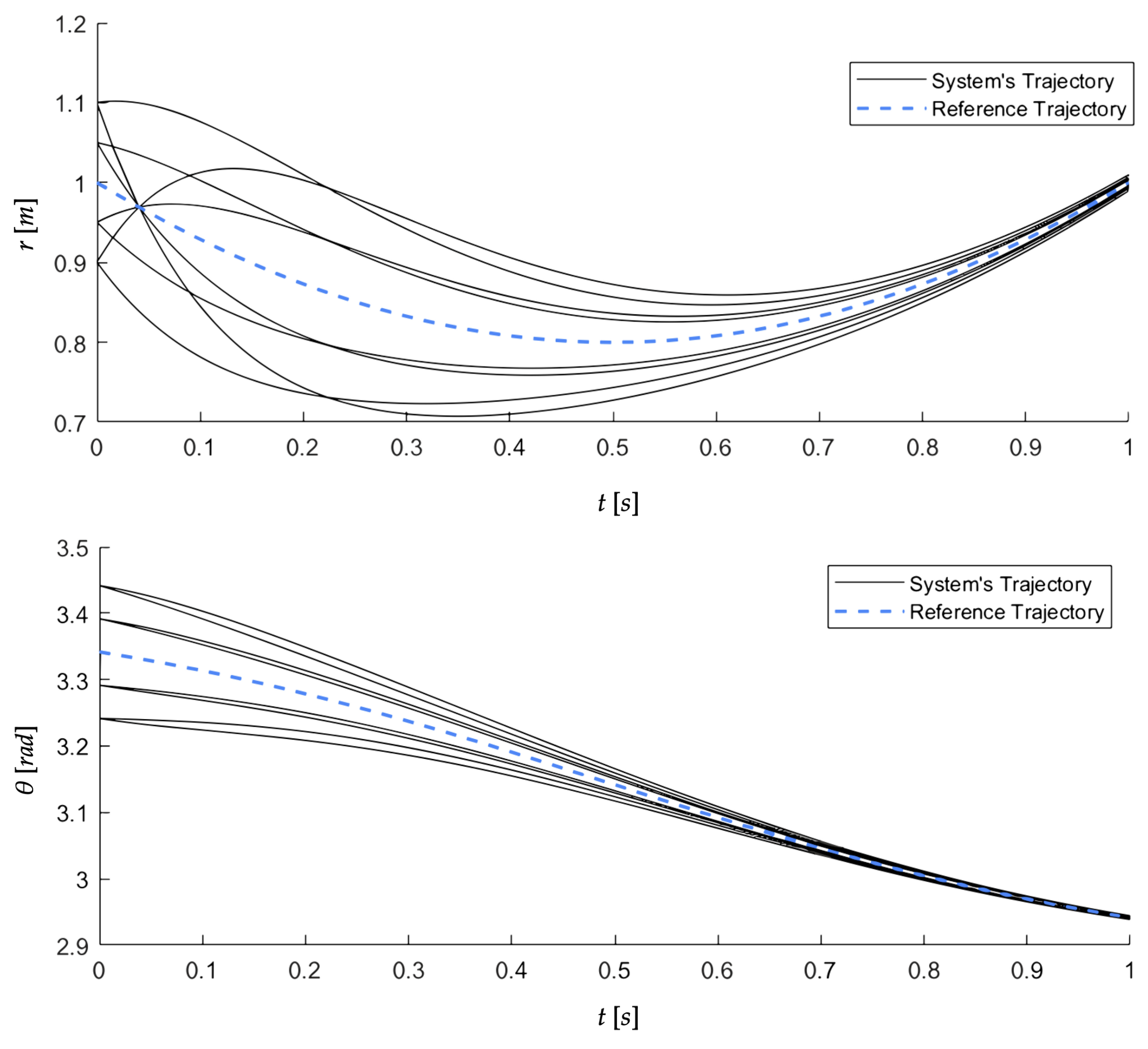
Abstract: In this paper, we present an energy-conservation based control architecture for stable dynamic motion in quadruped robots. We model the robot as a Spring-loaded Inverted Pendulum (SLIP), a model well-suited to represent the bouncing motion characteristic of running gaits observed in various biological quadrupeds and bio-inspired robotic systems. The model permits leg-orientation control during flight and leg-length control during stance, a design choice inspired by natural quadruped behaviors and prevalent in robotic quadruped systems. Our control algorithm uses the reduced-order SLIP dynamics of the quadruped to track a stable parabolic spline during stance, which is calculated using the principle of energy conservation. Through simulations based on the design specifications of an actual quadruped robot, Ghost Robotics Minitaur, we demonstrate that our control algorithm generates stable bouncing gaits. Additionally, we illustrate the robustness of our controller by showcasing its ability to maintain stable bouncing even when faced with up to a 10% error in sensor measurements.
Paper Prompts
Sign up for free to create and run prompts on this paper using GPT-5.
Top Community Prompts
Explain it Like I'm 14
What this paper is about
This paper shows a simple, nature-inspired way to make four-legged robots (quadrupeds) run in a steady, bouncy way. The authors use a basic physics model called the Spring-Loaded Inverted Pendulum (SLIP), which treats the robot like a mass on a springy leg, kind of like a pogo stick. With this model, they design a control method that keeps the robot’s bouncing smooth and stable, even if its sensors aren’t perfectly accurate.
The big questions the paper asks
- Can we control a running quadruped using a very simple model (SLIP) instead of a complex full-body robot model?
- Can we use energy ideas—like how a spring stores and releases energy—to plan safe, steady steps?
- Will this method stay stable even when the robot’s sensors have errors (up to 10%)?
How they did it (in everyday terms)
To keep the explanation simple, imagine a pogo stick:
- When the pogo stick is in the air (flight), it follows a curved path like a thrown ball.
- When it lands (stance), the spring compresses and then releases energy to push it back up.
The robot is controlled in two phases that repeat over and over:
- Flight phase: adjust the “angle” of the legs so the foot will land in a good spot next step.
- Stance phase: adjust the “length” (or compression) of the legs to use the spring energy well.
Here’s the key approach:
- Reduced-order model (SLIP): Instead of modeling every motor and link of the robot, they model just the center of mass bouncing on a springy leg. This is called a reduced-order model—it keeps only the important parts of the motion. Think of it like a cartoon version of the robot that captures the main idea: bounce!
- Energy-based path: During the stance phase (when the foot is on the ground), they calculate a smooth, curved path (a parabolic spline) for the center of mass to follow. This path is chosen using energy conservation—how much energy is stored in the “spring” versus how much is in motion—so the robot neither loses too much energy nor gains too much.
- Feedback cancellation: This sounds fancy, but it’s like noise-canceling headphones for control. They use the known physics of the SLIP model to “cancel out” predictable parts of the motion in the controller. That way, the controller only needs to fix the leftover errors (like small bumps or sensor noise), making control simpler and faster.
- Leg control split: In flight, they aim the legs (so the next landing is right). In stance, they adjust leg length (spring compression and push-off) to follow the energy-aware path.
They tested this in computer simulations using the real measurements of a known quadruped robot (Ghost Robotics Minitaur) in MATLAB.
What they found and why it matters
Main results:
- Stable bouncing gaits: The robot’s center of mass moves in a steady, repeatable bouncing pattern (like a pogo stick), which is a key part of fast gaits like trotting or pronking.
- Robust to sensor errors: Even if the robot’s sensors measure position or speed with up to 10% error (which is a lot), the controller still keeps the motion stable.
- Lightweight and fast: Because they use a simple model (SLIP) and feedback cancellation, the control method is computationally cheap. That means it’s practical for real robots that need to react quickly.
Why it matters:
- Simpler control with fewer calculations makes it easier to run on small onboard computers.
- Stability despite sensor noise means it can work outdoors and in real-world conditions.
- Using energy-smart planning helps save battery and reduces wear on the robot’s motors.
What this could lead to
- Better real-time running: Robots could move faster and more efficiently on uneven ground, helping with tasks like search and rescue, delivery, or outdoor inspection.
- Easier design and tuning: Because the model is simple and the controller is lightweight, engineers can set up stable running without heavy optimization or super-detailed robot models.
- A foundation for more complex gaits: The same energy-based, reduced-order ideas can help design other dynamic gaits (like trotting and galloping) and transitions between them.
In short, this paper shows that thinking like nature—bounce like a spring, conserve energy, and keep control simple—can make four-legged robots run stably and reliably, even when their “eyes and ears” (sensors) aren’t perfect.
Knowledge Gaps
Knowledge gaps, limitations, and open questions
Below is a concise list of what remains missing, uncertain, or unexplored in the paper. Each point is phrased to guide actionable future work.
- Lack of hardware validation: the controller is only demonstrated in MATLAB simulations; no experiments on a physical quadruped (e.g., Minitaur) to assess real-world feasibility, on-board computation, and sensor/actuator constraints.
- Unclear mapping from reduced-order
SLIPto full-order quadruped: the paper assumes SLIP-like COM embedding but does not specify how to realize this via low-level control (virtual compliance, whole-body control, impedance mappings) on a real robot. - Gait scope is narrow: results focus on pronking/bouncing; extension to multi-phase quadruped gaits (trot, bound, gallop) and inter-leg phasing policies is not addressed.
- No treatment of gait transitions: methods for initiating, switching, or stopping between gaits are not provided (e.g., pronk-to-trot, start/stop transients).
- Terrain assumptions are restrictive: evaluations appear limited to flat, rigid ground; robustness to slopes, steps, rough terrain, variable compliance, and uneven footholds is not studied.
- Contact modeling and friction: no analysis of ground friction, foot slip, or partial footholds; unilateral constraints, contact compliance, and impact losses are not explicitly modeled or tested.
- Energy-conservation reliance vs. real dissipation: the approach assumes an energy-conserving parabolic reference while real systems have damping and impact losses; how the controller compensates for persistent energy loss/gain is not formalized.
- Absence of formal stability guarantees: no Lyapunov/Poincaré or region-of-attraction analysis quantifying closed-loop hybrid stability, error bounds, or robustness margins.
- Parameter sensitivity is unquantified: impact of spring stiffness, effective damping, touchdown angle, apex height, controller gains, and mass uncertainty on stability and performance is not analyzed.
- Event detection robustness: touchdown/liftoff guard detection under sensor noise, bias, latency, and false positives/negatives is not characterized.
- State estimation design is unspecified: the paper assumes up to 10% state measurement error but does not define what states, which sensors, estimator architecture (e.g., IMU/leg odometry fusion), or how estimator lag affects stability.
- Actuator limits and dynamics: torque/velocity/current saturation, motor bandwidth, back-EMF, and drivetrain compliance/friction are not considered; their effect on trajectory tracking is unknown.
- Delays and discretization: controller sensitivity to control loop rate, computation delay, and discretization of hybrid events is not studied.
- Lateral-plane dynamics: the model and results appear planar; extension to full 3D COM dynamics (yaw, roll, lateral foot placement) and associated coupling is not addressed.
- Body attitude control: pitch/roll/yaw of the trunk and their coupling to COM dynamics are neglected; how to coordinate body attitude with COM energy shaping is unresolved.
- Foot placement policy in flight: the leg-orientation control strategy is not fully specified; how foot placement is chosen to regulate forward speed and stance timing beyond the energy-based reference is unclear.
- Speed and height regulation: methods to regulate forward speed, apex height, and step length via energy shaping (or additional controllers) are not formalized or benchmarked.
- Disturbance rejection beyond sensor noise: push recovery, terrain perturbations, height drops, and impulsive disturbances are not tested or analyzed.
- Performance metrics are limited: no comparison of cost of transport, GRF profiles, peak impact forces, tracking error statistics, or recovery times against baselines (e.g., Raibert-style foot placement, MPC, HZD).
- Computational profiling is missing: algorithmic complexity, CPU usage, real-time timing on embedded hardware, and memory footprint are not reported.
- Initialization and convergence: procedures for initializing the energy-consistent parabolic reference and the controller’s behavior from off-nominal initial conditions are not described.
- Region of attraction and safe operating envelope: bounds on allowable speed/height ranges, spring deflections, and terrain variations for which the controller remains stable are not provided.
- Robustness to model mismatch: unmodeled behaviors (e.g., non-linear spring curves, hysteresis, temperature-dependent stiffness, joint backlash) and their impact on performance are not quantified.
- Constraint handling: there is no explicit treatment of state/input constraints (joint limits, leg length bounds, feasible touchdown angles) within the control law.
- Adaptation and learning: no mechanism for online identification of effective SLIP parameters (stiffness/damping) or adaptive gain tuning under payload changes or wear.
- Safety considerations: analysis of peak ground reaction forces, actuator thermal limits, and failure modes during hybrid transitions is absent.
- Generalization to multi-contact scheduling: how to coordinate four legs to produce the desired COM trajectory (timing, duty factor, stance overlap) is not formalized for non-pronking gaits.
- Comparison to prior SLIP controllers: ablation or head-to-head studies against canonical SLIP-based regulators (e.g., apex return-map foot placement) to isolate the benefits of energy-based feedback cancellation are missing.
- Reproducibility details: full parameter sets, controller gains, simulation code, and terrain/contact settings are not provided to enable replication and fair comparison.
Practical Applications
Immediate Applications
Below are practical applications that can be deployed now, given the paper’s methods, findings, and validations.
- SLIP Energy-Shaping Gait Controller as a ROS/Microcontroller Plugin (Robotics, Software)
- Use case: Add a lightweight, energy-conservation-based “pronking/run” gait to existing quadruped platforms (e.g., Minitaur-like robots) to achieve stable, repeatable bouncing motion with low computational overhead.
- Workflow/tool: Implement a controller module that (i) estimates COM and phase, (ii) generates a parabolic stance trajectory from energy conservation, (iii) applies feedback cancellation during stance, and (iv) orients legs during flight to prepare for touchdown. Integrate as a ROS node or real-time firmware on embedded controllers.
- Assumptions/dependencies: SLIP-like COM dynamics are embedded mechanically or via low-level control; reliable ground-contact detection; leg-length actuation and touchdown angle control available; controller validated in simulation (hardware tuning required).
- Robust Fallback Gait under Sensor Noise (Robotics, Defense/Disaster Response)
- Use case: Deploy as a “safe mode” gait when perception or state estimation degrades (e.g., dust, vibration, partial occlusions), leveraging the demonstrated robustness to up to ~10% state measurement error.
- Workflow/tool: A supervisory layer that monitors sensor quality and switches to the energy-shaped SLIP gait when noise thresholds are exceeded.
- Assumptions/dependencies: Noise characteristics comparable to tested ranges; terrain not excessively uneven; reliable guard surfaces (touchdown/liftoff event detection).
- Energy-Aware Parameter Tuning for Field Efficiency (Robotics, Energy)
- Use case: Reduce energy consumption by tuning stride frequency, leg stiffness, touchdown angle, and COM height to align with SLIP energy recycling principles.
- Workflow/tool: A calibration script (MATLAB/Simulink or ROS tool) that fits reduced-order SLIP parameters to logged runs and recommends parameter updates to minimize energetic overhead.
- Assumptions/dependencies: Access to actuator telemetry and state logs; sufficiently compliant legs to store/release energy; moderate terrain variability.
- Digital Twin and Controller Prototyping Testbench (Robotics, Software)
- Use case: Use the paper’s MATLAB-based SLIP simulation framework as a fast, reduced-order “digital twin” to iterate controller designs and parameter sweeps before hardware trials.
- Workflow/tool: Model-based design pipeline: parameter identification → SLIP simulation with feedback-cancellation tracking → HIL (hardware-in-the-loop) → on-robot testing.
- Assumptions/dependencies: Adequate mapping from reduced-order parameters to real hardware; structured HIL interface; model fidelity acceptable for the intended gait.
- Educational Lab Module for Reduced-Order Legged Control (Education)
- Use case: Teach energy-shaping, hybrid systems, and feedback cancellation using a tractable SLIP-based lab exercise.
- Workflow/tool: Course materials and assignments implementing the stance-phase parabolic trajectory tracker; experiments on hobby quadruped kits or simulation-only labs.
- Assumptions/dependencies: Access to MATLAB/Simulink or Python equivalents; basic legged hardware for advanced labs.
- Anomaly Detection via Energy-Balance Residuals (Robotics, Maintenance)
- Use case: Monitor deviations between expected energy-conserving trajectories and measured motion to flag actuator degradation, spring fatigue, or sensor drift.
- Workflow/tool: A real-time residual monitor comparing energy-in/energy-out profiles during stance and flight phases.
- Assumptions/dependencies: Trustworthy energy computation and state estimation; baseline profiles established for the platform.
- Low-Cost Embedded Deployment for Consumer/Hobby Quadrupeds (Consumer Robotics)
- Use case: Provide stable dynamic gaits on inexpensive quadruped kits without heavy onboard compute, improving user experience and battery life.
- Workflow/tool: Port the controller to common microcontrollers (e.g., STM32, ESP32) with simple IMU/contact sensors.
- Assumptions/dependencies: Basic sensing for COM proxy and contact; actuators capable of leg-length control; relatively uniform surfaces.
Long-Term Applications
The following applications require additional research, scaling, hardware validation, or integration with broader systems before widespread deployment.
- Terrain-Adaptive Energy-Shaping Across Gaits (Robotics)
- Use case: Extend beyond pronking to trotting/galloping and adapt to slopes, soft substrates, and cluttered environments via online parameter adaptation.
- Potential product/workflow: A ROS2 package combining SLIP-based energy controllers with terrain classification and parameter schedulers (stiffness, touchdown angle).
- Assumptions/dependencies: Terrain sensing/fusion; reliable gait-phase detection; validation across diverse surfaces; integration with higher-level planners.
- Multi-Gait Library with Smooth Transitions (Robotics, Logistics)
- Use case: Commercial quadrupeds performing delivery/inspection switch among energy-efficient gaits for speed, stability, and payload changes.
- Potential product/workflow: Gait manager that blends energy-conserving SLIP controllers with whole-body planning (e.g., MPC for obstacle avoidance).
- Assumptions/dependencies: Full-order control stack integration; robust transition logic; obstacle-aware planning; certification for industrial environments.
- Legged Assistive Devices and Exoskeletons with Energy Recycling (Healthcare)
- Use case: Translate energy-shaping and elastic energy recycling to wearable robots for improved metabolic efficiency during dynamic activities.
- Potential product/workflow: Control strategies that modulate compliance and timing to capture/release energy, informed by SLIP-like reduced models.
- Assumptions/dependencies: Human-in-the-loop safety and comfort constraints; clinical testing; hardware capable of controllable compliance.
- Space and Low-Gravity Hopping Robots (Aerospace)
- Use case: Energy-conserving hopping locomotion on moons/asteroids where ballistic phases dominate, with low compute budgets.
- Potential product/workflow: SLIP-derived hopping controllers tailored to reduced gravity and varying surface compliance.
- Assumptions/dependencies: Planetary surface characterization; radiation-hardened, low-power compute; specialized actuation and anchoring.
- Swarm Quadrupeds for Rapid Material Handling (Logistics, Manufacturing)
- Use case: Many small legged robots performing agile, energy-efficient transport inside warehouses or construction sites.
- Potential product/workflow: Scalable controller instances with shared energy-aware policies; fleet-level energy management and route planning.
- Assumptions/dependencies: Reliable V2V and V2I communication; coordination layer; standardized sensing/actuation; safety protocols.
- Standardization and Policy for Energy-Efficient Legged Robotics (Policy, Industry Standards)
- Use case: Define benchmarks and procurement guidelines emphasizing energy efficiency, robustness to sensor noise, and reduced computational requirements.
- Potential product/workflow: A test suite (guard-event detection accuracy, energy profiles, noise-robust stability) for certifying legged platforms.
- Assumptions/dependencies: Multi-stakeholder consensus (industry, academia, regulators); broad hardware validation; repeatable test protocols.
- Battery Life Extension via Energy-Aware Route and Speed Planning (Robotics, Energy, Operations)
- Use case: Couple the controller with mission planning to select speeds and routes that keep operation near energy-optimal regimes.
- Potential product/workflow: Planning software that schedules tasks around energy-conserving gait parameters and known terrain features.
- Assumptions/dependencies: Integrated mapping and scheduling; accurate energy models; operational data streams.
- Hybrid Modeling Bridge: Reduced-Order to Full-Order Control (Academia, Software)
- Use case: Formal methods and toolchains that map SLIP outcomes to full-body controllers, enabling provably robust dynamic behavior with tractable computation.
- Potential product/workflow: Toolkits that auto-generate feedback cancellation terms and reference trajectories from reduced models, then verify them against full-order dynamics.
- Assumptions/dependencies: High-fidelity system identification; formal verification methods; cross-validation on hardware.
- ML-Augmented SLIP Control for Parameter Adaptation (Robotics, Software)
- Use case: Learn terrain-dependent stiffness/touchdown-angle schedules while maintaining the energy-conservation structure for safety and interpretability.
- Potential product/workflow: Safe RL or meta-learning layer that tunes reduced-order parameters online without breaking guard-event logic.
- Assumptions/dependencies: Safety envelopes; reliable exploration constraints; dataset curation; sim-to-real transfer.
- Agriculture and Outdoor Inspection at Speed (Agritech, Infrastructure)
- Use case: Legged platforms traverse fields and uneven grounds quickly with energy-aware controllers to reduce battery swaps and increase coverage.
- Potential product/workflow: Field-validated SLIP-based controllers integrated with crop/asset sensing payloads.
- Assumptions/dependencies: Terrain variability handling; dust/water ingress protection; long-duration robustness studies.
Notes on general feasibility across applications:
- The approach assumes SLIP-like COM dynamics can be realized via hardware compliance or low-level control. Noncompliant platforms may need mechanical or control retrofits.
- The controller is validated in simulation; hardware implementation and tuning are necessary for full deployment and certification.
- Robustness is demonstrated up to ~10% sensor error; extreme noise, latency, or biased sensors may require improved estimation and filtering.
- Gait generalization (beyond pronking) and operation on highly irregular terrain will require additional control layers and sensing.
Glossary
- Ballistic motion: Motion of the system during flight governed only by gravity, with no ground contact forces. "a repetitive cycle of ballistic motion and elastic rebound"
- Center of mass (COM): The point representing the average location of the mass of the robot, used to simplify dynamics. "(a) A quadruped robot with center of mass (COM) depicted."
- Elastic rebound: Release of stored elastic energy in the leg during extension after compression, contributing to bouncing motion. "a repetitive cycle of ballistic motion and elastic rebound"
- Energy-aware trajectory synthesis: Designing reference trajectories that explicitly account for energy conservation or shaping principles. "Our approach integrates energy-aware trajectory synthesis with a feedback cancellation strategy"
- Energy-shaping Control: A control methodology that alters the system’s energy landscape to achieve desired behaviors and stability. "Energy-shaping Control"
- Feedback cancellation: A control technique that uses model-based terms to cancel dynamics or disturbances, simplifying tracking and stabilization. "Energy Conservation-Based Feedback Cancellation for Quadrupedal Applications"
- Flight phase: The portion of the gait when the feet are off the ground and the body follows projectile motion. "The flight phase is defined by projectile dynamics"
- Guard surfaces: Condition surfaces in state space that trigger mode switches in hybrid systems (e.g., between flight and stance). "The touchdown and liftoff events define the guard surfaces in the state space"
- Hybrid dynamical system: A system with both continuous-time dynamics and discrete events that switch between modes. "The SLIP model is a hybrid dynamical system"
- Hybrid transitions: Discrete changes (events) that switch the system between different dynamical modes. "which involve nonlinearities, hybrid transitions, and high dimensionality"
- Liftoff: The event at which a foot leaves contact with the ground, marking the transition from stance to flight. "The touchdown and liftoff events define the guard surfaces in the state space"
- Parabolic spline: A smooth, piecewise-parabolic curve used as a reference trajectory for tracking during stance. "track a stable parabolic spline during stance"
- Pronking: A gait where all legs strike and leave the ground nearly simultaneously, producing a bounding motion. "pronking motion."
- Projectile dynamics: The equations governing motion under gravity with no contact forces, used to model flight. "The flight phase is defined by projectile dynamics"
- Reduced-order SLIP model: A simplified SLIP-based representation that captures essential running dynamics with fewer states. "we consider a reduced-order SLIP model."
- Resonance frequency: The natural frequency of a spring-mass system at which oscillations efficiently store and release energy. "frequencies different from the resonance frequency"
- Spring-loaded Inverted Pendulum (SLIP) model: An idealized running model with a point mass and massless spring leg used to represent compliant locomotion. "(b) A reduced-order spring-loaded inverted pendulum (SLIP) model of the quadruped robot."
- Stance phase: The portion of the gait when the foot is on the ground and the leg acts like a spring. "the stance phase is characterized by spring-loaded inverted pendulum dynamics"
- State measurement errors: Inaccuracies in sensor-reported state variables that can affect control performance. "robustness to state measurement errors of up to 10\%"
- State space: The mathematical space of all possible system states used to define mode-switching conditions. "guard surfaces in the state space"
- Stride frequency: The rate at which successive steps occur during locomotion. "maintain a certain stride frequency"
- Touchdown: The event at which a foot makes contact with the ground, marking the transition from flight to stance. "The touchdown and liftoff events define the guard surfaces in the state space"
- Tracking controller: A controller designed to follow a specified reference trajectory despite disturbances or uncertainties. "feedback cancellation-based tracking controller"
Collections
Sign up for free to add this paper to one or more collections.