- The paper proposes a digital twin-assisted framework integrating ISAC and IoV to optimize task offloading and resource allocation using dual transmission modes.
- It employs a Lyapunov-based optimization strategy with an actor-critic DRL (Ly-DTMPPO) to stabilize queue dynamics and reduce delay and energy usage.
- Simulations demonstrate that the proposed method outperforms conventional baselines by lowering system cost, enhancing spectral efficiency, and accelerating convergence.
Digital Twin-Assisted Task Offloading and Resource Allocation in ISAC-Enabled Internet of Vehicles
The paper "Digital Twin-Assisted Task Offloading and Resource Allocation in ISAC-Enabled Internet of Vehicles" (2511.05789) introduces a framework for optimizing task offloading and resource allocation in Internet of Vehicles (IoV) networks that leverage Digital Twin (DT) and Integrated Sensing and Communication (ISAC) technologies. The approach aims to enhance spectral efficiency, latency reduction, and energy consumption, supported by Lyapunov optimization to stabilize queue dynamics in such highly dynamic environments.
DT-Assisted ISAC Network Model
The proposed system model integrates DT and ISAC technologies within IoV, depicted in a scenario where vehicles and Roadside Units (RSUs) engage cooperatively in sensing, communication, and computation activities. The physical layer facilitates ISAC operations, while the DT layer creates synchronized digital replicas for predictive control and proactive resource optimization.
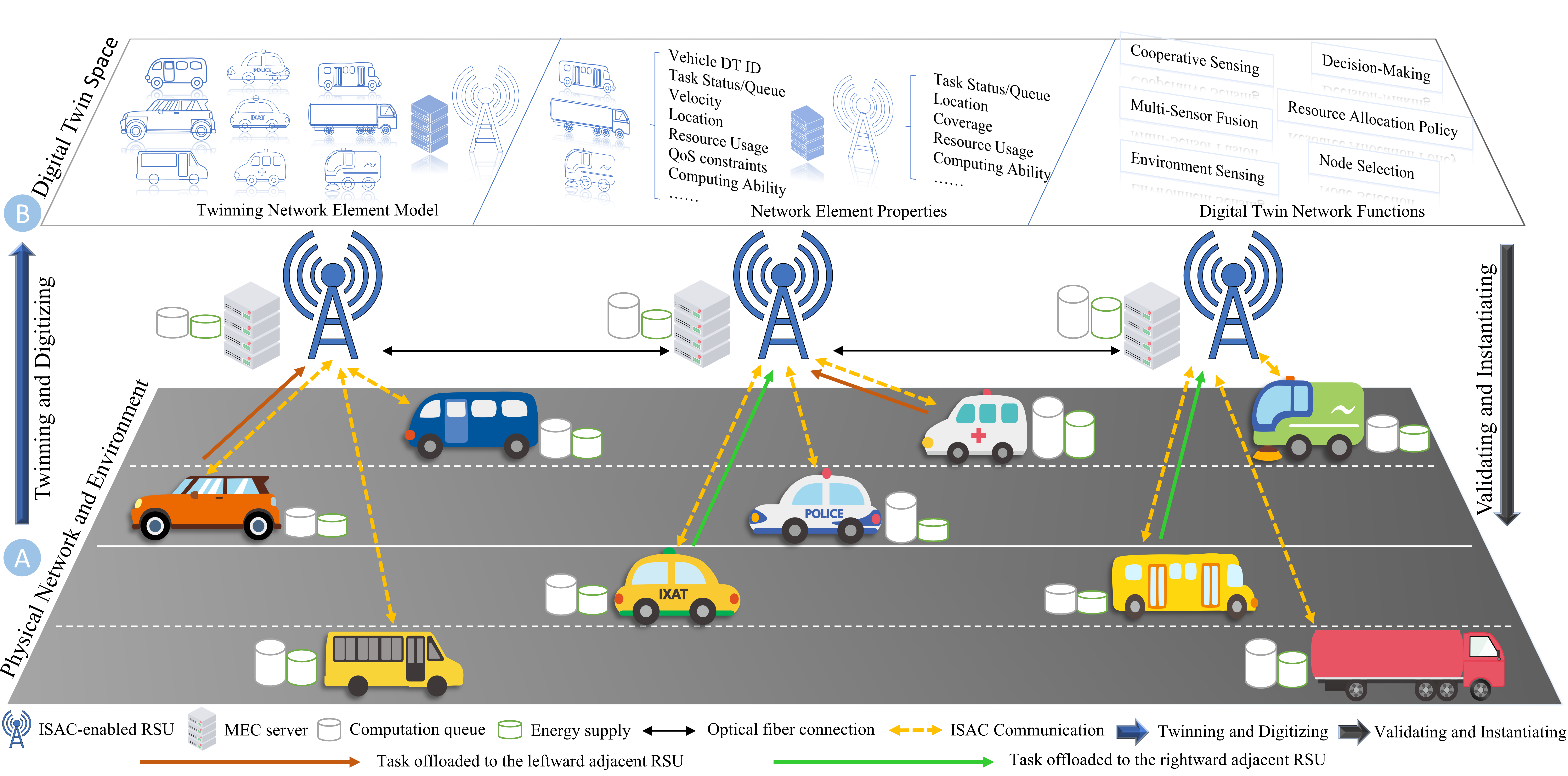
Figure 1: DT-Assisted ISAC vehicular network scenario, demonstrating the interaction between ISAC-enabled vehicles and RSUs and their digital twins.
Task Offloading and Resource Allocation
Two modes of transmission are introduced to optimize vehicular task offloading:
- Data Transmission (DataT) Mode: Involves uploading full sensory data to RSUs.
- Instruction Transmission (InstrT) Mode: Involves transmission of computation instructions for reconstruction at the RSUs using locally perceived data.
This dual-mode configuration aims to reduce data transmission volume and improve spectral efficiency, thereby mitigating transmission overhead and enhancing task execution accuracy.
Lyapunov-Based Optimization
To address the complexity of dynamically fluctuating IoV environments, a Lyapunov optimization strategy decomposes the long-term stochastic control problem into tractable per-slot decisions, ensuring queue stability throughout operations. This facilitates balancing latency reduction and energy consumption while maintaining QoS under high mobility and dynamic task arrival scenarios.
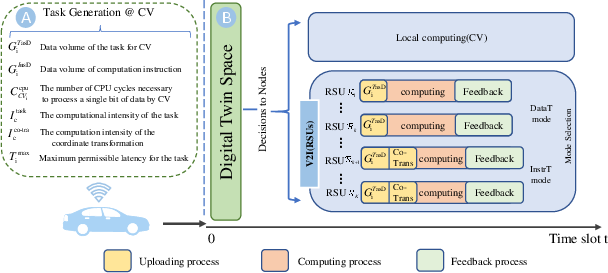
Figure 2: Total task completion latency, indicating task-offloading ratio determination in DT space.
Ly-DTMPPO Algorithm
An actor-critic DRL framework is proposed utilizing Lyapunov-driven DT-enhanced multi-agent proximal policy optimization (Ly-DTMPPO). It leverages DT for global state awareness within centralized training and decentralized execution architecture, enhancing decision-making robustness in volatile environments.
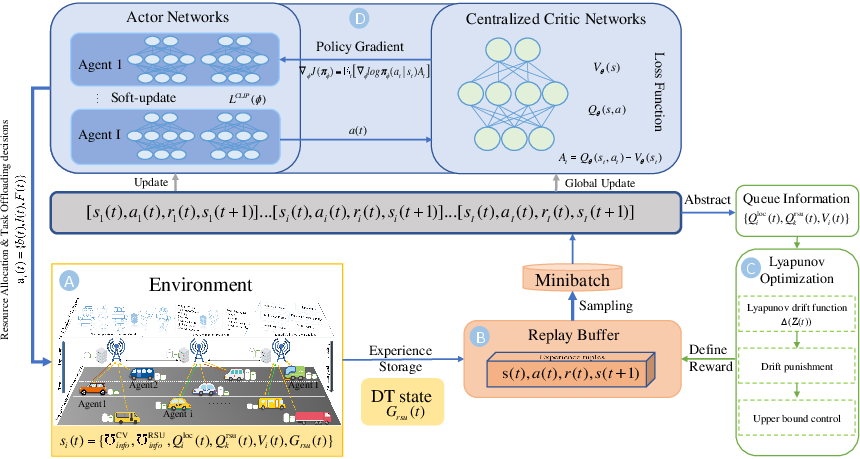
Figure 3: Framework of the proposed Ly-DTMPPO algorithm, integrating DT-enhanced environment interaction within cooperative multi-agent learning.
Various simulations demonstrate the superior performance of Ly-DTMPPO against multi-agent DRL baselines, showcasing lower delay, reduced energy consumption, and faster convergence. The results validate the efficacy of the DT-enhanced framework in attaining the lowest average system cost compared to its absence.
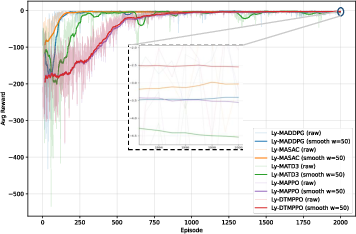
Figure 4: Average rewards under different algorithms show Ly-DTMPPO achieves superior results compared to established methods.
Conclusion and Future Directions
The integration of DT with Ly-DTMPPO frameworks provides significant advancements in resource allocation and task optimization for IoV networks. Future research could explore heterogeneous vehicular networks and employ GenAI-based robust optimization techniques to further enhance system adaptability.
The study suggests promising directions in leveraging DT and ISAC for IoV, proposing innovative strategies that address both practical and theoretical challenges in achieving efficient vehicular network management. These findings offer potential pathways for advancing intelligent transportation systems, facilitating more adaptive and sustainable IoV infrastructures.