- The paper introduces detailed analyses of azimuthal modulations in photon-induced processes, emphasizing linear polarization effects in UPCs and e+e- colliders.
- It employs the equivalent photon approximation and TMD factorization to quantify angular asymmetries, such as cos(2φ) and cos(4φ), in dilepton and light-by-light scattering.
- Findings reveal that soft radiation and interference phenomena critically influence modulation patterns, guiding future explorations in QCD and electrodynamics.
Azimuthal Modulations in Photon-Induced Processes
This essay provides an overview of the advances in understanding azimuthal modulations within photon-induced processes, as detailed in the paper "Azimuthal Modulations in Photon-Induced Processes" (2511.06855). The focus is on Ultra-Peripheral Collisions (UPCs) and e+e− colliders, with applications ranging from probing linear photon polarizations to soft radiation effects.
Introduction and Theoretical Considerations
Ultra-peripheral collisions (UPCs) serve as a pristine platform for studying photon-induced reactions at high energies by suppressing hadronic interactions. Central to this analysis is the equivalent photon approximation (EPA), which reinterprets electromagnetic fields as fluxes of quasi-real photons. A critical complement to EPA is polarization effects, historically contextualized within bremsstrahlung theories and modernized through transverse-momentum-dependent (TMD) factorization.
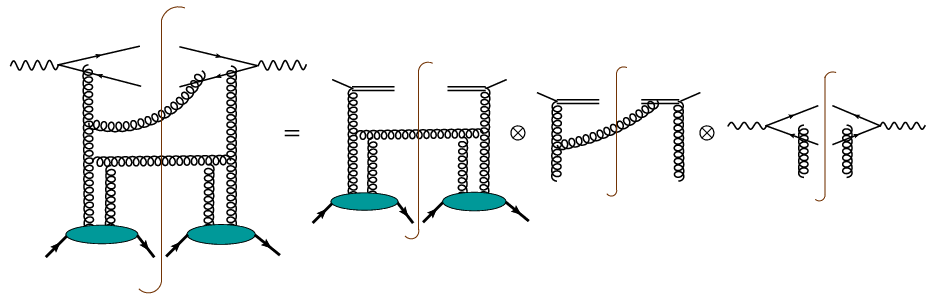
Figure 1: An illustration of the factorization scheme. The double line represents the gauge link.
Linearly polarized photons lead to characteristic angular modulations, detectable as a cos(2ϕ) component in cross-sectional analyses. Further developments describe polarization via gluon and photon TMDs, predicting maximal linear polarization at small x, a regime important in high-energy hadronic processes.
Key Processes and Their Azimuthal Modulations
Photon-induced processes, particularly in UPCs and e+e− colliders, exhibit distinctive azimuthal structures from polarization and soft radiation contributions. Below, we analyze several processes that leverage these modulations for deeper physical insights.
Dilepton Production in UPCs
Dilepton production (e+e− or μ+μ−) offers a baseline for testing polarized-EPA predictions, with experimental confirmations via detected cos(4ϕ) asymmetries matching theoretical expectations. This process benefits from contributions between initial-state linear polarization at low transverse momentum (q⊥) and final-state radiation effects at moderate q⊥. Importantly, rigorous treatments using soft-collinear effective theory (SCET) have shown these asymmetries are sensitive to both mass corrections and emission dynamics.
Light-by-Light Scattering
As a core reaction in UPCs, Light-by-Light (LbL) scattering (γγ→γγ) provides insights into QED processes and potential new physics. Modulatory effects, such as cos(2ϕ), reveal underlying photon polarization structures and can expose beyond-Standard-Model signatures.
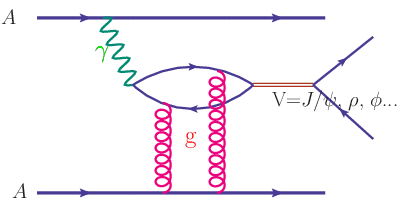
Figure 2: Schematic diagram for diffractive vector meson production in UPC.
Photon-Nuclear Collisions
Diffractive dijet production offers a window into gluonic structure with azimuthal asymmetries indicative of underlying Wigner distributions. The process benefits from defined impact parameters, allowing studies of initial and final-state radiation influences on modulations like cos(2ϕ). Complementary measurements in diffractive vector meson production explore gluon distributions and exhibit enhancements through unique double-slit interference effects, integral for analyzing structural dynamics at femtometer scales.
Photon-Photon Collisions at e+e− Colliders
e+e− collider settings enable refined analyses of light meson pair production through cleaner initial-state conditions. Such environments facilitate the direct extraction of helicity amplitude phases, crucial for advancing understanding of QCD structures and testing theoretical models of the muon anomalous magnetic moment.
Conclusion
Azimuthal modulations, through their sensitivity to polarization, soft radiation, and interference phenomena, provide a robust probe for exploring photon-induced processes across several domains. Future analyses targeting high-precision datasets, multi-dimensional imaging, and global constraint methodologies hold promise for refining theoretical frameworks and broadening the utility of azimuthal observables in probing quantum chromodynamics and electrodynamics.
As experimental capabilities evolve, these azimuthal modulation studies will enhance our theoretical and practical understanding of hadronic and nuclear interactions, offering new insights into the complex interplay of forces at the microcosmic level.