Papers
Topics
Authors
Recent
Search
2000 character limit reached

CloudMamba: Grouped Selective State Spaces for Point Cloud Analysis

Published 11 Nov 2025 in cs.CV | (2511.07823v1)

Abstract: Due to the long-range modeling ability and linear complexity property, Mamba has attracted considerable attention in point cloud analysis. Despite some interesting progress, related work still suffers from imperfect point cloud serialization, insufficient high-level geometric perception, and overfitting of the selective state space model (S6) at the core of Mamba. To this end, we resort to an SSM-based point cloud network termed CloudMamba to address the above challenges. Specifically, we propose sequence expanding and sequence merging, where the former serializes points along each axis separately and the latter serves to fuse the corresponding higher-order features causally inferred from different sequences, enabling unordered point sets to adapt more stably to the causal nature of Mamba without parameters. Meanwhile, we design chainedMamba that chains the forward and backward processes in the parallel bidirectional Mamba, capturing high-level geometric information during scanning. In addition, we propose a grouped selective state space model (GS6) via parameter sharing on S6, alleviating the overfitting problem caused by the computational mode in S6. Experiments on various point cloud tasks validate CloudMamba's ability to achieve state-of-the-art results with significantly less complexity.
Summary

  • The paper introduces CloudMamba, a network that employs grouped selective state spaces to address challenges in point cloud serialization and overfitting.
  • The paper presents chainedMamba, which enhances high-level geometric perception by capturing global semantic dependencies in point cloud data.
  • The paper demonstrates state-of-the-art performance in classification and segmentation tasks while significantly reducing computational complexity.

CloudMamba: Grouped Selective State Spaces for Point Cloud Analysis

Introduction

The paper "CloudMamba: Grouped Selective State Spaces for Point Cloud Analysis" (2511.07823) introduces CloudMamba, a novel SSM-based network designed to tackle inherent challenges in point cloud analysis. Building upon the Mamba architecture, CloudMamba aims to address limitations related to point cloud serialization, geometric perception, and overfitting associated with the selective state space model (S6). The proposed model is characterized by its linear complexity and improved computational efficiencies.

Challenges in Point Cloud Analysis

The paper identifies several persistent challenges in applying Mamba-like architectures to point cloud data:

  1. Point Cloud Serialization: Existing serialization strategies often rely on space-filling curves which are sensitive to grid size settings, resulting in unreliable structural dependencies.
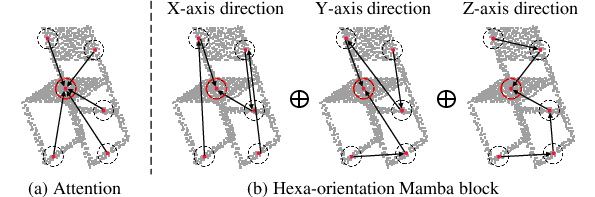
  2. High-Level Geometric Perception: The unidirectional nature of Mamba limits its applicability in visual data contexts requiring global learning. Parallel bidirectional Mamba structures are insufficient for capturing high-level geometric semantics.
  3. Overfitting in S6: Multi-dimensional sequences processed by S6 tend to overfit due to excessive parameters. Figure 1

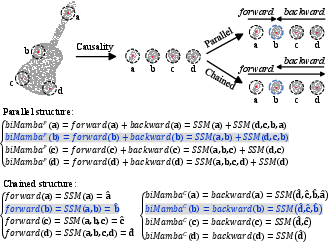
    Figure 1: Inference process of the bidirectional Mamba with different structures, where the blue equations denote the inference processes of both bidirectional Mamba for the point b, respectively.

Innovations in CloudMamba

The authors propose multiple innovations to overcome these issues:

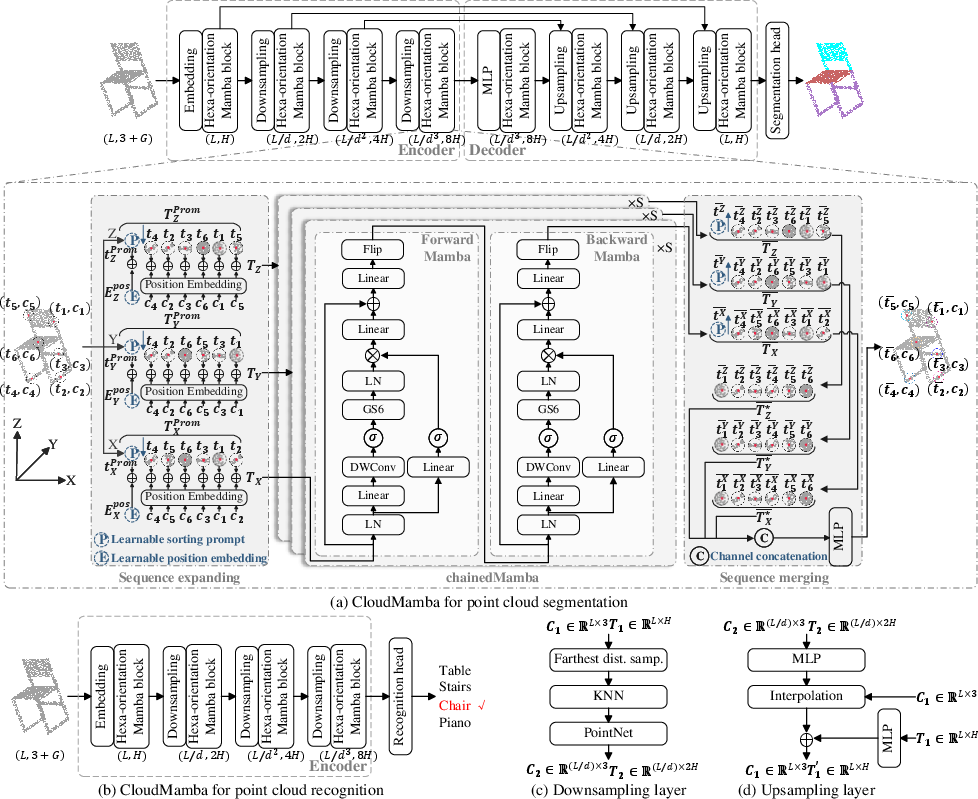
  • Sequence Expanding and Merging: To ensure stable causal adaptation without parameters, CloudMamba introduces strategies to serialize points along separate axes and merges causally inferred higher-order features.
  • ChainedMamba: A novel variant that chains the directional processes in bidirectional Mamba to ameliorate high-level semantic capture during inference.
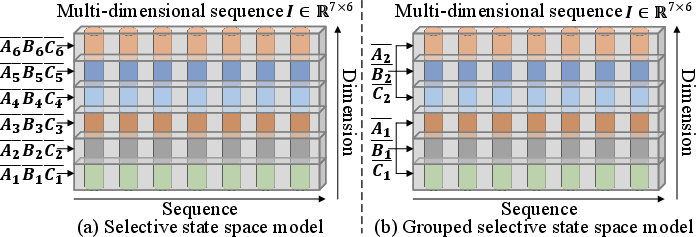
  • Grouped Selective State Space Model (GS6): A parameter-sharing model that mitigates overfitting by configuring multiple dimensions to use the same set of parameters. Figure 2

    Figure 2: Computational modes of S6 and GS6, where GS6's grouping rate is 3. A multi-dimensional sequence $\boldsymbol{I$ is used as an example.

Implementation and Experimental Results

The proposed CloudMamba network is validated across several point cloud tasks including classification, part segmentation, and semantic segmentation, where it demonstrates state-of-the-art results with reduced computational complexity.

  • Point Cloud Recognition: Achieving competitive accuracy on ModelNet40 and ScanObjectNN datasets with reduced FLOPs and Params compared to leading models such as Point Transformer.
  • Part Segmentation: Demonstrating high instance mIoU with fewer computational resources on the ShapeNet dataset, highlighting its efficient handling of geometric structures.
  • Semantic Segmentation: Outperforming contemporary models on the S3DIS dataset with improved expressivity in capturing complex scene-level semantics. Figure 3

    Figure 3: Pipeline of the proposed network. The Flip layer in the chainedMamba indicates a flip operation on the sequence for global modeling.

Conclusions and Future Directions

The paper concludes that CloudMamba significantly enhances point cloud analysis by leveraging Mamba's long-range modeling capabilities into a simplified and efficient framework. The introduction of GS6 and innovative sequence handling mechanisms shows potential for further development in self-supervised pre-training and pre-defined meaningful causal dependency structures. Future explorations are poised to optimize these functionalities, potentially surpassing the efficacy of attention networks in point cloud analysis. Figure 4

Figure 4: Comparison of SSM-based networks on ModelNet40 dataset, where a larger circle means more parameters.

Paper to Video (Beta)

No one has generated a video about this paper yet.

Whiteboard

No one has generated a whiteboard explanation for this paper yet.

Open Problems

We haven't generated a list of open problems mentioned in this paper yet.

Collections

Sign up for free to add this paper to one or more collections.

Tweets

Sign up for free to view the 1 tweet with 3 likes about this paper.