- The paper develops a semiclassical framework that computes scaling dimensions of composite operators in the Ising CFT with next-to-leading order precision.
- It integrates multi-loop perturbative data and resums infinite Feynman diagrams via a controlled 1/n expansion using Bohr-Sommerfeld quantization.
- The study reveals instabilities in the operator spectrum and sets benchmark predictions for large-charge operators in the three-dimensional critical Ising CFT.
Introduction
The determination of scaling dimensions for composite operators in conformal field theories (CFTs) is a longstanding problem, particularly in regimes inaccessible to conventional perturbation theory, such as at large operator dimension or charge. The Ising λϕ4 theory in d=4−ϵ dimensions provides a paradigmatic example wherein standard tools are challenged by the breakdown of perturbativity at large n due to the proliferation of operator mixing and Feynman diagrams. This work develops and applies a semiclassical framework that computes the full spectrum of scaling dimensions of neutral composite operators in the traceless-symmetric Lorentz representations to next-to-leading order (NLO) in a double-scaling limit, thus accessing data beyond perturbative and numerical techniques. The results integrate with and extend multi-loop perturbative computations, yielding five-loop anomalous dimensions and offering state-of-the-art predictions for large-n operators in three-dimensional critical Ising CFT.
Semiclassical Methodology for Operator Spectra
The approach builds on the mapping of operator dimensions to the energy spectrum of the quantized periodic classical solutions on the Euclidean cylinder R×Sd−1. The critical λϕ4 model is considered with the Lagrangian
L=21(∂ϕ)2−4λϕ4,
and the fixed-point coupling λ∗ specified by the Wilson-Fisher solution. Primary operators in the traceless-symmetric representation, schematically denoted ∂s□pϕn, are associated with homogeneous solutions v(t) of the quartic oscillator,
dt2d2v+μ2v+λv3=0,
with v(t) given by a Jacobi cosine-elliptic function. The semiclassical quantization is implemented via Bohr-Sommerfeld condition on the classical action, producing a controlled $1/n$ expansion
Δn,{qℓ}=ni=0∑∞niCi(λn,{qℓ}),
where {qℓ} encodes excitation integers and Ci are calculable order-by-order.
The NLO coefficient C1 is obtained by quantizing quadratic fluctuations about the classical trajectory, governed by a Lamé-type spectral problem. This allows resummation of infinitely-many Feynman diagrams without explicit diagrammatic computation and, in tandem with available perturbative data, enables full determination of multi-loop scaling dimensions for composite primaries.
Structure and Features of the Semiclassical Spectrum
The operator spectrum's structure is governed by the band structure of the $2$-gap Lamé operator, with the parameter m tied to λn via the quantization condition. For small λn, Λℓ is in the allowed bands for all ℓ, while for λn≳50, certain Λℓ cross into forbidden regions, leading to instabilities and complex stability angles, signaling a breakdown of the homogeneous solution saddle-point.
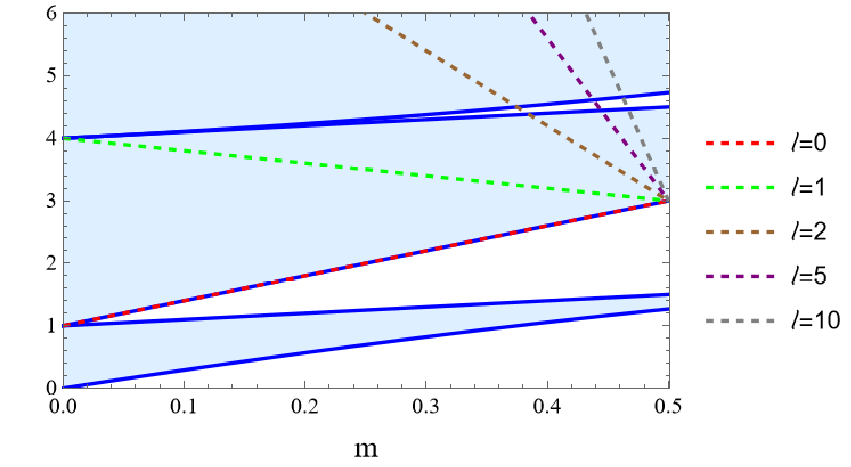
Figure 1: Comparison of the band structure of the Lamé operator L2 (allowed bands colored in light blue) and Λℓ for various ℓ as a function of m. Complex stability angles (instabilities) manifest when the parameter Λℓ enters the forbidden regions.
For the ground state (qℓ=0), the scaling dimension at NLO is
Δn=nC0(λn)+C1(λn)+O(1/n)
with C0 and C1 given by explicit analytic expressions involving elliptic integrals and convergent series over the Lamé spectrum. The structure of descendant and spin-s primaries is handled rigorously using representations of SU(2) and decompositions of excitation modes.
Connection with Perturbation Theory and Five-Loop Results
A key achievement is the synthesis of semiclassical and Feynman diagrammatic approaches. The small-λn expansion of the coefficients Ci matches the leading powers of n at each loop order, effectively resumming certain contributions to all orders in ϵ. By matching the remaining unknown coefficients with available k-loop results for finite n, the complete O(ϵ5) scaling dimensions for ϕn operators are obtained:
\begin{align*}
\Delta_n = \left(1-\frac{\epsilon}{2}\right)n + \frac{n}{6}(n-1)\epsilon
- \frac{n}{324}(17 n2 - 67 n + 47)\epsilon2 + \dotsb
\end{align*}
with further explicit higher-loop terms provided, yielding improved predictions for n≥8.
Large-n, Large-λn Limit and Instabilities
In the asymptotic regime, NLO corrections alter the leading large-n scaling from Δn∼n4/3 to Δn∼nd/(d−1). This behavior is consistent with non-perturbative expectations from generic CFTs with global symmetries, albeit with unique multicritical structure: the multivaluedness of the spectrum due to branch cuts in the relevant integrals, and the emergence of complex stability angles when certain Lamé spectral gaps are crossed. These features indicate a need for an extension of semiclassical analysis, potentially invoking Lefschetz thimble formalism for correct treatment of path integral saddles.
Comparison with Bootstrap and Resummed ϵ-Expansion
The physical three-dimensional Ising CFT serves as a testbed for the utility of the semiclassical framework. For small n, Monte Carlo, bootstrap, and resummed ϵ-expansion give mutually consistent results, but for n≳12, the semiclassical NLO predictions surpass all available alternatives in accuracy.
In particular, the semiclassical expansion proves robust when analytically continued to ϵ=1 and n finite. Padé and other resummation techniques markedly improve ϵ-expansion convergence, but cannot access the regime where perturbation theory in λn is invalid.
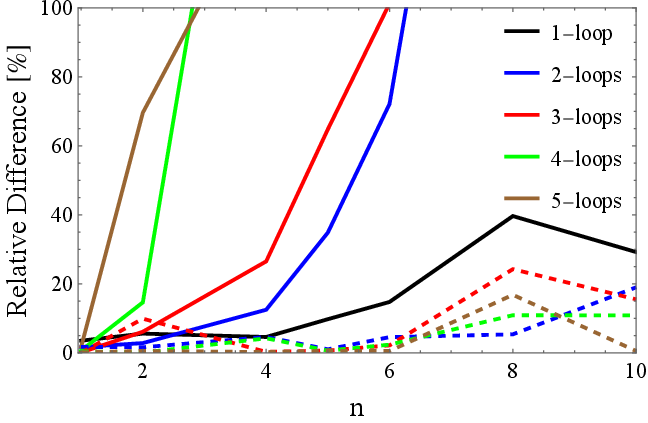
Figure 2: Relative difference for Δn between bootstrap and ϵ-expansion at various truncation orders (solid) and their Padé approximants (dashed), demonstrating the rapid onset of the semiclassical regime.
Theoretical and Practical Implications
The presented results constitute a rigorous solution for the spectrum of large-charge neutral composites in the critical Ising CFT, resolving operator mixing and non-perturbative behavior. The band structure analysis elucidates the onset of instability, providing a criterion for the breakdown of the homogeneous saddle-point computation and indicating further structure in the operator landscape.
These advances have direct impact on the study of renormalization group flows and operator mixing in effective theories, including the Standard Model effective field theory, and lay the groundwork for similar semiclassical treatments in gauge theories, supersymmetric CFTs, and contexts with extended operator spectra.
The analytic control over multi-loop scaling dimensions, together with the transparent integration of classical, semiclassical, and perturbative techniques, signals a shift in the methodology for studying operator dynamics in CFTs. The ability to accurately resolve the high-dimension spectrum is of direct relevance to conformal bootstrap, Monte Carlo simulations, and the pursuit of non-trivial fixed points in higher-dimensional quantum field theory.
Conclusion
This work introduces and executes a semiclassical approach yielding exact next-to-leading order results for scaling dimensions of composite neutral operators in the Ising CFT, valid beyond traditional perturbative limits and integrating with state-of-the-art multi-loop data. The analysis systematically characterizes the structure and limitations of the operator spectrum, with explicit identification of regimes of instability and crossover. The semiclassical NLO predictions now set the benchmark for operator scaling dimensions at large n in three-dimensional Ising CFT and provide a blueprint for similar studies across quantum field theory, with anticipated applications spanning from statistical to high-energy physics.