Traversable wormhole with double trace deformations via gravitational shear and sound channels
Published 12 Nov 2025 in hep-th and gr-qc | (2511.09815v1)
Abstract: We investigate how non-local gravitational couplings from double-trace deformation between two asymptotic boundaries of an AdS$_5$ black brane can lead to the violation of the Averaged Null Energy Condition (ANEC). The first-order gravitational perturbations backreact with the background metric at second-order, creating a wormhole opening. The wormhole becomes traversable in both the gravitational shear and sound channels within the hydrodynamic approximation. This shows that dynamical metric perturbations can facilitate information transfer in a purely gravitational setting, with the emergence of $G_N$ indicating the gravitational origin. For the shear channel, we consider three different coupling configurations, whereas for the sound channel, we vary both the speed of sound and the attenuation constant, as these parameters control the wormhole traversability. Furthermore, we obtain late-time power-law behavior in the ANEC using fitting function and present a generalization that applies to both shear and sound channels. Due to its propagating nature, the sound channel exhibits late-time power-law remnants at low sound speed similar to the vector diffusive probes, but it prefers an exponential decay at higher sound speed similar to the scalar non-diffusive probes, as the power-law exponent weakened with increasing sound speed. For superluminal sound channels, the wormhole opens for an extremely brief duration at late insertion times, rendering it non-traversable.
The paper shows that double-trace deformations, via gravitational perturbations in shear and sound channels, enable traversable wormholes by violating the averaged null energy condition.
It utilizes hydrodynamic analysis and perturbative backreaction in an AdS5 black brane to quantitatively relate wormhole opening with second-order stress-energy tensor components.
The study employs numerical fittings revealing power-law and exponential decays in ANEC, providing insights into quantum scrambling and constraints on information transfer.
Traversable Wormholes via Gravitational Shear and Sound Channels Under Double Trace Deformations
Overview and Key Findings
This work systematically investigates traversable wormhole geometries rendered possible by double-trace deformations involving gravitational metric perturbations in both shear and sound channels, within the context of an AdS5 black brane. The violation of the averaged null energy condition (ANEC) is established through the backreaction of quantum-induced gravitational perturbations, facilitating causal traversal between wormhole mouths. The approach generalizes prior scalar and vector field studies by explicitly treating metric (tensor) perturbations in the hydrodynamic regime, deriving key relations between wormhole opening ΔU and second-order stress-energy tensor components.
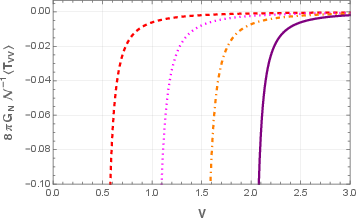
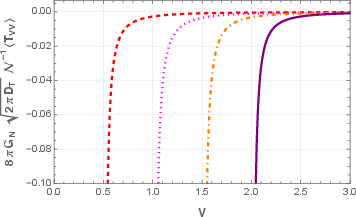
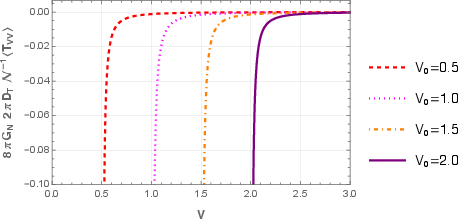
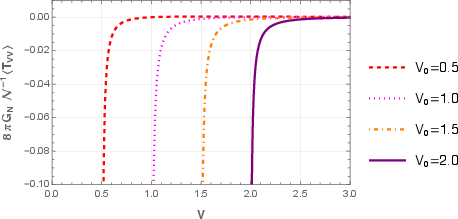
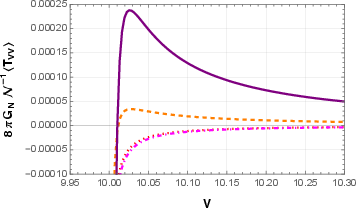
Figure 1: Normalized energy-momentum tensor ⟨T^VV(2)⟩ as a function of V, for different insertion times V0, across three gravitational shear coupling configurations.
Gravitational Background and Perturbative Framework
The bulk metric is formulated as a general (d+1)-dimensional black brane with asymptotically AdS boundary conditions. Metric perturbations hMN are introduced in Fefferman-Graham gauge, yielding decompositions into scalar, shear (vector), and sound (tensor) channels, each decoupled in their linearized equations. Couplings at the two conformal field theory (CFT) boundaries are related via double-trace deformations linking sources and responses through the near-boundary expansion of bulk fields.
The gravitational perturbations are treated quantum mechanically in the interaction picture under the influence of the double-trace deformation Hamiltonian. These perturbations induce a second-order backreaction γMN, responsible for the wormhole opening proportional to the integrated quadratic stress-energy tensor, thus connecting geometric traversability to quantum expectation values in the boundary CFT.
Violation of the Averaged Null Energy Condition and Wormhole Traversability
Shear Channel Analysis
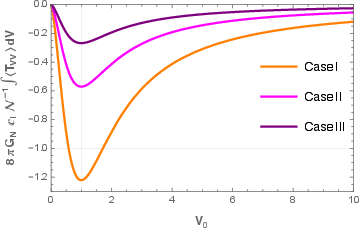
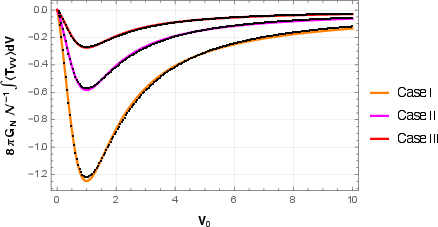
Explicit calculation of the quadratic (second-order) energy-momentum tensor ⟨T^VV(2)⟩ is performed for gravitational shear modes, using the backreacted metric near the AdS horizon. Three distinct coupling configurations are considered—momentum density-momentum density, momentum density-shear, and shear-shear—demonstrating quantitative differences in wormhole opening and ANEC violation:
The strongest traversability is achieved via the momentum density-momentum density configuration.
All three shear cases demonstrate negative-energy shock waves (with negative coupling), confirming wormhole traversability.
Generation of bulk-to-boundary Green's functions in the hydrodynamic limit allows analytic expressions for ⟨T^VV(2)⟩, incorporating a generalized tensorial diffusion constant DT adaptable to arbitrary blackening functions f(u).
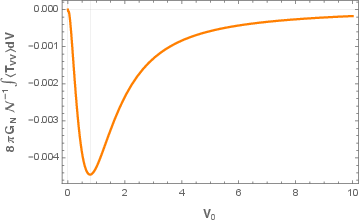
Figure 2: The normalized ANEC as a function of insertion time V0 for all three shear channel configurations.
Sound Channel Analysis
Sound channel perturbations, characterized by speed vs and attenuation Γs, yield a more complex structure:
Traversability magnitude is generally reduced compared to shear channels.
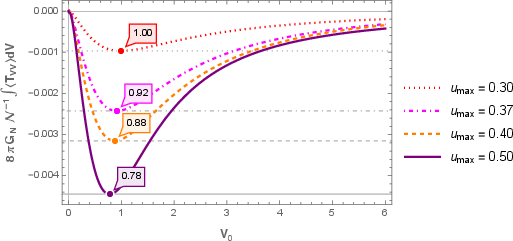
Maximal ANEC violation in sound channels shifts to earlier insertion times for higher vs, indicating different scrambling dynamics.
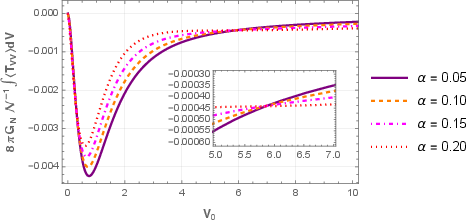
Attenuation modifies the ANEC profile, with higher Γs suppressing traversability for small V0 but enhancing it for large V0. Superluminal sound speeds cause the wormhole opening to become fleeting, rendering traversal impossible for sufficiently late insertions.
Figure 3: Normalized ⟨T^VV(2)⟩ and corresponding ANEC vs. V0 for sound channel perturbations.
Figure 4: ANEC vs. V0 for varying umax, demonstrating the dependence of wormhole traversability on sound speed.
Figure 5: ANEC vs. V0 for different ratios α=2πΓˉs/vs2 (attenuation/sound speed squared), illustrating effects of sound channel damping.
Data Fitting and Power-Law Scaling of ANEC
Numerical solutions reveal that ANEC exhibits a power-law decay at late insertion times. The authors introduce a three-parameter fitting model:
Anew(V0)=−V0c+1+1V0[ln(V0+1/V0)]ba
Parameters b (power-law exponent) and c (exponential scaling) discriminate between diffusive and ballistic regimes:
Shear channel fits show c≈1, preserving power-law remnants.
Sound channel fits demonstrate b→0 as vs increases, indicating exponential decay at large sound speeds; i.e., power-law tail is suppressed, approaching non-diffusive dynamics.
Figure 6: ANEC fitting for shear and sound channels with empirical and model curves.
Figure 7: Comparison of ANEC fitting model parameters c, b for sound speed variations, highlighting the transition from power-law to exponential late-time decay.
Remarks on Localized Perturbations
For localized double-trace perturbations, traversability is further constrained by "butterfly cone" dynamics. Causal propagation requires time t−t0∼∣x1−x0∣/vB (with vB butterfly velocity) to enter the effective traversable region. Before scrambling completes, the energy-momentum tensor expectation remains positive, precluding traversal despite negative ANEC at later times.
Theoretical and Practical Implications
The explicit emergence of GN in traversability bounds underlines the genuinely gravitational character of the protocol.
Upper theoretical bound for information transfer through the wormhole scales as (rHd−1)/GN; achieving Nbits∼O(1) demands gravitational perturbations hMN∼O(GN). The semiclassical regime imposes strict limitations, with higher-order perturbations yielding negligible transfer.
The analytic generalization of diffusion constants to arbitrary backgrounds provides a toolbox for applying the protocol to diverse black brane metrics, including those with holographic momentum relaxation or nontrivial hair.
Prospects for Future Development
Several avenues for extension are suggested:
Incorporation of fermionic operators, with well-posed boundary conditions yielding alternative traversable deformations.
Analysis of wormhole traversability in black holes with scalar/vector hair, rotating backgrounds, or quantum exotic compact objects, potentially relevant for astrophysical observability.
Application in inflationary cosmology, where primordial gravitational perturbations might provide settings analogous to wormhole formation via quantum fluctuations; connections to recent proposals linking AdS wormholes and initial condition problems in inflation.
Conclusion
This study rigorously establishes that traversable wormholes can be engineered via double-trace boundary deformations using gravitational metric perturbations, in both shear and sound channels, within an AdS5 black brane context. The theoretical framework connects quantum boundary interactions and bulk causal geometry, yielding quantitative predictions for wormhole openness and bounds on information transfer. The research elucidates the critical role of hydrodynamic transport parameters and quantum scrambling, offering analytic extensions and broad applicability, with significant implications for quantum gravity, holography, and potentially cosmology.