- The paper demonstrates a rigorous second-order TDGL analysis that predicts coherent Higgs wave interference via structured light-induced vortex lattices.
- It reveals that beam parameters such as separation and width directly tune the interference patterns and control both amplitude and phase dynamics.
- The findings imply applications in ultrafast quantum state control and superconducting device engineering using patterned quantum printing techniques.
Kapitza-Dirac Interference of Higgs Waves in Superconductors
Introduction
The paper "Kapitza-Dirac interference of Higgs waves in superconductors" (2511.10954) presents a rigorous theoretical framework for controlling amplitude (Higgs) collective excitations and vortex dynamics in superconducting films via structured light, particularly focusing on the emergence of Kapitza-Dirac (KD) interference patterns. Analogous to the original KD effect—where matter waves are diffracted by a periodic optical potential—the authors demonstrate that Higgs waves, generated within the superconducting condensate, can scatter off light-induced vortex lattices, resulting in observable interference analogous to electron diffraction from a standing light wave [kapitza_reflection_1933, batelaan_colloquium_2007]. The work leverages a second-order time-dependent Ginzburg–Landau (TDGL) formalism to capture both inertial Higgs dynamics and vortex nucleation/interaction.
The analysis is grounded in a second-order TDGL equation, allowing for undamped, coherent oscillations representing Higgs modes:
τ∂t′2∂2ψ+γ∂t′∂ψ=ψ−ψ∣ψ∣2+(∇′−iA′)2ψ
where ψ is the normalized superconducting order parameter, τ encodes inertial response, and γ is a phenomenological damping term. Crucially, structured light fields implemented as Laguerre-Gaussian beams with tunable quantum numbers (s: spin, l: orbital, p: radial) serve to modulate the vector potential A, thus enabling spatial control over both vortex generation and Higgs excitation [allen_orbital_1992, forbes_structured_2021].
Unlike overdamped first-order TDGL dynamics [kramer_theory_1978, bishop-van_horn_pytdgl_2023], this second-order treatment is crucial for observing wave-like Higgs behavior on picosecond timescales, as attained under intense THz irradiation [matsunaga_light-induced_2014, shimano_higgs_2020].
Emergent Kapitza-Dirac Interference in Superconducting Higgs Waves
A central result is the demonstration that Higgs waves scattered from a vortex lattice, induced by structured light, produce interference fringes in both real and momentum space. By exciting the superconducting film with two spatially separated beams, the Higgs wave functions interfere constructively and destructively according to the spatial periodicity of the vortex grid (Figure 1):
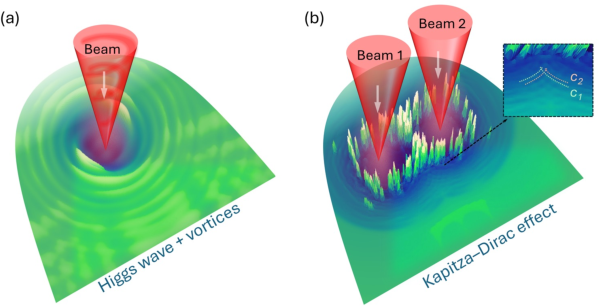
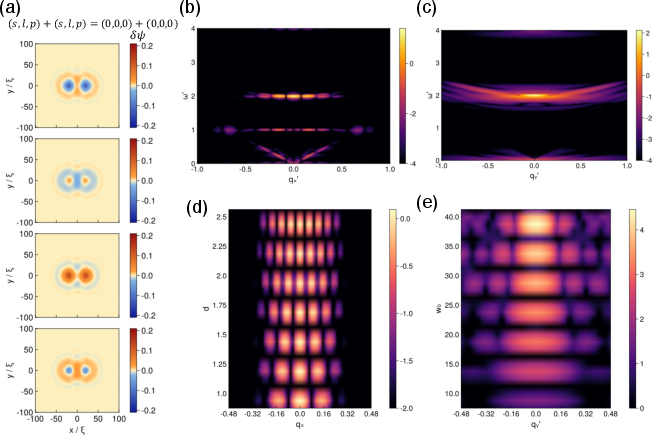
Figure 2: Chiral Higgs wave propagation and interference from paired vortices under structured light illumination.
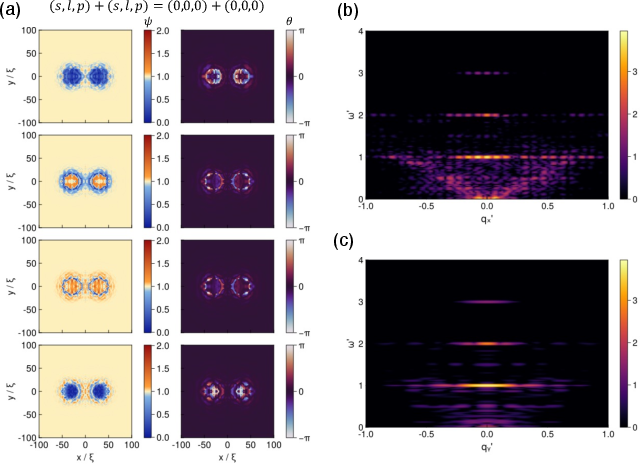
Figure 1: Higgs mode interference/diffraction mapped in real and reciprocal space after vortex lattice imprinting by structured light beams.
The paper substantiates the following claims:
- The presence of vortices enables a linear coupling of the Higgs mode to electromagnetic fields, a notable departure from the conventional nonlinear coupling scenario for single-band superconductors [kamatani_optical_2022, nagashima_classification_2024].
- Kapitza-Dirac type stripes and sidebands appear in the Higgs wave's momentum-space spectrum, tunable by laser spot separation and the quantum numbers of the driving beams.
Spatially resolved Fourier analysis reveals signatures of both the amplitude Higgs dispersion (parabolic near 2Δ) and additional interference stripes attributed to KD scattering, providing direct observables for future pump-probe experimental validation.
Vortex Dynamics and Higgs-Nambu-Goldstone Coupling
The structured light not only generates static vortex arrays but can dynamically drive complex vortex-antivortex pair creation, spiral dynamics, and interaction between amplitude (Higgs) and phase (Nambu-Goldstone, NG) modes. Notably, creation and evolution of vortex pairs can proceed even in the absence of the dissipation term, indicating magnetic field-driven (not relaxation-driven) nucleation (Figure 3):
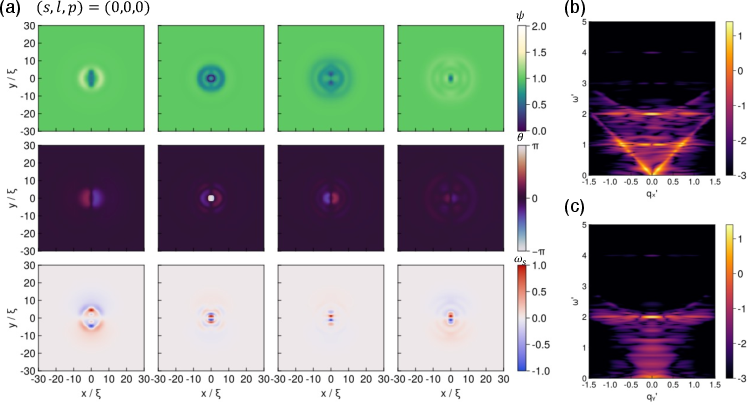
Figure 3: Real-time snapshots of vortex-antivortex pair creation and corresponding Higgs/NG spectral signatures.
Structured light beams with nontrivial angular momentum (circular/Laguerre-Gaussian modes) induce spiral vortex motion and rotational Higgs waves (Figure 4):
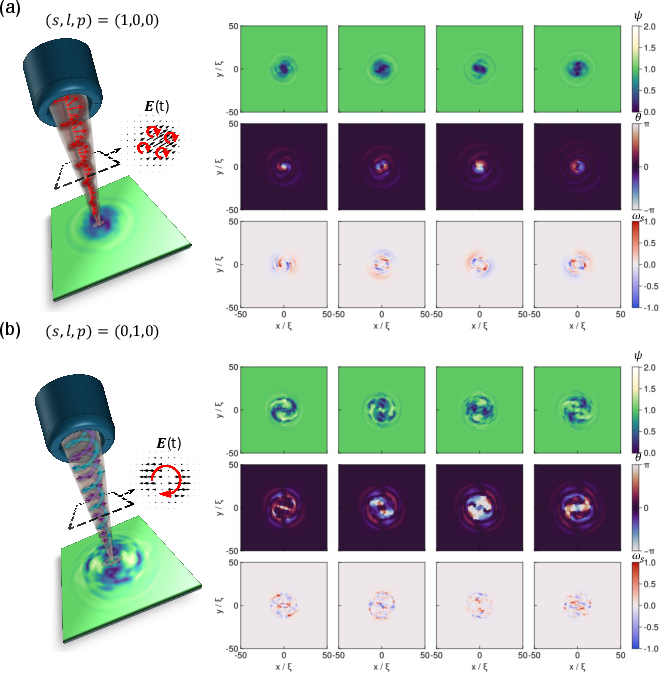
Figure 4: Spiral dynamics of vortices and Higgs mode under beams with angular momentum.
These results establish that amplitude-phase coupling is dynamically activated in the presence of vortices due to phase singularity protection against full gauge removal.
Direct Control of Interference via Beam Parameters
The research provides powerful numerical evidence that both the KD interference pattern periodicity and spatial localization can be directly tuned by laser parameters:
Vortex Lattice Imprinting and Patterned Higgs Diffraction
In addition to optically-generated vortices, static magnetic fields can form Abrikosov lattices, which then act as effective diffraction gratings for subsequent structured light-induced Higgs waves (Figure 6). The paper shows Higgs mode scattering from such static vortex arrays, leading to periodically modulated chiral and spiral amplitude oscillations.
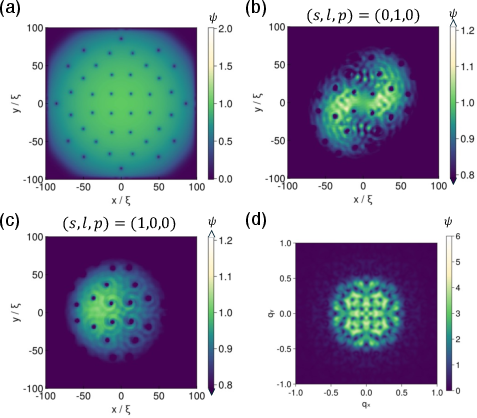
Figure 6: Vortex lattice formation and Higgs wave diffraction for various structured beam configurations, with reciprocal-space characterization.
The periodicity of vortex arrays is reflected in the reciprocal-space spectrum, showcasing the versatility of the approach for imaging and controlling nonequilibrium superconductivity.
Implications and Future Directions
This work moves beyond traditional nonlinear optical phenomena in superconductors and firmly establishes spatially structured optical control—quantum printing—as a protocol for sculpting, probing, and manipulating collective quantum fluid excitations at ultrafast timescales. The authors assert that linear coupling of Higgs modes is enabled via topological defect (vortex) generation, enabling spectroscopic observability previously thought unattainable in single-band superconductors.
These findings have direct implications for:
- Ultrafast pump-probe optical mapping of amplitude/phase coherence in superconducting films.
- Patterned quantum state imprinting for quantum fluid electronics—potentially relevant for high-speed superconducting device engineering.
- Extension of quantum printing protocols to other correlated electron fluids (e.g., charge density waves [narusaka_intense_2025], quantum Hall fluids [cardoso_orbital_2025]) as a universal approach to controlled collective excitation dynamics.
Conclusion
The paper delivers a formal, quantitative analysis of KD interference phenomena in superconducting Higgs waves, establishes new mechanisms for externally controlled linear and nonlinear optical response via structured light-induced topological engineering, and expands the potential paradigms for ultrafast quantum control in condensed matter systems. This theoretical platform is well-positioned for direct experimental validation and future cross-disciplinary application in quantum optics and correlated electron materials research.