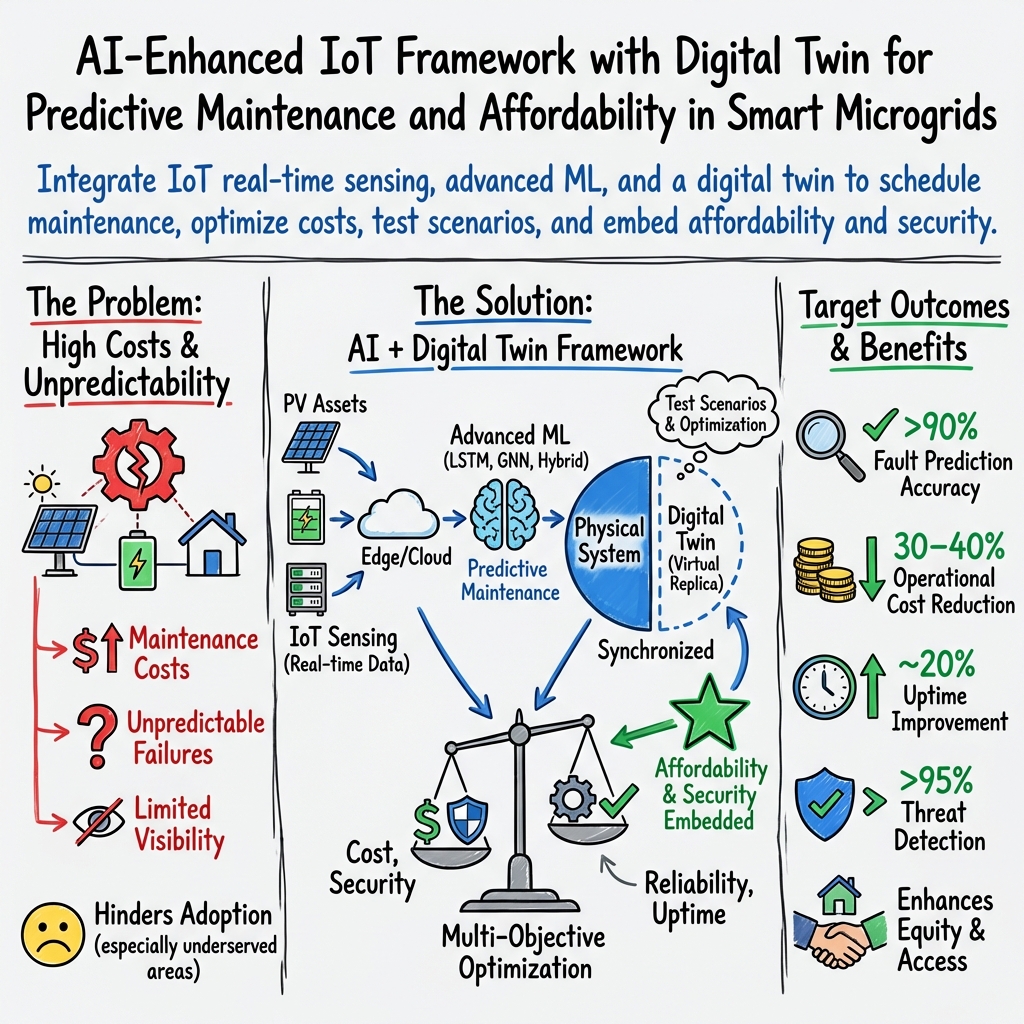
- The paper introduces a digital twin approach that integrates AI and IoT for proactive microgrid maintenance and cost reduction.
- It details machine learning and edge computing methodologies to accurately predict faults and enhance operational efficiency.
- The framework addresses affordability and cybersecurity, offering scalable, resilient solutions for energy access in remote areas.
AI-Enhanced IoT Systems for Predictive Maintenance and Affordability Optimization in Smart Microgrids
Introduction
The paper "AI-Enhanced IoT Systems for Predictive Maintenance and Affordability Optimization in Smart Microgrids: A Digital Twin Approach" (2511.12175) outlines a comprehensive framework for enhancing the operation of smart microgrids using AI and IoT technologies. The focus of this research is on predictive maintenance and affordability optimization, which are crucial for improving energy resilience and accessibility, particularly in remote and underserved areas. This proposal integrates machine learning algorithms with real-time IoT monitoring within a digital twin framework to optimize maintenance and reduce operational costs. Furthermore, the research emphasizes a holistic approach integrating scenario testing, energy equity, and system resilience.
IoT Monitoring in Microgrids
The paper discusses how recent advancements have enabled the development of more efficient and secure IoT-enabled monitoring systems for microgrids. Innovations in distributed IoT frameworks, low-cost platforms, and advanced communication protocols have significantly reduced maintenance costs and improved data integrity. The application of edge computing has enabled real-time decision-making, making IoT systems economically viable, even in rural and remote environments.
AI and Machine Learning Applications
The study highlights the application of AI and ML technologies, especially for predictive maintenance in microgrids. Techniques such as LSTMs and hybrid models combining physics-based simulations with deep learning are used to enhance fault prediction accuracy and enable dynamic maintenance scheduling. These innovations help to anticipate faults, optimize maintenance activities, and reduce costs, thus extending the lifespan of microgrid components.
Digital Twin Framework
The paper presents digital twins as essential elements in modern microgrids, moving beyond conceptual models to practical applications. The framework enables real-time synchronization with physical systems, allowing simulated operations without physical disruption. This offers improvements in performance optimization, scenario testing, and energy losses reduction, achieving more efficient management of microgrids.
Affordability and Accessibility
A significant aspect of the research is addressing the economic challenges of microgrid adoption. Innovative pricing algorithms, cooperative ownership models, and microgrid-as-a-service strategies are evaluated for their potential to reduce costs and improve accessibility. The focus on open-source platforms ensures affordability and promotes local customization and maintenance capabilities.
Cybersecurity Challenges
Cybersecurity remains a critical concern in IoT-driven microgrids. The paper explores adversarial AI techniques, quantum-resistant cryptography, and blockchain mechanisms to enhance system resilience to cyber threats. These measures are integrated to provide a robust defense strategy, ensuring that microgrid operations remain secure and reliable.
Research Objectives and Methodology
The research objectives focus on developing an AI-IoT predictive maintenance framework, achieving high operational efficiency, and ensuring system affordability and security through practical testing. The methodology includes comprehensive system modeling, algorithm development, cybersecurity integration, and socio-economic impact analysis. Hardware-in-the-loop experiments are employed to validate system performance under realistic conditions.
Experimental Validation
The proposed solutions are validated through rigorous testing, ensuring a high degree of accuracy in fault detection and resilience against cyber threats. Predictive maintenance strategies demonstrate significant reductions in unplanned outages and cost. The framework's adaptability is assessed under various scenarios to explore global scalability and potential for integration with existing systems.
Conclusion
This research addresses critical challenges in the domain of smart microgrids, focusing on maintenance, cost-efficiency, and system resilience. By integrating AI-enhanced IoT systems with digital twins, the proposal presents a viable solution for optimizing microgrid operations, thereby making sustainable energy more accessible. The successful implementation of these strategies will contribute to the global transition toward decentralized energy systems and provide tangible benefits to communities.