Measurement-based Dynamical Decoupling for Fidelity Preservation on Large-scale Quantum Processors
Abstract: Dynamical decoupling (DD) is a key technique for suppressing decoherence and preserving the performance of quantum algorithms. We introduce a measurement-based DD (MDD) protocol that determines control unitary gates from partial measurements of noisy subsystems, with measurement overhead scaling linearly with the number of subsystems. We prove that, under local energy relaxation and dephasing noise, MDD achieves the maximum entanglement fidelity attainable by any DD scheme based on bang-bang operations to first order in evolution time. On the IBM Eagle processor, MDD achieved up to a $450$-fold improvement in the success probability of a $14$-qubit quantum Fourier transform, and improved the accuracy of ground-state energy estimation for $N_2$ in the $56$-qubit sample-based quantum diagonalization compared with the standard XX-pulse DD. These results establish MDD as a scalable and effective approach for suppressing decoherence in large-scale quantum algorithms.
Paper Prompts
Sign up for free to create and run prompts on this paper using GPT-5.
Top Community Prompts
Explain it Like I'm 14
A simple guide to “Measurement-based Dynamical Decoupling for Fidelity Preservation on Large-scale Quantum Processors”
Overview
This paper is about making quantum computers work better by protecting their delicate quantum information from noise. The authors introduce a new method called Measurement-based Dynamical Decoupling (MDD) that helps keep qubits (the basic units of quantum computers) from losing their state when they’re idle. They show that MDD is both practical for large machines and, in key cases, the best possible way to protect information during short time periods.
Key objectives
The paper asks three main questions in everyday terms:
- How can we stop idle qubits from “forgetting” their state due to noise?
- Can we use quick, simple measurements to decide the best way to protect each qubit, without huge extra costs?
- Is this new protection method actually better than popular pulse-based methods, both in theory and on real hardware?
Methods and approach
Think of a qubit like a tiny arrow pointing somewhere on a sphere (this is called the Bloch sphere). Noise makes the arrow wobble and drift, which “decoheres” the qubit. Traditional dynamical decoupling uses fast flip pulses (like tapping the arrow at precise times) to average out the wobble. That works, but for many qubits it can demand lots of carefully timed pulses.
MDD takes a different, more informed approach:
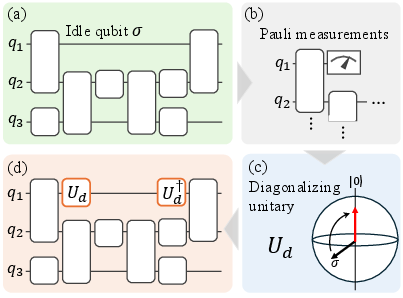
- First, it briefly measures each idle qubit in three simple ways (“Pauli X, Y, Z”), which tells us where the arrow is pointing right now.
- Then it calculates a small rotation (a unitary gate) that turns the arrow to align as closely as possible with the “ground state” direction. The ground state is special because it is the most stable under common types of noise.
- It applies that rotation at the start of the idle period and its exact opposite at the end, so the qubit returns to its original orientation when it’s needed again.
In practice:
- This needs only two physical gates per idle period (an rotation and a “virtual” rotation, which is done by changing the control signal’s phase rather than a real gate).
- The extra measurements grow only linearly with the number of idle qubits, which is manageable for large circuits.
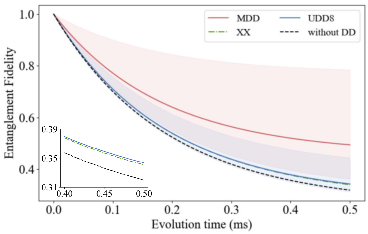
To compare methods, the authors use “entanglement fidelity,” a similarity score between the original state and the noisy state after protection. They also run real experiments on IBM’s 127-qubit Eagle processor to see how MDD performs in practice.
Main findings and why they matter
The authors report both theoretical guarantees and real-world improvements:
- Theory: For the most common local noises (energy relaxation, called , and dephasing, called ), MDD preserves the entanglement fidelity as well as any bang–bang (fast pulse) method can, to first order in short time. In simple words, for short idle periods, MDD is the best you can do among standard decoupling strategies that use quick pulses.
- Practice on real hardware:
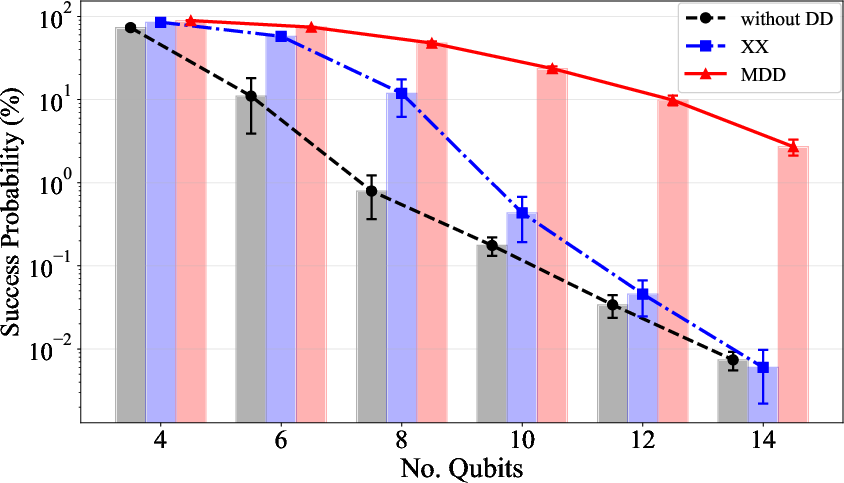
- Quantum Fourier Transform (QFT) tests up to 14 qubits: MDD improved the success rate dramatically compared with a common pulse method (“XX” sequence). At 14 qubits, MDD achieved up to a 450-times higher success probability.
- Molecular energy estimation (N₂) with sample-based quantum diagonalization (SQD):
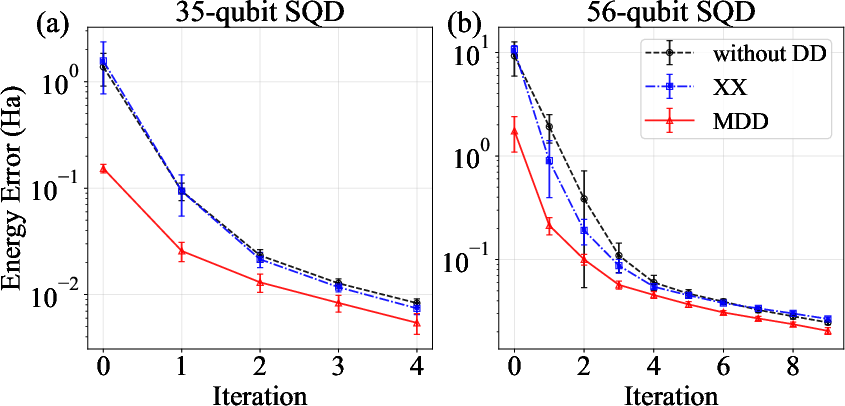
- On 35- and 56-qubit circuits, MDD produced cleaner data samples that led to more accurate and faster energy estimates.
- Initial errors were reduced by about 5–10× compared with no decoupling or the XX scheme, and final accuracy after classical post-processing was also better.
These results matter because they show a scalable way to protect quantum computations without waiting for full error-correcting codes (which are still very resource-heavy). MDD is simple, adaptable, and works on today’s devices.
Implications and impact
- MDD is a practical tool for near-term quantum computers, helping them run larger and deeper algorithms more reliably.
- It complements other techniques (like quantum error mitigation and future quantum error correction), because it works at the hardware level to reduce noise during execution.
- By using just a few extra measurements and two lightweight gates per idle interval, MDD scales to many qubits, making it attractive for complex tasks in chemistry, optimization, and beyond.
- In short: MDD shows that “using a little information smartly” can protect quantum algorithms much more effectively, pushing current quantum machines closer to useful, real-world performance.
Knowledge Gaps
Knowledge gaps, limitations, and open questions
Below is a single, consolidated list of unresolved issues in the paper that future work could address concretely.
- How is the reduced single-qubit density matrix estimated without collapsing the running computation? The paper states “Pauli-basis measurements are performed on each idle qubit at the beginning of the idle interval,” but does not specify whether this is done via mid-circuit measurement and low-latency feedback, via separate calibration circuits, or via classical-shadow-style tomography. A precise, hardware-feasible protocol and its latency budget are needed.
- End-to-end overhead and scaling beyond linear-in-qubits is unclear. The text claims MDD needs “3k Pauli-basis measurements” for k idle qubits, but steps (b)–(d) are iterated “throughout the circuit over all idle intervals,” implying the overhead also scales with the number and length of idle intervals. Provide a formula and measurements for total shots, runtime, compilation time, and wall-clock cost versus number of intervals and circuit depth.
- Sample complexity and robustness to shot noise are not quantified. How many shots per Pauli observable are necessary to keep angle estimation errors in below a target bound for given , circuit depth, and idle duration? Derive error bars for from finite-shot estimates, and analyze the induced fidelity degradation.
- Behavior when the Bloch vector norm is small (near-maximally mixed states) is not analyzed. Estimators for and become ill-conditioned for small . Define thresholds, regularization strategies, and decision rules for when to skip or modify MDD.
- Impact of additional control errors and finite-duration gates is not modeled. The theorem assumes ideal bang-bang operations, but hardware executes gates with nonzero duration, infidelity, and crosstalk. Provide a quantitative trade-off model that includes gate error, duration, and scheduling conflicts, and show regimes where MDD is net beneficial.
- Optimality only proven to first order in short evolution time. The paper’s theorem is -optimal; it does not provide second-order (or full-time) bounds or characterize when higher-order terms dominate in deep circuits. Extend the analysis to (or resummed) regimes and derive practical time-window criteria for safe application.
- Generality of the noise model is limited. The theory assumes local amplitude damping and dephasing (Lindbladian, Markovian) with uncorrelated subsystems. Assess performance under non-Markovian noise (e.g., $1/f$ flux noise), drift, control crosstalk, spectator effects, pulse distortion, and time-varying .
- Leakage outside the qubit subspace (e.g., to the transmon level) is not considered. Analyze whether MDD exacerbates or mitigates leakage, and design leakage-aware variants (e.g., qutrit MDD or leakage-reduction units).
- Correlated noise and crosstalk are acknowledged but not solved. A two-qubit MDD is proposed conceptually but not implemented; quantify the cost of entangling control for correlated errors, and develop practical criteria for when single-qubit vs two-qubit MDD is preferable.
- Interaction with active gates and scheduling constraints is unspecified. Inserting may conflict with two-qubit operations, alter gate cancelation opportunities, or introduce alignment/crosstalk issues. Provide a compiler-level scheduling strategy and measure its impact on depth, parallelism, and fidelity.
- Hardware feasibility and latency of real-time feedback are not demonstrated. If MDD relies on mid-circuit measurements and adaptive control, quantify latency, memory, and controller constraints on IBM Eagle (or similar), and show how to maintain timing fidelity in the presence of control flow.
- No hardware validation against leading DD sequences beyond . UDD, XY4, QDD, and learning-based DD are compared in simulation but not experimentally on Eagle. Perform head-to-head hardware benchmarks across these baselines to confirm superiority under real device noise.
- Entanglement fidelity is not measured on hardware. The paper uses success probability and energy error as proxies; provide experimental protocols (e.g., entanglement-fidelity estimation via randomized measurements or classical shadows) to directly validate the claimed fidelity preservation.
- MDD assumes uniform application intervals in the proof, but idle intervals in compiled circuits are nonuniform. Extend the derivation to nonuniform intervals and control-dependent toggling frames typical of real schedules.
- Sensitivity to device heterogeneity is unaddressed. Qubits have different , connectivity, and calibration drifts. Investigate qubit-specific weighting (e.g., noise-aware diagonalization prioritizing axes with shorter ) and adaptive policies.
- Angle computation stability and numerical conditioning are not discussed. Provide algorithms that enforce physicality (e.g., clipping estimates to the Bloch ball), uncertainty-aware selection, and smoothing across adjacent intervals to avoid oscillatory control.
- The choice of using only as physical control may not be optimal. Explore shaped pulses, composite rotations, DRAG, or filter-function-based control that could outperform pure in realistic noise spectra, and reconcile with the optimality claims beyond bang-bang.
- MDD’s effect on global algorithmic objectives beyond local fidelity is not analyzed. Diagonalizing reduced states could alter entanglement structure or phase relations crucial to some algorithms. Establish conditions where local diagonalization does not harm global performance and propose tests on QAOA, Grover, and random circuits.
- Overhead and convergence in SQD are not fully quantified. Separate the benefits of better samples from the cost of MDD calibration; analyze how MDD changes the sample quality distribution, the rate of configuration recovery, and the total time-to-accuracy for 35–56 qubits.
- Integration with QEM/QEC is only mentioned. Design and test combined workflows (e.g., MDD + zero-noise extrapolation, probabilistic error cancellation, or stabilizer-based codes) to quantify additive vs overlapping gains and optimize resource allocation.
- Choice of shot counts (e.g., per Pauli, total) lacks justification. Provide sensitivity analyses showing how performance scales with shot budgets and derive minimal shot thresholds that maintain target accuracy.
- Model mismatch risk is not treated. The angles are inferred from separate runs; device drift and context dependence may invalidate them during actual execution. Develop online recalibration strategies or predictive models (e.g., learned state estimators from classical shadows) to reduce mismatch.
- Applicability to larger (>56-qubit) and deeper circuits is not established. Extend experiments to larger problem instances, quantify breakdown points, and present scaling laws for success probability or energy error with and without MDD.
- Reproducibility and implementation details are limited. Provide open-source code, transpilation settings, idle-interval identification heuristics, and full device calibration snapshots to enable independent verification and benchmarking.
Practical Applications
Immediate Applications
The following applications can be deployed now on existing superconducting quantum processors and standard quantum software stacks. Each item notes sector relevance, potential tools/products/workflows, and key assumptions/dependencies.
- MDD-enabled transpiler pass for quantum compilers
- Sectors: software/cloud, academia, industry R&D
- Tools/products/workflows: implement an “MDD pass” in Qiskit, tket, or Cirq that (i) identifies idle intervals after transpilation, (ii) schedules Pauli-basis measurement runs to estimate each idle qubit’s reduced state, (iii) computes angles for
R_y(-θ_d)and virtualR_z(-φ_d), and (iv) inserts the(U_d, U_d†)sequence. - Assumptions/dependencies: availability of virtual Z rotations and low-error single-qubit
R_ygates; ability to run truncated or instrumented subcircuits to collect Pauli expectations without mid-circuit measurements; measurement shots budget (paper used about 104 per Pauli per interval; overhead scales linearly with idle qubits).
- Cloud quantum service option: “MDD-on” execution mode
- Sectors: cloud providers (IBM, AWS Braket, Azure), enterprise users
- Tools/products/workflows: a toggle in job configuration to enable MDD pre-processing and gate insertion; reporting of “MDD fidelity gain factor” per job.
- Assumptions/dependencies: provider supports pre-execution data collection runs to estimate idle-qubit states; shot limits and queue time accommodate extra measurements; device supports virtual Z implementations.
- Robust prototyping of QFT-based algorithms
- Sectors: finance (quantum amplitude estimation for risk/option pricing), logistics/supply-chain (phase-estimation subroutines in optimization), cybersecurity (small-scale phase-estimation demos)
- Tools/products/workflows: enhance success probabilities of QFT-heavy circuits by inserting MDD; use as a guardrail in demos and benchmarks that rely on prolonged idle periods early in the circuit.
- Assumptions/dependencies: decoherence dominated by local ; idle intervals are identifiable and sufficiently long; first-order optimality gains persist for the circuit schedule.
- Quantum chemistry sampling pipelines with SQD
- Sectors: healthcare/pharma (drug discovery), materials/energy (catalysts, battery materials), chemicals
- Tools/products/workflows: integrate MDD into sample-based quantum diagonalization (SQD) pipelines to reduce sampling noise and accelerate convergence of self-consistent configuration recovery; provide a plugin to PySCF/LUCJ workflows that transparently runs MDD-augmented circuits.
- Assumptions/dependencies: SQD sampling (not expectation-value estimation) benefits from cleaner samples; classical recovery is in place; shot budgets (105–107) are feasible; device decoherence is largely local (weak correlated noise).
- Hardware benchmarking and procurement metrics based on MDD
- Sectors: industry procurement, academia, standards bodies
- Tools/products/workflows: define device health metrics like “MDD-improved success probability” for QFT and “MDD-improved energy error” for SQD; use in RFPs and internal dashboards to compare processors (e.g., Eagle vs. Heron).
- Assumptions/dependencies: reproducible measurement protocols; consistent shot budgets and circuit sets; acceptance that first-order optimality holds under the device’s noise model.
- Combined noise management: MDD + QEM/QEC workflows
- Sectors: academia, cloud users, software toolchains
- Tools/products/workflows: use MDD to suppress decoherence at the hardware level while applying lightweight error mitigation (e.g., readout mitigation) and early-stage QEC (logical qubit experiments). Offer “composable noise management” templates in SDKs.
- Assumptions/dependencies: additivity of benefits without introducing prohibitive gate overhead; compatibility with error-mitigated postprocessing and syndrome extraction schedules.
- Instructional labs and curricula for NISQ-era reliability engineering
- Sectors: education, workforce development
- Tools/products/workflows: course modules showing how idle-qubit alignment via MDD boosts algorithm performance; lab exercises with QFT and SQD comparing baseline, XX-pulse DD, and MDD.
- Assumptions/dependencies: access to small cloud quotas for measurement; basic SDK knowledge; devices with virtual Z implementations.
Long-Term Applications
These applications require further research, scaling, or hardware capabilities (e.g., low-latency control, mid-circuit feedback) before broad deployment.
- Real-time, closed-loop MDD with low-latency feedback
- Sectors: cloud providers, hardware vendors, advanced research labs
- Tools/products/workflows: on-chip or near-chip controllers that perform rapid reduced-state estimation of idle qubits and apply adaptive
(U_d, U_d†)in real time; automated calibration of angles under drift. - Assumptions/dependencies: mid-circuit observation without destructive collapse (or fast surrogate tomography via repeated scheduling), sub-millisecond feedback latency, robust control electronics.
- Correlated-noise MDD (two-qubit or multi-qubit variants)
- Sectors: superconducting and spin-qubit hardware, software compilers
- Tools/products/workflows: extend MDD to handle crosstalk and other correlated channels via tailored entangling unitaries (e.g., mapping the pair’s state near ); transpiler support for scheduling such sequences without creating new problematic idle periods elsewhere.
- Assumptions/dependencies: entangling gates with sufficiently low error; accurate estimation of pairwise reduced states; careful global scheduling to avoid cascading idles.
- Integration with logical qubits and fault tolerance to reduce logical error rates
- Sectors: hardware, academia, standards
- Tools/products/workflows: use MDD around idle regions of logical qubits (e.g., during syndrome extraction gaps) to reduce logical error accumulation; develop guidelines for “MDD-aware” QEC cycles.
- Assumptions/dependencies: compatibility with code constraints and stabilizer schedules; demonstrated net benefit vs. added control overhead; cross-validation on multiple code families.
- Standardization and policy for hardware-level noise suppression reporting
- Sectors: policy/standards bodies, cloud marketplaces, procurement
- Tools/products/workflows: define reporting standards (e.g., “MDD gain indices”) for device listings; incorporate MDD-readiness into procurement criteria for public-sector and enterprise buyers; support funding decisions highlighting demonstrated utility pre–fault tolerance.
- Assumptions/dependencies: consensus on metrics and test suites; cooperation across vendors; transparency about noise models and scheduling.
- Cross-modality generalization (ions, NV centers, silicon spin, qudits)
- Sectors: hardware research and productization
- Tools/products/workflows: adapt MDD parameterization and control primitives to modalities with different native gates and virtual-phase capabilities; extend to qudits where virtual phase operations are available.
- Assumptions/dependencies: validated noise models dominated by local relaxation/dephasing; availability of fast single-qubit rotations and virtual phase controls in each modality.
- ML-enhanced MDD for interval selection and angle prediction
- Sectors: software tooling, academia
- Tools/products/workflows: train models to predict effective
U_dangles from circuit context and recent device telemetry, reducing measurement overhead; reinforcement learning to choose intervals where MDD provides the largest gain. - Assumptions/dependencies: sufficient telemetry and labels; stability of device behavior; safeguards against overfitting and drift.
- Industrial-scale phase estimation and chemistry with MDD-robust subroutines
- Sectors: healthcare/pharma, energy/materials, finance
- Tools/products/workflows: deploy larger phase-estimation/QPE instances and sample-based chemistry routines that rely on MDD to keep error growth manageable during long idle windows; pipelines for catalyst screening, battery design, and risk analytics where MDD reduces shot counts and accelerates convergence.
- Assumptions/dependencies: scaling of MDD benefits beyond first order in longer/deeper circuits; manageable measurement overhead; combined advances in hardware coherence and compiler scheduling.
- Hardware–software co-design for native MDD support
- Sectors: hardware vendors, cloud providers, tooling
- Tools/products/workflows: design control stacks and schedulers that natively expose idle-interval metadata, support rapid pre-run state estimation, and optimize insertion of
R_yand virtualR_zwith minimal collision; offer SLAs that include “idle-qubit protection.” - Assumptions/dependencies: coordinated compiler–firmware interfaces; robust phase-reference management; capacity to run extra calibration shots without impacting overall throughput.
Glossary
- Amplitude damping: A quantum noise process where an excited state relaxes to a lower-energy state, typically emitting energy to the environment; it models energy loss. "the single-qubit ground state \ket{0} remains unaffected by amplitude damping and dephasing."
- Bang-bang operations: Very strong, nearly instantaneous control pulses used in dynamical decoupling to average out unwanted interactions. "This sequence typically consists of bang-bang operations, which are strong and nearly instantaneous pulses."
- cc-pVDZ basis set: A common Gaussian-type orbital basis set in quantum chemistry used to approximate molecular electronic wavefunctions. "with the $6$-$31$G and cc-pVDZ basis sets, respectively."
- Controlled-phase gate: A two-qubit gate that applies a phase shift conditioned on the state of a control qubit; central to QFT circuits. "QFT circuits consist of successive controlled-phase gates that cause qubits acted on early in the sequence to remain idle for long periods."
- Coupled cluster singles and doubles (CCSD): A high-accuracy quantum chemistry method that includes single and double electron excitations to approximate correlated electron behavior. "The LUCJ gate parameters are initialized from the classical coupled cluster singles and doubles (CCSD) method"
- Dephasing: A decoherence mechanism that randomizes the relative phase between quantum states without changing populations, degrading coherence. "under local energy relaxation () and dephasing noise ()"
- Dephasing time (T2): The characteristic timescale over which quantum phase coherence decays due to dephasing processes. "with relaxation time and dephasing time ."
- Diagonalizing unitary: A unitary that rotates a density matrix to a diagonal form in some basis, aligning eigenstates with preferred axes (e.g., energy eigenbasis). "(c) Classically compute the corresponding diagonalizing unitary ."
- Directed acyclic graph (DAG) embedding: A compilation/optimization strategy that embeds circuit structure into a DAG to exploit scheduling and hardware constraints. "a scheme exploiting directed acyclic graph embedding the structure of overlapped idle qubits and qubit connectivity"
- Dynamical decoupling (DD): A control technique that applies sequences of pulses to average out environmental noise and suppress decoherence. "Dynamical decoupling (DD) is a key technique for suppressing decoherence and preserving the performance of quantum algorithms."
- Entanglement fidelity: A fidelity measure that quantifies how well a channel preserves a state when it is part of a larger entangled system. "We theoretically show that MDD maximally preserves the entanglement fidelity"
- Entangling operations: Multi-qubit gates that create entanglement between qubits, such as CNOT or CZ. "Implementing such two-qubit MDD requires entangling operations that may introduce additional idle intervals elsewhere in the circuit."
- Fault tolerance: The property of a computation to proceed reliably even when components are faulty, typically via error correction and fault-tolerant gate constructions. "the theories of quantum error correction (QEC) and fault tolerance are well established"
- Ground state: The lowest-energy state of a quantum system, often stable against certain noise processes. "The ground state serves as the steady state of this channel"
- Ground-state energy: The minimum energy eigenvalue of a system’s Hamiltonian, a key target in quantum chemistry simulations. "to obtain the ground-state energy."
- Idle qubit: A qubit not currently involved in active gates during a circuit interval, vulnerable to decoherence. "For each idle qubit, Pauli-basis measurements are performed to estimate its reduced density matrix"
- Lindblad operators: Operators in the Lindblad master equation that describe Markovian open-system dynamics (dissipation and dephasing). "described by Lindblad operators and "
- Local energy relaxation (T1): Energy-loss (amplitude damping) process characterized by , the time constant for population decay to the ground state. "local energy relaxation ()"
- Local Unitary Cluster Jastrow (LUCJ) ansatz: A variational quantum state ansatz combining local unitaries with Jastrow-like correlations for electronic structure. "using the Local Unitary Cluster Jastrow (LUCJ) ansatz"
- Measurement-based dynamical decoupling (MDD): A DD protocol that uses partial measurements to determine local unitaries that optimally preserve fidelity under noise. "we introduce measurement-based dynamical decoupling (MDD), a scalable protocol that derives gate sequences from partial measurements."
- Pauli-basis measurements: Measurements of the expectation values of Pauli operators (X, Y, Z) used to reconstruct single-qubit states. "Pauli-basis measurements are performed to estimate its reduced density matrix"
- Quadratic dynamical decoupling (QDD): A DD scheme that nests Uhrig sequences in two axes to suppress general decoherence to high order. "including ~\cite{MAUDSLEY1986488}, and quadratic DD (QDD), are provided in the SM"
- Quantum channel: A completely positive, trace-preserving map describing the evolution (possibly noisy) of a quantum state. "denotes the quantum channel obtained by conjugating the decoherence process"
- Quantum error correction (QEC): Techniques that encode quantum information into larger systems to detect and correct errors without collapsing the state. "quantum error correction (QEC)"
- Quantum error mitigation (QEM): Methods that reduce the impact of noise on measured observables without full fault tolerance, often via postprocessing. "Quantum error mitigation (QEM) has been shown effective in improving the accuracy of expectation-value estimation on current noisy hardware"
- Quantum Fourier Transform (QFT): The quantum analogue of the discrete Fourier transform, a core subroutine in many algorithms. "QFT is a key subroutine underlying many quantum algorithms that exhibit quantum advantage"
- Sample-based quantum diagonalization (SQD): A hybrid approach that uses samples from a quantum device to build subspaces for classical Hamiltonian diagonalization. "SQD is a quantum-classical hybrid scheme to estimate the energy of molecules."
- Self-consistent configuration recovery: An iterative classical postprocessing step that repairs sampled configurations based on updated occupancy statistics. "self-consistent configuration recovery, which identifies configurations with incorrect particle numbers and probabilistically corrects them"
- Steady state: A state that remains invariant under the dynamics of a channel or master equation. "serves as the steady state of this channel"
- Toggling frame: A rotating interaction picture defined by applied control unitaries, used to analyze DD sequences. "defined in the toggling frames of the cumulative control operations"
- Transpilation: Compiler-level transformation of a quantum circuit into a hardware-compliant form, optimizing gates and scheduling. "After circuit transpilation, idle intervals naturally appear between active operations."
- Uhrig dynamical decoupling (UDD): A DD sequence with nonuniform pulse timings that suppresses dephasing to high order for single qubits. "The Uhrig DD (UDD) sequence provides near-optimal suppression of single-qubit dephasing"
- XX dynamical decoupling (XX): A DD scheme using X pulses at specific times in an idle interval (akin to CPMG in NMR) to refocus dephasing. "The protocol applies gates at and of idle interval"
- XY4: A basic four-pulse DD sequence alternating X and Y pulses to cancel certain noise terms. "including "
- ZZ crosstalk: Undesired coherent coupling between qubits via a σz⊗σz interaction that induces correlated dephasing. "arising from crosstalk between subsystems and "
Collections
Sign up for free to add this paper to one or more collections.